
February 19, 2026


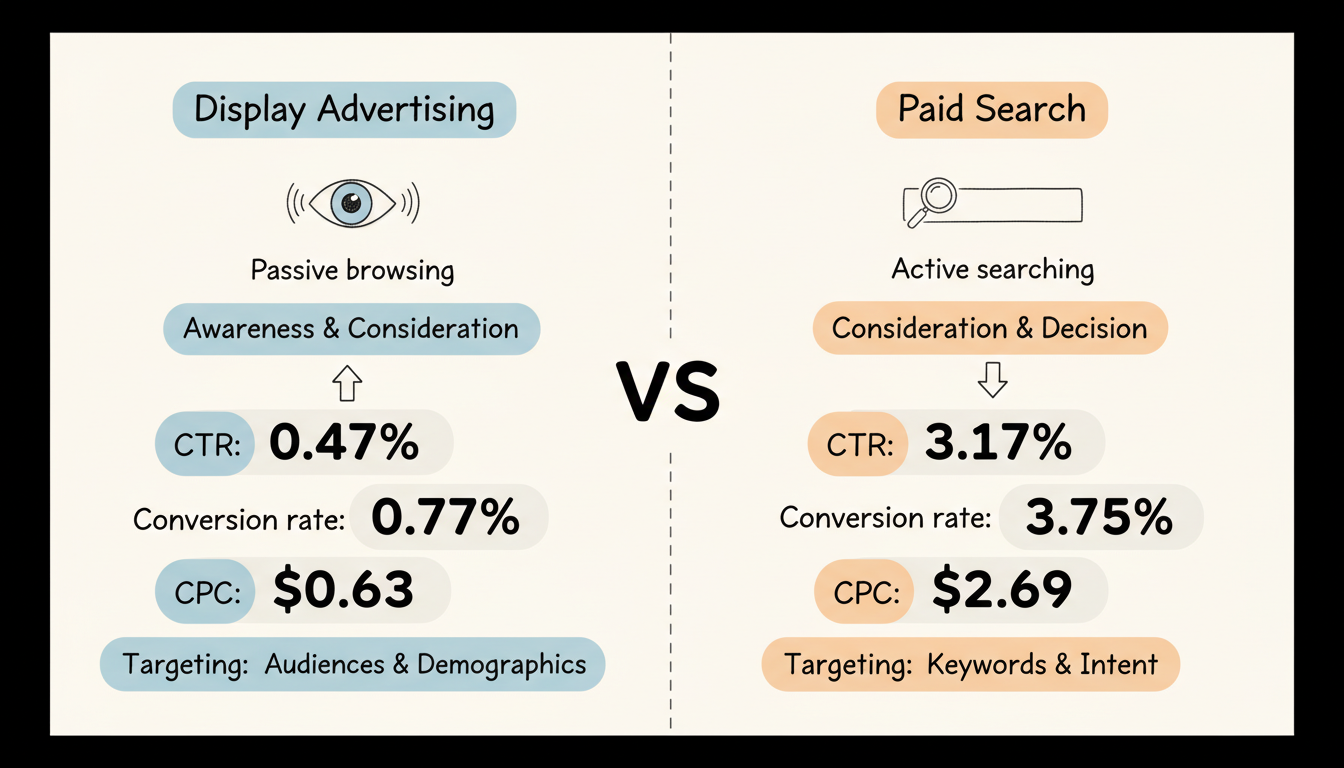
Choosing between display advertising and paid search is one of the most fundamental decisions in digital advertising. Each serves a distinct purpose in the customer journey—and understanding when to use each (and how to combine them) separates effective campaigns from wasted budgets.
This guide breaks down the key differences, performance benchmarks, and strategic applications for both advertising types in 2026.
Display advertising uses visual banner ads, images, and rich media to reach audiences across websites, apps, and video platforms. These ads appear based on audience targeting rather than search queries.
Display ads run across massive networks:
Paid search (also called search advertising or PPC) displays text ads to users actively searching for specific terms on search engines like Google and Bing.
Search ads display on:
Understanding these distinctions helps you allocate budget effectively.
Factor | Display Advertising | Paid Search |
User mindset | Passive browsing | Active searching |
Intent level | Low to medium | High |
Stage in funnel | Awareness, consideration | Consideration, decision |
Primary goal | Reach and awareness | Conversions and leads |
The fundamental difference: display ads interrupt; search ads respond. This is why paid search advertising statistics consistently show higher conversion rates for search compared to display campaigns.
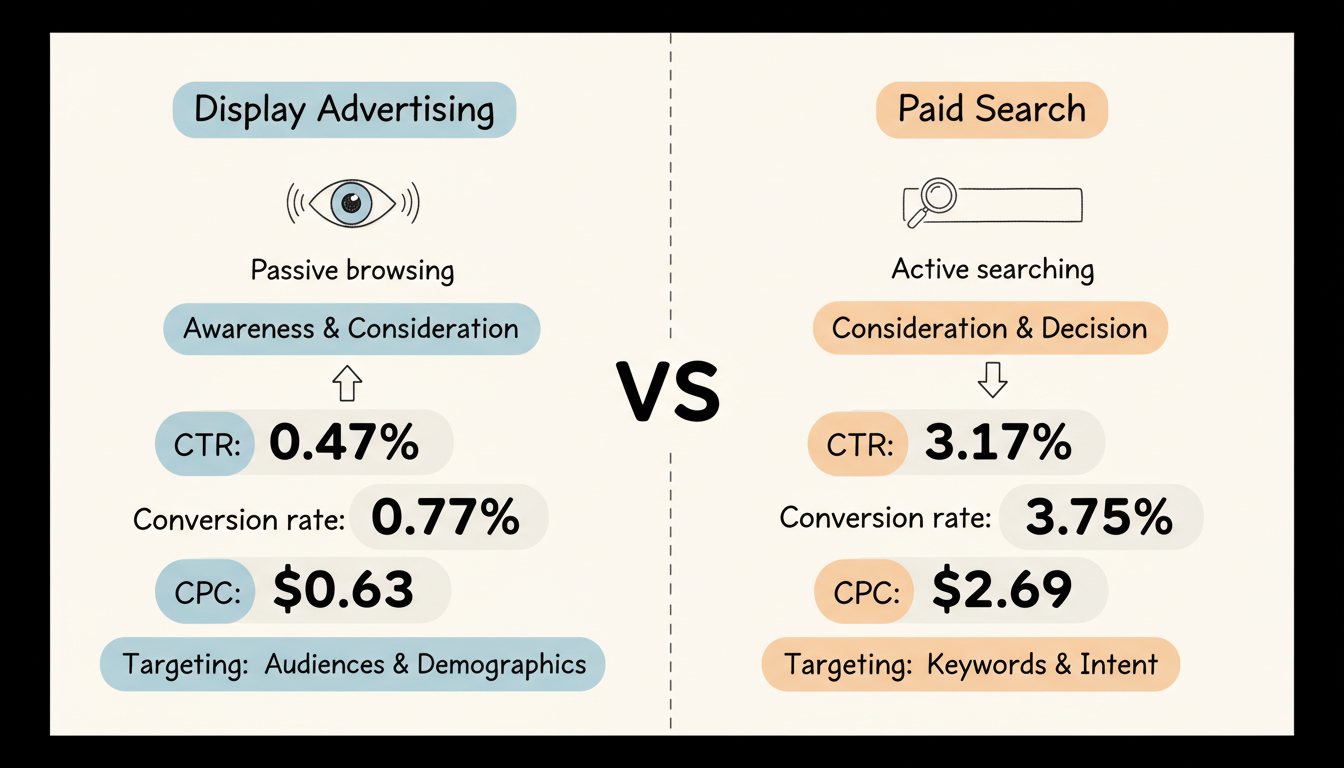
According to 2026 PPC benchmark data, the performance gap between formats is significant:
Metric | Search Ads | Display Ads |
Average CTR | 3.17% | 0.47% |
Average conversion rate | 3.75% | 0.77% |
Average CPC | $2.69 | $0.63 |
Search ads dramatically outperform display on click-through and conversion rates—but display delivers far more impressions at lower cost.
Display advertising targets people:
Paid search targets intent:
Element | Display | Search |
Visual assets | Required (images, video) | Not required |
Ad copy | Limited text | Headlines + descriptions |
Landing pages | Recommended | Critical |
A/B testing | Creative variations | Copy variations |
Display demands visual creative; search demands compelling copy.
Strategic selection depends on your goals and where customers are in their journey.
Building brand awareness: Display reaches massive audiences who don't yet know your brand. Display networks provide access to users you cannot reach through search alone.
Retargeting past visitors: Someone visited your site but didn't convert? Display remarketing keeps your brand visible as they browse other sites.
Visual product showcase: Fashion, home decor, travel—industries where visuals drive desire benefit from display's image-forward format.
Launching new products: When no one is searching for your new offering yet, display creates initial awareness.
Supplementing search reach: Even dominant search advertisers can't reach everyone through keywords alone. For a comprehensive approach, consider paid search agency services that integrate both channels.
Capturing high-intent traffic: Users searching "buy [product]" or "[service] near me" have immediate purchase intent. Search captures them at decision time.
Generating leads and sales: Search ads deliver higher conversion rates because users are actively seeking solutions. Understanding how pay-per-click works helps you maximize this conversion advantage.
Targeting specific problems: When people search for solutions to problems you solve, search ads put your answer directly in front of them.
Limited creative resources: No design team? Search ads require only text—fast to create and test.
Competitive industries: When competitors are bidding on keywords, absence from search results cedes market share.
The most effective strategies combine both formats strategically.
Leading brands in 2026 diversify their media mix rather than relying on a single channel:
Funnel Stage | Primary Channel | Supporting Channel |
Awareness | Display | Social |
Consideration | Display remarketing | Search |
Decision | Search | Remarketing |
Retention | Display remarketing |
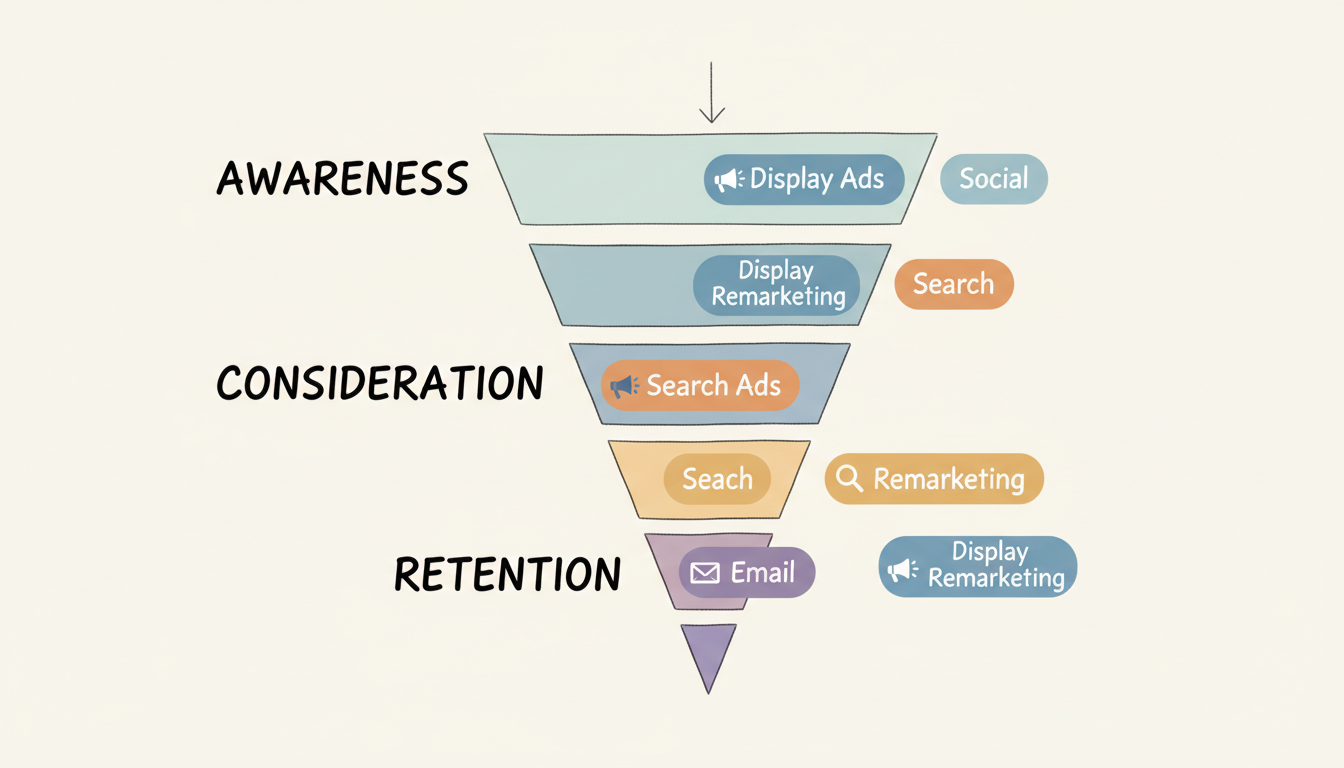
The proven combination:
This approach leverages each channel's strength: search for intent, display for persistence. A comprehensive SEM marketing strategy framework incorporates both channels to maximize customer acquisition.
Expert recommendations for 2026:
Start with search to establish baseline conversions, then layer in display for incremental reach.
As channels increasingly interact, measurement must account for assisted conversions—not just last-click attribution:
Neither is universally "better." Search advertising delivers higher conversion rates and captures high-intent users ready to buy. Display advertising excels at brand awareness, remarketing, and reaching audiences not actively searching. Most businesses benefit from using both strategically.
According to 2026 benchmarks, average search ad CTR is 3.17% while display ad CTR averages 0.47%. The difference reflects user intent—search users are actively looking for solutions, while display users are passively browsing.
Start with search advertising if you have limited budget and need direct conversions. Search captures users with immediate purchase intent and delivers faster ROI. Add display once search campaigns are profitable, using it for remarketing and awareness building.
By submitting this form, you agree to our Privacy Policy and Terms & Conditions.



