
February 19, 2026


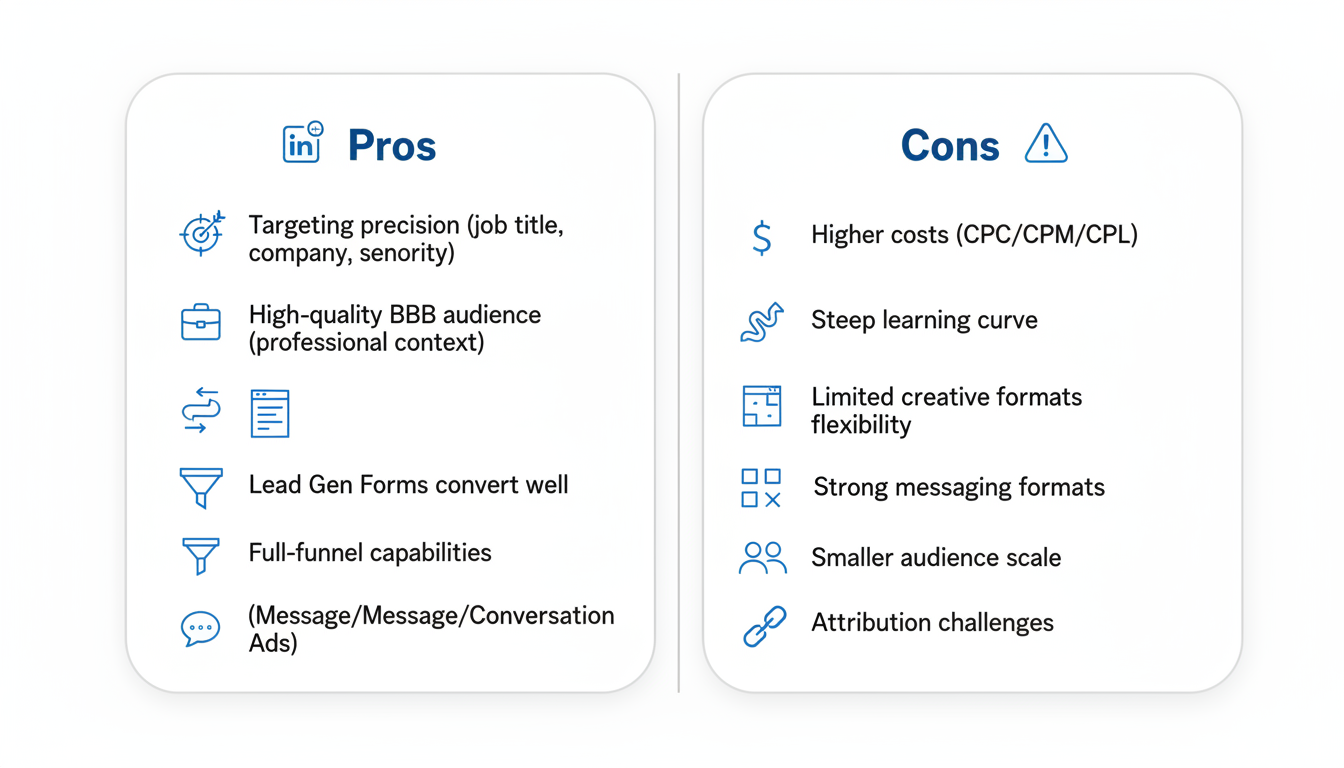
LinkedIn advertising has become a staple for B2B marketers—but it's not without controversy. High costs, steep learning curves, and mixed results leave many wondering: is LinkedIn advertising actually worth it?
This honest review breaks down the pros, cons, and who should (and shouldn't) advertise on LinkedIn in 2026.
Platform: LinkedIn Campaign Manager Best for: B2B companies targeting professionals by job title, company, industry Cost range: $5-15 CPC, $30-60 CPM, $50-200+ CPL Ad formats: Sponsored Content, Message Ads, Text Ads, Dynamic Ads Minimum budget: $10/day (though $50-100/day recommended for meaningful testing)
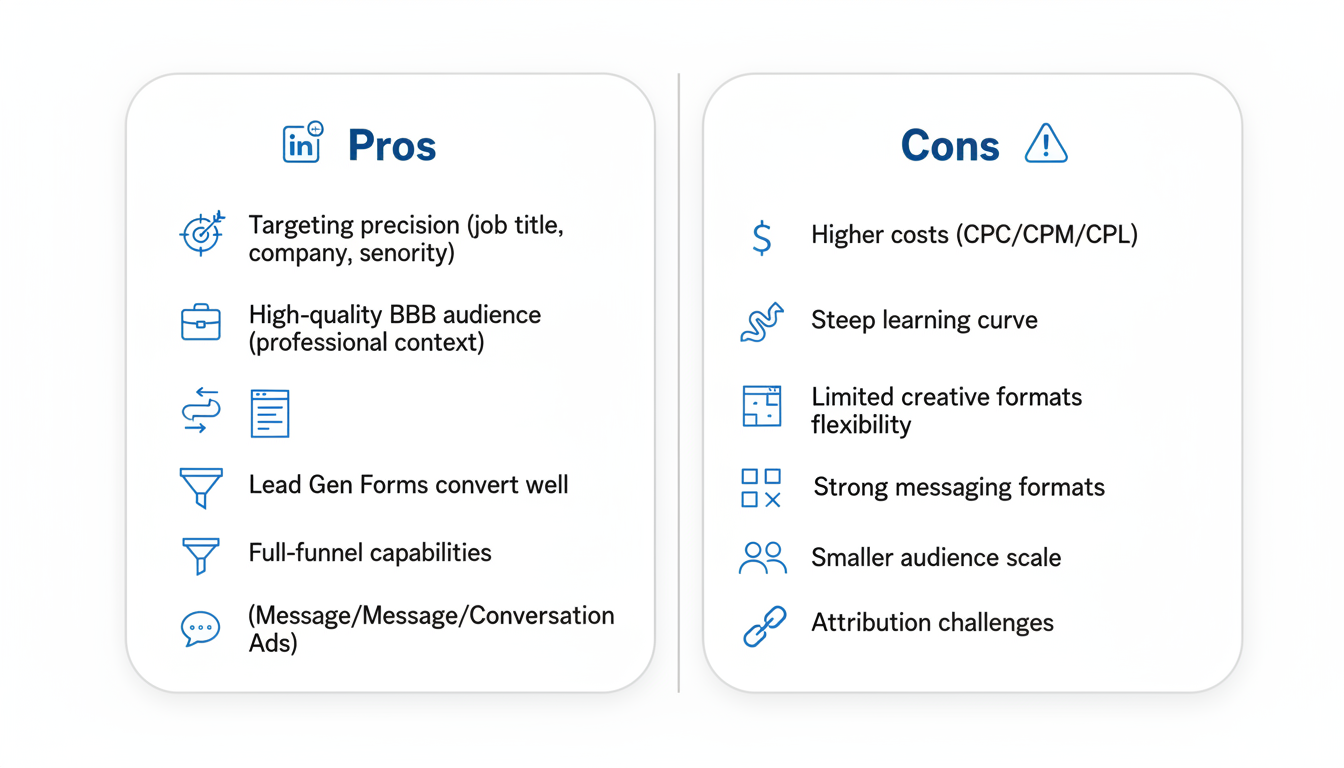
LinkedIn's greatest strength is its targeting precision. You can reach people by:
No other platform offers this level of professional targeting accuracy. Facebook and Google rely on inferred data; LinkedIn has verified, self-reported professional information.
LinkedIn's 1 billion members include professionals actively engaged in business context. When someone is on LinkedIn, they're in a professional mindset—more receptive to B2B messaging than when scrolling Instagram or watching YouTube.
According to Hootsuite's research, viewers of LinkedIn's new video formats are 18% more likely to become leads compared to other placements.
LinkedIn Lead Gen Forms achieve 2-3x higher conversion rates than traditional landing pages. Pre-filled fields reduce friction significantly, and lead quality tends to be higher because data comes directly from LinkedIn profiles. For companies focused on best LinkedIn ads lead generation practices, these native forms are often the top-performing conversion mechanism.
LinkedIn supports campaigns across the entire funnel:
You can build complete B2B marketing funnels within a single platform.
According to industry benchmarks, Message Ads achieve 40-55% open rates—among the highest in digital advertising. Conversation Ads deliver 3x higher reply rates than traditional InMail.
LinkedIn's 2026 Campaign Manager includes:
The platform continues closing the gap with Meta and Google on advertising capabilities.
This is LinkedIn's biggest drawback. Understanding LinkedIn ads cost is critical before committing budget. Expect:
For companies with tight budgets, LinkedIn's cost structure can be prohibitive. A $1,000 test budget might generate only 50-100 leads on Meta but just 10-20 on LinkedIn.
Campaign Manager isn't as intuitive as Meta Ads Manager. The interface has improved but still requires significant learning to master:
Compared to Meta, LinkedIn creative options are constrained. Marketers must carefully navigate LinkedIn ad specs sizes and format restrictions:
Creative fatigue sets in faster when you have fewer ways to vary messaging and visuals.
With 1 billion members, LinkedIn is massive—but compared to Facebook's 3+ billion or Google's entire search volume, it's smaller. Niche B2B targeting can result in audiences too small for meaningful scale.
LinkedIn operates as a walled garden, limiting data sharing with external platforms. Cross-channel attribution requires workarounds, and LinkedIn's native attribution may not match your other reporting tools.
Message Ads are powerful but overused. Decision-makers receive numerous sponsored messages, leading to declining engagement as the format matures.
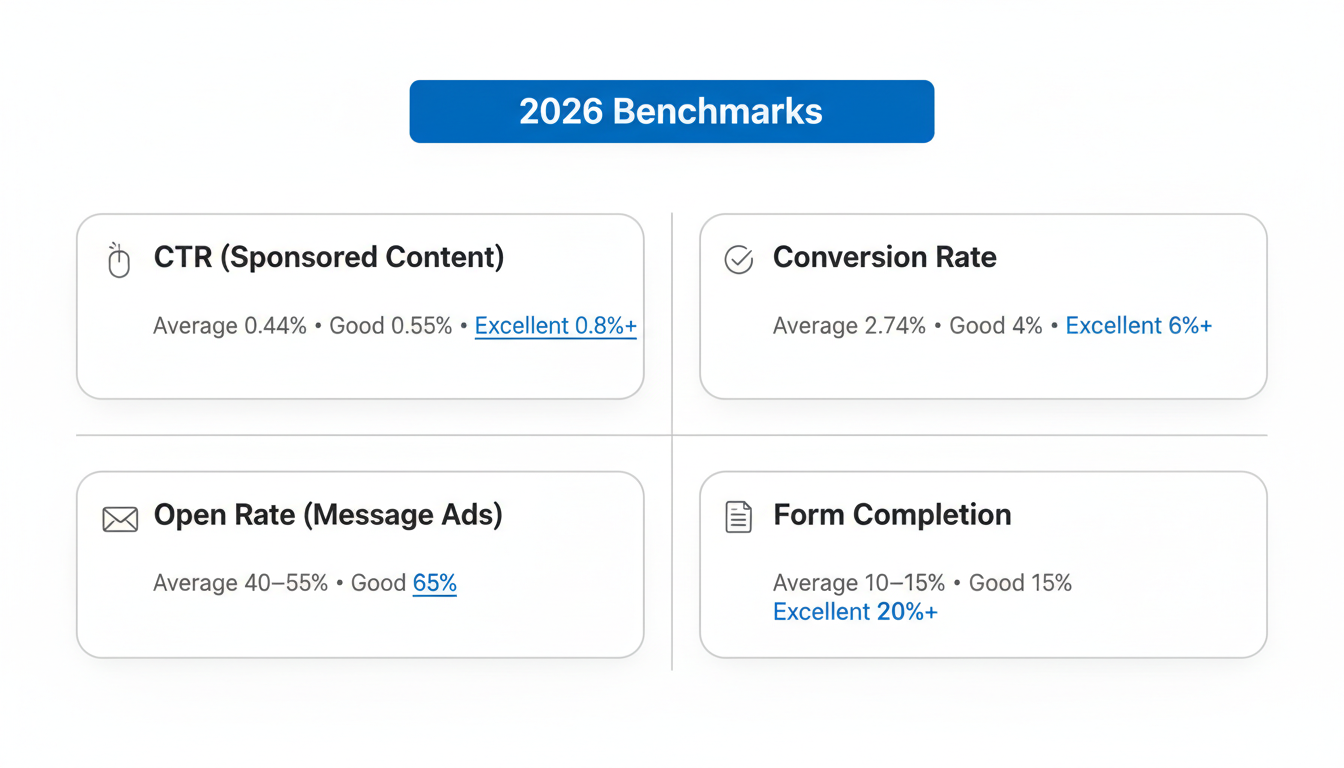
Metric | Average | Good | Excellent |
CTR (Sponsored Content) | 0.44% | 0.55% | 0.8%+ |
Conversion Rate | 2.74% | 4% | 6%+ |
Open Rate (Message Ads) | 40-55% | 55% | 65%+ |
Form Completion | 10-15% | 15% | 20%+ |
Source: LinkedIn Benchmarks Report
B2B companies targeting specific roles: If you need to reach "IT Directors at mid-market financial services companies," LinkedIn is unmatched.
High ACV products: When customer lifetime value is $10,000+, LinkedIn's higher CPL is easily justified.
Account-based marketing: Targeting named accounts is LinkedIn's specialty.
Enterprise sales: Reaching C-suite and senior decision-makers works better on LinkedIn than any other platform.
Professional services: Consultants, agencies, and service providers find qualified prospects here. Many organizations work with a specialized LinkedIn ad agency guide to maximize returns given the platform's complexity.
B2C companies: Limited consumer targeting makes LinkedIn inefficient for most B2C.
Low ACV products: If your product costs $50/month, LinkedIn CPLs of $150+ don't make economic sense.
Limited budgets: Under $3,000/month makes meaningful testing difficult.
Mass-market offerings: If everyone is your customer, LinkedIn's targeting precision isn't useful.
Factor | Meta | |
B2B targeting | Excellent | Limited |
Cost | High | Low |
Scale | Moderate | Massive |
Creative flexibility | Limited | Extensive |
Best for | BOFU, ABM | TOFU, Scale |
According to 2026 ABM benchmarks, Meta excels at awareness and nurture (TOFU/MOFU), while LinkedIn wins at conversion and deal acceleration (BOFU).
Factor | ||
Intent | Professional context | Active search |
Targeting | Job-based | Keyword-based |
Cost | High | Variable |
Best for | Awareness, nurture | Demand capture |
Yes, if:
No, if:
For most B2B companies with sufficient budget and clear professional audience definitions, LinkedIn advertising delivers ROI that other platforms can't match. The high costs are a feature, not a bug—they filter out competition and deliver genuinely qualified prospects.
Yes, for B2B companies. LinkedIn advertising delivers 2.74% average conversion rates and unmatched professional targeting. Effectiveness depends on your audience fit—LinkedIn excels at reaching specific job titles and companies but isn't suitable for B2C or mass-market campaigns.
LinkedIn's professional audience is highly valuable to B2B marketers, creating intense competition for limited inventory. Unlike Facebook's 3+ billion users, LinkedIn's 1 billion professionals mean smaller auction pools. Additionally, LinkedIn's data accuracy justifies premium pricing—you're paying for verified professional information, not inferred demographics.
Plan for $3,000-5,000/month minimum for meaningful testing. At $50-200 per lead, smaller budgets don't generate enough data to optimize. Most successful B2B advertisers spend $10,000-50,000/month on LinkedIn, scaling to $100,000+ for enterprise programs.
By submitting this form, you agree to our Privacy Policy and Terms & Conditions.



