
February 19, 2026


Choosing between Microsoft Ads and Facebook Ads isn't about picking a winner—it's about matching the right platform to your goals. Both drive results, but they work in fundamentally different ways.
Microsoft Ads captures people actively searching for solutions. Facebook Ads reaches people based on interests and behaviors while they browse their feeds. Understanding these differences helps you allocate budget where it'll have the greatest impact.
This comparison breaks down each platform's strengths, costs, and ideal use cases.
Before diving into specifics, let's establish what each platform offers.
Microsoft Advertising (formerly Bing Ads) is a search advertising platform. Your ads appear when people search on Bing, Yahoo, AOL, and partner sites like DuckDuckGo.
The platform operates on a pay-per-click model—you bid on keywords and pay when someone clicks. Searchers have intent; they're actively looking for something, which often translates to higher conversion rates.
Microsoft powers search on Windows devices by default, reaching users who never use Google. The platform also offers unique LinkedIn profile targeting, allowing you to layer professional attributes onto search campaigns.
Facebook Ads—part of the Meta advertising ecosystem—is a social media advertising platform. Your ads appear in Facebook feeds, Instagram feeds, Messenger, and the Audience Network.
Rather than targeting by search queries, Facebook targets by demographics, interests, behaviors, and custom audiences. Users aren't actively searching; they're scrolling. This makes Facebook powerful for demand generation and brand awareness.
The platform excels at visual storytelling through image ads, video ads, carousel formats, and Stories placements.
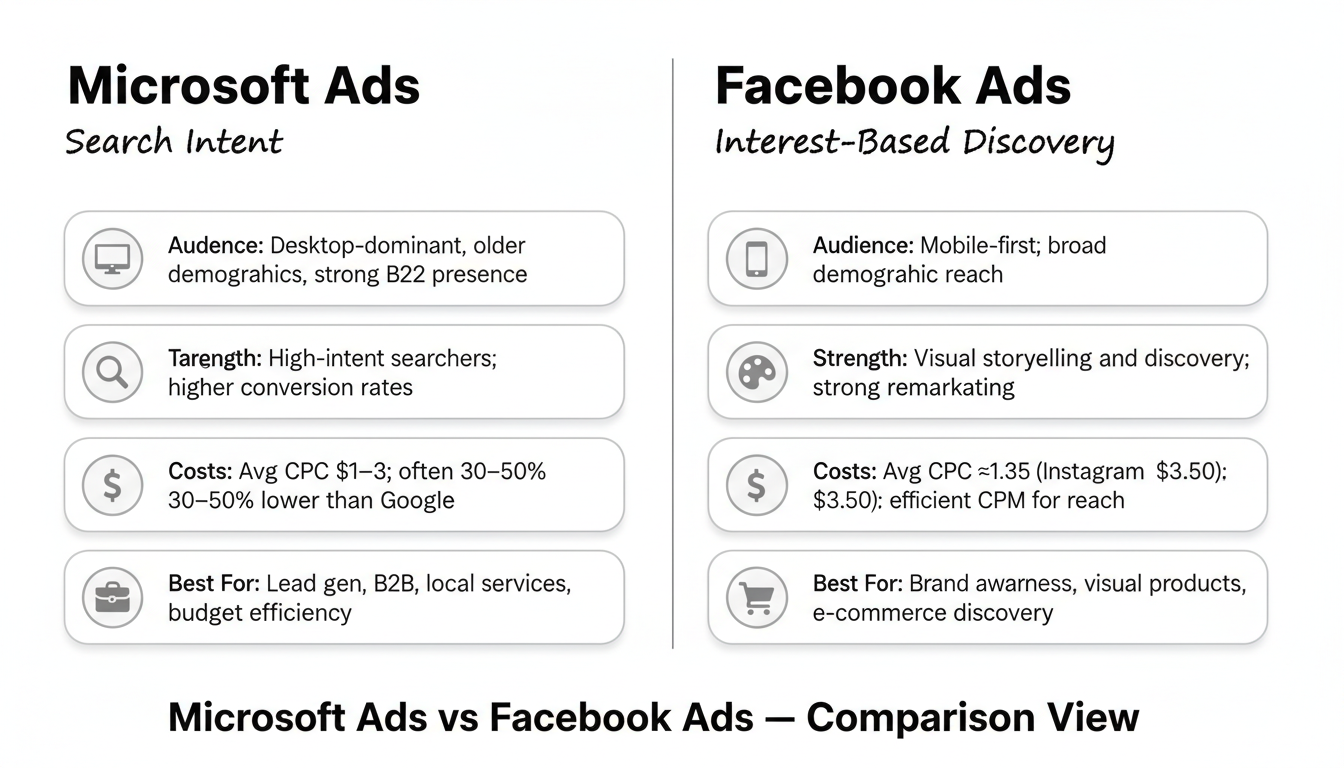
The audiences you reach on each platform differ significantly.
Microsoft's audience skews toward certain demographics:
Desktop-dominant users. Bing is the default search engine on Windows, so Microsoft reaches heavy desktop users—often in professional and workplace settings.
Older demographics. Microsoft Ads reaches an older demographic with significant purchasing power, making it valuable for products and services targeting established consumers.
B2B decision-makers. Microsoft Advertising captures B2B audiences on desktop at 30-40% lower cost than Google, and LinkedIn integration enables professional targeting unavailable elsewhere. If you're exploring Microsoft Advertising managed services for your B2B campaigns, understanding these audience characteristics becomes even more critical.
High-intent searchers. People using search have intent—they want answers, solutions, or products. This intent typically produces higher conversion rates.
Facebook's audience characteristics differ:
Mobile-first users. The vast majority of Facebook usage happens on mobile devices, requiring mobile-optimized creative and landing pages.
Broad demographic reach. Facebook covers nearly every age group, interest category, and geographic region. You can reach almost anyone.
Interest-based discovery. Users browse for entertainment and connection, not information retrieval. They discover products rather than search for them.
Lookalike scaling. Facebook's lookalike audiences let you find people similar to your existing customers—powerful for scaling beyond initial segments.
Both platforms use auction-based pricing, but typical costs vary.
Microsoft Advertising generally offers favorable economics:
Lower competition on Microsoft means your budget stretches further. The same keywords that cost $5 on Google might cost $2-3 on Microsoft.
Facebook costs vary widely by industry and objective:
Facebook's costs depend heavily on audience targeting, ad relevance, and competition for your specific segments. Broad targeting costs less but converts worse; precise targeting costs more but converts better.
Raw CPC doesn't tell the whole story:
Microsoft Ads often delivers higher conversion rates because searchers have intent. A $2 click that converts at 5% beats a $1 click that converts at 1%.
Facebook Ads can deliver lower cost-per-impression for awareness campaigns. If your goal is reach rather than immediate conversion, Facebook's CPM model often wins.
Each platform offers distinct creative options.
Responsive Search Ads: Text ads with multiple headlines and descriptions that the system optimizes automatically. The workhorse of search advertising.
Shopping Ads: Product listings with images, prices, and merchant information. Essential for e-commerce.
Audience Ads: Display and native ads across the Microsoft Audience Network—MSN, Outlook, and partner sites.
Performance Max: AI-optimized campaigns that run across multiple formats and placements automatically.
Image Ads: Single images with text overlays and captions. Simple but effective for direct response.
Video Ads: From short clips to longer content. Video typically outperforms static images for engagement.
Carousel Ads: Multiple images or videos users swipe through. Great for showcasing product collections.
Stories Ads: Full-screen vertical content appearing between user Stories. High engagement, mobile-native format.
Lead Ads: Forms that populate automatically with user information. Reduces friction for lead generation.
Collection Ads: Product catalogs that open into instant experiences. Powerful for e-commerce discovery.
Different business goals favor different platforms.
High-intent lead generation. If people search for your solution category, Microsoft captures them at the moment of interest. B2B services, professional services, and considered purchases benefit.
B2B marketing. Microsoft captures desktop B2B audiences effectively, and LinkedIn targeting lets you reach specific job titles, industries, and company sizes.
Local services. Microsoft is a great option for local businesses wanting affordable access to high-intent searchers. Someone searching "plumber near me" is ready to hire.
Google Ads expansion. Already running profitable Google campaigns? Import them to Microsoft for additional volume at lower costs.
Budget-conscious advertisers. Lower competition means smaller budgets can still generate meaningful data and results. When evaluating PPC advertising companies to choose for your campaigns, consider those with expertise across both platforms to maximize your budget efficiency.
Brand awareness campaigns. Reaching large audiences affordably to build recognition. Facebook's scale and targeting make awareness efficient.
Visual products. Fashion, home decor, food, travel—anything that sells through imagery thrives on Facebook and Instagram.
E-commerce discovery. People don't search for products they don't know exist. Facebook introduces products to interested audiences.
Retargeting. Bringing back website visitors who didn't convert. Facebook's pixel and audience tools excel at remarketing.
Lookalike scaling. Once you identify converting customer profiles, Facebook finds similar users across its massive network.
Consumer products. B2C products with broad appeal and visual appeal perform strongly on social platforms.
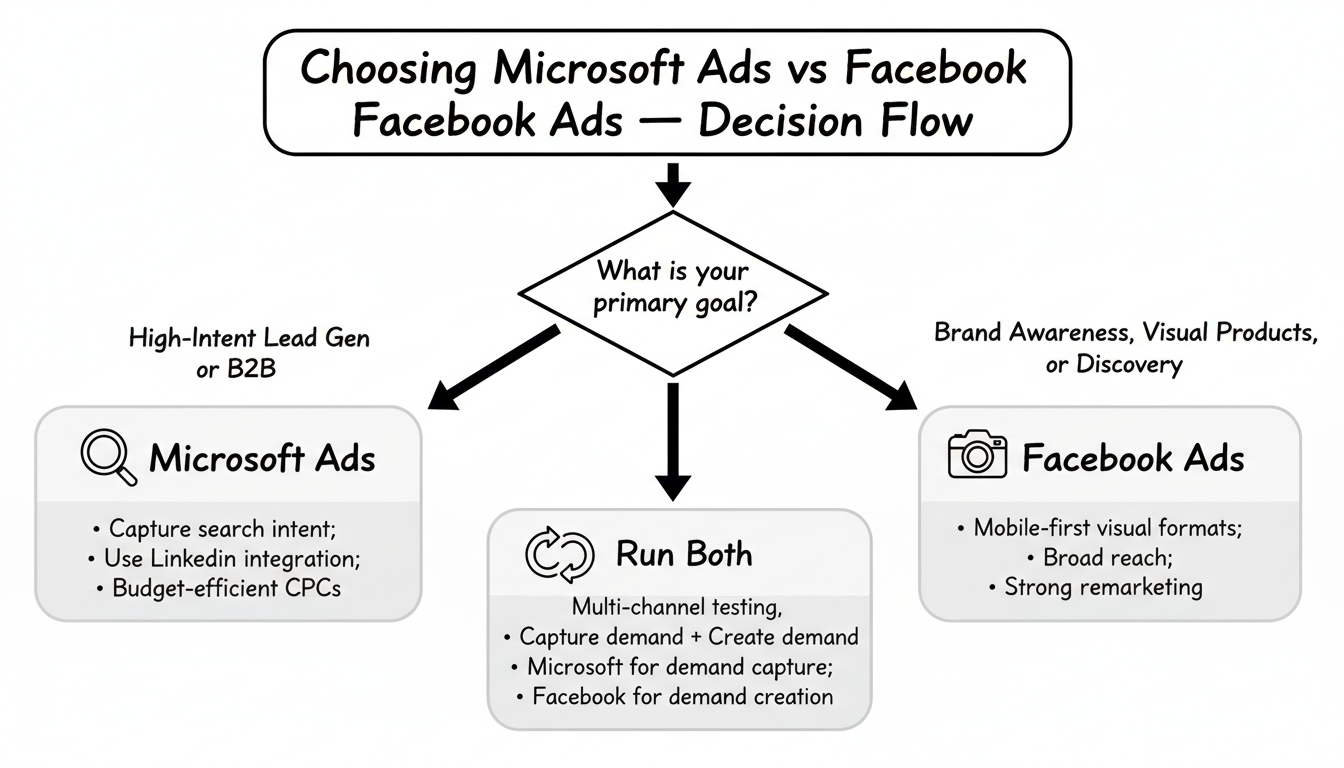
The answer depends on your specific situation.
For many businesses, the optimal approach combines both platforms. Use Microsoft Ads to capture existing demand (people searching for solutions), and use Facebook Ads to create new demand (introducing products to interested audiences). Understanding the broader landscape of types of search engine marketing helps you position each platform within your overall strategy.
Microsoft Ads typically has lower cost-per-click ($1-3 average) compared to Facebook ($1.35 average), but Facebook can deliver lower cost-per-impression for awareness campaigns. The "cheaper" platform depends on your goals—conversions favor Microsoft, reach often favors Facebook.
Not directly. Microsoft Ads uses text-based search ads triggered by keywords. Facebook Ads uses visual creative shown to targeted audiences. Each platform requires native creative and strategy tailored to how users interact with it. Effective PPC campaign optimization tips emphasize platform-specific creative testing rather than one-size-fits-all approaches.
Microsoft Ads generally outperforms for B2B due to search intent and LinkedIn targeting integration. However, Facebook can work for B2B brand awareness and retargeting. Many B2B marketers use Microsoft for lead generation and Facebook for nurturing.
By submitting this form, you agree to our Privacy Policy and Terms & Conditions.



