
February 19, 2026


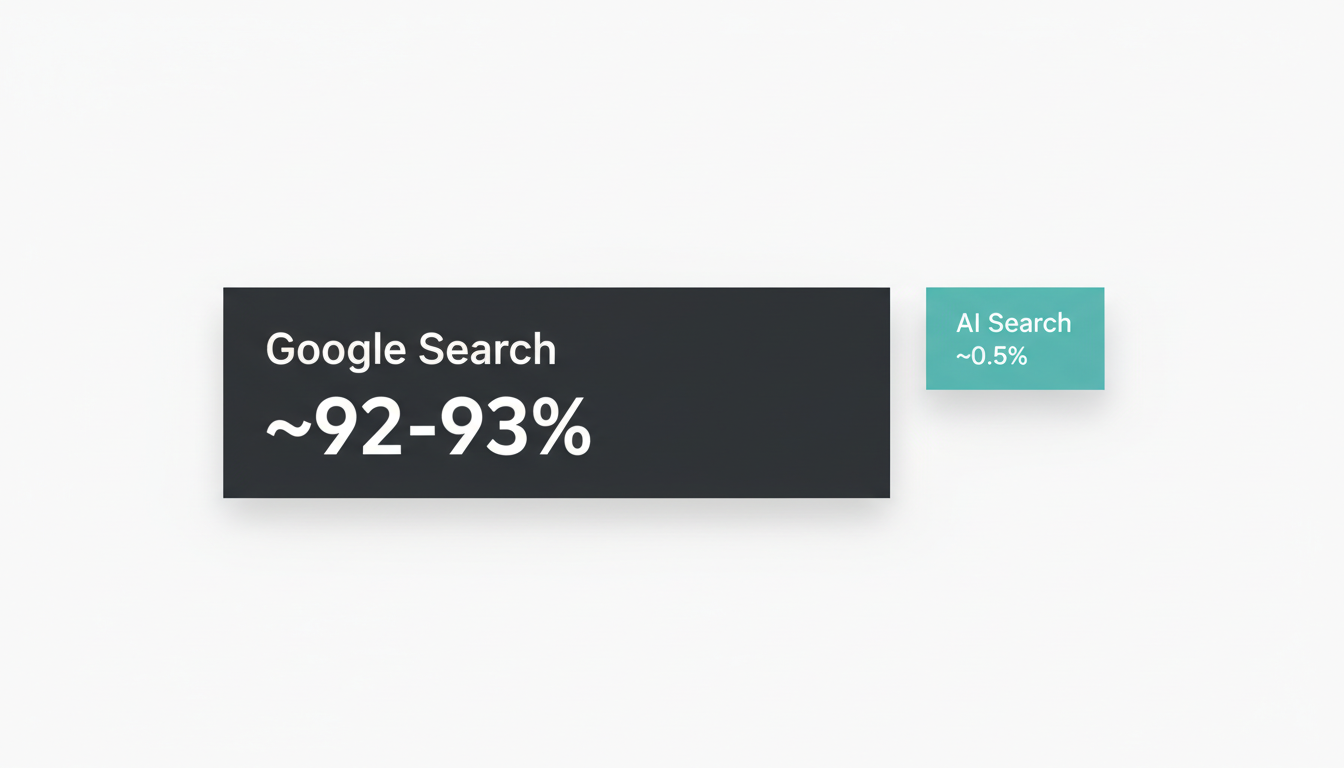
SearchGPT and ChatGPT Search represent a small but rapidly growing slice of the search market. While Google maintains overwhelming dominance with 92-93% global market share, the trajectory of AI search adoption tells a compelling story for marketers watching emerging opportunities.
This guide examines current market share data, adoption trends, user demographics, and growth projections to help you understand when and why SearchGPT optimization makes strategic sense in 2026.
The numbers reveal where AI search stands relative to traditional search.
Platform | Global Search Market Share | Daily Queries |
Google Search | ~92-93% | ~14 billion |
ChatGPT/SearchGPT | ~0.25% | ~37.5 million |
Perplexity | <0.1% | ~16 million |
All AI Search Combined | ~0.5% | ~60 million |
At first glance, AI search appears insignificant. But context matters: 0.25% of the global search market still represents tens of millions of daily searches, and growth rates tell a different story than raw market share. Understanding these trends is crucial when comparing seo vs aeo key differences and deciding where to allocate optimization resources.
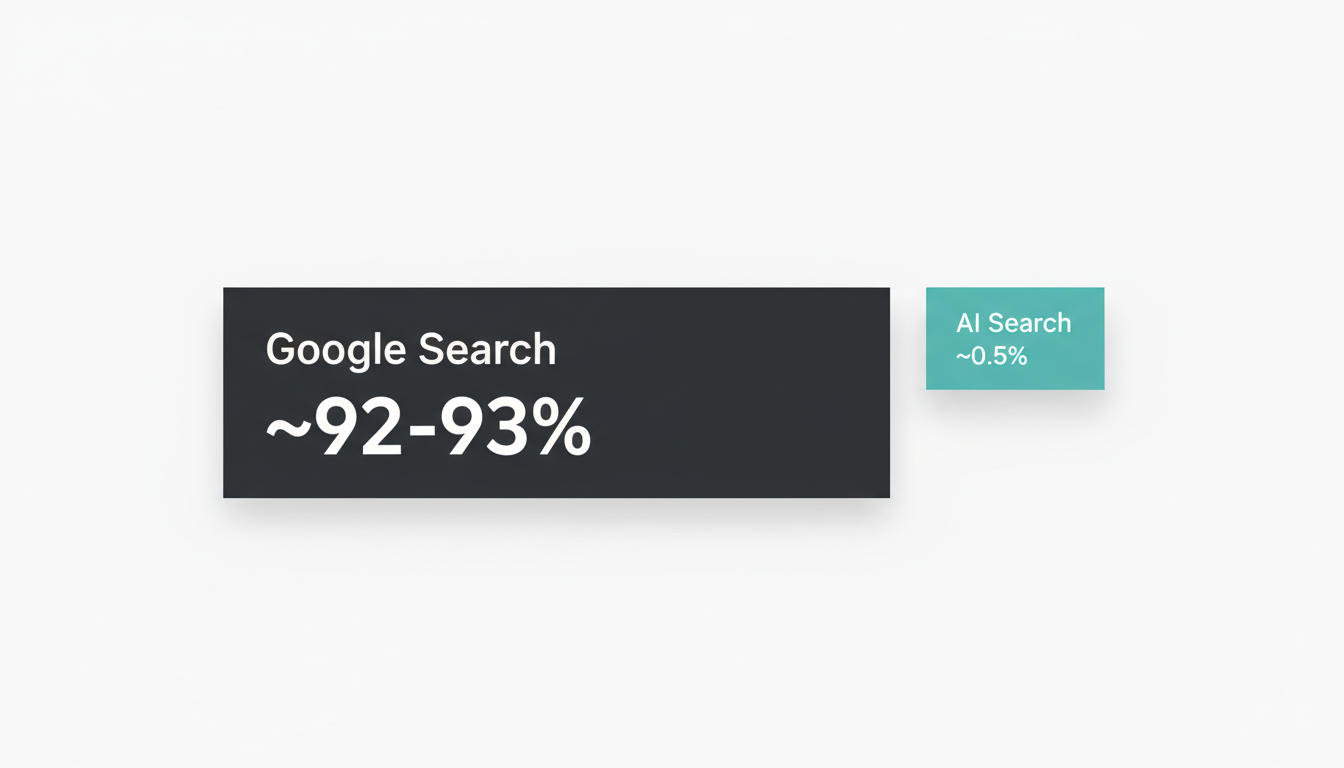
ChatGPT as a platform has seen explosive growth:
Date | Weekly Active Users |
November 2023 | 100 million |
August 2024 | 200 million |
December 2024 | 300 million |
February 2025 | 400 million |
August 2025 | 700 million |
October 2025 | 800 million |
December 2025 | 900 million |
ChatGPT now has approximately 900 million weekly active users as of late 2025—approaching 1 billion. Search functionality (SearchGPT) is used in roughly 46% of these interactions, meaning hundreds of millions of search queries flow through ChatGPT weekly.
Among AI chatbot platforms specifically, ChatGPT leads but faces increasing competition:
Platform | Market Share (2026) | Year-over-Year Change |
ChatGPT | 68% | -12% |
Google Gemini | 18.2% | +236% |
Claude | ~5% | +40% |
Others | ~8.8% | Various |
ChatGPT's market share is declining from previous highs near 80%, primarily due to Google Gemini's aggressive growth (5.4% to 18.2% in one year). Google Gemini now has 350 million monthly users.
Beyond static market share, the trajectory reveals where AI search is heading.
ChatGPT's US user base grew from 6.95% to 14.68% of internet users between 2024 and 2025—more than doubling in one year. Even more striking: sessions per user increased 195%, meaning existing users search more frequently, not just that more users joined.
Research indicates significant behavioral changes:
AI search isn't replacing Google for most queries—yet. But for certain query types (recommendations, research, complex questions), it's becoming the starting point. The rise of generative engine optimization geo services reflects how businesses are adapting to this shift in search behavior.
Understanding who uses AI search helps target optimization efforts.
Age Group | ChatGPT Adoption Rate |
18-29 | 58% |
30-49 | 41% |
50-64 | 25% |
65+ | 10% |
Younger demographics adopt AI search at dramatically higher rates. More than half of adults under 30 have used ChatGPT. If your audience skews younger, AI search optimization matters more urgently.
Users turn to AI search for specific query types:
High AI search adoption:
Low AI search adoption (Google preferred):
AI search captures high-intent, complex queries—often the most valuable from a marketing perspective. This shift demonstrates why aeo benefits why it matters for businesses targeting high-value conversions.
Industry analysts project continued AI search growth despite Google's dominance.
These projections assume current trajectories continue. Actual outcomes depend on technological breakthroughs, regulatory changes, and consumer behavior evolution.
SearchGPT exists within a competitive AI search ecosystem.
ChatGPT/SearchGPT (OpenAI)
Google Gemini
Perplexity
Microsoft Copilot
The AI search market is consolidating around major players while differentiating by use case. ChatGPT dominates general AI assistance, Gemini leverages Google's ecosystem, Perplexity owns research queries, and Copilot captures enterprise workflows. Developing a multi-platform ai search optimization strategy ensures visibility across this evolving landscape.
Given current market share, when should you prioritize SearchGPT optimization?
Target audience skews under 40: Younger demographics use AI search at 2-5x the rate of older groups.
Complex product/service offerings: AI search excels at research queries—perfect for considered purchases.
High-intent keyword targets: AI search captures decision-making queries disproportionately.
Early mover advantage matters: Lower competition in AI search than traditional SEO.
Brand recommendation queries: 58% of consumers use AI for product recommendations.
Local business queries: AI search still directs users to Google Maps for local results.
Simple navigational queries: Users searching for specific websites don't use AI search.
Visual/video content: Google remains dominant for image and video search.
Budget-constrained campaigns: Limited resources may be better spent on traditional SEO with proven ROI.
Several trends will shape AI search market evolution.
Yes, but slowly. AI search has grown from negligible to approximately 0.25-0.5% of global search market share. The growth rate is significant even if absolute numbers remain small.
No. Google still handles 92-93% of global search queries. Traditional SEO remains essential. Add AI search optimization as a complement, not a replacement.
Very fast. ChatGPT users doubled year-over-year, and sessions per user increased 195%. AI search is the fastest-growing search segment.
Not in the near term. Long-term predictions vary, but the most likely outcome is hybrid search behavior where users choose platforms based on query type.
By submitting this form, you agree to our Privacy Policy and Terms & Conditions.



