
February 19, 2026


SEM marketing has become one of the most effective ways to reach customers actively searching for products and services like yours. Unlike traditional advertising that interrupts people, search engine marketing meets them exactly when they're looking for solutions.
This guide covers everything beginners need to know: what SEM actually is, how it works in 2026, how to get started with your first campaigns, and the best practices that separate successful advertisers from those wasting their budgets.
SEM (Search Engine Marketing) is a paid advertising strategy that places your ads in search engine results when people search for relevant keywords. You bid on search terms, and your ads appear at the top or bottom of results pages—typically marked as "Sponsored" or "Ad."
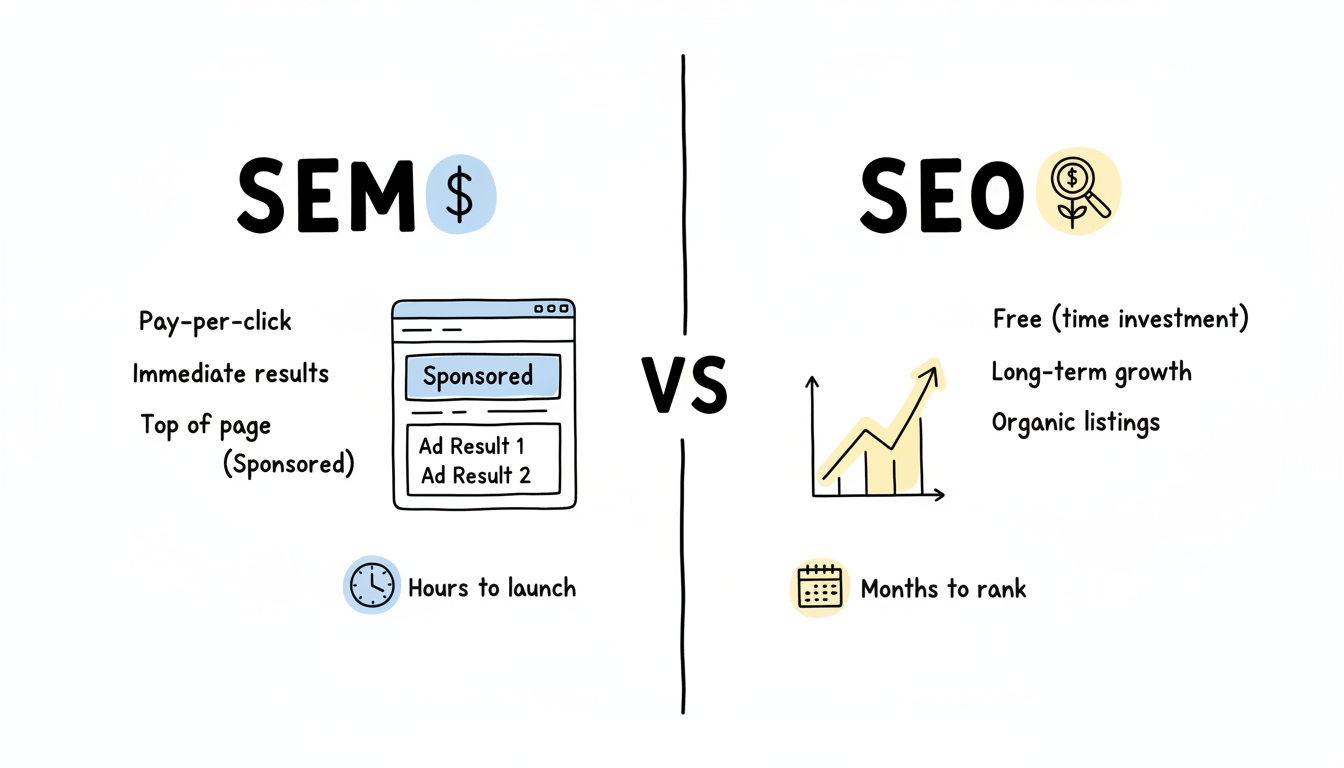
According to Neal Schaffer, SEO focuses on improving organic (free) search rankings, while SEM includes paid advertising for instant visibility.
Factor | SEO | SEM |
Cost | "Free" (time/resource investment) | Pay-per-click or impression |
Speed to Results | Months | Immediate |
Sustainability | Long-term once established | Stops when budget stops |
Control | Limited (algorithm-dependent) | High (bid control, targeting) |
Position | Organic listings | Top of page (sponsored) |
In practice, Vertical Institute notes that successful marketers combine both: SEM for immediate results and SEO for sustainable long-term growth.
Search marketing has evolved significantly. According to NoGood's analysis of search marketing in 2026, SEM ads now appear not just in standard search results, but also above or alongside AI-generated overviews, making them highly visible even as zero-click searches increase.
Key changes to understand:
Despite changes in search behavior, SEM remains one of the most measurable marketing channels. According to Sprints' digital marketing guide, SEM delivers immediate visibility and you only pay when someone clicks your ad—making ROI straightforward to calculate.
Understanding the mechanics of SEM helps you build better campaigns from the start.
Every time someone searches, an instant auction determines which ads appear. Your ad position depends on:
The formula: Ad Rank = Bid × Quality Score
A higher Quality Score means you can pay less and still outrank competitors with higher bids.
Quality Score measures how relevant your ad is to the searcher:
Component | Weight | How to Improve |
Expected CTR | High | Write compelling ad copy |
Ad relevance | Medium | Match keywords to ad text |
Landing page experience | High | Fast, relevant, mobile-friendly pages |
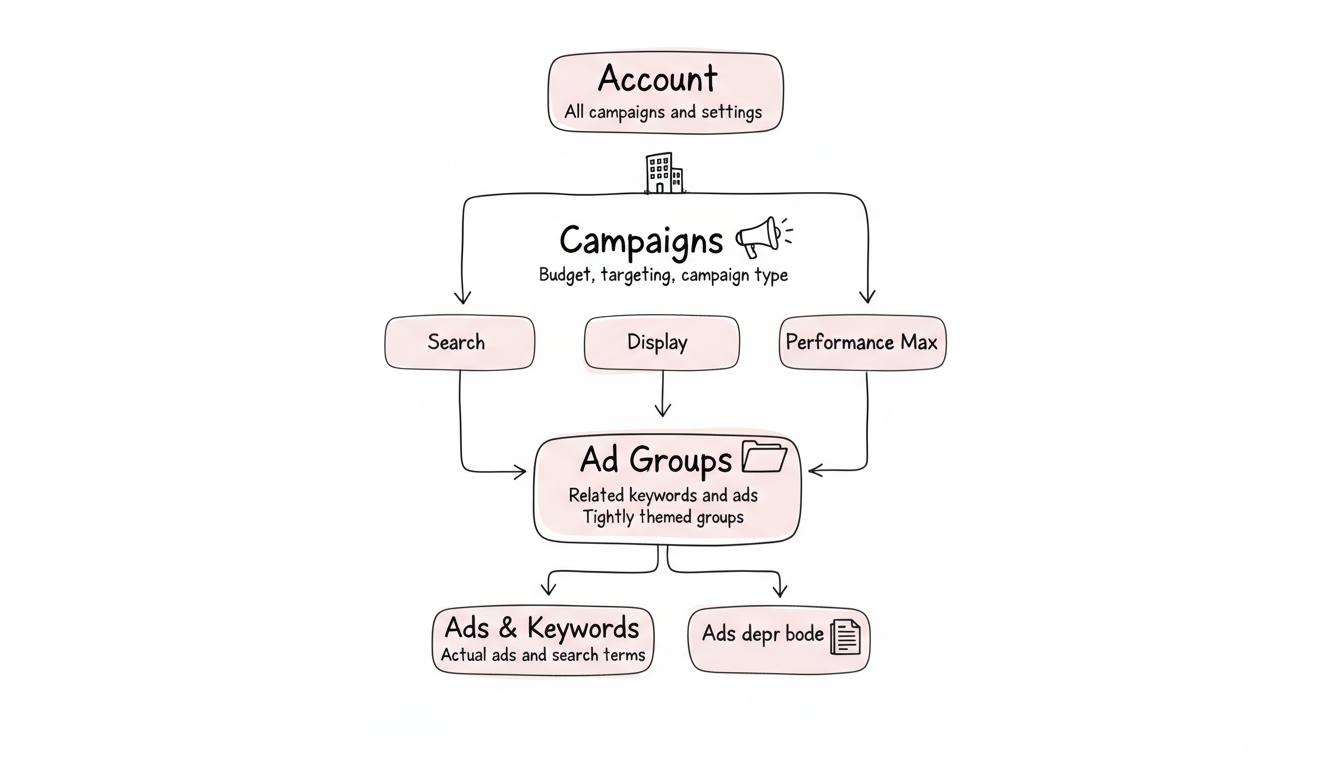
According to WordStream's account structure guide, a well-organized Google Ads account follows this hierarchy:
Account → Contains all campaigns and account-level settings
Campaigns → Where you set budget, targeting, and campaign type
Ad Groups → Groups of related keywords and ads
Ads & Keywords → The actual ads and search terms you're targeting
Keywords can match searches in different ways:
Match Type | Symbol | Example Keyword | Matches |
Broad | none | women shoes | Women's running sneakers, buy ladies footwear |
Phrase | "..." | "women shoes" | Women shoes online, buy women shoes |
Exact | [...] | [women shoes] | Women shoes, women shoe |
Start with more restrictive match types (exact/phrase) for control, then expand to broad match as you gather data.
Here's how to launch your first SEM campaign step by step.
Before creating campaigns, clarify what success looks like:
Your goal determines campaign type, bidding strategy, and success metrics.
Use tools like Google Keyword Planner, SEMrush, or Ahrefs to identify:
Focus on keywords that signal buying intent—"hire accountant" converts better than "what does an accountant do."
According to WordStream, run a few different campaign types within your Google Ads account to maximize performance:
Start simple:
Your ads compete for attention. Include:
Without conversion tracking, you're flying blind. Set up tracking for:
According to Vertical Institute, understanding how to interpret performance data and optimize campaigns dynamically is essential for 2026 success.
These proven strategies help you get better results from your SEM investment.
Don't spread your budget thin across too many keywords. Focus on 10-20 high-intent keywords, gather data, then expand what works.
Add negative keywords to prevent ads showing for irrelevant searches. For example, if you sell premium services, add "free," "cheap," and "DIY" as negatives.
Create 3-4 ad variations per ad group and let the platform test them. After gathering data, pause underperformers and create new variations to beat your winners.
Your landing page must match the ad and search intent. Key elements:
Review the actual searches triggering your ads. Add relevant searches as keywords; add irrelevant ones as negatives.
According to Vertical Institute's SEM guide, today's marketers must understand how to target audiences and optimize campaigns dynamically—meaning Smart Bidding is essential once you have conversion data.
Wait until you have 30+ conversions monthly before relying on automated bidding.
Google gets most attention, but Microsoft Advertising (Bing) often delivers:
Ready to move beyond the basics? Here's your path forward.
Core skills to develop:
According to NoGood, your current SEM expertise (bidding strategy, audience targeting, and conversion tracking) will translate to AI advertising as new platforms emerge.
As campaigns grow more complex, working with a PPC campaign management service can accelerate results. Signs you might benefit from professional help:
The SEM landscape evolves constantly. According to LinkedIn industry insights, 2026 has introduced a third pillar: GEO (Generative Engine Optimization) for AI-driven visibility. Smart marketers use SEM data to refine SEO content and GEO-focused answers, creating a feedback loop that improves all channels.
Start with $500-$1,500 monthly to generate meaningful data. This gives you enough clicks to identify what works without risking significant budget. Scale up once you have proof of ROI. According to Vertical Institute, SEM brings fast traffic and visibility, but you need enough data to optimize effectively.
Unlike SEO, which takes months, SEM delivers immediate visibility. Your ads can appear within hours of campaign launch. However, optimization takes 2-4 weeks as you gather data, refine targeting, and improve Quality Scores. Expect 1-2 months before campaigns reach peak efficiency.
Yes—SEM's pay-per-click model means you only pay when someone engages. It's often more cost-effective than traditional advertising because you target people actively searching for your services. Start with a modest budget focused on high-intent local keywords for best results. For those new to PPC advertising, this approach minimizes risk while building expertise.
By submitting this form, you agree to our Privacy Policy and Terms & Conditions.



