February 19, 2026


Understanding TikTok CPM benchmarks helps you set realistic budgets and evaluate whether your campaigns are performing competitively. CPM rates vary significantly based on your industry, target audience, timing, and creative quality—knowing the benchmarks lets you identify optimization opportunities.
This guide covers current TikTok CPM averages, how they compare across industries and countries, and practical strategies to reduce your costs while maintaining performance.
CPM stands for Cost Per Mille (or Cost Per Thousand Impressions). It's the amount you pay for every 1,000 times your ad is shown to users. CPM is a standard metric for measuring advertising efficiency across platforms.
How CPM is calculated:
CPM = (Total Ad Spend / Total Impressions) × 1,000
For example, if you spend $350 and receive 100,000 impressions, your CPM is $3.50.
CPM matters because it directly affects how far your budget reaches. A lower CPM means more people see your ads for the same spend. However, CPM alone doesn't tell you everything—a $2 CPM that generates no conversions is worse than a $6 CPM that drives sales.
TikTok uses an auction-based system where advertisers bid for ad placements. Your CPM depends on competition for your target audience, ad quality scores, and overall demand in the auction.
CPM varies substantially across industries due to differences in audience value, competition levels, and typical conversion rates.
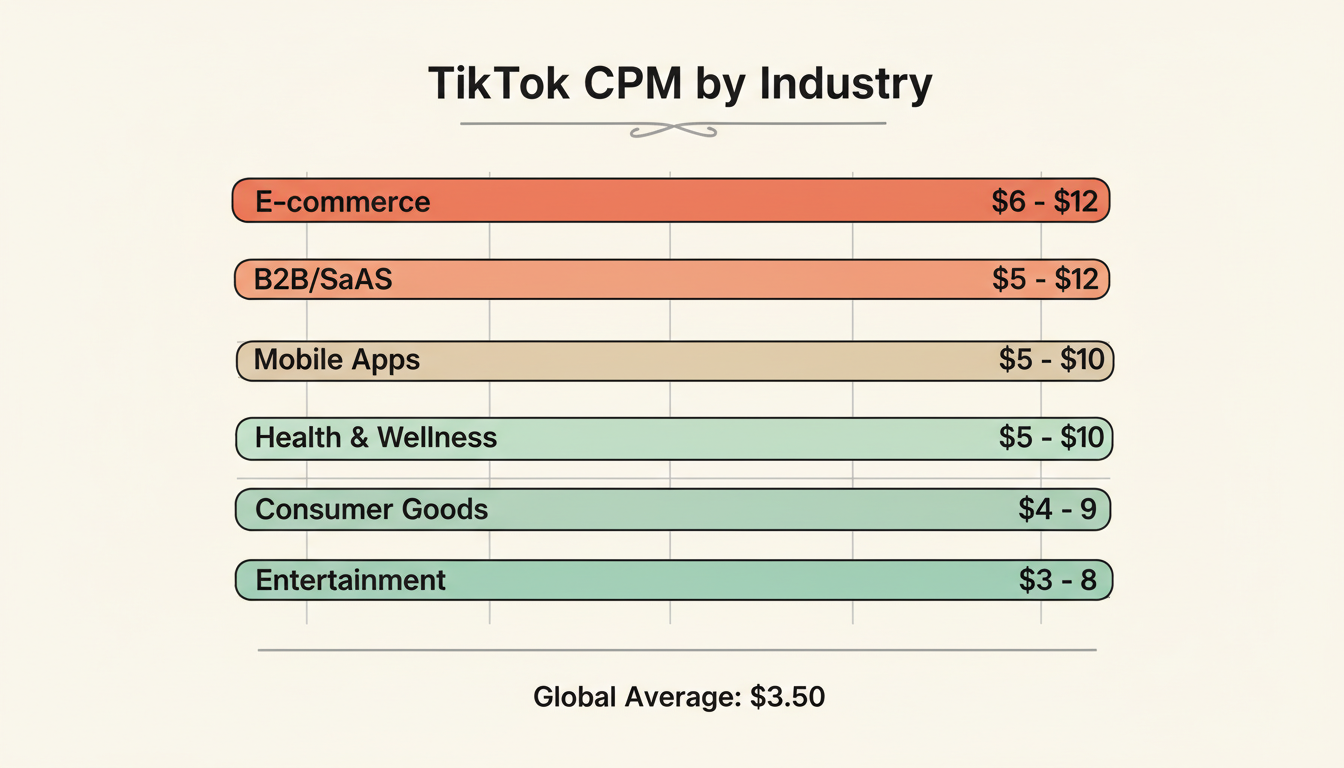
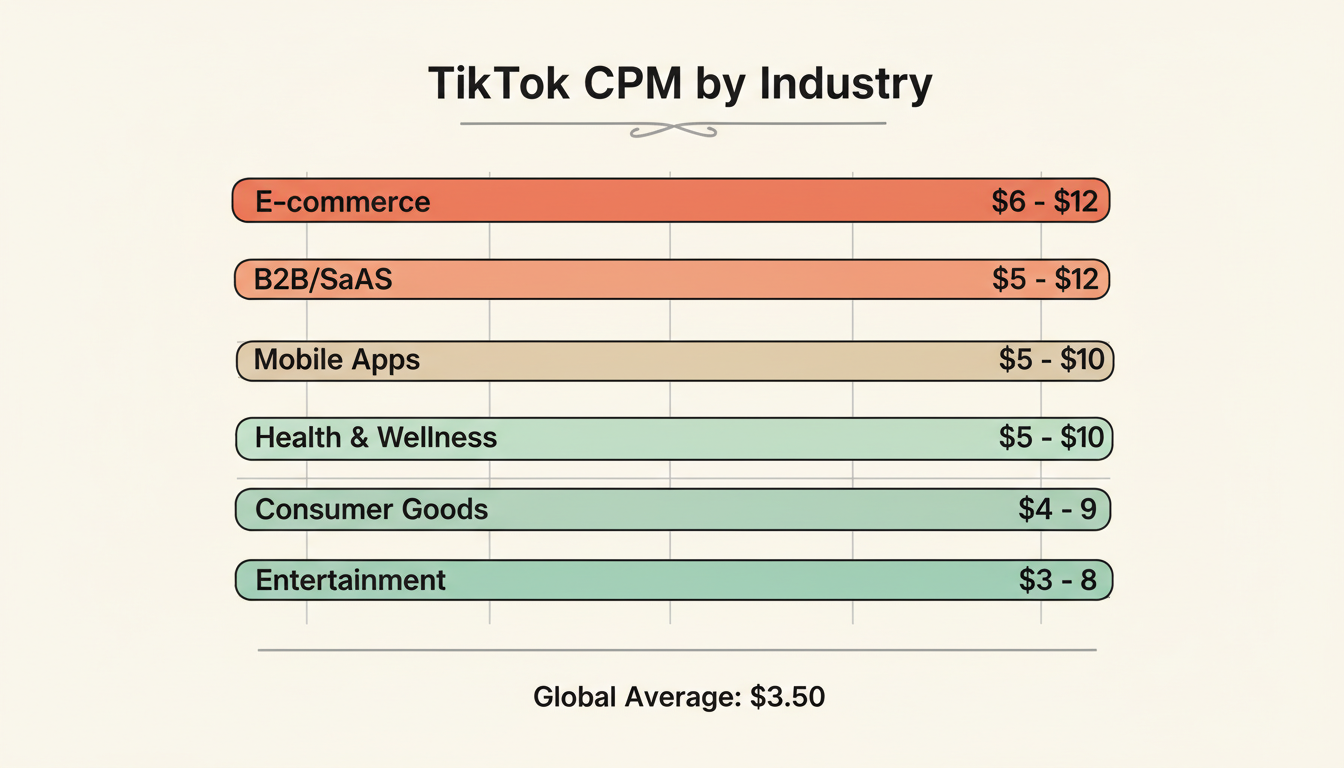
According to industry benchmarks, here are typical TikTok CPM ranges by vertical:
Industry | Average CPM Range |
E-commerce | $6 - $12 |
B2B/SaaS | $5 - $12 |
Mobile Apps | $5 - $10 |
Entertainment | $3 - $8 |
Consumer Goods | $4 - $9 |
Health & Wellness | $5 - $10 |
E-commerce advertisers typically see higher CPMs due to intense competition, particularly around shopping events. The tradeoff is higher purchase intent—users who engage are often ready to buy.
B2B and SaaS advertisers face similar CPM ranges but often target narrower professional audiences, which can push costs higher during business hours.
Mobile app campaigns benefit from TikTok's young, app-engaged audience, with CPMs remaining competitive against other app install platforms.
Entertainment and media brands often see lower CPMs because their content naturally fits the platform's entertainment-first environment.
The global average TikTok CPM hovers around $3.50, though this varies significantly by market and campaign objective. Awareness campaigns typically range from $4 to $10 CPM, while conversion-optimized campaigns may see different dynamics as the algorithm prioritizes quality over quantity.
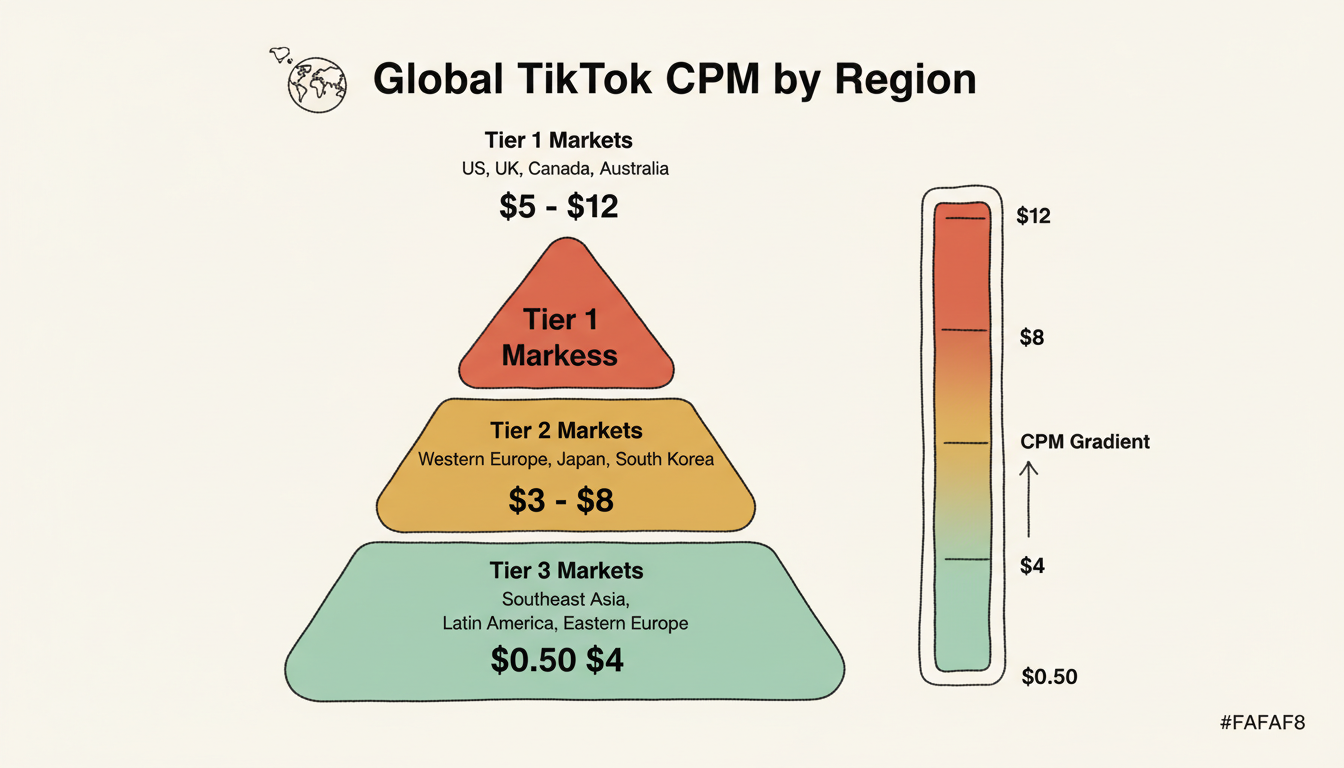
Geographic targeting significantly impacts CPM. Markets with more advertisers and higher consumer purchasing power command higher rates.
Tier 1 Markets (Higher CPMs):
Tier 2 Markets (Moderate CPMs):
Tier 3 Markets (Lower CPMs):
Understanding TikTok ads pricing across different markets helps you allocate budgets effectively. TikTok remains competitively priced compared to Meta platforms, with an average CPM of $3.50 versus Meta's $6.59. This price advantage exists partly because TikTok's ad ecosystem is still maturing, creating opportunities for early adopters.
Brands targeting multiple countries should consider geographic bid adjustments. Running campaigns in Tier 2 or Tier 3 markets alongside Tier 1 can lower blended CPMs while maintaining reach.
Several factors influence what you'll actually pay:
Broader targeting typically yields lower CPMs. According to TikTok data, campaigns using broad targeting can achieve up to 15% lower CPA compared to narrow interest-based targeting, partly due to more efficient auction dynamics.
Narrowing your audience to specific interests, behaviors, or demographics increases competition for that smaller pool—driving CPMs up. When planning your TikTok ads targeting options, consider that custom audiences (website visitors, customer lists) often command premium CPMs because they represent high-value users.
CPMs fluctuate predictably throughout the year:
Planning campaigns around these patterns helps optimize budget efficiency. Launch awareness campaigns in Q1 when CPMs are lowest; plan conversion pushes for Q4 despite higher costs if your product fits holiday shopping.
TikTok rewards engaging content with lower costs. Ads with high completion rates, strong engagement (likes, comments, shares), and low negative feedback signals receive preferential treatment in the auction.
The first 3 seconds are critical—71% of whether users continue watching is determined immediately. Strong hooks directly impact your quality scores and, consequently, your CPMs.
Your selected objective influences CPM:
Conversion-optimized campaigns may show higher or lower CPM than awareness campaigns—the algorithm focuses on finding users likely to convert, not maximizing impressions. Before you run TikTok ads, understanding these objective-based variations helps set realistic expectations.
Your bidding approach affects CPM outcomes:
Reducing CPM while maintaining quality requires strategic adjustments:
Rotate creative every 7-10 days to combat ad fatigue. TikTok's algorithm favors fresh content, and fatigued creative sees declining engagement—which raises CPM. Maintain 3-5 active creatives per ad group to enable rotation. Following TikTok ad specs and requirements ensures your creatives perform optimally from the start.
Spark Ads typically deliver 4% lower CPM than traditional In-Feed ads because they benefit from existing social proof and authentic content format. Boosting organic posts that already perform well compounds this advantage.
Start with TikTok's automatic targeting or broad demographic settings. Let the algorithm find efficient audiences rather than constraining it with narrow interest targeting. You can refine later based on performance data.
Avoid peak competition periods when possible. Running ads during off-peak hours or in Q1 when demand is lower can reduce CPMs by 15-30%. Use dayparting to focus budget on hours when your audience is active but competition is moderate.
While not directly affecting CPM, better landing pages improve conversion rates—making higher CPMs worthwhile. A $6 CPM with 4% conversion rate beats a $3 CPM with 1% conversion rate.
If your product works in multiple markets, testing Tier 2 or Tier 3 countries can significantly lower blended CPM. International expansion often reveals efficient markets overlooked by competitors.
A "good" CPM depends on your industry and objectives. For most advertisers, $3-$8 CPM indicates competitive performance. E-commerce brands may see $6-$12 as normal, while entertainment campaigns often achieve under $5. Compare your CPM to industry benchmarks rather than absolute numbers.
High CPMs typically result from narrow targeting, poor creative engagement, competitive timing (Q4), or low relevance scores. Test broader audiences, refresh creative, and check if your content resonates with TikTok's entertainment-first culture.
Generally, yes. TikTok's average CPM of $3.50 compares favorably to Meta's $6.59 average. However, this varies by industry and targeting—some audiences cost more on TikTok than Facebook depending on competition levels.
In TikTok Ads Manager, navigate to your campaign or ad group, then view the CPM column in reporting. You can customize columns to display CPM alongside other metrics like CTR and conversion rate for comprehensive analysis.
By submitting this form, you agree to our Privacy Policy and Terms & Conditions.