
February 19, 2026



One of the most compelling arguments for AEO investment lies in conversion data. Traffic from AI search citations consistently converts at higher rates than traditional organic search traffic. Understanding why this happens—and how to maximize these conversions—helps organizations build stronger business cases for answer engine optimization.
Early data from 2026 reveals significant conversion differences between AI-referred traffic and traditional search visitors.
Reported conversion metrics:
These numbers represent early industry data and vary by sector, but the pattern holds across most categories—AI-referred visitors engage more deeply and convert more frequently.
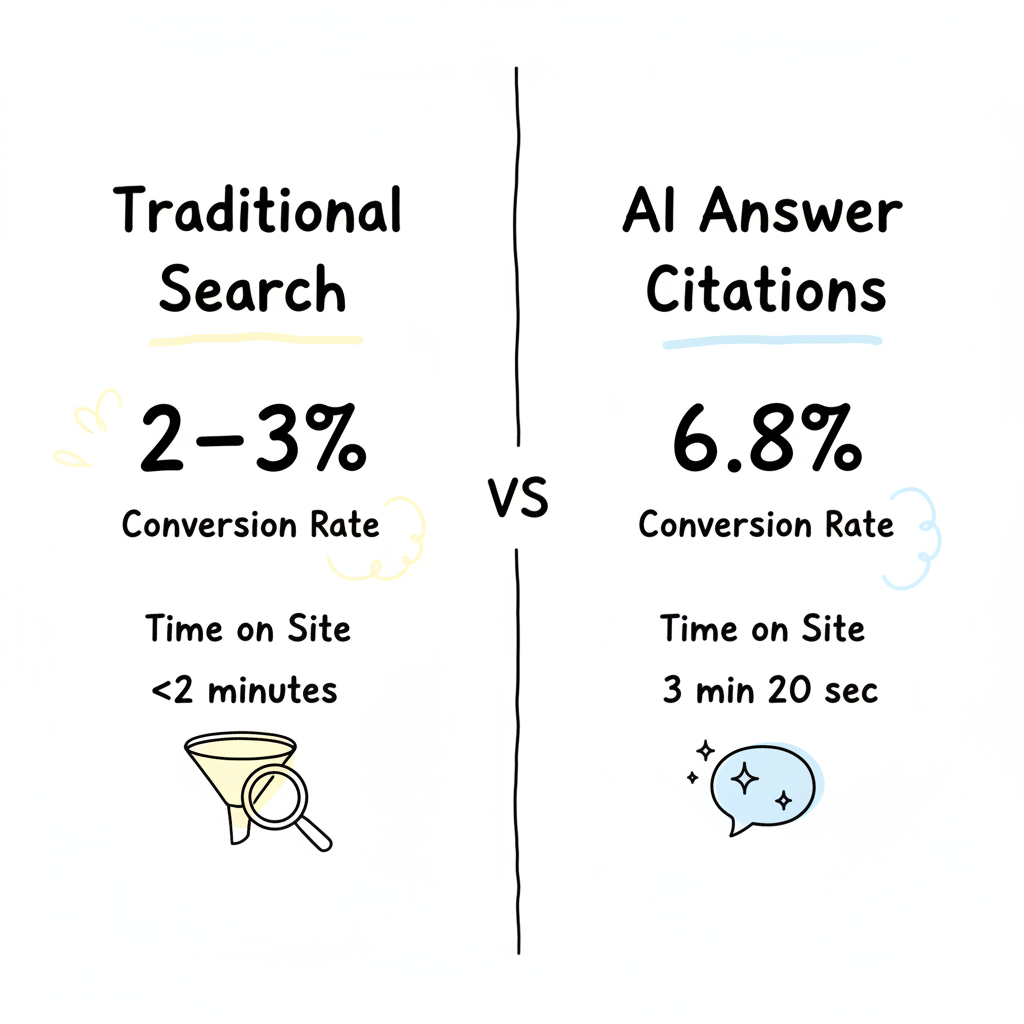
Several factors explain the conversion rate differential between AI search and traditional organic traffic.
Users asking AI assistants questions have already demonstrated specific intent. Unlike broad keyword searches that capture users at various awareness stages, AI queries typically indicate clear information needs or purchase consideration.
Intent qualification examples:
AI systems filter and respond to these queries, meaning your cited content reaches users with demonstrated, specific intent rather than casual browsers.
When AI platforms cite your content, they transfer credibility to your brand. Users encountering your business as an AI-recommended source perceive you differently than finding you in a list of search results.
Trust transfer dynamics:
This trust transfer reduces friction throughout the conversion funnel. Visitors who already trust you spend less time evaluating credibility and move faster toward conversion actions.
AI citations often occur within comprehensive answer contexts. Users have already received valuable information before visiting your site, meaning they arrive with baseline knowledge rather than starting from zero.
Engagement implications:
Pre-educated visitors convert more efficiently because the AI interaction has already handled initial awareness and education stages.
Traditional search results present 10+ competing options simultaneously. AI citations typically mention fewer sources within answer contexts, reducing direct competition when users click through.
Competitive dynamics:
With fewer alternatives competing for immediate attention, cited sources receive more focused consideration from visitors.
Capitalizing on higher-converting AI traffic requires optimizing the post-click experience. Organizations should follow AEO content guidelines to ensure their pages deliver on the promise that earned the citation.
Ensure pages receiving AI traffic align with the context that generated citations.
Alignment strategies:
If AI cites your page for "best project management software for remote teams," visitors expect content addressing that specific topic with clear paths to evaluation or purchase.
Different AI queries indicate different funnel stages. Design conversion paths matching the intent that generated visits.
Intent-to-conversion mapping:
Informational queries: Offer deeper content, newsletter signups, or resource downloads before purchase conversations.
Comparison queries: Provide comparison tools, free trials, or consultation requests—visitors are evaluating options.
Transactional queries: Make purchase or signup processes immediately accessible—these visitors are ready to act.
Mismatched conversion paths waste high-quality traffic. Don't push hard sales on informational visitors or bury purchase options from ready buyers.
AI referrals arrive with elevated trust—reinforce rather than squander it.
Trust reinforcement tactics:
Visitors trusting you based on AI recommendations will quickly distrust if your site contradicts that positioning with pushy or inconsistent experiences.
High-intent visitors won't tolerate slow or frustrating experiences. Technical performance matters more when conversion probability is already elevated. Consider implementing AI overview website optimization techniques to maximize engagement.
Experience priorities:
Every friction point represents lost conversions from otherwise highly-qualified visitors.
Track AI traffic conversions separately from general organic traffic when possible. Organizations should establish AI search KPI goal setting frameworks to measure success accurately.
Direct tracking methods:
Indirect measurement:
Attribution remains imperfect, but directional measurement reveals whether AEO investments produce conversion benefits.
Compare AEO conversion rates against appropriate baselines:
Context matters—a 6% AEO conversion rate means different things depending on your typical organic conversion rate.
Conversion advantages vary by industry and query type.
Higher conversion differential sectors:
Lower differential sectors:
Industries where trust and expertise influence purchase decisions see larger AEO conversion premiums than commodity categories.
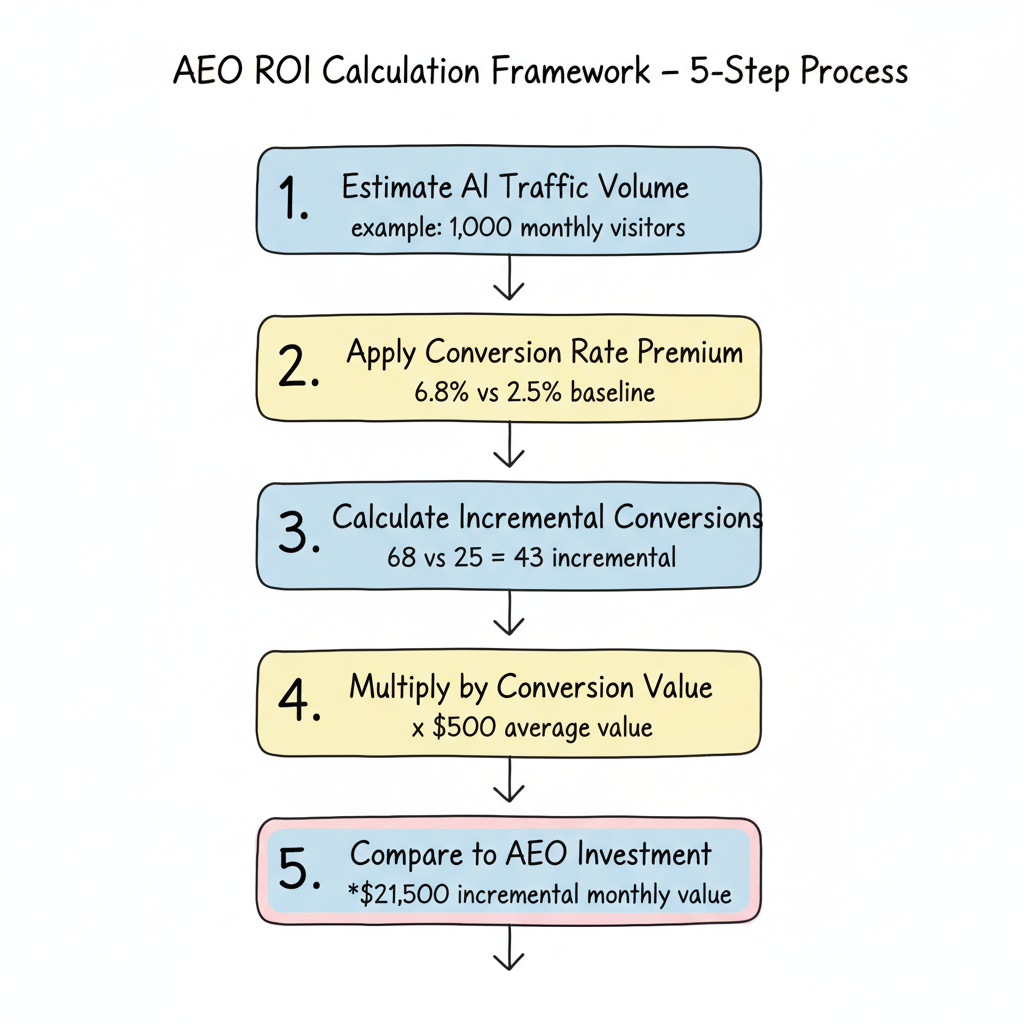
Use conversion data to justify AEO investment. Tools like the AEO ROI calculator can help quantify the financial impact of answer engine optimization.
ROI calculation framework:
Even modest AI traffic volumes produce meaningful ROI when conversion rates significantly exceed alternatives.
Example calculation:
These calculations help executives understand AEO as a business investment rather than abstract marketing activity.
Early adopters benefit from novelty effects that may moderate over time. However, fundamental factors driving higher conversions—pre-qualified intent, trust transfer, reduced competition—should persist even as AI search matures.
Most AI platforms don't pass clean referrer data. Use landing page segmentation, correlational analysis, and available referrer data where platforms do identify AI sources. Perfect attribution isn't possible, but directional measurement guides optimization.
Both matter. Citations drive traffic; conversion optimization extracts value from that traffic. Neglecting either limits AEO program effectiveness.
By submitting this form, you agree to our Privacy Policy and Terms & Conditions.



