
February 19, 2026


Last Updated: January 2026
Search optimization in 2026 requires understanding two complementary disciplines: SEO (Search Engine Optimization) and AEO (Answer Engine Optimization). While they share common foundations, they serve different purposes in how your content gets discovered.
This guide explains the key differences between AEO and SEO, and why successful brands need both.
Answer Engine Optimization (AEO) prepares your content to appear in direct responses generated by AI-powered search systems. Unlike traditional SEO, which aims to rank pages in search results, AEO focuses on making your content easy for AI systems to extract, understand, and present as answers.
AEO targets visibility across:
The core goal: become the source AI systems select when generating answers to user questions.
Understanding where these disciplines diverge helps prioritize your optimization efforts.
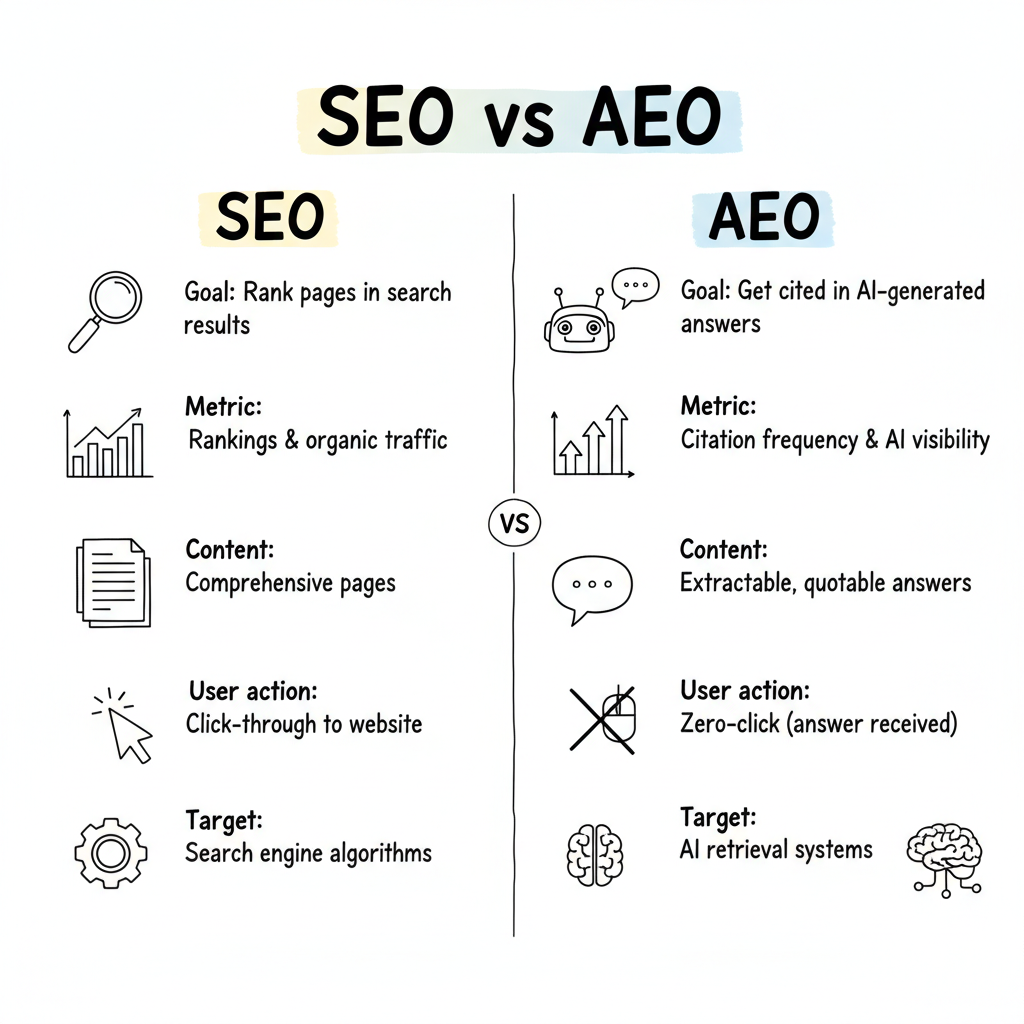
Factor | SEO | AEO |
Primary Goal | Rank pages in search results | Get cited in AI-generated answers |
Success Metric | Rankings, clicks, organic traffic | Citation frequency, AI visibility |
Content Focus | Comprehensive pages that rank | Extractable answers AI can quote |
User Action | Click through to website | May receive answer without clicking |
Optimization Target | Search engine algorithms | AI retrieval and synthesis systems |
Traditional SEO optimizes content for search engine algorithms. The process involves:
Success means ranking on page one, earning clicks, and driving organic traffic.
AEO optimizes content for AI extraction. The approach involves:
Success means getting selected as the source when AI generates answers.
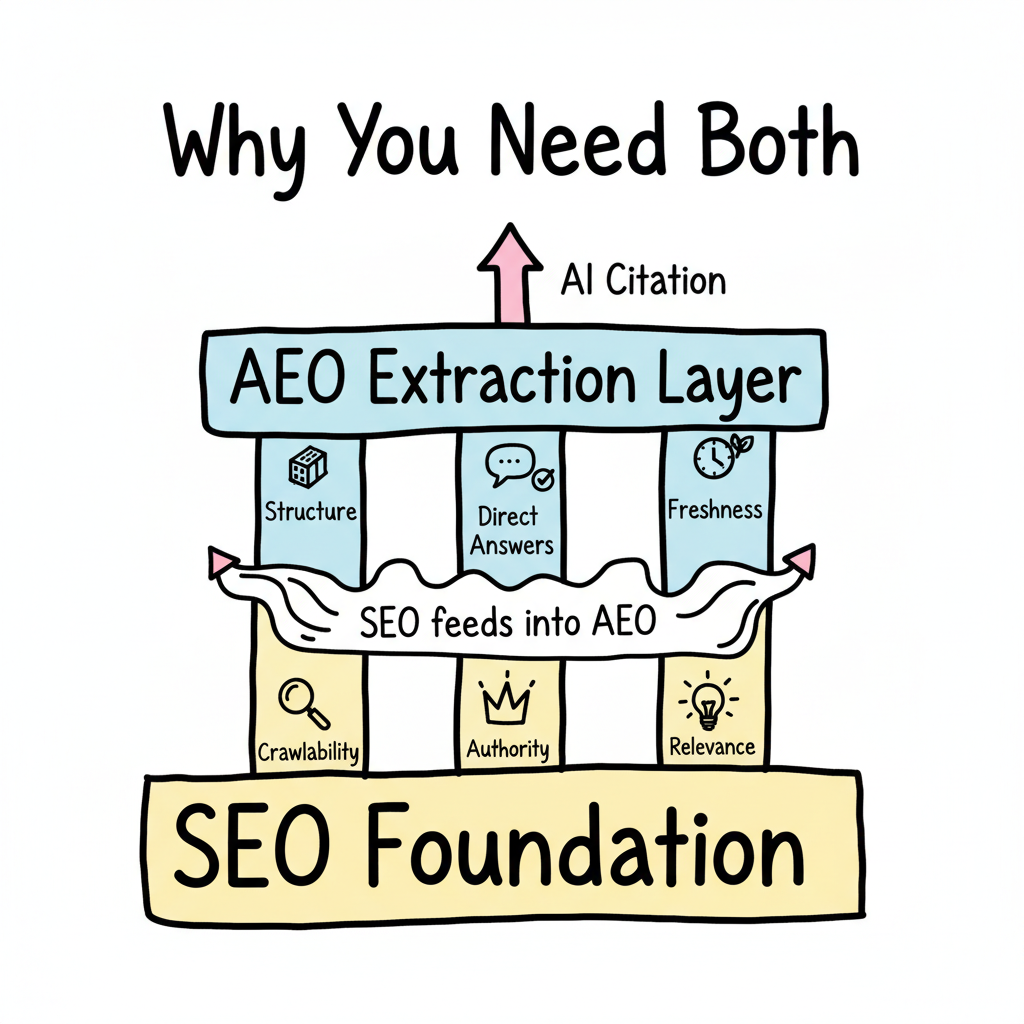
AEO doesn't replace SEO—it depends on it. Research shows that Google AI Overviews maintain significant overlap with organic results. Pages that rank well traditionally have higher chances of appearing in AI responses.
SEO provides the foundation:
AEO adds the extraction layer:
Think of it this way: SEO earns relevance. AEO earns selection.
If you already have strong SEO, these AEO optimizations build on that foundation:
Structure content for extraction
Add FAQ sections
Include specific data
Optimize URLs
AEO and SEO serve different but complementary purposes. SEO gets your pages ranked; AEO gets your content cited in AI responses.
Neither replaces the other. Strong SEO foundations support AEO success. Without crawlability and authority, AI systems won't find or trust your content.
The shift is real. With Google AI Mode reaching over 2 billion monthly users, optimizing only for traditional rankings means missing significant visibility opportunities.
Start with structure. Most AEO improvements involve restructuring existing content rather than creating new pages. Focus on making your best content more extractable. Consider working with an AEO marketing consultant to identify quick wins in your existing content library.
No. SEO remains essential for visibility in traditional search results and provides the foundation that AEO builds upon. Without SEO fundamentals like crawlability, indexing, and relevance signals, AI systems won't surface your content. SEO and AEO work together rather than one replacing the other.
No. AEO rewards content clarity and answer quality over brand size. Smaller sites with well-structured, authoritative content can earn AI citations even when competing against larger competitors. The key is providing clear, trustworthy answers rather than having the biggest domain. AEO marketing for startups offers a level playing field against established competitors.
Results vary by platform. Answer engines pick up new and updated content faster than traditional search—content updated within 13 weeks shows significantly higher citation rates. Initial improvements to structure and formatting can impact AI visibility within weeks, while building full authority takes longer.
Start with SEO if you don't have it. AEO depends on SEO fundamentals. If you already rank well, add AEO optimizations to capture AI visibility. For most brands, the approach isn't either/or—it's SEO first, then AEO layered on top.
By submitting this form, you agree to our Privacy Policy and Terms & Conditions.



