February 19, 2026


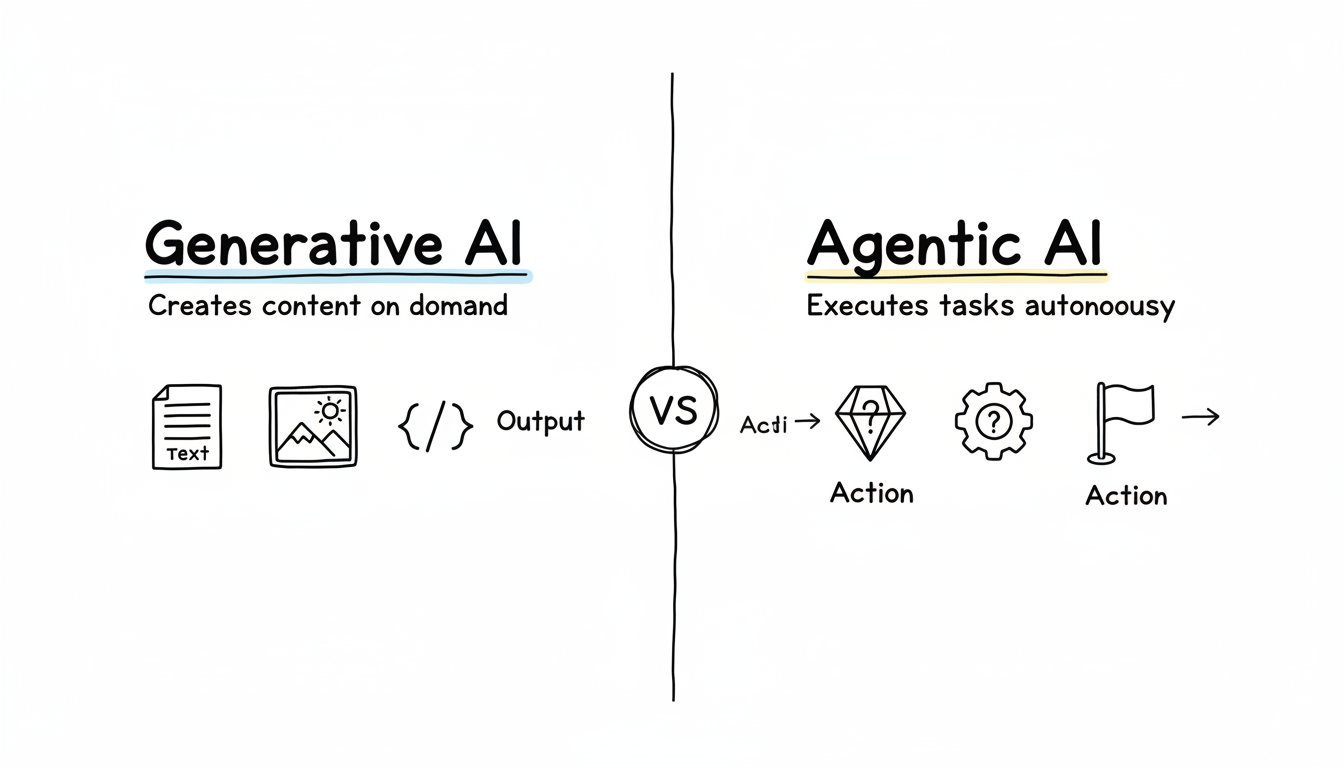
Two AI paradigms are reshaping business operations: generative AI and agentic AI. While often confused, these technologies serve fundamentally different purposes. Generative AI creates content—text, images, code—based on prompts. Agentic AI makes decisions and executes tasks autonomously to achieve specific goals.
According to IBM's comparison of agentic and generative AI, potential agentic AI use cases are emerging in functions like customer service, healthcare security, workflow management, and financial risk management, while generative AI excels at content creation and synthesis.
According to IGM Guru's 2026 analysis, agentic AI focuses on making decisions and executing tasks autonomously, while generative AI focuses on creating content like text, images, or code based on user prompts. This fundamental distinction shapes how businesses apply each technology.
Simple distinction:
According to TestGrid's comparison, agentic AI autonomously executes goal-oriented tasks, while generative AI creates new ideas and content like text, code, or images.
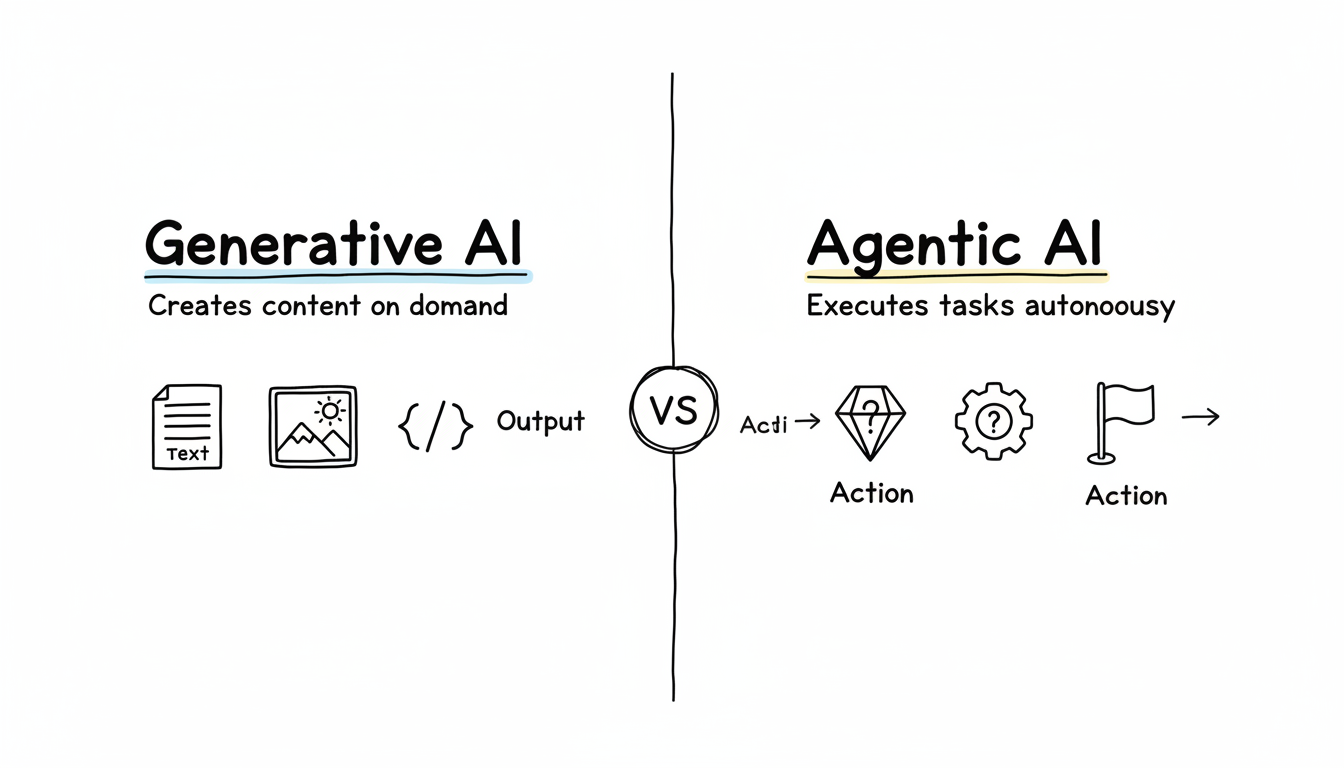
According to Thomson Reuters' analysis, GenAI works by recognizing patterns and making statistical predictions to generate human-like outputs, making it particularly valuable for content creation, summarization, translation, and information synthesis tasks. Agentic AI, in contrast, can plan and execute complex tasks across multiple systems to achieve specific goals.
Generative AI mechanics:
Component | Function | Output |
Training data | Learns patterns | Pattern recognition |
Transformers | Processes input | Context understanding |
Generation | Creates output | Content (text, images, code) |
Refinement | Improves quality | Polished outputs |
Agentic AI mechanics:
Component | Function | Output |
Goal setting | Defines objectives | Clear targets |
Planning | Maps approach | Multi-step strategy |
Tool use | Executes actions | Real-world changes |
Feedback | Learns from results | Improved performance |
According to IIT Kanpur's analysis, agentic AI uses optimization strategies like reinforcement learning and rule-based systems to enhance decision-making, while generative AI uses data-driven learning techniques like transformers and GANs to produce outputs that mimic human creativity.
According to DevCom's business comparison, generative AI is better for content and creativity, while agentic AI is better for automation, operations, and workflow execution patterns that mirror Copilot citation patterns.
Common generative AI applications:
According to Thomson Reuters, the Thomson Reuters Institute 2025 Generative AI in Professional Services Report identifies saving time, increasing productivity, assisting with routine work, improving work quality, and reducing costs as GenAI's most compelling capabilities.
According to IBM, agentic AI can manage business processes autonomously, handling complex tasks like reordering supplies and optimizing supply chain operations. It analyzes market trends and financial data to make autonomous decisions about investments and credit risks.
Common agentic AI applications:
According to Akka's use case analysis, agentic AI is not just an evolution of generative tools—it's a full leap toward intelligent, autonomous systems that can act in the world without step-by-step human guidance. From infrastructure management to supply chains, education, sales, and entertainment, these AI agents are already learning, acting, and adapting.
According to Exabeam's 5 key differences analysis, agentic AI makes decisions and takes actions while generative AI primarily focuses on content generation. Understanding these differences is critical for tracking AEO optimization metrics effectively.
Comparison framework:
Dimension | Generative AI | Agentic AI |
Primary function | Creates content | Executes tasks |
User interaction | Responds to prompts | Pursues goals autonomously |
Decision-making | Limited to generation | Active decision-maker |
Workflow role | Content creation tool | Process automation engine |
Adaptation | Static per request | Learns and adapts over time |
Output type | Text, images, code | Actions and outcomes |
Human involvement | High (prompt-dependent) | Low (goal-dependent) |
According to Terralogic's comparison, the ability of agentic AI to do more than just generate ideas makes it stand out. While generative AI does content creation, agentic AI is more action-oriented—driving intelligent decision-making and actions.
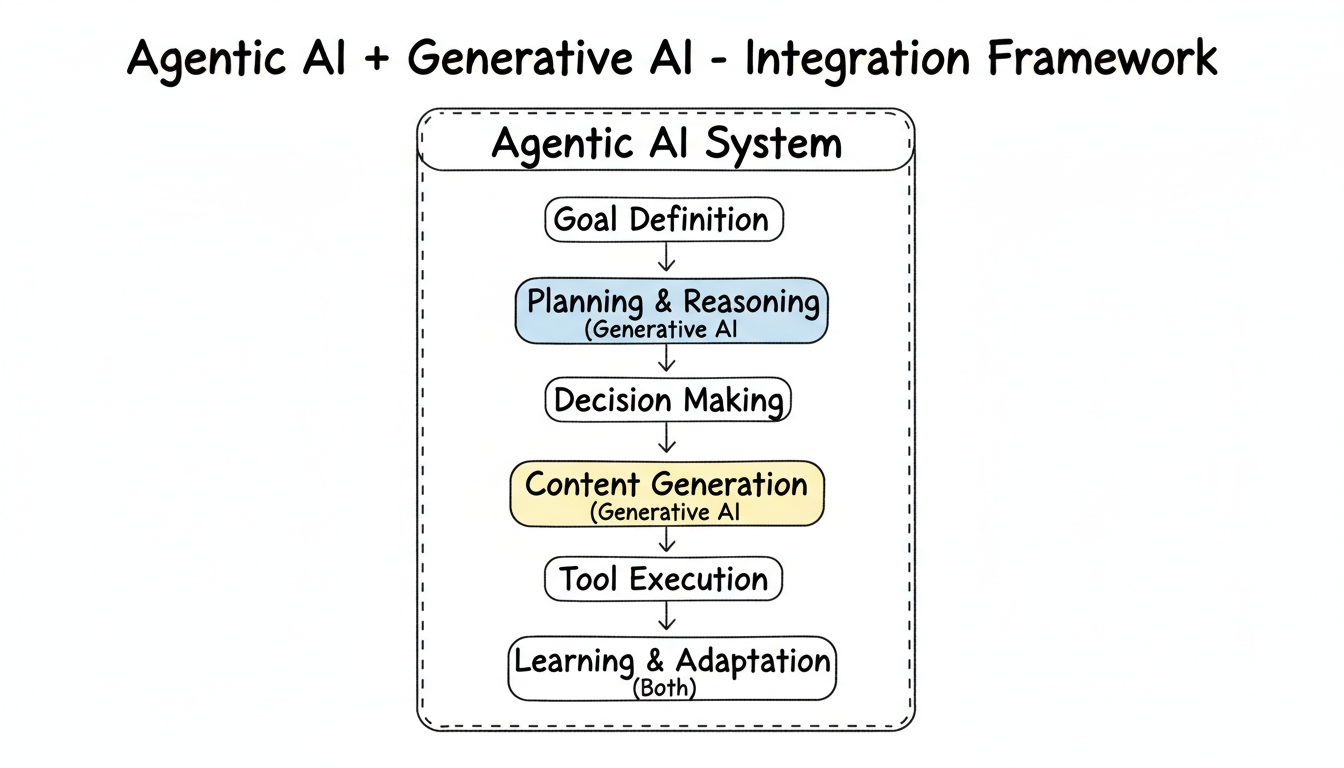
According to IGM Guru, in most modern systems, agentic AI relies on generative AI models for reasoning and planning, but the agentic layer adds decision-making, memory, and tool execution. The technologies are complementary rather than competitive.
Integration model:
Agentic AI System
├── Goal Definition (Agentic layer)
├── Planning & Reasoning (Generative AI)
├── Decision Making (Agentic layer)
├── Content Generation (Generative AI)
├── Tool Execution (Agentic layer)
└── Learning & Adaptation (Both)
According to Exabeam, generative AI is the foundation for agentic AI. The key difference lies in execution: generative AI helps humans understand and communicate, while agentic AI can directly manage operations with minimal intervention.
According to DevCom, use generative AI when your focus is content creation and enhancing creativity or productivity, but choose agentic AI when you need goal-driven automation that can make decisions and complete workflows. These considerations align with broader AEO future trends shaping how businesses optimize for AI-powered search.
Use generative AI for:
Use agentic AI for:
According to Triple Whale's ecommerce analysis, while generative AI focuses on content creation, agentic AI is transforming operations through the implementation of autonomous decision-making. Generative AI excels at creating content based on patterns in training data, while agentic AI takes automation to the next level.
According to DevCom, for many businesses, the most powerful approach is to combine both: use generative AI for content and communication, and agentic AI to handle processes and decisions.
Combined strategy framework:
Business Function | Generative AI Role | Agentic AI Role |
Customer service | Draft responses | Resolve issues autonomously |
Marketing | Create content | Optimize campaigns |
Operations | Generate reports | Execute processes |
Sales | Personalize outreach | Manage pipeline |
Finance | Summarize data | Make investment decisions |
According to Synoptek's analysis, while generative AI is about what to create, agentic AI is about what to do. Generative AI may be one of the tools used within an agentic AI system, with each serving its specialized purpose.
Understanding the difference matters for visibility in AI-powered search. Generative AI powers the search interfaces users interact with, while agentic AI enables autonomous research and recommendation systems. These insights are essential for developing comprehensive AI search citations strategies.
Optimization considerations:
Understanding agentic AI vs generative AI is essential for 2026 business strategy:
According to Thomson Reuters, purpose-built agentic systems don't merely respond to prompts but operate within established professional workflows, while ensuring human expertise remains firmly in the loop. Both technologies reshape how businesses operate—choosing the right one depends on your specific needs.
By submitting this form, you agree to our Privacy Policy and Terms & Conditions.