February 19, 2026


The AI search landscape has transformed dramatically. What began as experimental chatbots has evolved into a fragmented ecosystem where users search across ChatGPT, Perplexity, Google AI Overviews, Gemini, and specialized tools depending on their needs. Understanding where this market is heading—and how fast—shapes strategy for businesses competing for visibility.
This analysis breaks down the current growth trajectories, market share shifts, and predictions defining AI search in 2026 and beyond.
The AI chatbot and search market has consolidated around a few major players, with distinct positioning emerging for each.
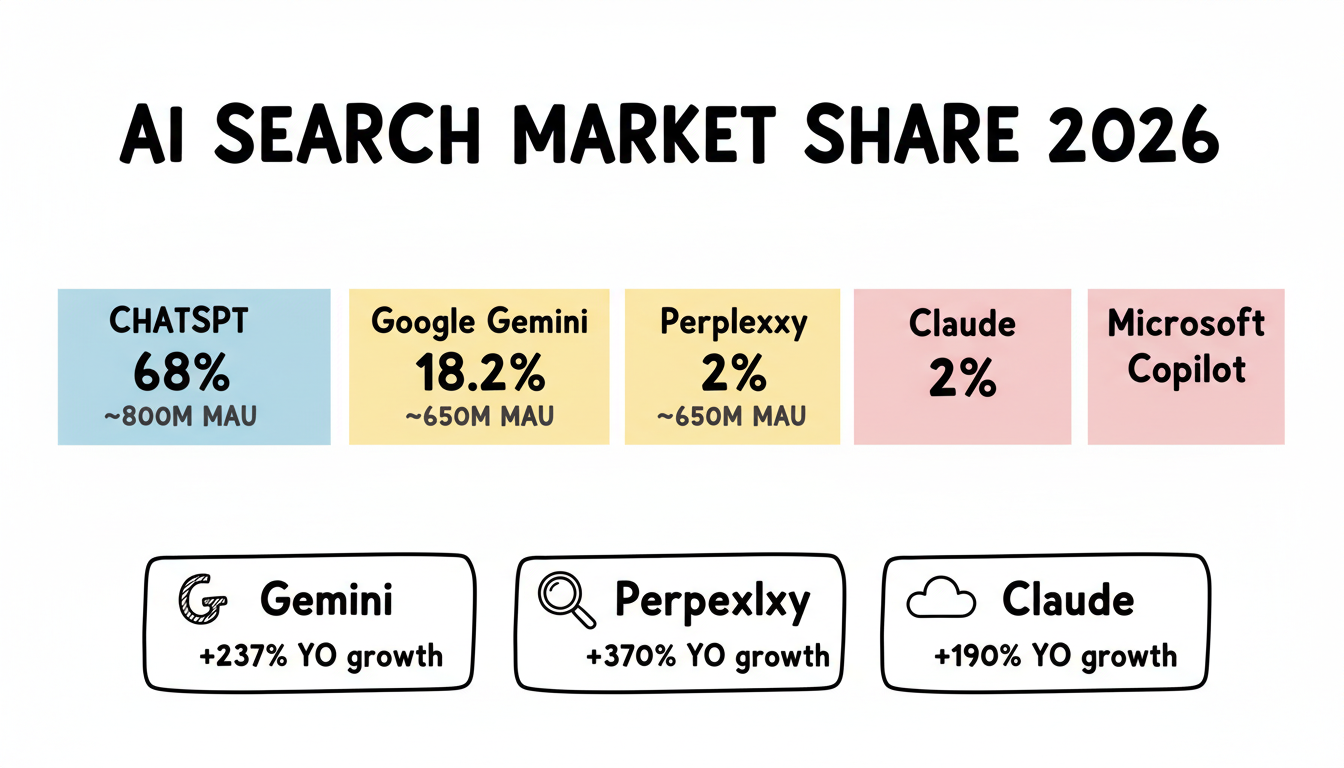
ChatGPT maintains market leadership at approximately 68% market share, with around 800 million monthly active users. While still dominant, this represents a decline from higher market concentration in 2024 as competitors gained ground.
Google Gemini has emerged as the fastest-growing major platform, reaching 18.2% market share with 650 million monthly active users—up from 450 million in mid-2025. Year-over-year growth exceeds 237%, driven by integration across Search, Android, Chrome, and Workspace products.
Perplexity holds approximately 2% market share but experienced 370% year-over-year growth by positioning as a citation-first research tool rather than a general chatbot. The "AI-first search engine" differentiation resonates with users prioritizing verifiable information.
Claude (Anthropic) maintains 2% market share with 190% year-over-year growth, focusing on enterprise adoption and responsible AI positioning. Despite smaller market share, Claude generates substantial revenue—projected at $2.2 billion for 2025.
Microsoft Copilot holds 1.2% market share, leveraging deep integration with Windows and Office productivity tools.
The pattern is clear: ChatGPT and Gemini control 86% of the market, while specialized players grow rapidly by serving distinct use cases.
Despite adoption continuing to rise, growth rates are slowing from the explosive early trajectory.
Analysis of usage data suggests AI tool adoption is plateauing at rates lower than social media, traditional search, or e-commerce achieved. The initial surge of curiosity-driven adoption has normalized into habitual use among a committed segment rather than universal adoption.
However, enterprise adoption tells a different story. McKinsey reports 72% of organizations now use generative AI in one or more business functions, compared to 56% in 2021. Business adoption continues accelerating even as consumer growth moderates.
Gartner projects global AI spending will exceed $2 trillion in 2026, growing 36.8% from $1.48 trillion in 2025. This investment drives capability improvements that expand use cases and draw more users into AI search tools.
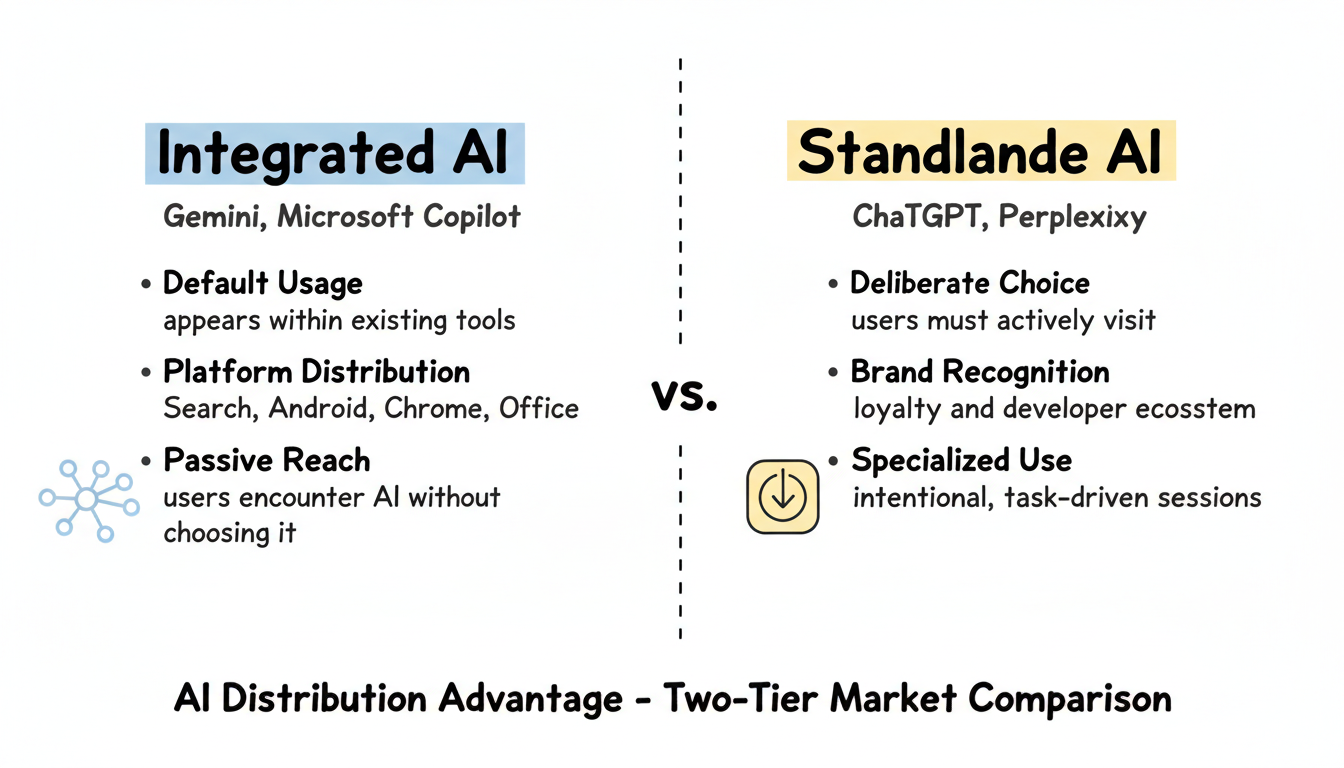
Technical quality alone doesn't determine winners in AI search. Distribution shapes behavior at scale.
Google's Gemini growth illustrates this principle. Integration into Search, Android, Chrome, and Workspace creates default usage that pure-play AI tools can't match. Users encounter Gemini without deliberately choosing it—the AI appears within tools they already use.
Microsoft follows the same strategy with Copilot embedded throughout Windows and Office. As Deloitte projects, accessing generative AI within search engines will become 300% more common than using standalone AI tools by end of 2026.
This creates a two-tier market:
OpenAI retains influence through brand recognition and developer adoption, but Google and Microsoft leverage ubiquitous platform integration that compounds over time.
The fundamental shift from traditional SEO vs AI search optimization accelerates through 2026.
Traditional search optimization focused on ranking in results lists. AI search optimization focuses on being selected as a source within AI-generated answers. The distinction matters:
As one analyst summarizes: "AI does not replace search. It absorbs it." Search fades into background infrastructure while still directing decisions—just through AI intermediaries rather than direct user queries.
Brands relying on single-channel search visibility risk falling behind as the ecosystem fragments. Success increasingly requires optimization across multiple AI platforms simultaneously.
Two trends beyond traditional text search gain momentum in 2026.
Voice AI reaches mainstream scale. Projections indicate 8 billion AI-powered voice assistants will exist by 2026, with 157 million users actively using voice search. The interface shift from typing to speaking changes query patterns and optimization requirements.
Agentic AI represents the next evolution beyond search. AI tools transition from answering questions to taking actions—booking flights, summarizing emails, completing tasks. Gartner projects 40% of enterprise applications will include task-specific AI agents by end of 2026.
This evolution transforms SEO from visibility optimization to workflow integration. Brands must consider not just whether AI mentions them, but whether AI agents can complete actions on their behalf.
The era of one-tool-fits-all is ending. Users increasingly match tools to tasks:
This specialization creates optimization complexity. A single content strategy optimized for ChatGPT may underperform on Perplexity. Different platforms evaluate authority, freshness, and citation-worthiness through different criteria.
Businesses must understand which platforms their audiences use and optimize accordingly—or accept variable visibility across the fragmented landscape. Organizations implementing comprehensive AI search optimization strategies typically see better citation rates across multiple platforms.
How users consume content is changing as dramatically as how they find it.
One projection suggests users will consume 10 times as much content via AI summaries as through direct engagement with longer-form content in 2026. Blog posts, articles, and detailed product pages get summarized and synthesized rather than read in full.
This shifts content strategy. Writing for AI extraction becomes as important as writing for human readers. Content must be structured for snippet extraction while still providing value to users who click through.
The implication: even excellent content may generate less direct traffic as AI intermediaries synthesize it into answers. Brand visibility and citation frequency become primary metrics alongside traditional traffic. Understanding how answer engines work helps businesses adapt their content strategies for this new consumption model.
Several trends will likely define the next phase of AI search evolution:
AI visibility tracking becomes a major market. Prediction: tracking AI mentions and citations will become a $200+ million market segment, though ROI measurement remains challenging given the statistical nature of AI responses.
Corroboration drives citation confidence. AI systems increasingly assign confidence based on how consistently they find information across sources. Brands that maintain consistent, accurate information across all digital touchpoints earn more AI visibility.
Memory changes personalization. AI systems with persistent memory will tailor responses based on user history, creating personalized search experiences that vary by individual rather than returning consistent results.
Regulatory pressure increases. Scrutiny on data use for AI training and market concentration among integrated giants (Google, Microsoft) will shape competitive dynamics.
For businesses navigating AI search evolution:
Diversify platform strategy. Single-platform optimization creates risk as the landscape fragments. Build visibility across Google AI, ChatGPT, Perplexity, and emerging platforms.
Optimize for extraction. Structure content for AI citation—clear answers, authoritative sourcing, consistent entity information across properties. AI search content structure plays a crucial role in determining which sources AI systems select.
Monitor share of voice. Track competitive visibility across AI platforms, not just traditional search rankings.
Prepare for agentic AI. Consider how AI agents might interact with your business—completing transactions, retrieving information, executing tasks.
The organizations adapting strategy to match AI search evolution position themselves for visibility in the emerging answer-first landscape. Those optimizing only for traditional search increasingly compete for a shrinking slice of user attention.
By submitting this form, you agree to our Privacy Policy and Terms & Conditions.