February 19, 2026


Understanding Facebook ad costs helps you set realistic budgets and benchmark your campaign performance. But "average" costs vary significantly based on your industry, objectives, and targeting.
This guide breaks down the latest 2026 Facebook advertising costs by metric type, industry, and recent trends to help you plan your ad spend effectively.
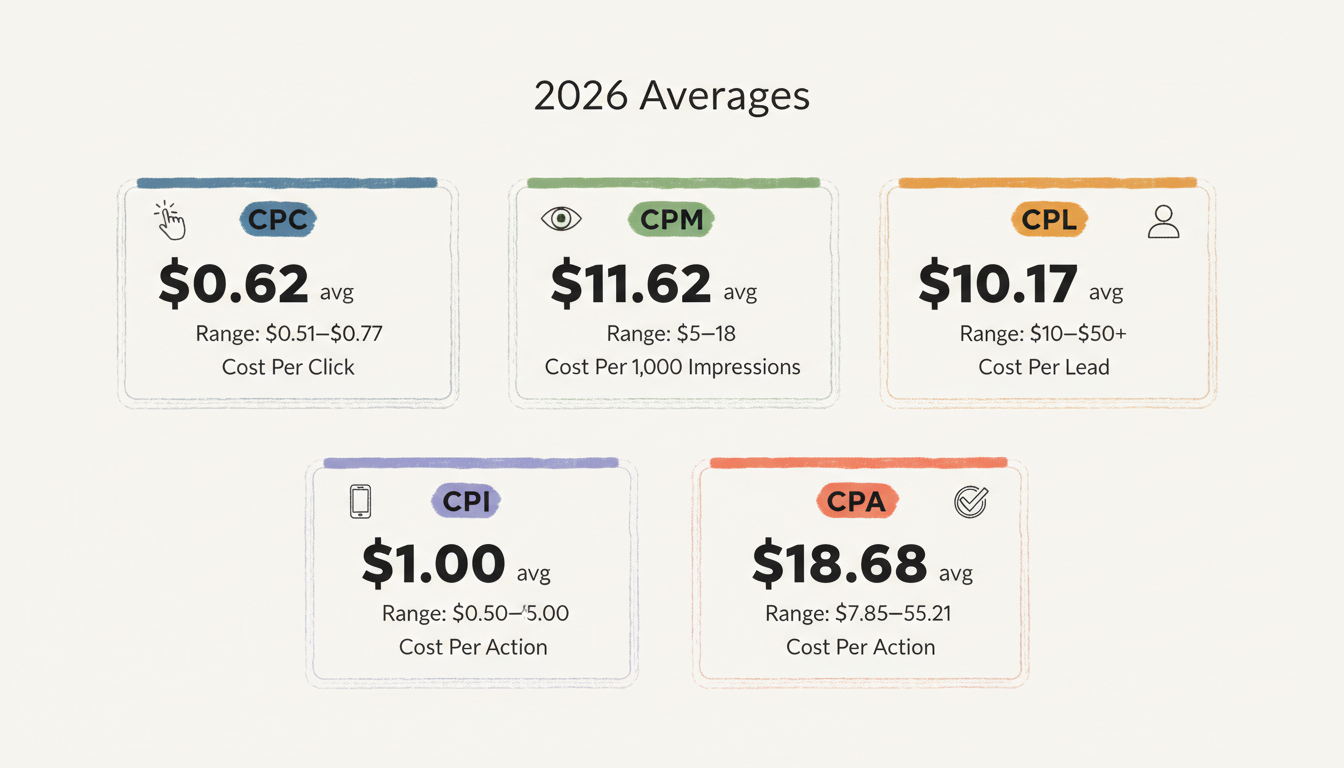
Facebook ads operate on an auction system where costs fluctuate based on competition, audience, and ad quality. Here are the current averages for 2026:
Metric | Average Cost | Typical Range |
Cost Per Click (CPC) | $0.62 | $0.51 – $0.77 |
Cost Per 1,000 Impressions (CPM) | $11.62 | $5 – $18 |
Cost Per Lead (CPL) | $10.17 | $10 – $50+ |
Cost Per Install (CPI) | $1.00 | $0.50 – $5.00 |
Cost Per Action (CPA) | $18.68 | $7.85 – $55.21 |
These averages are compiled from millions of ad impressions across industries. Your actual costs will depend on factors like audience targeting, industry competitiveness, and creative quality.
Several factors push costs above or below these averages:
Understanding each cost metric helps you choose the right one to optimize.
CPC measures what you pay when someone clicks your ad. According to December 2025 benchmarks, the median CPC across industries is $0.57.
When CPC matters:
CPC by vertical:
Understanding facebook ads cost per click patterns can help you identify optimization opportunities and benchmark your performance against industry standards.
CPM reflects the cost per 1,000 impressions. U.S. averages for 2025 show:
The U.S. commands approximately 12% higher CPMs than global averages, reflecting the premium nature of American audiences.
When CPM matters:
CPL measures lead acquisition cost. The average CPL is $27.66 for lead-focused campaigns, but this varies dramatically by industry:
CPA tracks the cost of completed conversions. Purchase-driven campaigns average between $35-$55 depending on product value.
CPA benchmarks:
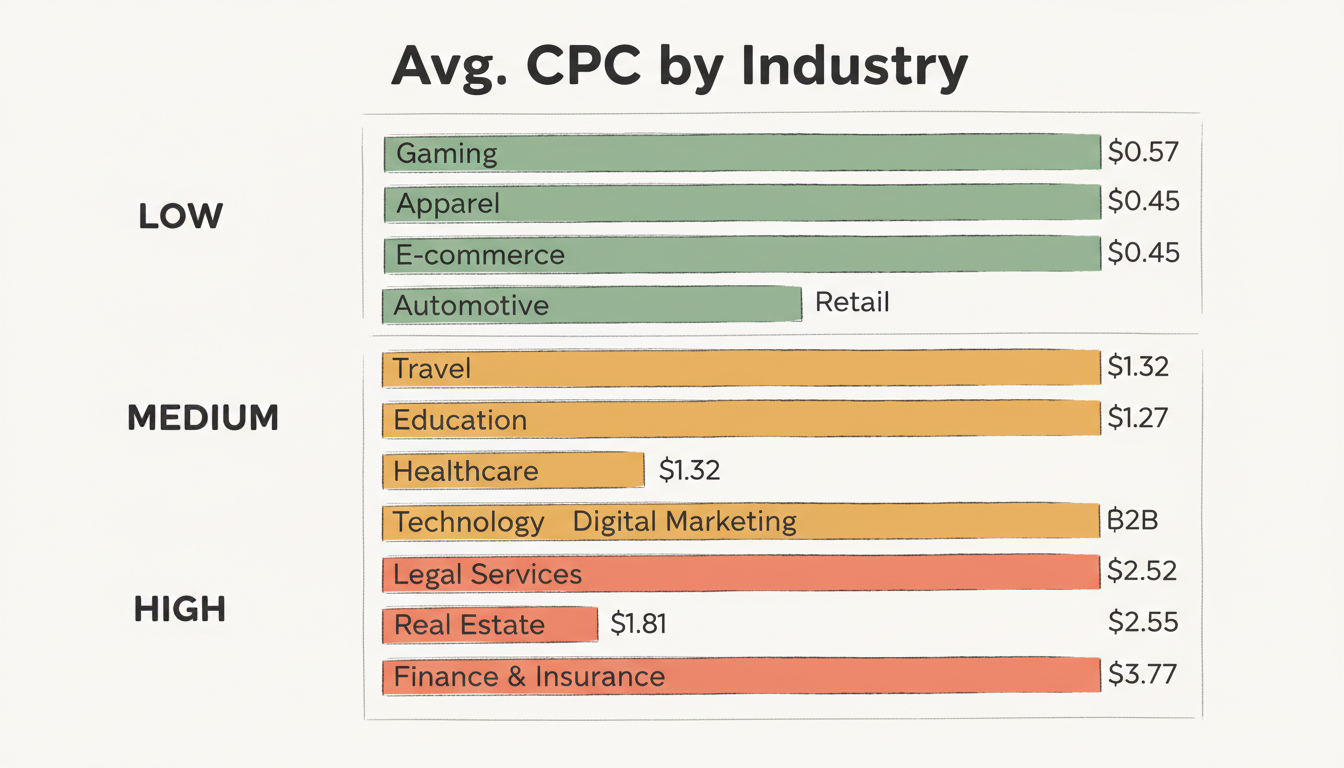
Your industry heavily influences Facebook ad costs. Here are 2026 industry benchmarks:
Industry | Avg. CPC | Avg. CPM | Avg. CPA |
Retail | $0.70 | $1.38 | $21.47 |
E-commerce | $0.45 | $5.33 | $45.00 |
Apparel | $0.45 | $5.99 | $10.98 |
Automotive | $0.45 | $6.81 | $43.84 |
Gaming | $0.57 | $8.90 | $29.00 |
Industry | Avg. CPC | Avg. CPM | Avg. CPA |
Education | $1.06 | $5.31 | $7.85 |
Healthcare | $1.32 | $5.78 | $12.31 |
Digital Marketing | $1.38 | $7.19 | $23.10 |
Technology | $1.27 | $9.98 | $55.21 |
Travel & Tourism | $0.63 | $9.89 | $22.50 |
Industry | Avg. CPC | Avg. CPM | Avg. CPA |
Legal Services | $1.81 | $11.31 | $28.70 |
Real Estate | $1.81 | $10.97 | $16.92 |
B2B | $2.52 | $22.50 | $23.77 |
Fintech | $2.55 | $19.35 | $40.00 |
Finance & Insurance | $3.77 | $11.37 | $41.43 |
Recent data from Emplifi shows diverging trends:
The difference? E-commerce campaigns have clearer online conversion signals, allowing Meta's AI to optimize more efficiently. Retail advertisers with mixed online/offline goals see less optimization benefit. For e-commerce advertisers looking to maximize efficiency, implementing an ecommerce meta ads strategy tailored to your conversion signals is essential.
Understanding historical patterns helps you plan budgets and anticipate fluctuations.
Facebook ad costs follow predictable seasonal cycles. According to benchmark data:
The Q4 2025 average CPM was $25.49—about 22% higher than Q1's $20.96.
Month | U.S. CPM | Change from Start |
January 2025 | $20.41 | Baseline |
March 2025 | $21.95 | +7.5% |
June 2025 | $22.10 | +8.3% |
September 2025 | $22.10 | +8.3% |
November 2025 | $28.09 | +38% (Peak) |
January 2026 | $17.12 | -16% |
Facebook ad costs have generally increased over time, though AI-driven optimization is creating efficiency gains for some advertisers.
Key trends:
For context on what businesses actually spend, agency reporting shows:
Business Type | Typical Monthly Spend |
Small business average | $2,000 - $5,000 |
Competitive markets | $3,000+ |
Testing/learning phase | $1,000 minimum |
Median across industries | $1,051.86 |
Campaigns under $1,000/month often struggle to generate meaningful data for optimization. When planning your budget, factor in enough spend to reach statistical significance for your conversion goals. Understanding whether do facebook ads cost money fits your business model is an important first step in budget planning.
Monthly spend varies significantly by sector:
This reflects both market competitiveness and customer acquisition costs in each industry. Working with a specialized facebook ads management agency can help optimize spending patterns within your industry's typical range.
Don't compare your B2B software campaign to e-commerce benchmarks. Instead:
Understanding these benchmarks allows you to set realistic expectations and make informed decisions about your advertising investment across Meta's platforms.
By submitting this form, you agree to our Privacy Policy and Terms & Conditions.