
February 19, 2026


B2B PPC is a different animal from consumer advertising. You're not selling impulse purchases to individuals—you're targeting buying committees that average eleven decision-makers, navigating sales cycles that stretch 30 to 90+ days, and competing for attention from prospects who complete 70% of their research before ever talking to sales.
These complexities are exactly why B2B companies increasingly turn to specialized PPC agencies. Generic paid search advertising approaches don't account for the nuances of enterprise buying behavior, multi-touch attribution across long conversion paths, or the unique targeting capabilities that B2B advertisers need.
This guide covers what B2B PPC agencies do, why Microsoft Ads' LinkedIn integration matters, and how to choose the right partner for your business.
The differences between B2B and B2C PPC run deep. What works for e-commerce or consumer services often fails completely in enterprise contexts.
The average B2B buying cycle lasts 11.3 months. During that time, prospects interact with your brand across multiple touchpoints—search ads, LinkedIn, content downloads, webinars, and direct sales conversations.
Standard PPC campaign management approaches optimize for immediate conversions. B2B PPC requires full-funnel strategies that nurture prospects across extended decision timelines.
B2B purchasing decisions involve committees, not individuals. A SaaS purchase might require buy-in from the end user, their manager, IT security, procurement, and finance.
Each stakeholder has different concerns and search behaviors. A specialized B2B agency creates messaging and targeting strategies for each persona, not a one-size-fits-all approach.
In B2C, more leads generally means more sales. In B2B, a thousand junk leads cost more to process than they're worth.
B2B PPC success hinges on precision targeting and lead qualification—reaching the right companies and the right people within those companies. Volume without quality destroys ROI.
A B2B buyer might see your LinkedIn ad, visit your website multiple times, download content, attend a webinar, and finally request a demo weeks later. If your agency can't track and attribute across these touchpoints, you're flying blind.
B2B agencies specialize in multi-touch attribution models that reveal which campaigns actually drive pipeline and revenue, not just clicks and form fills.
Microsoft Advertising offers a capability no other platform can match: native LinkedIn targeting that combines professional attributes with search intent.
LinkedIn profile targeting is available across Search and Performance Max campaigns on Microsoft's network. You can target by:
These professional attributes function as targeting layers in search campaigns and as optimization signals in Performance Max.
Observation mode first. Start by adding LinkedIn audiences in observation mode to understand how different professional segments perform without restricting reach. This builds data before commitment.
Layered targeting. Combine LinkedIn attributes with keyword targeting for precision. Someone searching "enterprise project management software" who is a Director at a company with 500+ employees represents a very different opportunity than the same search from a freelancer.
Bid adjustments. Once you have performance data, increase bids for high-value professional segments. A VP of IT clicking on your cybersecurity software ad is worth more than an analyst.
LinkedIn drives higher MQL-to-SQL conversion rates (20-30%) compared to 8-15% for Meta and other platforms. When combined with the intent signal of search, Microsoft advertising strategies create uniquely qualified B2B traffic.
For industries where Google Ads CPCs are prohibitive, Microsoft Ads offers competitive advantages that stretch B2B budgets further while maintaining targeting precision.
Understanding the strategic differences ensures your agency takes the right approach.
Factor | B2C PPC | B2B PPC |
Sales cycle | Days to weeks | Months to years |
Decision maker | Individual | Committee (avg. 11 people) |
Ad messaging | Discounts, urgency, emotion | Value, credibility, proof |
Targeting | Demographics, interests | Job title, company, industry |
Primary KPI | ROAS, cost per sale | Cost per qualified lead, pipeline |
Budget priority | Volume and scale | Precision and quality |
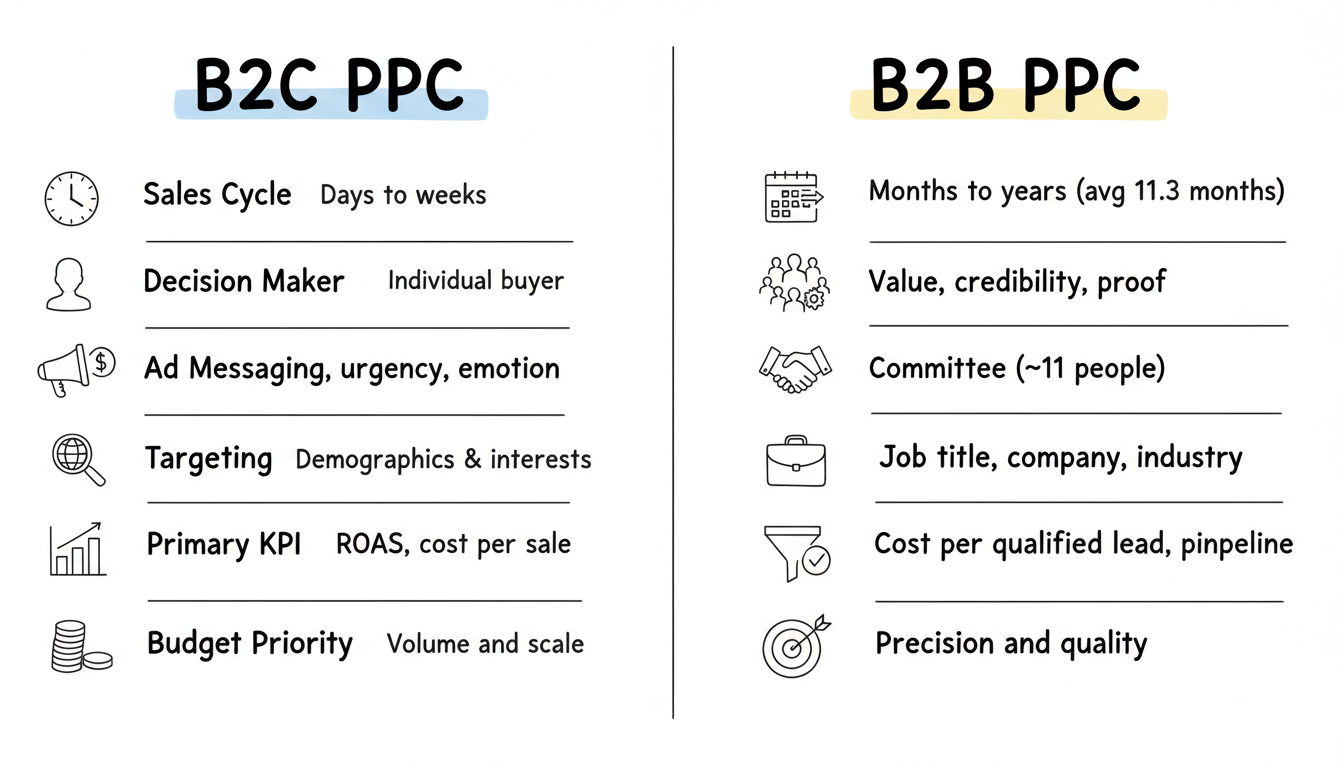
B2C PPC can lead with flash discounts and "buy now" urgency. B2B requires different approaches:
B2C often treats PPC as a direct response channel. B2B requires campaigns mapped to the entire buyer journey:
Top of funnel: Awareness campaigns targeting broad job functions with educational content offers.
Middle of funnel: Retargeting campaigns to website visitors with case studies and comparison content.
Bottom of funnel: Demo and trial campaigns targeting high-intent searches from qualified prospects.
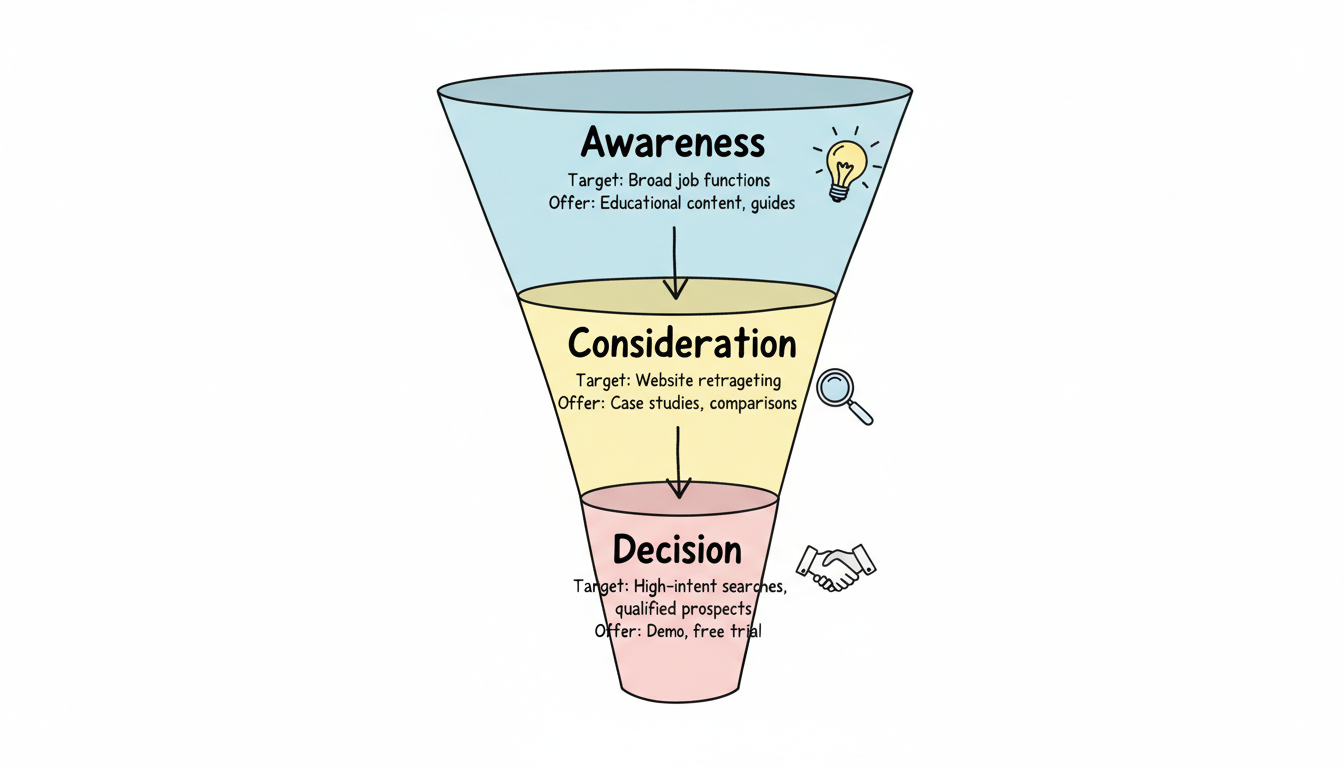
Each stage requires different messaging, landing pages, and success metrics that professional PPC management services should optimize continuously.
Managing PPC campaigns across extended B2B sales cycles requires specific strategies.
A prospect who downloads your whitepaper today might not be ready to buy for six months. Sophisticated retargeting keeps your brand visible throughout:
Don't expect PPC to drive immediate closed-won deals. Track leading indicators:
LinkedIn Ads can reduce B2B sales cycle length by 15-25% when used for demos and ABM—that's meaningful acceleration even if attribution looks indirect.
B2B PPC budgets should account for learning periods. Understanding Microsoft advertising costs helps set realistic expectations:
Agencies that promise immediate B2B results don't understand the space.
The defining characteristic of successful B2B PPC is ruthless focus on lead quality.
Quality begins with targeting precision:
Your ads should pre-qualify prospects before they click:
Higher-quality ads may generate fewer leads but dramatically better conversion to opportunity.
Landing pages should continue qualification:
Work with agencies that integrate PPC data into your lead scoring systems. A lead from a high-value keyword, high-seniority LinkedIn segment, and enterprise company size should score differently than a generic form fill.
Standard PPC metrics (CTR, CPC, conversion rate) tell only part of the B2B story. Focus on these:
Cost Per Marketing Qualified Lead (CPL): What you pay for leads that meet basic qualification criteria.
Cost Per Sales Qualified Lead: The cost of leads that sales accepts for follow-up.
Pipeline Influenced: Total potential deal value from prospects who interacted with PPC.
Cost Per Opportunity: The true cost of generating sales pipeline.
MQL-to-SQL Rate: What percentage of marketing leads convert to sales-accepted opportunities?
SQL-to-Opportunity Rate: How often do sales conversations become real deals?
Lead-to-Customer Rate: Ultimate conversion across the entire funnel.
Customer Acquisition Cost (CAC): Full cost of acquiring a customer, including PPC.
CAC Payback Period: How long until PPC investment pays off.
Lifetime Value / CAC Ratio: Long-term ROI of PPC-acquired customers.
Track these metrics at the campaign and channel level to understand what's actually working. Understanding Microsoft Ads ROI benchmarks helps set realistic performance expectations.
Account-Based Marketing (ABM) and PPC complement each other powerfully when integrated correctly.
For B2B companies with defined target account lists, account-based PPC takes precision to the next level:
ABM-integrated PPC aligns with sales outreach:
This coordination drives significantly higher conversion rates than uncoordinated approaches.
Standard PPC reporting shows individual leads. ABM-integrated reporting shows:
Not all PPC agencies understand B2B. Here's what to evaluate.
B2B-specific experience. Ask for case studies from companies with similar sales cycles and deal sizes. Consumer experience doesn't transfer.
Multi-platform expertise. Search engine advertising platforms including Google Ads, Microsoft Advertising, and LinkedIn all play roles in B2B. Agencies should demonstrate proficiency across platforms.
Full-funnel approach. Agencies focused only on lead generation miss the broader B2B picture. Look for partners who understand the entire buyer journey.
Attribution sophistication. Simple last-click attribution doesn't work for B2B. Agencies should understand multi-touch models and integration with CRM/marketing automation.
A comprehensive B2B PPC agency should offer:
B2B PPC agency pricing typically ranges from $3,000-$15,000+ monthly depending on scope and ad spend. Models include:
Higher-end agencies often deliver better ROI despite higher fees through superior targeting and optimization. When evaluating options, finding the best PPC agency requires looking beyond price to focus on specialized B2B experience.
B2B PPC targets business buyers with longer sales cycles, multiple decision-makers, and higher deal values. Strategies must account for extended conversion timelines, lead quality over volume, and attribution across many touchpoints.
Yes. Microsoft's exclusive LinkedIn targeting lets you layer professional attributes (job title, company size, industry) onto search campaigns. This precision targeting is invaluable for B2B, often at lower CPCs than Google. Microsoft advertising partnerships can provide additional support and resources.
Expect 60-90 days for meaningful data collection and optimization. Full-funnel impact on pipeline and revenue may take 6+ months given typical B2B sales cycles. Agencies promising faster results don't understand the space.
It depends entirely on deal value and close rates. A $500 lead is expensive for a $2,000 product but cheap for a $100,000 enterprise contract. Focus on cost per qualified opportunity and customer acquisition cost rather than raw CPL.
By submitting this form, you agree to our Privacy Policy and Terms & Conditions.



