February 19, 2026


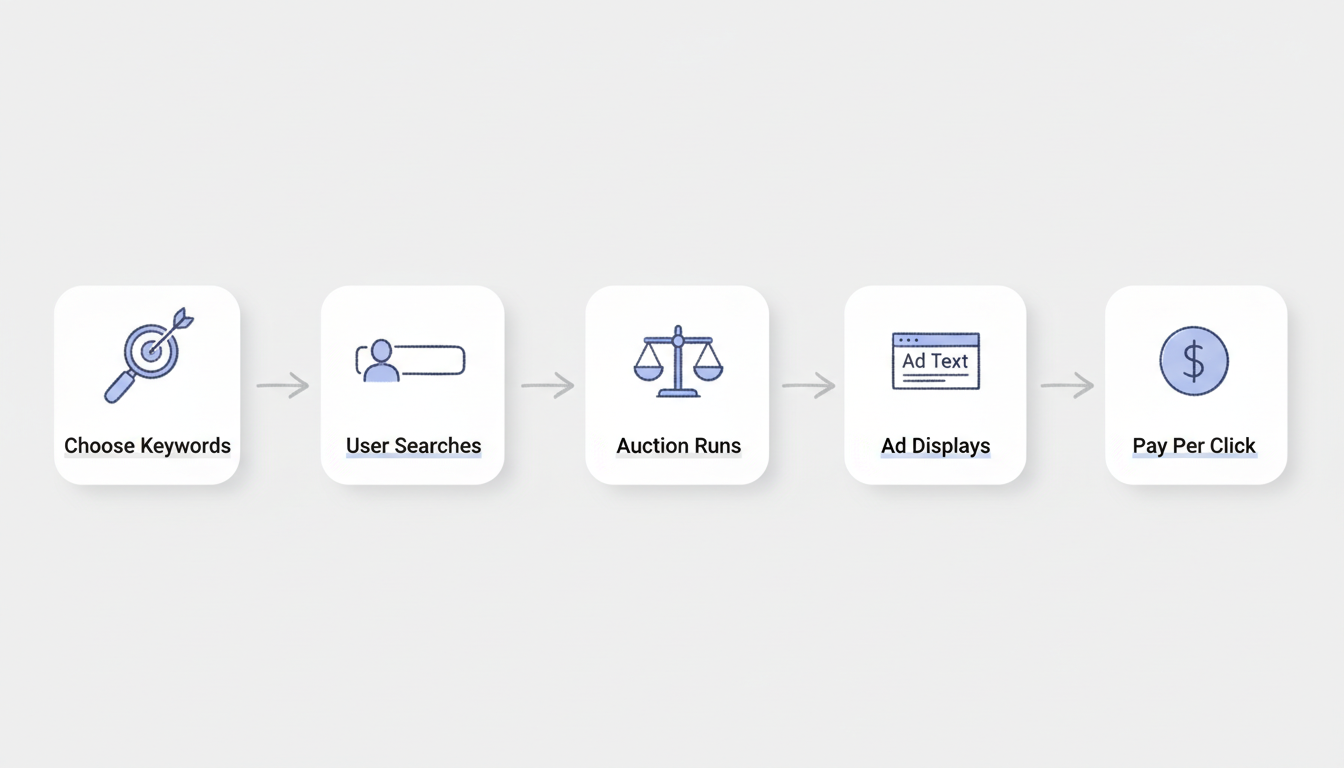
Search engine advertising puts your business at the top of search results when potential customers look for what you offer. Unlike organic results that take months to achieve, paid search ads can appear immediately after launch.
But how does the system actually work? This guide explains the mechanics behind search advertising, from the auction process to the factors that determine success.
Search engine advertising is a form of digital marketing where advertisers pay to display ads on search engine results pages (SERPs). When someone searches for a relevant term, your ad can appear above or alongside the organic results.
The model is called pay-per-click (PPC) because you only pay when someone actually clicks your ad. If your ad appears but nobody clicks, you pay nothing for that impression.
This system ensures you're paying for engaged interest, not just visibility. Every click represents someone who found your ad relevant enough to learn more.
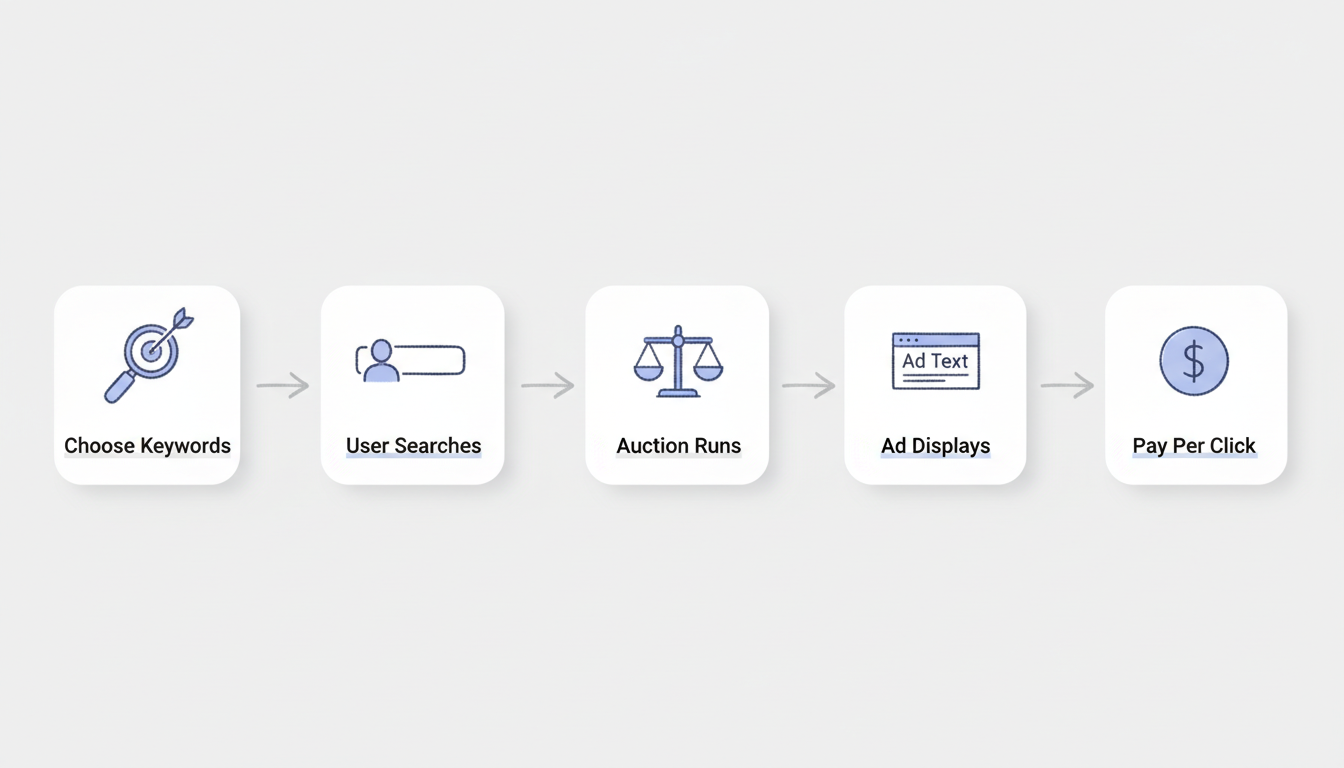
Every time someone searches, ad platforms run instantaneous auctions to determine which ads appear and in what position. This happens in milliseconds—completely invisible to the searcher.
Contrary to common belief, the highest bidder doesn't automatically win. Search advertising uses a sophisticated approach where Ad Rank decides which ads appear and where.
Ad Rank = Bid Amount × Quality Score × Expected Impact of Extensions
This formula means advertisers with better relevance can beat competitors who bid higher. A $5 bid with excellent Quality Score often outperforms a $10 bid with poor relevance.
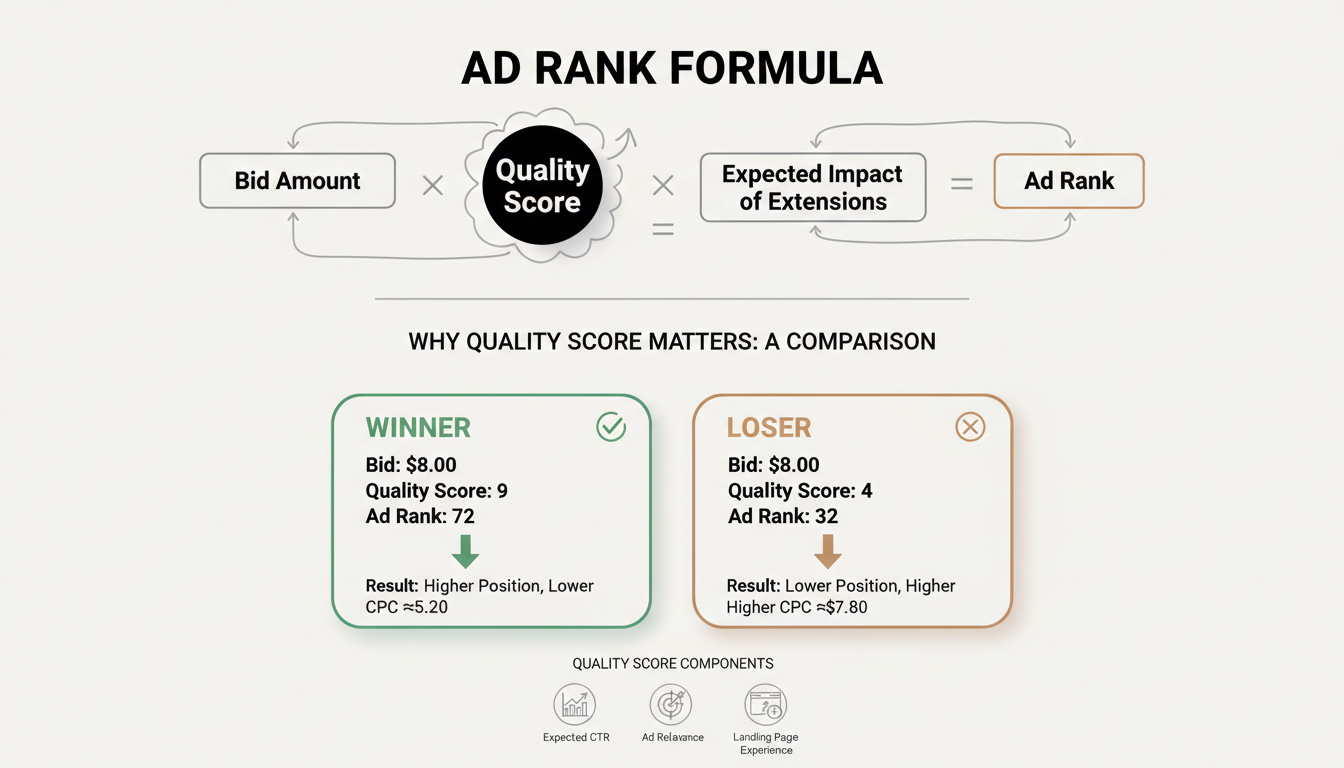
Quality Score measures how relevant and useful your ad is to searchers. It typically considers:
Expected Click-Through Rate (CTR): Based on past performance, how likely is someone to click your ad? Historical data trains the system to predict performance.
Ad Relevance: Does your ad copy match the search query's intent? An ad about "running shoes" should appear for running shoe searches, not general footwear queries.
Landing Page Experience: Is your landing page fast, relevant, and easy to use? Pages that load slowly, don't match the ad message, or provide poor user experience hurt Quality Score.
The impact of Quality Score on your costs is significant. Consider this example from Google PPC advertising optimization research:
Scenario | Bid | Quality Score | Ad Rank | Result |
Your ad | $8.00 | 4 | 32 | Lower position, ~$7.80 CPC |
Competitor | $8.00 | 9 | 72 | Higher position, ~$5.20 CPC |
With identical bids, the competitor appears above you and pays less per click. Improving your Quality Score from 4 to 8 while maintaining the same bid can reduce CPC by approximately 26%.
You don't necessarily pay your maximum bid. Search platforms use second-price auction mechanics—you pay just enough to beat the advertiser below you in Ad Rank, not your full bid amount.
If you bid $5 and the next competitor has an Ad Rank that requires $3.01 to beat, you pay $3.01—not $5.
Two platforms dominate search advertising in 2026.
Google Ads is the largest search advertising platform, reaching billions of daily searches across Google Search, Google Maps, YouTube, and partner sites.
Strengths:
Considerations:
Microsoft Advertising (formerly Bing Ads) reaches searches on Bing, Yahoo, AOL, and DuckDuckGo.
Strengths:
Considerations:
Most advertisers start with Google Ads for volume, then expand to Microsoft Advertising for efficiency and reach extension. For businesses targeting other professionals, exploring B2B PPC agency services can help optimize campaigns across both platforms.
Success in search advertising comes from applying proven principles consistently.
Not all keywords are equal. Focus on terms that indicate purchase or conversion intent:
High-intent keywords cost more but convert better. Low-intent keywords are cheaper but rarely lead to sales. Understanding the distinction between SEM vs SEO helps you allocate budget to the right channels based on intent.
Your ad copy should directly address the search query. If someone searches "emergency plumber San Diego," they should see an ad mentioning emergency services and San Diego—not a generic plumbing ad.
This relevance improves Quality Score, click-through rates, and conversions simultaneously.
Don't send ad traffic to your homepage. Create landing pages that:
Landing page experience directly affects Quality Score—the headline on your page should match your ad headline, and content should directly address the keyword intent.
Negative keywords prevent your ads from showing for irrelevant searches. If you sell premium products, add "free," "cheap," and "discount" as negatives to avoid bargain-hunters who won't convert.
Review search term reports weekly to identify new negatives.
Search advertising rewards experimentation:
Small improvements compound over time. A 10% improvement in CTR plus a 10% improvement in conversion rate equals 21% more conversions from the same spend. Learning from PPC advertising examples can inspire new testing approaches.
Ready to launch your first search advertising campaign? Follow these steps.
Before spending money, ensure you can measure results. Install tracking tags and define what counts as a conversion (purchase, form submission, phone call, etc.).
Use platform keyword tools to identify relevant terms with reasonable search volume and competition. Start with 10-20 highly relevant keywords rather than hundreds of marginal ones.
Write ads that speak directly to searcher intent. Include your keyword naturally, highlight unique benefits, and include a clear call to action.
Create dedicated pages for each ad group theme. Ensure message match, fast load times, and clear conversion paths.
Start with a daily budget that allows meaningful data collection—typically $20-50 minimum. Launch, monitor daily, and optimize based on performance data.
By submitting this form, you agree to our Privacy Policy and Terms & Conditions.