February 19, 2026


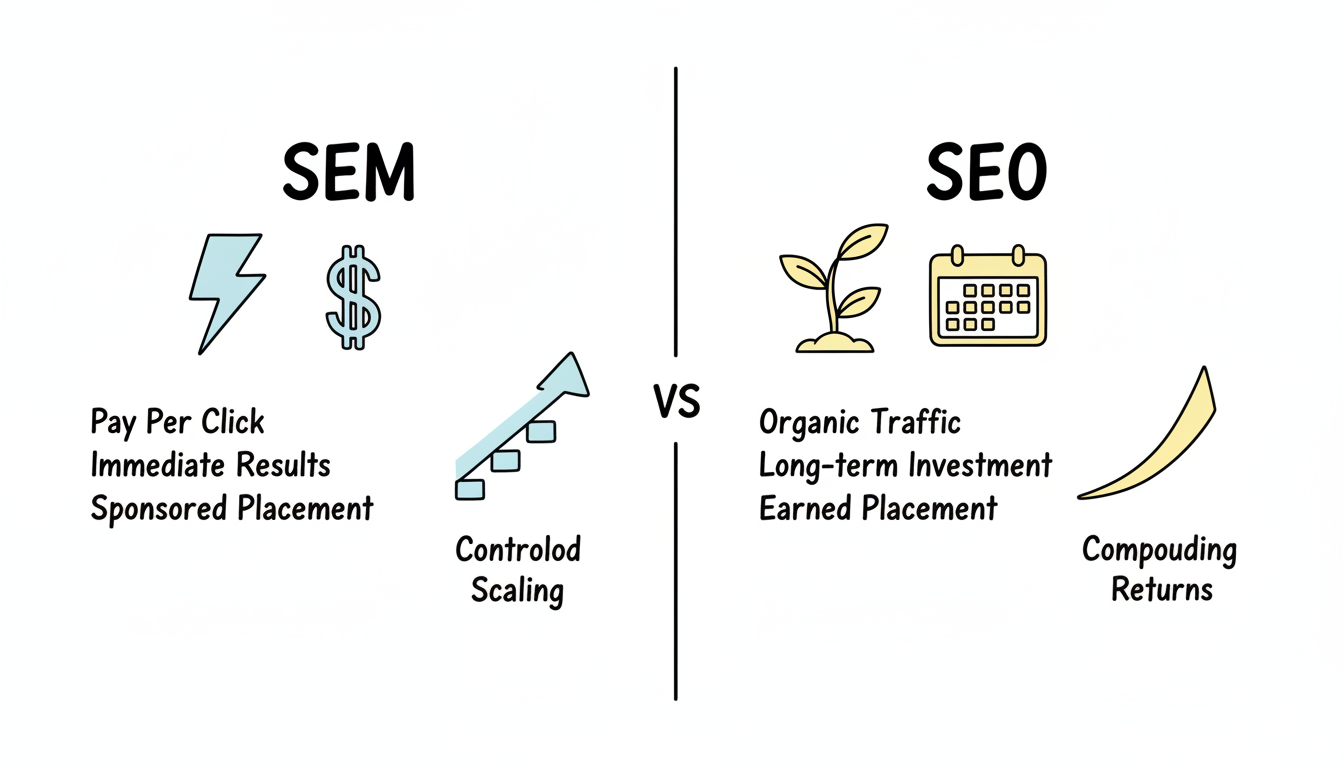
Search marketing offers two distinct paths to visibility: pay for placement immediately or earn it organically over time. Understanding the difference between SEM and SEO helps you allocate resources effectively and build a strategy that delivers both quick wins and sustainable growth.
This guide breaks down how SEM and SEO work, their key differences, and when to prioritize each approach.
Search Engine Marketing (SEM) is the umbrella term for all strategies that increase visibility on search platforms, including both paid advertising and organic optimization. However, in common usage, SEM typically refers specifically to paid search advertising.
SEM works through platforms like Google Ads and Microsoft Advertising. You bid on keywords, create search ads targeting those keywords, and compete with other advertisers for placement in sponsored positions.
When someone searches a term you're bidding on, your ad may appear at the top of search results—marked with a "Sponsored" label. You pay when someone clicks your ad (pay-per-click or PPC).
Your actual cost per click depends on several factors:
SEM provides precise control over targeting. You choose exactly which keywords trigger your ads, which geographic areas see them, and even which times of day they appear.
Search Engine Optimization (SEO) focuses on earning organic placement through technical optimization, keyword research, and authoritative content. You don't pay for clicks—you invest in making your site worthy of ranking.
SEO encompasses three main areas:
Technical SEO: Site speed, mobile optimization, crawlability, structured data, and architecture that helps search engines understand your content.
On-page SEO: Content optimization including keyword usage, title tags, meta descriptions, headers, and internal linking.
Off-page SEO: Authority building through backlinks from other reputable websites, brand mentions, and digital PR.
The goal is appearing in organic (non-paid) search results for queries relevant to your business. Higher rankings mean more visibility and traffic—without paying for each click.
While SEM and SEO both aim for search visibility, they differ fundamentally in how you achieve and pay for that visibility.
Factor | SEM (Paid Search) | SEO (Organic) |
Cost model | Pay per click | Investment in content/technical work |
Time to results | Immediate (same day) | Months (typically 6+) |
Placement | Sponsored ad positions | Organic search results |
Sustainability | Stops when budget stops | Builds lasting value |
Targeting | Keywords, location, device, schedule | Content relevance, authority |
Control | Precise bid and budget control | Less direct control over rankings |
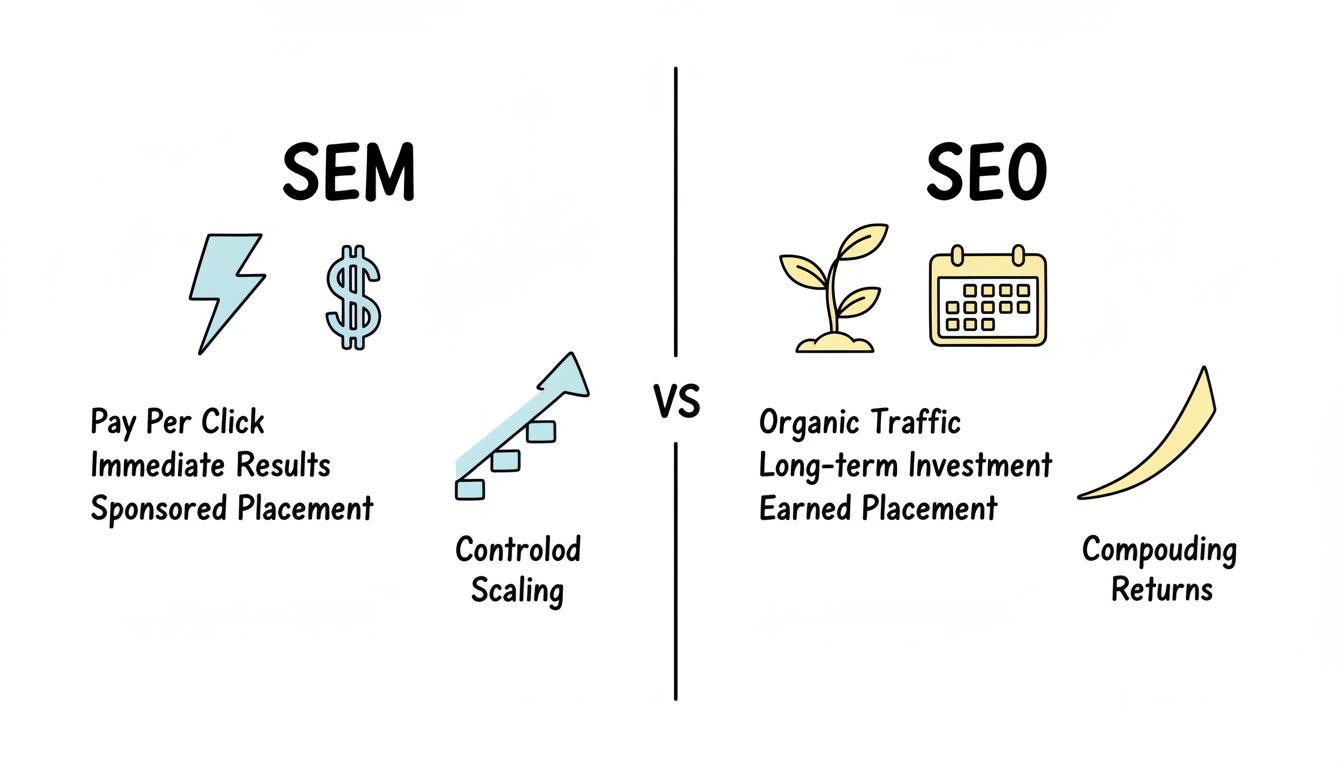
SEM delivers immediate placement as long as there's budget, while SEO requires patience but builds lasting authority. Organic results often receive more trust from searchers who recognize the difference between paid and earned placement.
Paid ads appear above organic results but carry the "Sponsored" label. Some users skip ads entirely and scroll to organic listings. Others click the first relevant result regardless of type.
The data varies by industry and intent. High-commercial intent searches (someone ready to buy) often perform well with ads. Informational searches may see higher organic click-through rates.
Both approaches require investment, but the cost structures differ fundamentally.
With SEM, you pay directly for visibility:
SEM costs are predictable and controllable. Set a daily budget, and platforms won't exceed it. But the moment you stop spending, visibility disappears. For detailed pricing information, see our guide on Microsoft advertising cost and pricing.
SEO doesn't charge per click, but it's not free:
SEO is a cumulative investment. Content you create continues driving traffic indefinitely, unlike ads that require ongoing spend. A blog post ranking well today may drive traffic for years.
SEM offers immediate, measurable returns but requires perpetual investment. SEO compounds over time—early investments build on themselves as content gains authority and attracts links.
Many businesses find SEO delivers better long-term ROI, while SEM provides essential short-term results and predictability. Understanding the benefits of paid search advertising helps contextualize when immediate results justify the ongoing investment.
One of the starkest differences between SEM and SEO is how quickly you see outcomes.
SEM delivers results immediately. Launch a campaign today and receive clicks within hours.
Even with active optimization, it's unlikely you'll see strong SEO results in under six months. Google needs time to discover, index, and trust your content.
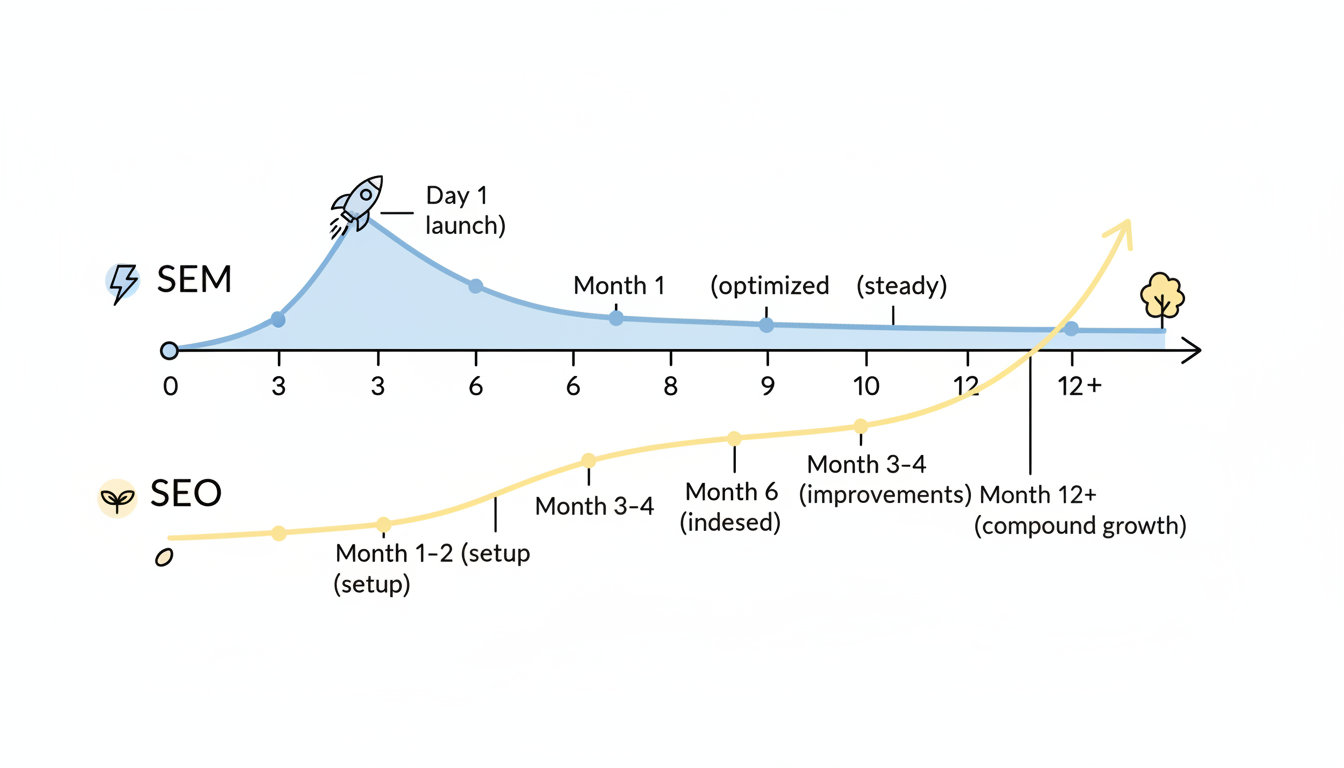
This timeline reality makes the SEM vs SEO decision partly about patience and planning horizon.
Different business situations call for different approaches.
You need results immediately. Product launch, time-sensitive promotion, or startup needing quick traction—SEM delivers visibility today.
You're in a highly competitive organic space. If established competitors dominate organic results, SEM provides an alternate path to visibility while building SEO. Consider working with a Microsoft advertising agency to maximize your paid search effectiveness.
You have proven conversion funnels. When you know your landing pages convert profitably, SEM lets you scale traffic predictably.
You're testing markets or messaging. SEM provides rapid feedback. Test keywords, audiences, and value propositions before committing SEO resources.
You're building for the long term. If you plan to be in business for years, SEO's compounding returns become increasingly valuable.
Your margins are tight. Industries with low customer lifetime value may struggle with paid acquisition costs. Organic traffic has no per-click cost.
You have content resources. If you can consistently produce quality content, SEO rewards that investment over time.
You want to build brand authority. Ranking organically for industry terms positions you as an authority in ways ads cannot.
The most effective search strategies combine both disciplines rather than treating them as rivals. For a comprehensive approach, explore our guide on SEO and SEM strategies for integrated marketing.
SEO builds long-term authority and captures users at every funnel stage. SEM delivers immediate visibility, captures high-intent searches, and provides predictable results. Together, they create comprehensive search presence.
Cover gaps during SEO build-up. Use SEM to capture traffic for keywords you're working to rank organically. As SEO rankings improve, you can reduce paid spend on those terms.
Test keywords before SEO investment. Run SEM campaigns to validate keyword demand and conversion rates before committing significant SEO resources.
Dominate high-value SERPs. Appearing in both paid and organic results for the same query increases total click share and brand authority. Review PPC advertising examples to see how top brands execute this strategy.
Use SEM data to inform SEO. Search query reports from SEM campaigns reveal exactly what terms drive conversions—valuable intelligence for content strategy.
Many businesses start with a 60/40 or 70/30 split favoring SEM, then gradually shift toward SEO as organic rankings develop:
Stage | SEM Budget | SEO Investment |
Launch (Month 1-6) | 70% | 30% |
Growth (Month 7-12) | 50% | 50% |
Mature (Year 2+) | 30% | 70% |
The specific ratio depends on your industry, competition, and growth timeline. Learn more about PPC campaign optimization to maximize your paid search investment during each stage.
There's no universal answer—the right choice depends on your specific situation.
For most businesses, the answer is "both"—in proportions that match your timeline, budget, and competitive landscape. To understand how different marketing channels work together, see our overview of types of digital marketing.
PPC (pay-per-click) is a subset of SEM. While SEM technically includes all search marketing (paid and organic), it commonly refers to paid search specifically. For a detailed explanation, see our article on PPC advertising meaning and definition.
Long-term, SEO typically delivers better cost per acquisition because organic traffic has no per-click cost. However, SEM provides faster results and predictable spend. The most cost-effective approach usually combines both.
Expect 6-12 months before seeing meaningful results from a new SEO effort. Highly competitive terms may take longer. SEO is a long-term investment, not a quick-win tactic.
Yes, but you'll pay for every visitor indefinitely. Many businesses run SEM-only strategies successfully, particularly those with high customer lifetime values that justify ongoing acquisition costs. However, adding SEO reduces long-term dependence on paid traffic.
By submitting this form, you agree to our Privacy Policy and Terms & Conditions.