February 19, 2026


Digital marketing in 2026 is no longer defined by individual channels working in isolation. It's defined by integrated systems, data-driven decisions, and coordinated campaigns across multiple touchpoints. With global digital advertising spend projected to exceed $740 billion, understanding each channel's role helps you allocate budget and effort where they'll drive the best results.
In this guide, you'll learn about the major types of digital marketing, how each channel works, and how to choose the right mix for your business goals.
Digital marketing encompasses all marketing efforts that use electronic devices or the internet to connect with potential customers. Unlike traditional marketing, digital channels offer precise targeting, real-time measurement, and the ability to adjust campaigns based on performance data.
The 2026 digital landscape has evolved significantly:
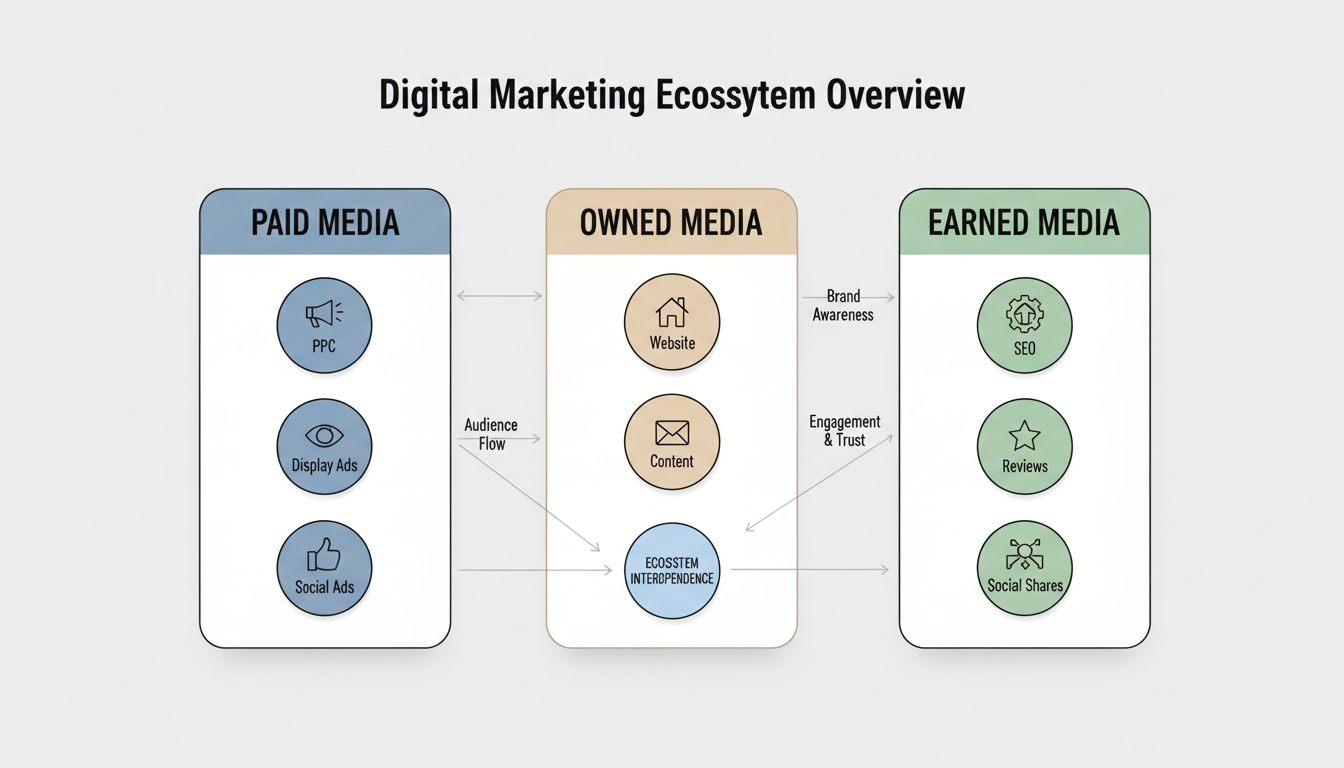
Digital marketing channels fall into several categories:
Category | Channels | Primary Goal |
Paid Media | PPC, Display, Social Ads | Immediate traffic & conversions |
Owned Media | Website, Email, Content | Building long-term assets |
Earned Media | SEO, Reviews, Social Shares | Organic visibility & trust |
Search engine marketing delivers ads to users actively searching for products or services like yours. This high-intent targeting makes SEM one of the most effective channels for driving immediate conversions.
When someone searches on Google or Microsoft Bing, advertisers bid to show ads for relevant keywords. You only pay when someone clicks your ad (pay-per-click), making it a performance-based channel. Understanding how pay-per-click works helps businesses maximize their advertising investments.
Google Ads: Dominates with approximately 85-90% of search ad spend. Offers search, display, video, and shopping formats. Learn more about Google PPC advertising strategies to optimize your campaigns.
Microsoft Advertising: Reaches 724 million monthly searchers across Bing, Yahoo, and partner networks. Offers exclusive LinkedIn profile targeting for B2B campaigns and typically delivers 30-40% lower CPCs than Google. Explore Microsoft Advertising for beginners to get started with this platform.
When evaluating different channels, a paid search advertising platforms comparison can help determine which platforms align best with your goals and budget.
SEM works best when:
Many businesses benefit from working with specialists who offer PPC campaign management services to handle the complexity of modern search advertising.
SEO focuses on improving your website's visibility in organic (unpaid) search results. While it takes longer to show results than paid search, SEO builds sustainable traffic without ongoing ad costs.
AI Overviews and generative search are reshaping SEO in 2026. Google's AI-generated summaries appear above traditional results, changing how users discover information.
Technical SEO: Site speed, mobile-friendliness, crawlability, and structured data.
On-Page SEO: Content optimization, keyword targeting, meta tags, and internal linking.
Off-Page SEO: Backlinks, brand mentions, and domain authority building.
Content SEO: Creating valuable content that answers user questions comprehensively.
Factor | SEO | SEM |
Time to Results | 3-6+ months | Immediate |
Cost Model | Time/labor investment | Pay per click |
Sustainability | Long-lasting | Stops when ads stop |
Trust Factor | Higher organic trust | "Ad" label visible |
For businesses considering both approaches, reviewing types of search engine marketing provides clarity on how each tactic fits into your overall strategy.
SEO is essential when:
Some businesses leverage organic SEM agency services to accelerate their organic search growth while maintaining cost efficiency.
Social media marketing uses platforms like Facebook, Instagram, LinkedIn, TikTok, and X (formerly Twitter) to build brand awareness, engage audiences, and drive conversions.
Social platforms have evolved beyond content sharing into full commerce ecosystems. 47% of businesses plan to invest more in social media advertising, while social search increasingly competes with traditional search engines.
Platform | Best For | Primary Audience |
Facebook/Instagram | Visual products, local businesses | Broad consumer audience |
B2B, professional services | Decision-makers, professionals | |
TikTok | Brand awareness, younger demographics | Gen Z, millennials |
X (Twitter) | Real-time engagement, news | Tech-savvy, media consumers |
YouTube | Video content, tutorials | All demographics |
Organic Social: Building community through regular content, engagement, and conversation.
Paid Social: Targeted advertising using platform data for precise audience reach.
Social Commerce: Selling directly within social platforms using shoppable posts and in-app checkout.
Influencer Marketing: Partnering with creators who have established audiences. The global influencer marketing market exceeded $32 billion in 2025 with continued growth expected.
Short-form video dominates social engagement in 2026:
Content marketing attracts and engages audiences by creating valuable, relevant content rather than directly promoting products. It builds trust and establishes expertise while supporting other marketing channels.
Blog Posts & Articles: Long-form content targeting search queries and establishing thought leadership.
Video Content: Tutorials, explainers, testimonials, and brand stories.
Podcasts: Audio content for on-the-go consumption and deep audience connection.
Infographics & Visual Content: Shareable graphics that simplify complex information.
Case Studies & White Papers: In-depth resources for B2B audiences researching solutions. Reviewing search engine marketing examples can inspire effective content strategies.
Effective content marketing in 2026 requires:
Email remains one of the highest-ROI marketing channels despite being one of the oldest digital tactics. Average email marketing ROI ranges from $36-45 for every $1 spent, outperforming most other channels.
Newsletters: Regular content updates keeping your brand top-of-mind.
Promotional Emails: Product announcements, sales, and special offers.
Automated Sequences: Triggered emails based on user behavior (welcome series, cart abandonment, re-engagement).
Transactional Emails: Order confirmations, shipping updates, and account notifications.
Key trends shaping email marketing:
Email excels at:
Display advertising shows visual ads (banners, images, video) across websites, apps, and connected devices. Programmatic technology automates the buying and placement of these ads at massive scale.
US programmatic display spending is expected to exceed $203 billion in 2026, representing 92% of all digital display ad spend. Programmatic now extends beyond traditional display to video, audio, connected TV (CTV), and digital out-of-home (DOOH).
Banner Ads: Traditional image ads in various sizes appearing on websites.
Native Ads: Ads matching the look and feel of surrounding content.
Video Ads: Pre-roll, mid-roll, and outstream video placements.
Rich Media: Interactive ads with engaging elements.
Connected TV (CTV): Streaming TV ads delivered programmatically.
Display advertising works best for:
No single channel works for every business. The right mix depends on your goals, budget, audience, and resources.
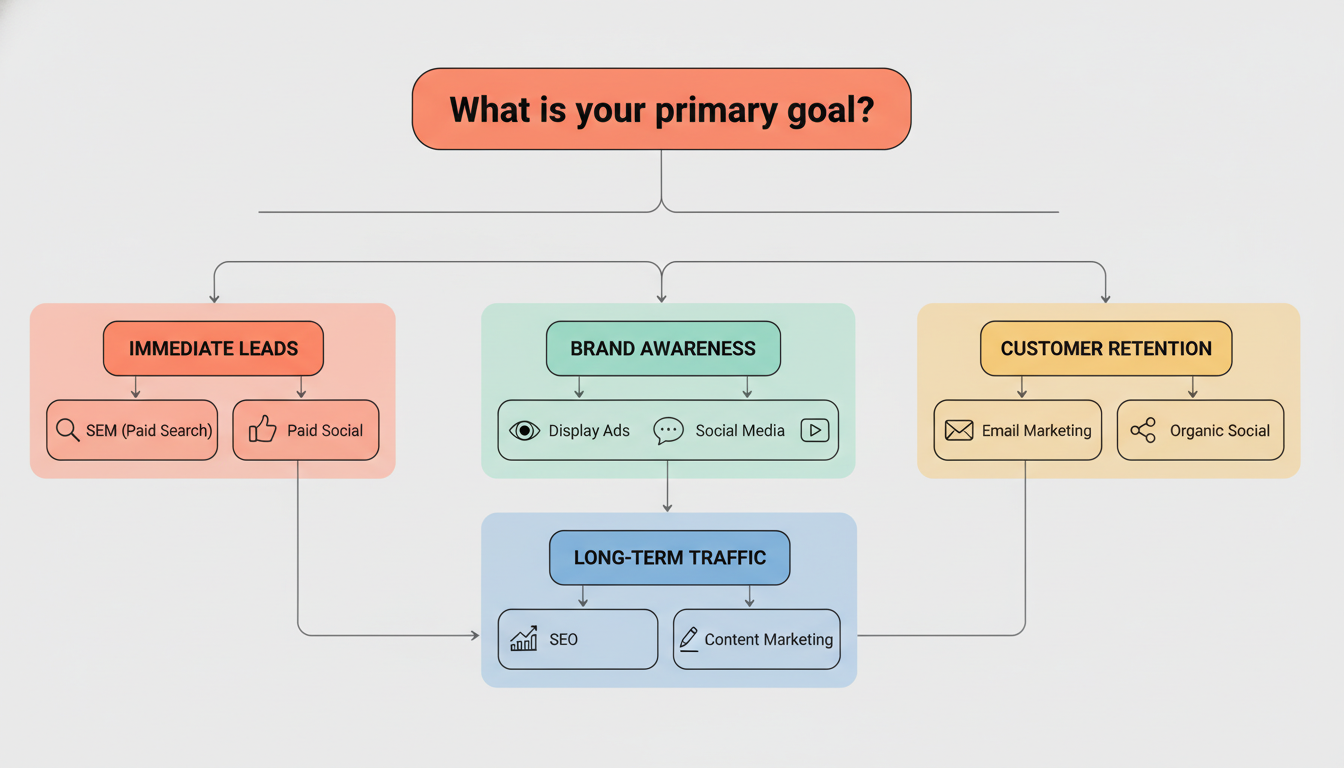
Consider your goals:
Consider your audience:
Consider your budget:
Understanding paid search advertising statistics helps inform budget allocation decisions across channels.
For most B2B businesses:
B2B companies often work with a B2B PPC agency to maximize their paid search investments and reach decision-makers effectively.
For most B2C businesses:
E-commerce businesses specifically benefit from specialized ecommerce PPC agency services that understand product feeds, shopping campaigns, and conversion optimization.
Effectiveness depends on your goals and audience. For immediate lead generation, SEM (paid search) typically delivers fastest results with measurable ROI. For long-term brand building and sustainable traffic, a combination of SEO and content marketing often performs best. Email marketing offers the highest average ROI at $36-45 per $1 spent, making it essential for customer retention.
Most successful businesses use 3-5 primary channels rather than spreading resources too thin. Start with channels that directly address your highest-priority goals, master those, then expand. A multi-channel approach is essential in 2026, but depth matters more than breadth.
SEM (Search Engine Marketing) involves paid advertisements that appear in search results—you pay each time someone clicks your ad. SEO (Search Engine Optimization) focuses on earning organic rankings through content quality, technical optimization, and authority building. SEM delivers immediate results; SEO builds sustainable traffic over time.
Both have important roles. Paid marketing (SEM, social ads, display) delivers immediate, controllable traffic but stops when you stop paying. Organic marketing (SEO, content, organic social) takes longer to build but creates lasting assets. Most businesses need a balanced mix, using paid to drive immediate results while building organic channels for long-term sustainability.
By submitting this form, you agree to our Privacy Policy and Terms & Conditions.