February 19, 2026


Growing an online store through paid advertising requires specialized expertise. While you might manage basic search campaigns in-house, ecommerce PPC demands specific skills—from product feed optimization to Shopping campaign management—that separate profitable stores from those burning through ad spend.
This guide covers everything you need to know about working with an ecommerce PPC agency in 2026, including what services to expect, how to evaluate agencies, and benchmarks to measure success.
Paid search drives immediate, measurable results for ecommerce businesses. Unlike SEO, which takes months to build momentum, PPC advertising puts your products in front of ready-to-buy shoppers today.
Immediate visibility: Launch campaigns and appear in shopping results within hours.
High purchase intent: Users searching for specific products are often ready to buy. Shopping ads capture this intent directly.
Measurable ROI: Track every dollar from click to purchase. No guessing about attribution.
Scalability: Profitable campaigns can scale quickly. Double your budget on what's working and watch revenue grow.
Seasonal flexibility: Ramp up during peak periods (Black Friday, holidays) and scale back during slow seasons.
Running profitable ecommerce PPC isn't simple. You're managing:
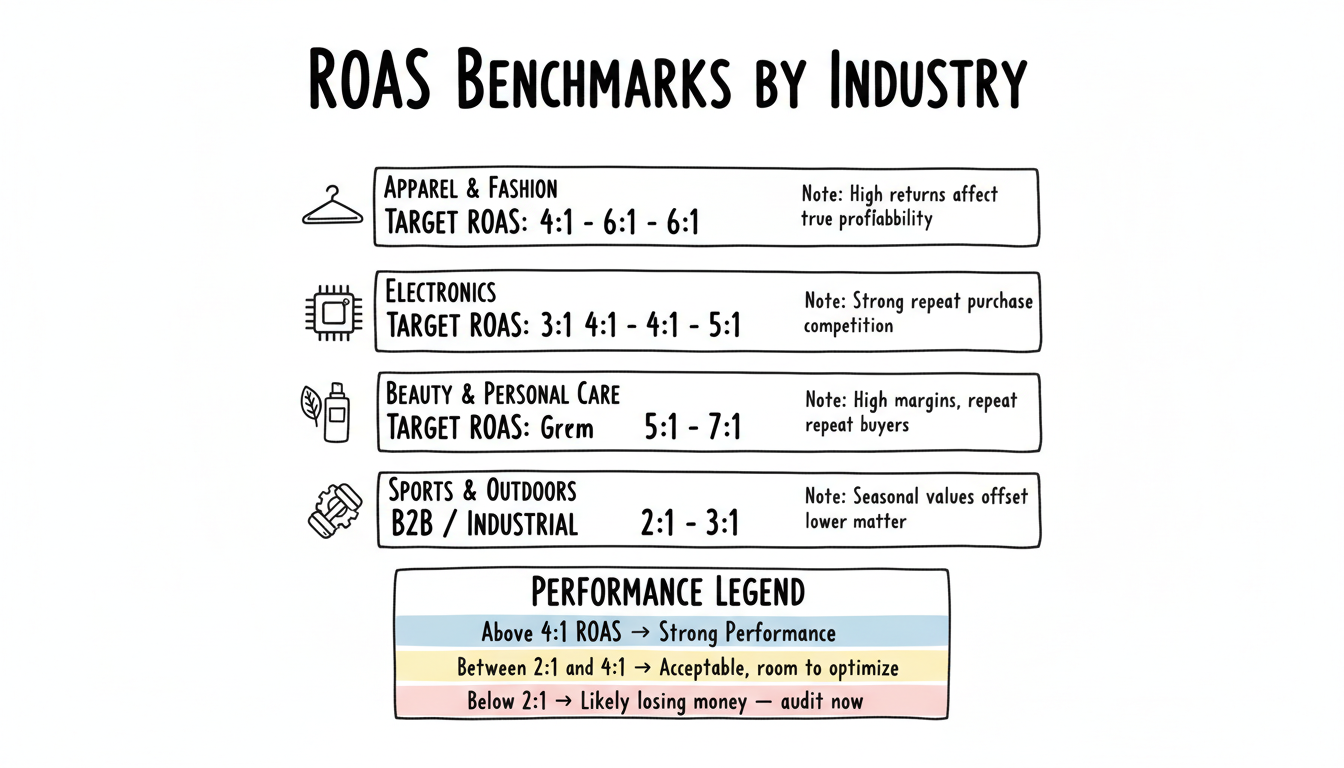
According to industry research, the benchmark ROAS to beat is 3.5:1—anything above 4:1 signals strong performance, while below 2:1 likely means you're losing money.
While Google Shopping dominates, Microsoft Shopping Ads offer compelling advantages for ecommerce brands.
Lower competition: Fewer advertisers means lower CPCs and easier visibility.
Affluent audience: Microsoft users tend to have higher household incomes, making them valuable shoppers for premium products.
Easy import: Transfer your Google Shopping campaigns directly to Microsoft with the import tool.
Performance results: EaseUS achieved 22% more conversions with Microsoft Shopping Ads compared to search alone, plus 17% lower CPA and a 10-point ROAS improvement.
A skilled PPC advertising management team handles both Google and Microsoft Shopping to maximize your reach and profitability.
Successful ecommerce agencies employ multiple campaign types working together.
Standard Shopping campaigns: Full control over bidding, budget, and product groups. Best for granular optimization.
Performance Max: Google and Microsoft's AI-driven campaigns that show products across Search, Display, YouTube, and more. Meta's Advantage+ Shopping campaigns deliver 32% average improvement in ROAS compared to manual campaigns.
Smart Shopping: Automated campaigns that blend Shopping with remarketing across Google's network.
Supplement Shopping with text ads for:
Re-engage shoppers who didn't convert:
Dynamic remarketing: Show users the exact products they viewed with updated pricing and availability.
Cart abandonment: Target high-intent users who added to cart but didn't purchase.
Customer win-back: Re-engage past customers with new products or promotions.
Recent data shows remarketing campaigns achieve 34% higher conversion rates than prospecting campaigns.
Your product feed is the foundation of Shopping campaign performance. Poor feed quality means poor results.
Product titles: Front-load with key attributes (brand, product type, color, size). Titles directly impact which searches trigger your ads.
Descriptions: Include relevant keywords and complete product information. Help the algorithm understand what you're selling.
Images: Use high-quality, white-background images. Poor images destroy click-through rates.
GTIN/MPN: Include manufacturer identifiers when available. Google and Microsoft use these for product matching and enhanced features.
Custom labels: Segment products by margin, inventory level, seasonality, or bestseller status for smarter bidding.
According to feed optimization specialists, your product feed accounts for roughly 95% of what shoppers see and click in Shopping ads. Improvements here compound across every product and every search.
A good ecommerce PPC advertising strategy starts with auditing your feed first—because great campaign management can't overcome a broken feed.
Expectations vary significantly by product category. Here are benchmark targets to evaluate performance.
Industry | Target ROAS | Notes |
Apparel & Fashion | 4:1 - 6:1 | High returns affect true profitability |
Electronics | 3:1 - 4:1 | Lower margins, higher competition |
Home & Garden | 4:1 - 5:1 | Strong repeat purchase potential |
Beauty & Personal Care | 5:1 - 7:1 | High margins, repeat buyers |
Sports & Outdoors | 4:1 - 5:1 | Seasonal peaks matter |
B2B / Industrial | 2:1 - 3:1 | Higher order values offset lower ROAS |
According to 2026 PPC advertising statistics:
Remember that ROAS doesn't account for margins. A 4:1 ROAS with 50% margins is much better than 4:1 with 25% margins.
Once you find profitable products and campaigns, scaling becomes the focus.
Budget incrementing: Increase budgets 20-30% at a time to avoid destabilizing campaigns. Dramatic increases can reset algorithm learning.
Geographic expansion: Roll successful campaigns to new markets. Test similar regions before international expansion.
Platform expansion: Take winning Google campaigns to Microsoft. Import proven structures and optimize for the new platform.
New campaign types: Add Performance Max once standard Shopping is optimized. Layer in Discovery and Demand Gen for full-funnel coverage.
Research shows that brands using advanced data pipelines achieve 20% higher revenue efficiency than those with fragmented tracking setups. Clean conversion data isn't optional at scale—it's required.
Full-service ecommerce agencies provide comprehensive management across the entire paid search advertising ecosystem.
Feed management & optimization: Building, maintaining, and optimizing your product feeds for Google Merchant Center, Microsoft Merchant Center, and other shopping platforms.
Shopping campaign management: Setting up and optimizing Shopping campaigns, including bidding strategies, product segmentation, and budget allocation.
Search campaign support: Brand defense, category targeting, and long-tail keyword coverage to supplement Shopping.
Remarketing setup: Dynamic remarketing, cart abandonment campaigns, and customer win-back sequences.
Performance tracking: Conversion setup, attribution modeling, and revenue reporting.
Multi-marketplace management: Advertising across Google, Microsoft, Amazon, and retail media networks.
Creative production: Product photography, video creation, and ad copy development.
Landing page optimization: Conversion rate improvements on product and category pages.
Competitive intelligence: Monitoring competitor pricing, positioning, and ad strategies.
According to 2026 agency selection guides, top ecommerce PPC agencies differentiate through:
Selecting the right agency determines your success. Here's what to evaluate.
Platform expertise: Are they Google Premier Partners? Microsoft Elite Partners? Platform certifications demonstrate competence.
Ecommerce experience: Do they specialize in ecommerce or are you one category among many? Ask for case studies from brands like yours.
Feed capabilities: Can they optimize your product feed or just manage campaigns? Feed work is foundational.
Reporting transparency: Will you see actual performance data? Some agencies hide metrics behind vanity dashboards.
Contract terms: Are you locked into long-term agreements? Quality agencies don't need to trap clients.
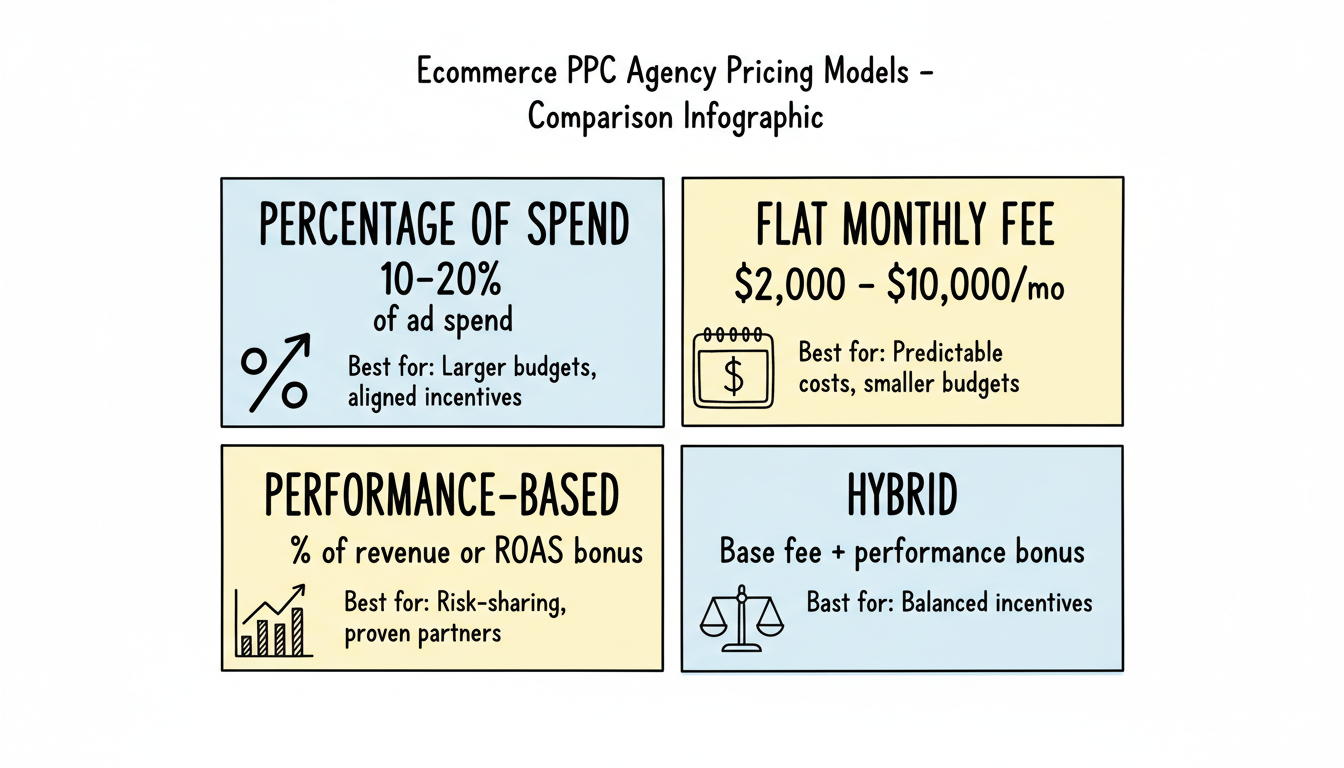
Model | Typical Range | Best For |
Percentage of spend | 10-20% of ad spend | Larger budgets, aligned incentives |
Flat monthly fee | $2,000-$10,000/mo | Predictable costs, smaller budgets |
Performance-based | % of revenue or ROAS bonus | Risk-sharing, proven partners |
Hybrid | Base fee + performance bonus | Balanced incentives |
Understanding PPC agency pricing helps you evaluate proposals accurately.
Target varies by industry, but 3.5:1 is the cross-industry benchmark to beat. Above 4:1 indicates strong performance. Fashion and beauty often achieve 5:1 or higher, while electronics and B2B typically see 2-3:1 ROAS due to thinner margins or longer sales cycles.
Most charge 10-20% of ad spend or $2,000-$10,000 per month flat fee. Minimum project costs at established agencies typically start around $5,000 according to Clutch agency data. Specialized Google Shopping agencies may charge premium rates for feed optimization expertise.
Start with Google Shopping for volume, then expand to Microsoft Advertising for cost-efficient incremental reach. Microsoft typically offers lower CPCs and serves an affluent, desktop-heavy audience. Microsoft Shopping delivered 22% more conversions and 17% lower CPA for EaseUS compared to search campaigns alone.
Shopping campaigns can generate sales within days of launch. Optimization cycles typically take 30-90 days to stabilize. Expect 2-3 months before campaigns reach full potential, though well-structured campaigns from experienced agencies often show positive returns in month one.
By submitting this form, you agree to our Privacy Policy and Terms & Conditions.