
February 19, 2026


Finding the best search engine marketing agency for your business requires more than a quick Google search. In a market projected to grow to $152.67 billion by 2033, the number of agencies competing for your attention has exploded. The challenge is separating genuine expertise from polished marketing.
This guide provides a practical framework for evaluating and selecting a top SEM agency that aligns with your goals, budget, and industry needs.
Search engine marketing agencies deliver a combination of paid advertising and organic search services designed to increase your visibility when potential customers search for products or services you offer.
A comprehensive SEM agency typically provides:
Paid Search (PPC) Management
Search Engine Optimization (SEO)
Strategic Planning
Analytics and Reporting
According to SeoProfy's 2026 agency analysis, the strongest agencies blend SEM with complementary services like CRO (conversion rate optimization), paid social, and content marketing to sync data across channels.
Not every highly-rated agency is right for your business. Use these criteria to narrow your search effectively.
The best search engine marketing agencies demonstrate results, not just promises. Look for:
Agencies with experience in your vertical understand your audience, competitive dynamics, and compliance requirements. A B2B software company needs different strategies than an e-commerce retailer or healthcare provider. When evaluating PPC management services, industry-specific experience becomes especially critical for maximizing ROI.
SeeResponse's agency evaluation framework emphasizes that reliable agencies take time to understand your industry, analyze your website, and perform a full audit before recommending a strategy. Be wary of agencies that promise results before examining your current situation.
Modern SEM requires proficiency with:
Frequent updates, clear explanations, and accessible reports build trust. Establish expectations upfront for communication frequency and reporting formats.
Different agency structures suit different business needs and budgets.
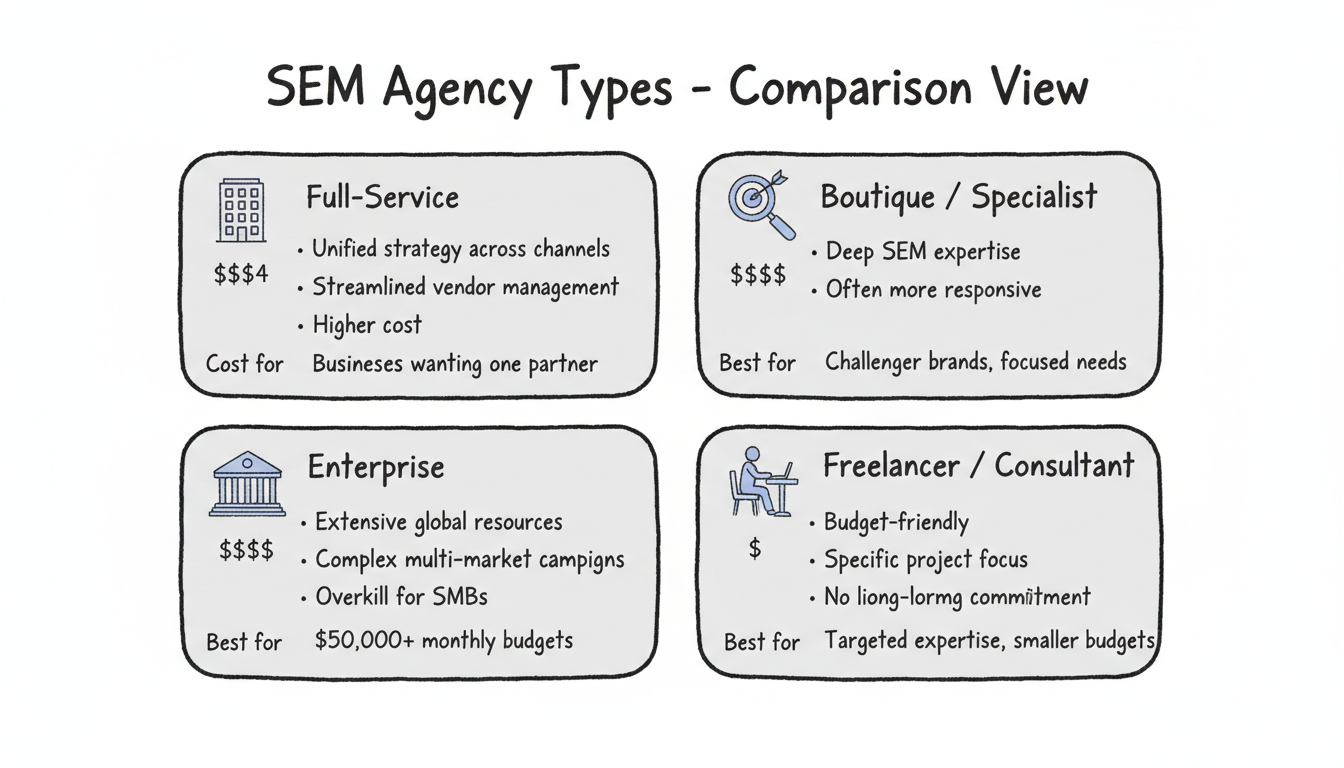
Full-service agencies handle all aspects of digital marketing, including SEM, SEO, social media, content, design, and sometimes traditional media. They're best for businesses wanting a single partner managing multiple channels.
Pros:
Cons:
Boutique agencies focus specifically on SEM, SEO, or a narrow set of services. According to industry analysis, challenger brands often achieve better results with focused boutique teams who "actually touch the work" rather than larger agencies where execution gets delegated through multiple layers.
Pros:
Cons:
Large enterprise agencies serve major brands with complex, multi-market campaigns. They offer extensive resources but may be overkill for small and mid-sized businesses. For companies requiring specialized expertise, working with a B2B PPC agency or SaaS PPC agency can deliver better results than a generalist enterprise firm.
Best for: Companies with $50,000+ monthly marketing budgets needing global reach or sophisticated enterprise integrations.
Individual specialists can provide excellent value for specific projects or smaller budgets. They're ideal for businesses needing targeted expertise without long-term retainer commitments.
Understanding how agencies charge helps you budget appropriately and compare proposals fairly.
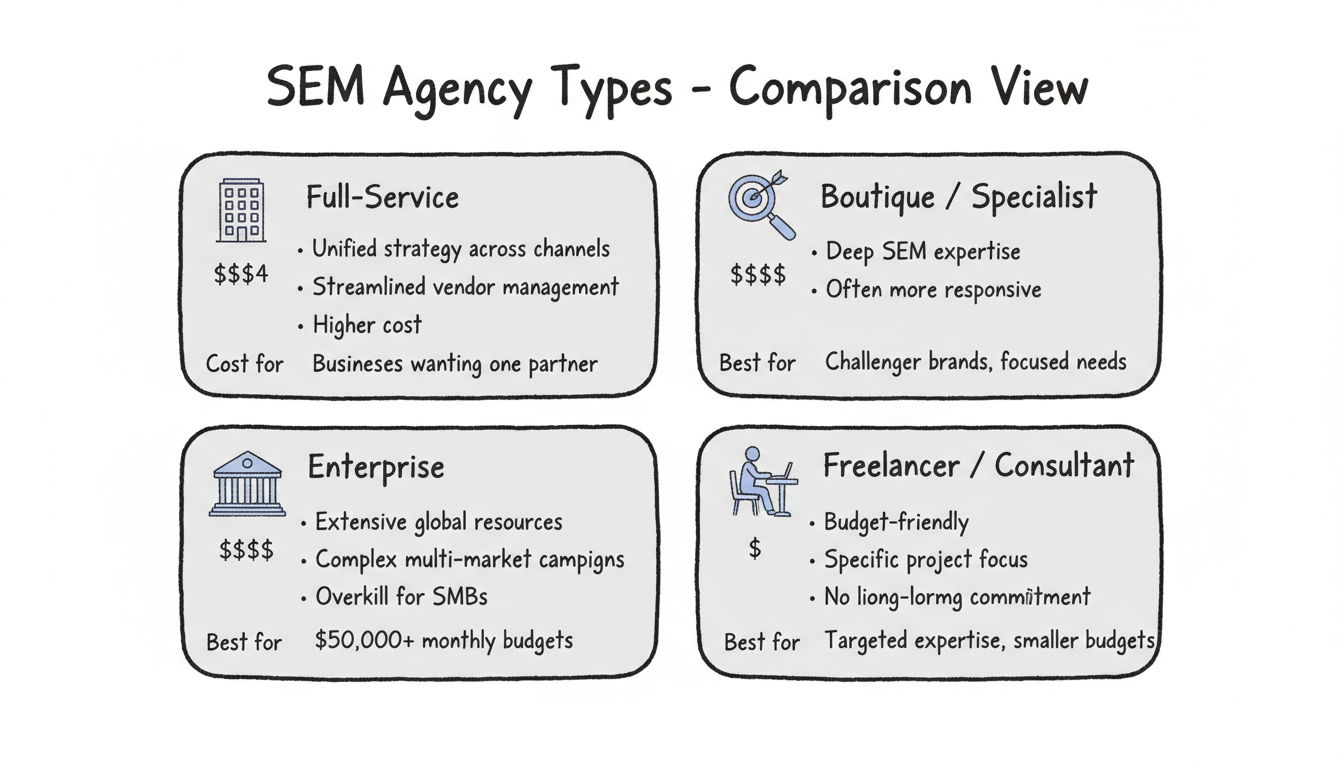
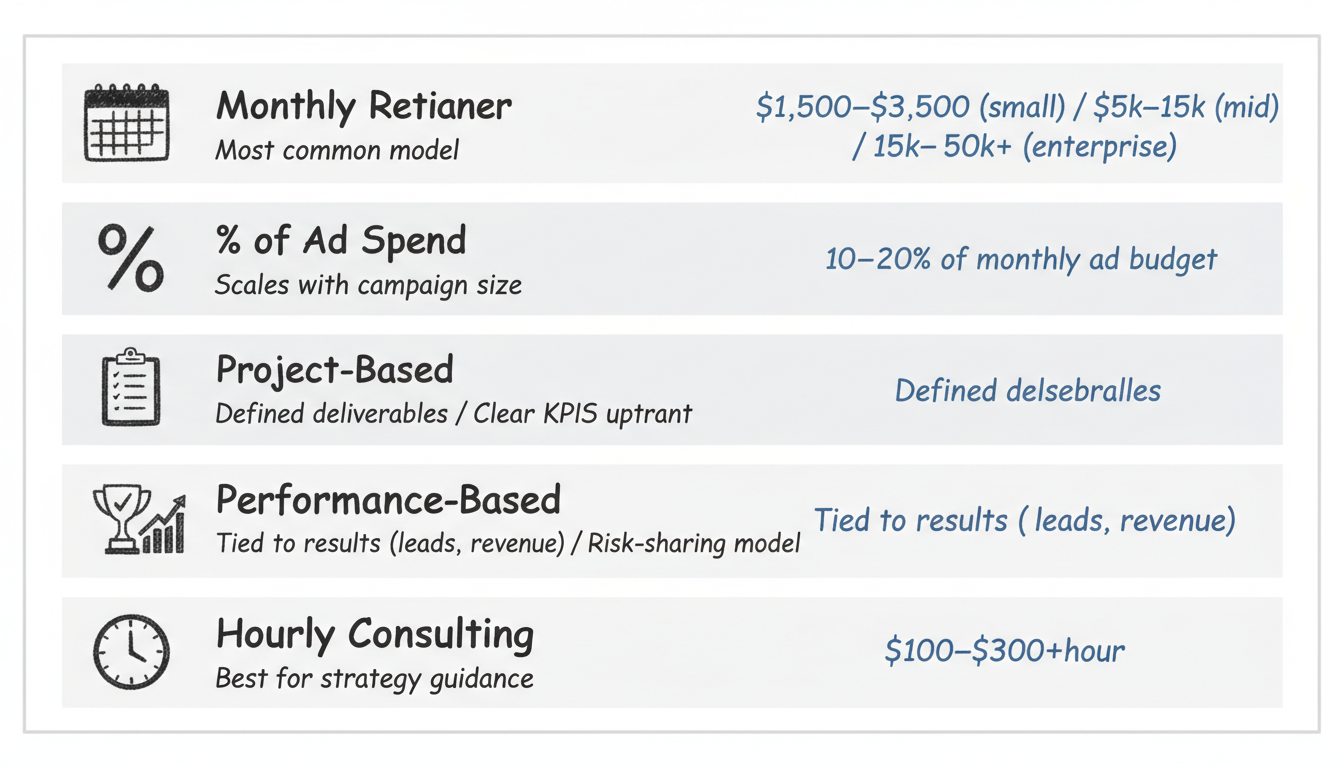
The most common model for ongoing SEM management. According to HawkSEM research, the average marketing agency costs $3,500 per month, with wide variation based on scope and experience.
Typical retainer ranges:
Some agencies charge 10-20% of your monthly advertising budget as their management fee. This aligns agency incentives with campaign scale but can become expensive as ad spend grows. Use a PPC budget calculator to model total costs including both ad spend and management fees.
Best for defined deliverables like audits, strategy development, or campaign launches. HawkSEM notes that project-based pricing makes budgeting easier and establishes clear KPIs upfront.
A portion of fees tied to results (leads generated, revenue driven, etc.). While appealing, this model can create misaligned incentives if not structured carefully.
Agencies charge $100-$300+/hour for consulting and advisory services. Best for businesses with internal teams needing strategic guidance rather than execution.
Follow this process to find and vet your ideal SEM partner.
Before contacting agencies, clarify:
Research 5-10 agencies that:
Ask shortlisted agencies to provide:
During evaluations, industry experts recommend asking:
Check for relevant certifications:
These credentials indicate technical competence and commitment to staying current with platform changes.
Consider a 3-month trial engagement before committing to a long-term contract. This allows both parties to evaluate fit without excessive risk.
SEM (search engine marketing) encompasses all search marketing activities, including both paid advertising (PPC) and organic search optimization (SEO). Some agencies use "SEM" specifically to mean paid search, while others use it as an umbrella term. Understanding the SEM vs SEO strategy comparison helps clarify what services are included when evaluating any SEM agency proposal.
Most reputable agencies request 3-6 month minimum engagements because optimization takes time. According to digital marketing experts, campaigns typically need three to six months to demonstrate real results. Avoid agencies requiring 12-month contracts upfront without performance guarantees.
Geography matters less than expertise and communication. Many excellent agencies work effectively with remote clients. Prioritize industry experience, case study results, and communication responsiveness over physical proximity—unless face-to-face meetings are critical for your organization.
By submitting this form, you agree to our Privacy Policy and Terms & Conditions.



