
February 19, 2026


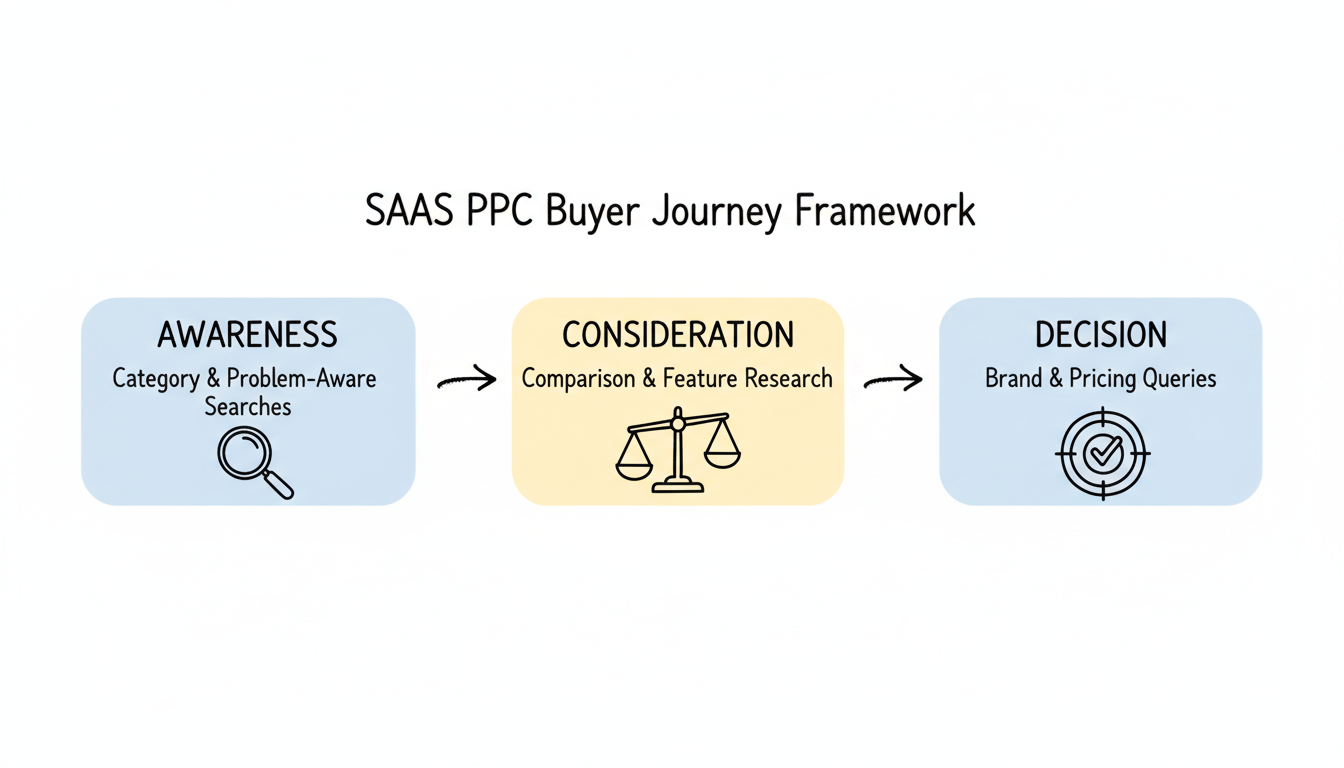
SaaS companies face unique challenges in paid advertising—long sales cycles, complex buyer journeys, and the need to balance customer acquisition cost (CAC) against lifetime value (LTV). A specialized SaaS PPC agency understands these dynamics and builds campaigns that drive qualified trials and demos, not just clicks.
In this guide, you'll learn why SaaS companies need specialized PPC expertise, how to structure campaigns for software products, and what to look for when choosing a SaaS PPC agency partner.
Organic growth takes time. For SaaS companies seeking predictable pipeline and scalable customer acquisition, PPC delivers immediate visibility and measurable results.
81% of B2B buyers pick a vendor before talking to sales, which means your brand needs visibility during the research phase. PPC puts your software in front of prospects actively searching for solutions like yours.
Immediate pipeline generation: Unlike content marketing or SEO that take months, PPC campaigns can generate qualified leads within days of launch. When developing your PPC advertising strategy, focus on campaigns designed to capture prospects at multiple stages of the buying journey.
Predictable acquisition costs: Once optimized, PPC provides consistent cost-per-trial or cost-per-demo metrics that enable accurate financial planning.
Market testing: Quickly validate messaging, positioning, and target audiences before investing in longer-term marketing initiatives.
Competitive defense: Bid on competitor brand terms to capture prospects actively evaluating alternatives.
PPC typically delivers best ROI for SaaS companies that:
While Google Ads dominates SaaS advertising, Microsoft Ads offers unique advantages for B2B software companies. Understanding the differences between Microsoft Ads vs Facebook Ads helps SaaS marketers choose the right platform mix.
Microsoft's exclusive LinkedIn integration allows targeting by:
This B2B targeting precision is unavailable on any other search platform.
Many SaaS companies ignore Microsoft Ads, creating opportunity:
Build Microsoft Ads campaigns that:
For advanced tactics, consult our guide on Bing Ads strategy to maximize your Microsoft Ads performance.
Successful SaaS PPC requires strategies tailored to software buying behavior. Whether you choose to outsource PPC management or build an in-house team, understanding these fundamentals is essential.
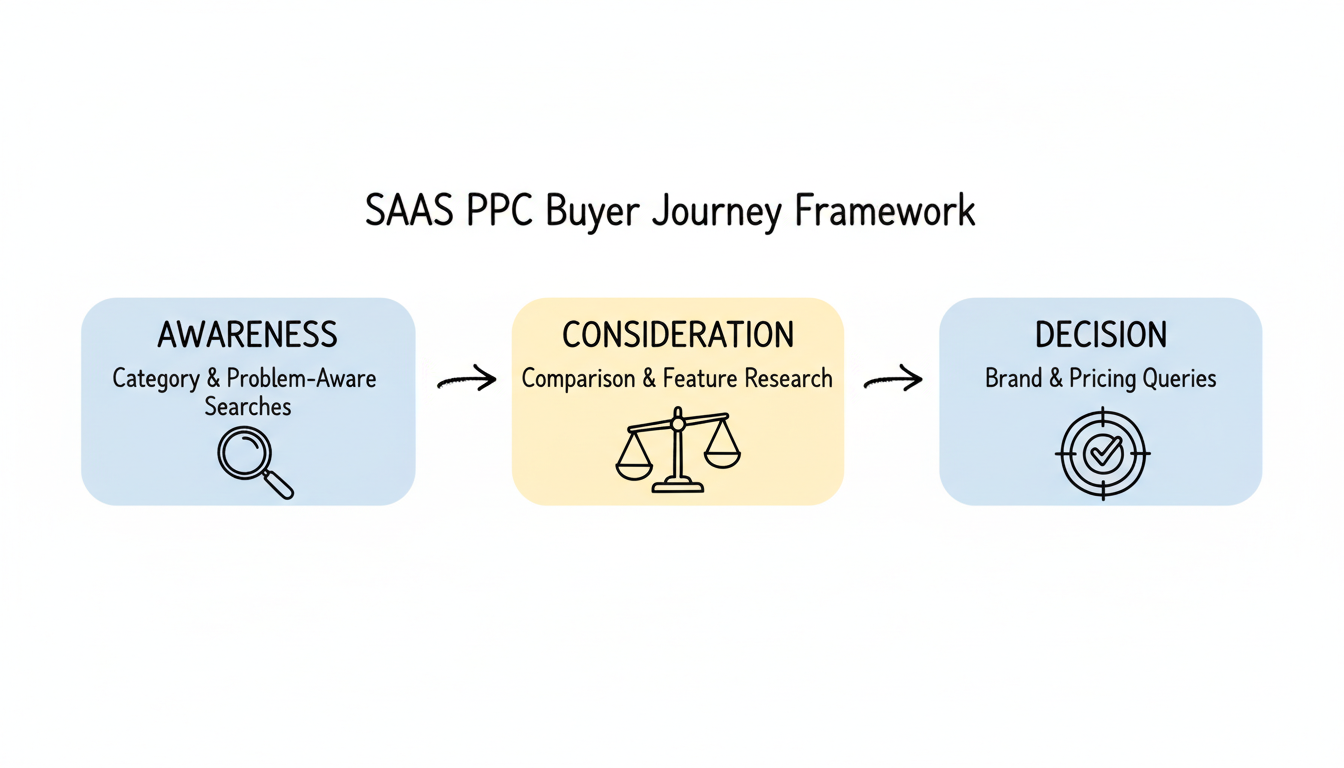
Organize campaigns by:
Buyer journey stage:
Audience segment:
Product/feature:
SaaS keyword research focuses on:
Keyword Type | Example | Typical Intent |
Category | "project management software" | Research |
Problem | "how to track employee time" | Awareness |
Comparison | "monday vs asana" | Evaluation |
Brand | "[competitor] alternative" | Decision |
Feature | "software with gantt charts" | Consideration |
High-intent keywords like "[category] software pricing" or "best [category] for [use case]" typically convert best.
Unlike ecommerce where the sale happens immediately, SaaS conversions usually mean free trials, demo requests, or content downloads.
Landing page essentials:
Ad copy that converts:
For enterprise SaaS with sales-assisted models:
Model | Primary Conversion | Secondary Conversion |
Freemium | Free trial sign-up | Upgrade to paid |
Sales-led | Demo request | Sales meeting |
Product-led | Free account | Expansion revenue |
Each model requires different landing pages, conversion tracking, and optimization approaches. Study paid search advertising examples to see how successful SaaS companies structure their campaigns.
Unit economics determine whether PPC makes sense and how much you can afford to spend.
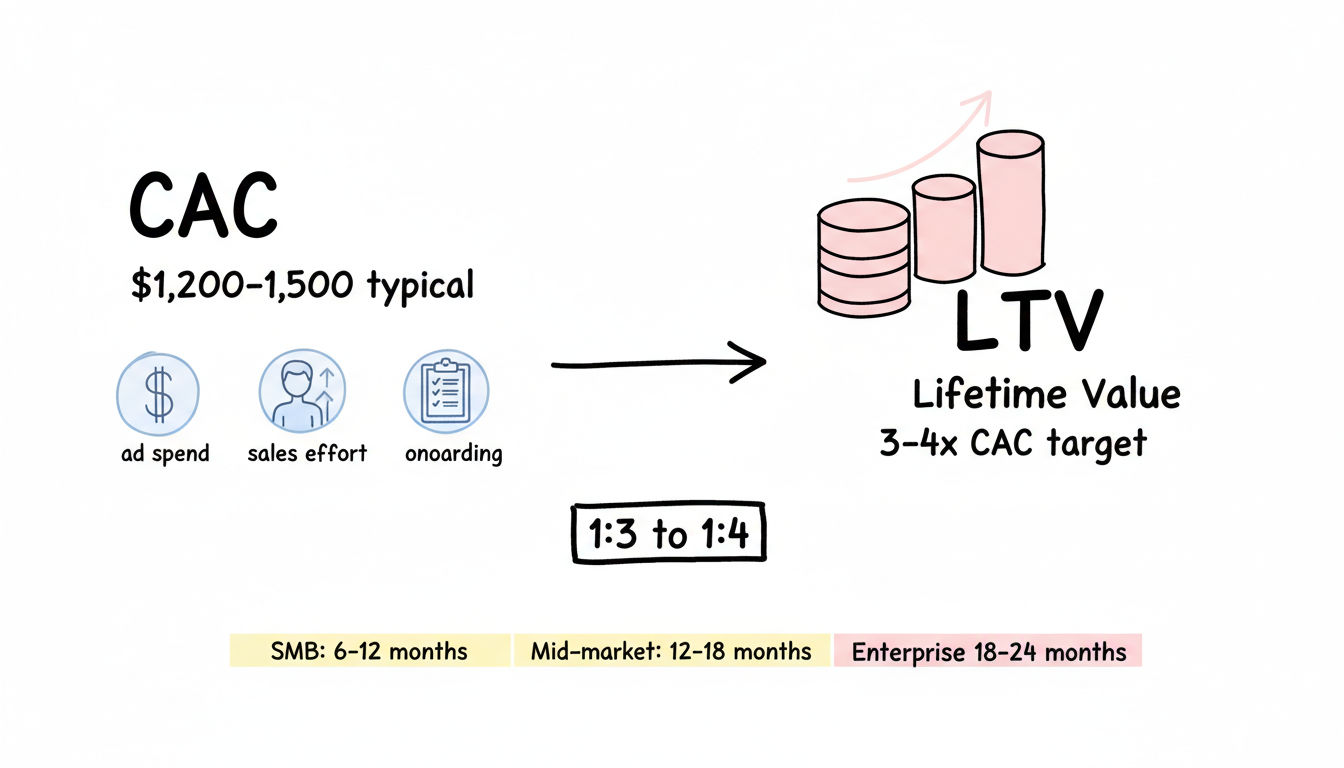
Customer Acquisition Cost includes all costs to acquire a paying customer:
For SaaS, CAC targets typically range from $1,200-$1,500 depending on ACV and market segment.
A healthy CAC:LTV ratio typically falls between 1:3 and 1:4. This means if your LTV is $10,000, you can afford up to $2,500-$3,300 in acquisition costs while maintaining healthy margins.
How quickly do you recover acquisition costs? Benchmarks vary by segment:
Segment | Target Payback |
SMB | 6-12 months |
Mid-market | 12-18 months |
Enterprise | 18-24 months |
PPC campaigns should be measured against these payback targets, not just cost-per-lead. Tracking Microsoft Ads ROI benchmarks helps you compare performance against industry standards.
If your target CAC is $1,500 and 20% of trials convert to paid:
Work backwards from unit economics to set realistic PPC targets.
Capturing prospects researching competitors is a proven SaaS PPC strategy.
Competitor brand bidding: Bid on competitor company names and product names to appear when prospects search for them.
Comparison content: Create ads and landing pages for "[your brand] vs [competitor]" searches.
Alternative targeting: Target "alternative to [competitor]" and similar searches from dissatisfied users.
Competitors will bid on your brand terms. Counter with:
Track metrics that connect to revenue, not just platform vanity metrics. Understanding Microsoft Ads reporting metrics provides insights into campaign performance beyond surface-level data.
Metric | What It Measures | Target Range |
CPC | Cost per click | Industry dependent |
CTR | Ad relevance | 2-5% for search |
Conversion Rate | Landing page effectiveness | 3-10% |
Quality Score | Account health | 7+ |
Cost per trial/demo: Primary efficiency metric for acquisition campaigns.
Trial-to-paid conversion rate: How well PPC traffic converts to revenue.
Cost per qualified opportunity: For sales-assisted models, measure pipeline quality.
Revenue attributed to PPC: Connect campaigns to closed-won deals.
CAC payback period: Time to recover acquisition investment.
SaaS buying journeys involve multiple touchpoints. Consider:
Not all PPC agencies understand SaaS. Here's what to look for when evaluating PPC advertising companies.
Look for agencies that demonstrate:
About their process:
About reporting:
About results:
According to agency research, when evaluating the best PPC agency, focus on firms that:
Model | Typical Range | Best For |
Flat monthly fee | $2,500-$10,000/month | Predictable budgets |
Percentage of spend | 10-20% | Scaling budgets |
Hybrid | Base + percentage | Most SaaS companies |
Performance-based | Revenue share | Mature programs |
Expect higher fees from agencies specializing in B2B SaaS due to the complexity involved.
Most SaaS companies should allocate 20-40% of their customer acquisition budget to paid advertising. In dollar terms, meaningful programs typically require $5,000-$20,000/month minimum to gather sufficient data for optimization. Scale budget based on CAC targets and payback period goals rather than arbitrary percentages.
Cost per trial varies significantly by market and ACV. For SMB SaaS with $50-200/month pricing, target $50-150 per trial. For mid-market ($500-2,000/month), expect $200-500 per demo. Enterprise SaaS may accept $500-1,500+ per qualified demo given higher deal values.
Both. Google Ads provides volume and reaches most searchers, making it essential for scale. Microsoft Ads offers 30-40% lower CPCs and exclusive LinkedIn targeting for B2B refinement. Most SaaS companies should run both platforms, allocating 75-85% to Google and 15-25% to Microsoft.
Initial leads appear within days of launch. However, meaningful optimization requires 60-90 days of data collection and testing. Connecting PPC to actual revenue outcomes may take 3-6 months depending on sales cycle length. Top SaaS brands design for value delivery within the first interactions, but ROI validation takes time.
By submitting this form, you agree to our Privacy Policy and Terms & Conditions.



