
February 19, 2026


Should you invest in paid search or organic rankings? It's one of the most common questions in digital marketing—and there's no universal answer. The right choice depends on your goals, budget, timeline, and competitive landscape.
This guide breaks down the key differences between SEM and SEO, compares their costs and timelines, and helps you determine which approach fits your situation in 2026.
Before comparing strategies, let's clarify what each term means.
SEO (Search Engine Optimization) focuses on improving your organic visibility in search results. You earn rankings through:
According to search marketing experts, SEO builds long-term authority, captures users at every funnel stage, and creates compounding returns over time.
SEM (Search Engine Marketing) typically refers to paid search advertising—bidding on keywords to display ads alongside organic results. In practice, SEM often means:
SEM delivers immediate visibility, captures high-intent commercial searches, and provides predictable, controllable results.
PPC (Pay-Per-Click) is the pricing model behind SEM. You pay only when someone clicks your ad. The terms SEM and PPC are often used interchangeably in the industry.
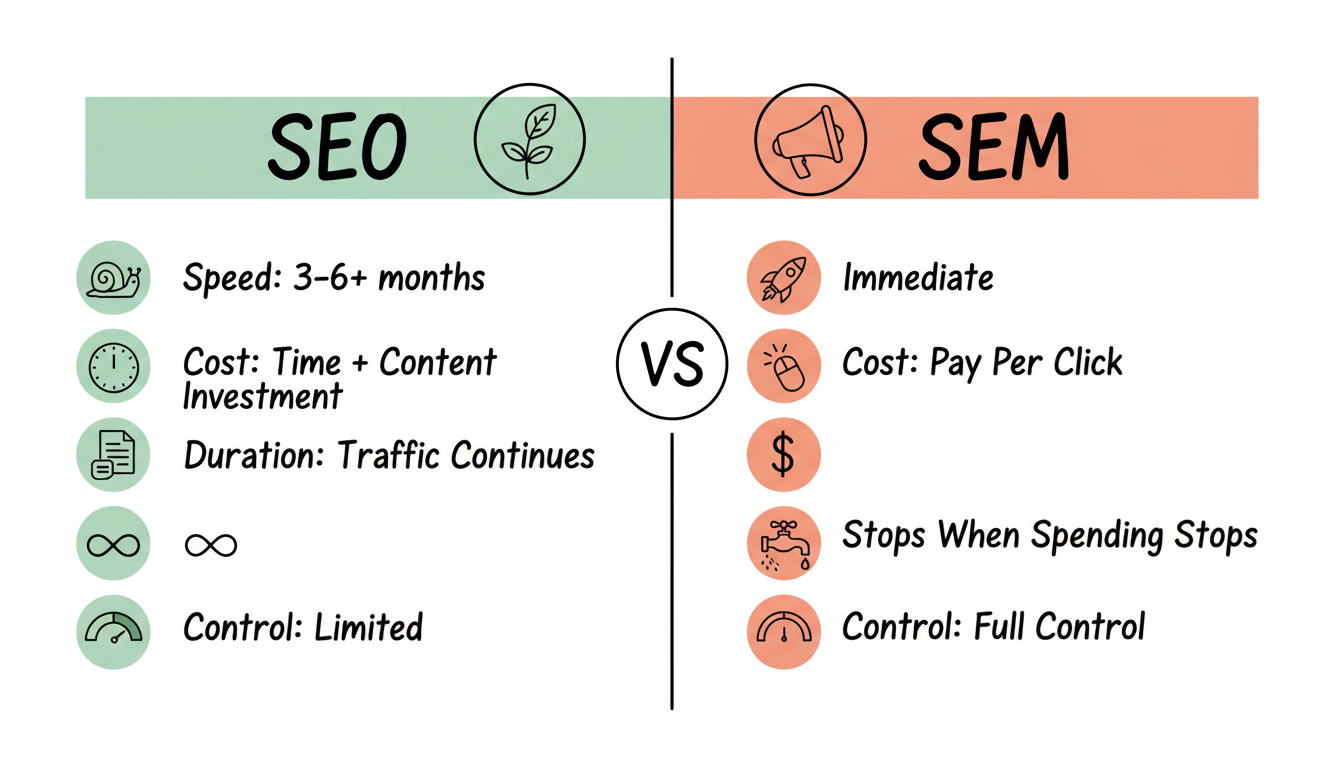
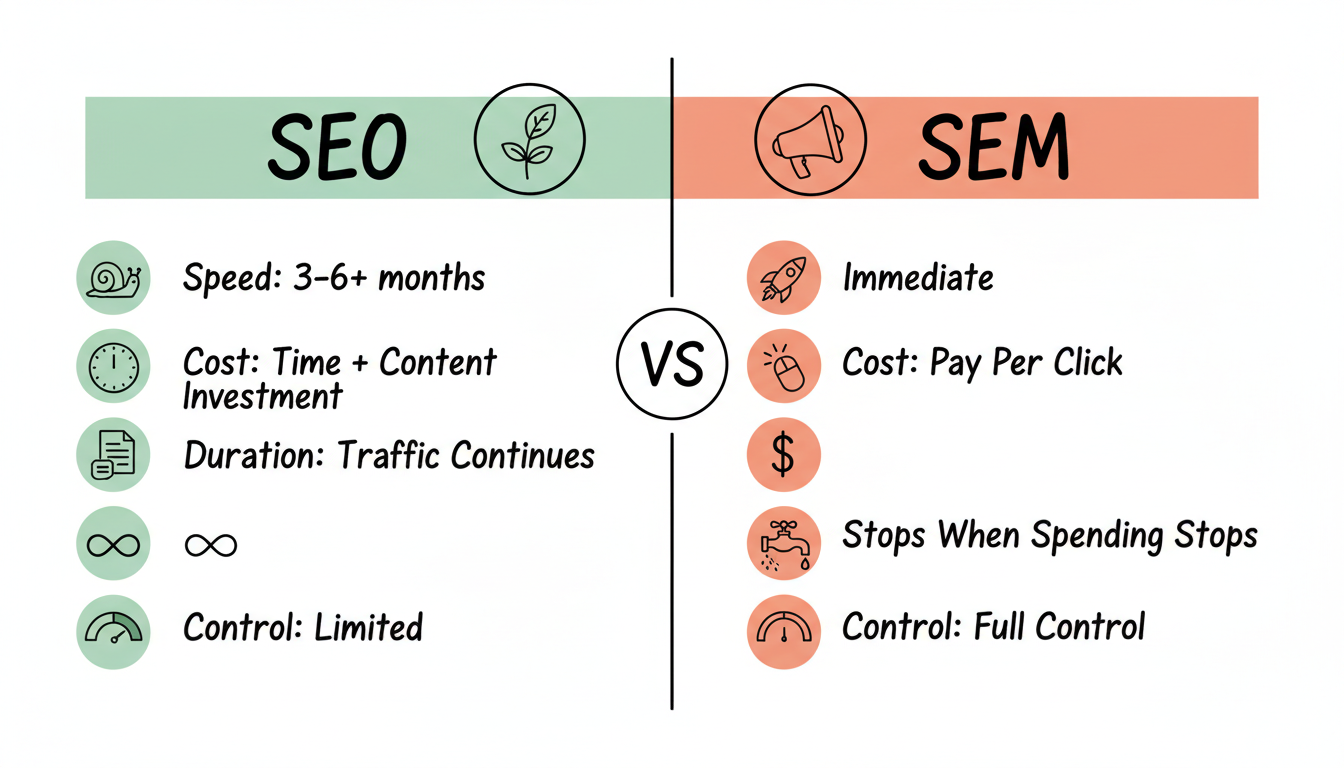
Aspect | SEO | SEM/PPC |
Cost model | Time and content investment | Pay per click |
Speed to results | 3-6+ months | Immediate |
Placement | Organic listings | Labeled as "Ad" |
Traffic when stopped | Continues | Stops immediately |
Control | Limited | Full control over messaging |
Targeting | Content-based | Keyword, demographic, device |
Understanding the true costs of each approach helps you budget appropriately.
SEO requires upfront investment in:
According to industry pricing, SEO has lower ongoing costs but requires sustained effort. Most businesses spend $500-$5,000/month on SEO services, with results compounding over time.
Long-term value: Once you rank, traffic continues without incremental cost per click. This makes SEO more cost-effective over extended periods.
SEM requires:
SEM involves cost per click that requires ongoing funding—potentially becoming costly if not managed strategically. For guidance on planning your PPC budget calculator and ad spend, industry tools can help you estimate realistic costs.
Average CPCs range from $2-$5 across industries, though competitive verticals like legal and insurance can exceed $50-$100+ per click.
Short-term: SEM provides faster ROI visibility, letting you see cost-per-acquisition clearly Long-term: SEO delivers better ROI once rankings are established, as traffic doesn't require ongoing payment
For sustainable growth, SEO is more cost-effective. For expedited results, SEM may be the better initial choice.
How quickly do you need results?
SEO is a long-term investment. Typical timelines:
According to search marketing guidance, even with active optimization, strong SEO results rarely appear in under six months. Google needs time to discover and trust your site.
SEM provides immediate visibility:
The trade-off: once you stop spending, you vanish from results right away.
Goal | SEO Timeline | SEM Timeline |
First traffic | 2-4 months | 1-2 days |
Meaningful results | 6-12 months | 1-3 months |
Optimal performance | 12-24 months | 2-3 months |
Sustainability | Indefinite | Requires ongoing spend |
Different situations call for different strategies.
SEM is critical for new launches, time-sensitive promotions, and competitive niches where organic search struggles to keep up. Understanding the various types of digital marketing can help you position SEM within your broader strategy.
Most successful businesses don't choose one or the other—they use both strategically.
Together, SEM and SEO create a comprehensive search presence that maximizes visibility regardless of where your audience searches.
Benefits of integration:
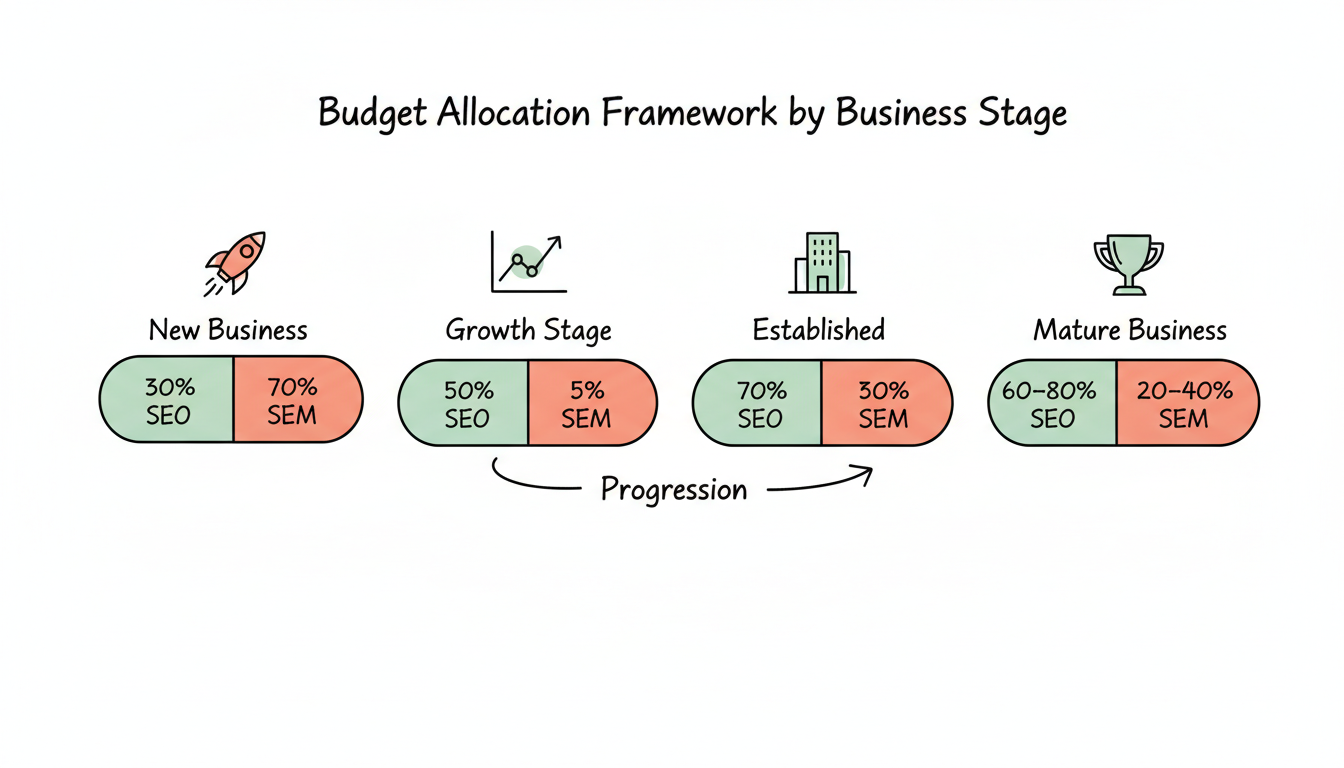
According to industry best practices, a 70/30 SEO/PPC split often works well—investing in long-term growth while maintaining short-term lead generation.
Business Stage | SEO Allocation | SEM Allocation |
New business (needs leads now) | 30% | 70% |
Growth stage | 50% | 50% |
Established (reducing CAC) | 70% | 30% |
Mature business | 60-80% | 20-40% |
When SEO and paid media operate from the same strategy, both channels perform better:
Effective PPC campaign optimization can inform your SEO priorities by revealing which keywords and messaging drive conversions. Similarly, exploring search engine marketing examples can inspire integrated strategies across both channels.
Yes. SEM delivers immediate visibility—ads can appear within hours of campaign launch. SEO typically takes 3-6+ months to show meaningful results. However, SEM traffic stops when you stop paying, while SEO traffic continues indefinitely.
Absolutely. The best digital marketing strategies combine both. Oftentimes, combining SEO and SEM is ideal—SEO builds your organic foundation while SEM provides immediate traffic surges, balancing short-term wins with long-term stability.
SEO is cheaper in the long run because organic traffic doesn't cost per click. SEM requires continuous spending to maintain visibility. However, SEO requires more upfront investment in content and optimization before seeing returns.
By submitting this form, you agree to our Privacy Policy and Terms & Conditions.



