
February 19, 2026


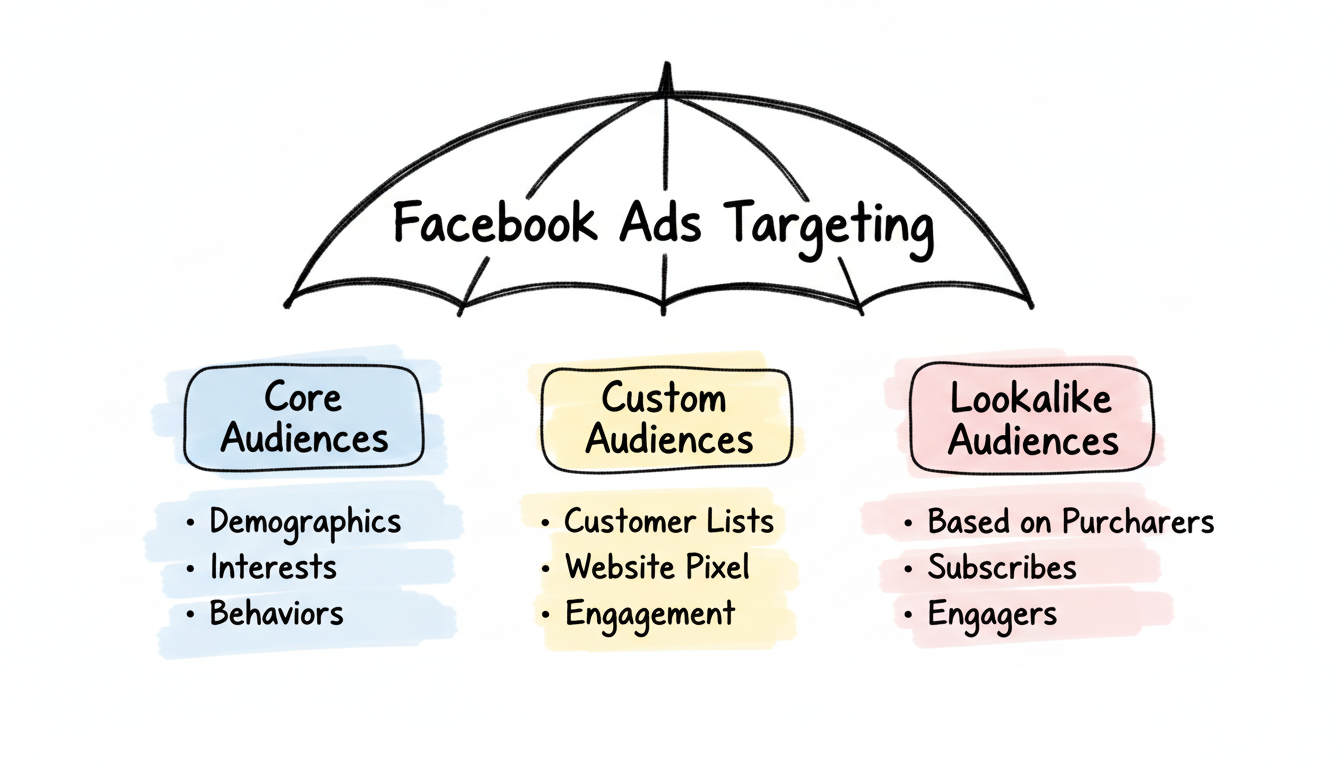
Getting your Facebook ads in front of the right audience is the difference between burning your budget and generating profitable returns. In 2026, Meta's targeting capabilities have evolved significantly, with AI-powered tools now handling much of the optimization work that advertisers used to manage manually.
This guide breaks down every Facebook ads targeting option available today, from foundational Core Audiences to advanced Custom and Lookalike audiences, plus the newer Advantage+ AI targeting that's changing how campaigns perform.
Facebook offers three primary audience targeting methods, each serving different purposes in your advertising strategy.
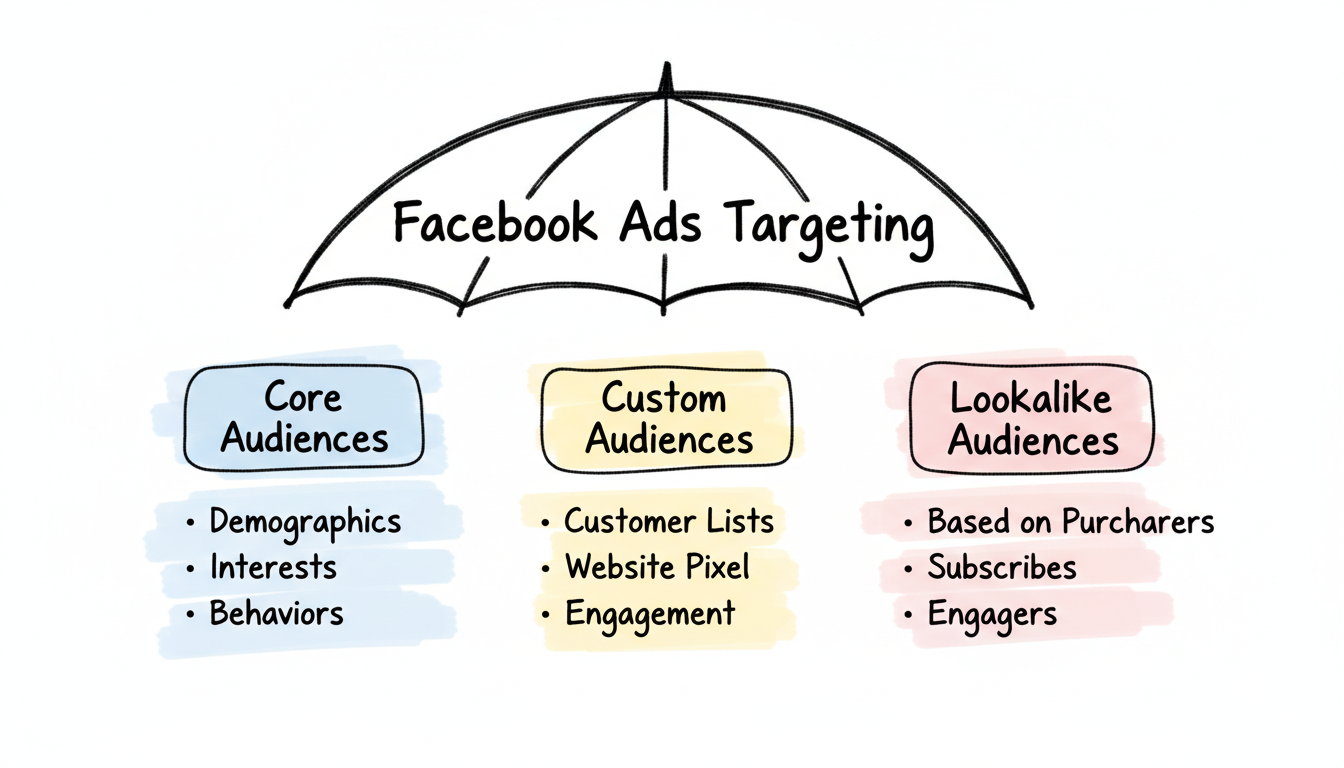
Core Audiences let you define who sees your ads based on demographics, interests, and behaviors. According to Meta's advertising platform, this targeting method draws from data across Facebook and Instagram's billions of users.
Demographics include:
Interests let you reach people based on:
Behaviors target based on:
2026 Reality Check: While detailed targeting still exists, Meta's algorithm now prioritizes AI-driven audience discovery over manual interest selection. Many advertisers report that broad targeting with strong creative now outperforms heavily segmented audiences.
For local businesses, location targeting remains essential. You can target:
Custom Audiences let you reach people who already have a relationship with your business. According to Meta's Help Center, these are your highest-intent targeting options.
Upload your existing customer data to target:
Best practices for customer list audiences:
Important 2026 update: Starting September 2025, Meta blocks Custom Audiences that suggest sensitive information such as health conditions or financial status. Avoid creating segments like "diabetes patients" or "high income" as these will be automatically rejected.
The Facebook Pixel tracks visitors to create audiences based on:
Pro tip: Combine Pixel data with the Conversions API (CAPI) for more accurate tracking. According to industry best practices, this dual-tracking approach improves conversion attribution, especially with iOS privacy changes affecting browser-based tracking.
Reach people who've interacted with your content on Meta platforms:
Retention windows vary by type: Video viewers can be retained for up to 365 days, while most engagement audiences max out at 365 days.
Lookalike Audiences find new people who share characteristics with your existing customers. They're built by analyzing your source audience and identifying common traits.
Best source audiences (in order of value):
Minimum source size: 100 people, though 1,000+ is recommended for statistical significance.
The percentage determines how closely the new audience matches your source:
Percentage | Audience Size | Best Use Case |
1% | Smallest, most similar | Highest conversion potential |
1-3% | Moderate reach | Balanced performance |
3-5% | Larger reach | Scale while maintaining relevance |
5-10% | Broadest | Awareness campaigns |
Testing recommendation: Start with a 1% lookalike for conversions, then test 3% and 5% as you scale. According to recent advertiser testing, 1% lookalikes typically deliver the best CPA, while broader percentages work better for awareness goals.
Meta has been shifting toward AI-powered predictive models that reduce reliance on traditional lookalikes. Some advertisers report that Advantage+ targeting now outperforms standard lookalikes for certain campaign types. Test both approaches to find what works for your business.
The targeting landscape has fundamentally shifted. Here's what's working now.
According to Social Media Examiner's analysis of 2026 algorithm changes, Meta's Andromeda update means broad targeting often outperforms narrow interest stacking.
When to go broad:
When manual targeting still matters:
In 2026, your ad creative acts as a filter. Meta's AI observes who engages with different creative concepts and optimizes delivery accordingly. Understanding meta ads creative strategy is essential for maximizing your campaign performance. This means:
Meta's Advantage+ targeting uses AI to expand beyond your defined audience when it predicts better results. According to advertising automation research, Advantage+ campaigns often deliver:
Best practices for Advantage+:
Don't rely on a single targeting method. Combine approaches:
Use Meta's Audience Overlap tool to ensure your ad sets aren't competing against each other. High overlap means you're bidding against yourself and inflating costs.
With privacy regulations tightening:
Start with broad targeting (location + age only) and let Meta's AI find your audience. Focus your energy on creating multiple ad variations that clearly communicate your value proposition. As Meta's algorithm has evolved, clear messaging in your creative now matters more than detailed targeting settings. Once you have conversion data, create Custom Audiences from your website visitors and purchasers. For businesses just getting started, working with a facebook ads management agency can help you navigate these complexities.
For most advertisers in 2026, lookalike audiences based on purchasers or high-intent actions outperform interest targeting. Interests can still work for very niche products or when you have limited first-party data. According to 2026 advertising benchmarks, combining a 1-3% lookalike with broad creative testing typically delivers the best results. When evaluating performance, consider comparing facebook ads vs google ads cost to ensure you're allocating budget to the right platform.
If your ads reach irrelevant users, check these areas: First, review your conversion event setup—optimizing for the wrong event attracts the wrong people. Second, examine your creative—does it clearly communicate who your product is for? Third, consider adding exclusions for past purchasers or unqualified leads. Finally, if using Advantage+ targeting, try adding more specific audience suggestions to guide the algorithm.
Meta requires at least 1,000 people in a Custom Audience before you can run ads to it. For lookalike source audiences, the minimum is 100 people, though 1,000+ leads to better performance. For detailed targeting, there's no strict minimum, but very narrow audiences (under 10,000 people) often struggle with delivery and have higher CPMs. Understanding the average cost of facebook ads helps you budget appropriately for your chosen audience size.
By submitting this form, you agree to our Privacy Policy and Terms & Conditions.



