February 19, 2026


Choosing between Facebook ads and Google ads often comes down to one question: which platform gives you more value for your advertising budget? While both platforms can drive results, their cost structures differ significantly based on how users interact with each.
This comparison breaks down the real costs of advertising on Facebook versus Google in 2026, including CPC, CPM, and cost per lead benchmarks to help you allocate your budget effectively.
Cost per click is often the first metric advertisers compare, and here the difference is substantial. Understanding facebook ads cost per click is essential when planning your campaign budget.
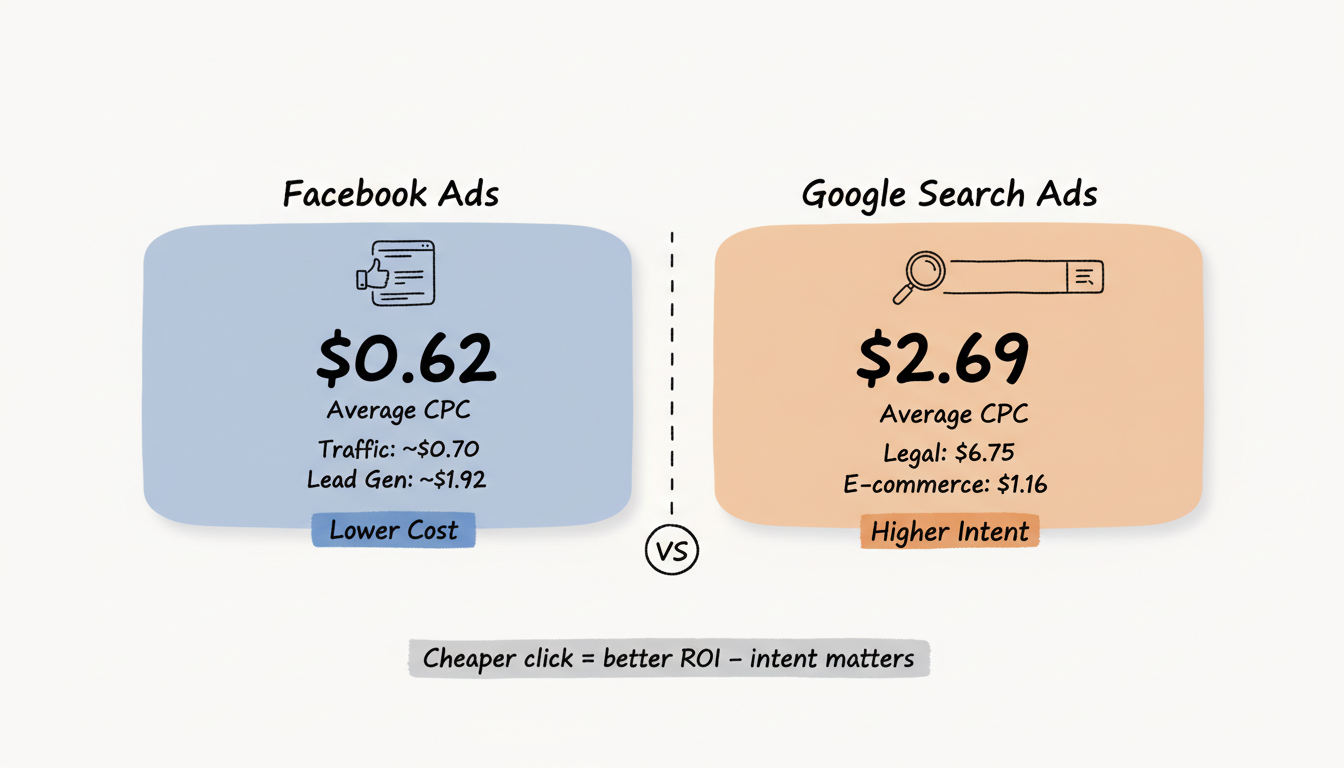
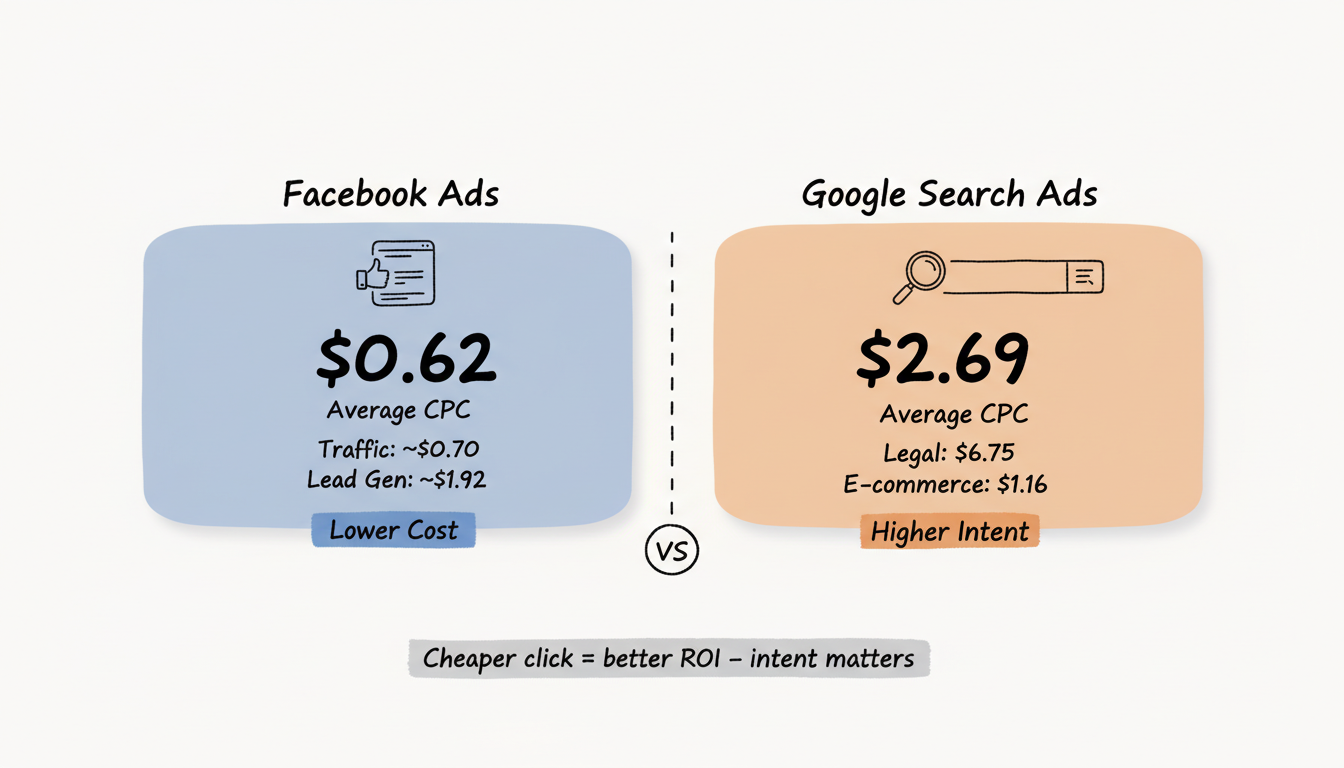
Facebook's average cost per click sits at $0.62 according to 2024-2025 benchmark data from WordStream, Revealbot, and Statista. This makes Facebook one of the more affordable platforms for driving clicks to your website or landing page.
However, CPC varies considerably by campaign objective:
Google Search ads have a significantly higher average CPC at $2.69 across industries, with some sectors paying much more. Many businesses work with a facebook ads management agency to optimize their campaigns and reduce costs across platforms.
Industry | Google Search CPC |
Legal | $6.75 |
Consumer Services | $6.40 |
Finance & Insurance | $3.44 |
Technology | $3.80 |
E-Commerce | $1.16 |
Travel & Hospitality | $1.53 |
Source: WordStream industry benchmarks
The Google Display Network offers lower CPCs at an average of $0.63, more comparable to Facebook's costs.
Facebook ads are typically cheaper per click. However, Google Search clicks often represent higher purchase intent, which can justify the higher cost. A user searching "buy running shoes" on Google is further along the buying journey than someone scrolling Instagram who sees a shoe ad.
Cost per thousand impressions (CPM) matters most for awareness campaigns where you're optimizing for reach rather than clicks. When evaluating facebook ads cost per impression, you'll need to consider both placement and targeting.
Facebook's average CPM is $11.62, with Meta CPM benchmarks showing ranges between $8 and $14 depending on your market and targeting.
Instagram CPM runs slightly higher at approximately $12.19, though both platforms are managed through the same Ads Manager. If you're running campaigns on multiple platforms, you might wonder whether you can run ads instagram without facebook entirely.
Google's CPM varies dramatically by network:
For broad reach at the lowest cost per impression, Google Display wins. But impressions on display networks are often less impactful than in-feed social placements.
Google Display offers cheaper impressions, but Facebook and Instagram placements typically drive better engagement and recall. Facebook Reels, video, and story placements deliver excellent reach while keeping CPMs competitive.
For lead generation campaigns, cost per lead is the metric that matters most. Before launching campaigns, use a facebook ads cost calculator to estimate your budget needs.
Facebook's average cost per lead ranges from $10 to $50+ depending on industry. The platform's Lead Ads feature with native forms can reduce CPL significantly compared to landing page conversions.
Benchmark CPL by business type:
For specialized industries like e-commerce, partnering with an ecommerce facebook ads agency can help optimize lead costs and conversion rates.
Google Ads CPL varies widely, with averages ranging from $70 for B2C leisure businesses to $819 for B2B manufacturing.
The average CPA for Google search ads is $48.96, while display ads average $75.51 per action.
Industry-specific Google Ads CPL:
Facebook generally delivers lower CPLs, especially for awareness-stage leads. But lead quality matters: Google Ads excels for high-intent conversions because users actively searched for solutions, while Facebook leads may require more nurturing.
Cost per action only tells part of the story. Return on investment depends on lead quality, conversion rates, and customer lifetime value. Tracking your facebook ads roi accurately is crucial for making informed budget decisions.
Well-optimized Facebook campaigns often achieve 3:1 to 5:1 ROAS. The platform excels at:
Understanding how to increase roi facebook ads can help you maximize returns on both platforms.
The median ROAS for Google Ads is approximately 3.5:1, meaning $3.50 returned for every $1 spent.
Google strengths include:
Neither platform is universally "better" for ROI. The right choice depends on your business model. To understand true performance, many advertisers use a facebook ads roi calculator that accounts for lifetime customer value.
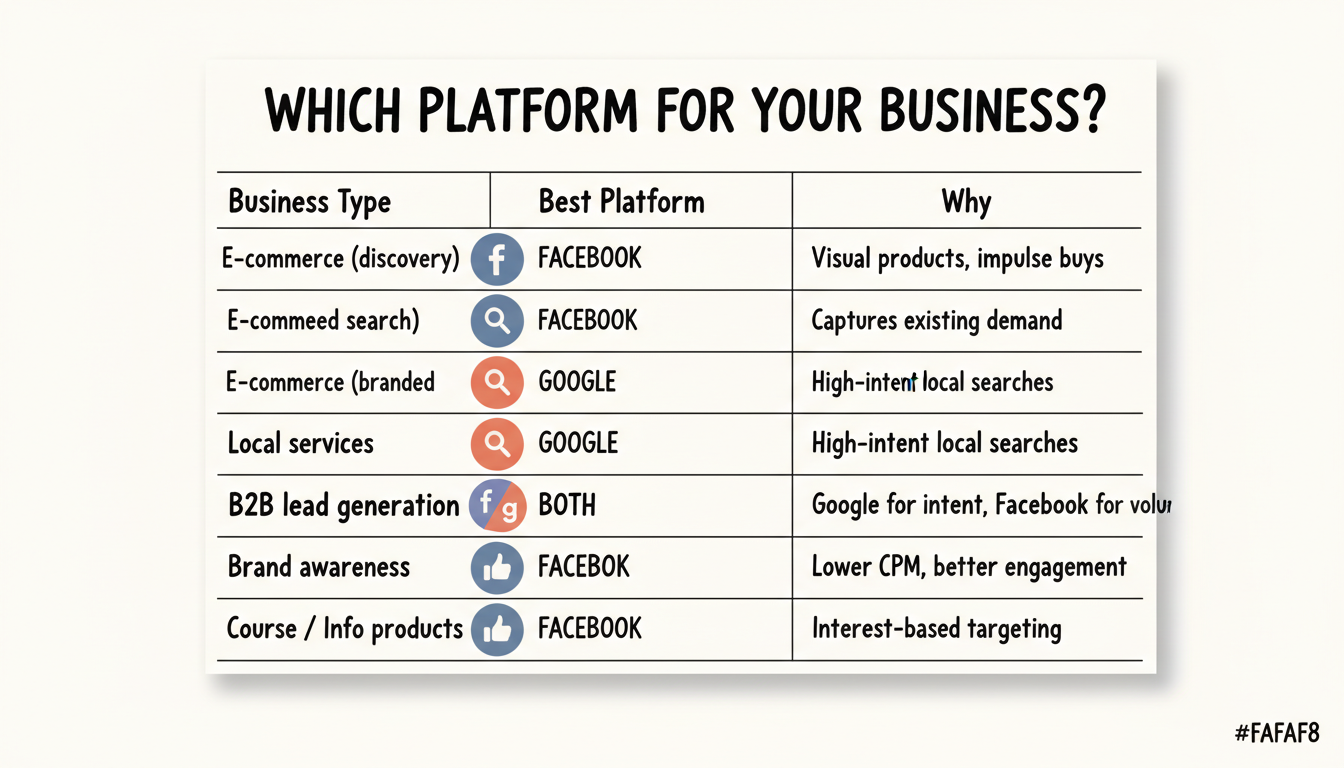
Business Type | Better Platform | Why |
E-commerce (discovery) | Visual products, impulse purchases | |
E-commerce (branded search) | Captures existing demand | |
Local services | High-intent local searches | |
B2B lead generation | Both | Google for high intent, Facebook for volume |
Brand awareness | Lower CPM, better engagement | |
Course/info products | Interest-based targeting works well |
If you're just getting started, learning facebook ads for beginners can help you avoid common mistakes.
The most effective approach combines both platforms. Use Facebook and Instagram to build interest, awareness, and recall. Use Google Ads to capture ready-to-buy search traffic. Together, they create a full-funnel advertising system. A comprehensive meta ads funnel strategy can help you coordinate campaigns across both platforms.
Facebook ads are typically cheaper per click, with an average CPC of $0.62 compared to Google Search at $2.69. However, cheaper isn't always better—Google's higher costs often reflect higher purchase intent, which can mean better conversion rates and lower overall cost per customer. The comparison of facebook ads vs google ads vs tiktok ads reveals that each platform has unique strengths.
Start with where your customers are in the buying journey. If you need to build awareness first, allocate more to Facebook. If people already search for your product, prioritize Google. Many businesses start with 60/40 splits (either direction) and adjust based on performance data. The question do facebook ads cost money often comes up—yes, but the investment can deliver strong returns when managed properly.
Yes, and most successful advertisers do. Facebook builds audiences and awareness, while Google captures demand when people search. Using both creates a complete funnel that neither platform can deliver alone.
By submitting this form, you agree to our Privacy Policy and Terms & Conditions.