February 19, 2026


Understanding your Facebook ads cost per impression is essential for budgeting and optimizing campaign performance. CPM (cost per mille) measures how much you pay for every 1,000 times your ad is shown to users, making it a key metric for evaluating reach efficiency across your Meta advertising campaigns.
This guide covers everything you need to know about Facebook CPM in 2026, including current benchmarks, industry variations, and actionable strategies to reduce your costs.
CPM stands for "cost per mille," where mille is Latin for thousand. It represents the amount you pay for every 1,000 impressions your ad receives on Facebook, Instagram, or other Meta placements.
CPM Formula:
CPM = (Total Ad Spend ÷ Total Impressions) × 1,000For example, if you spend $500 and receive 50,000 impressions, your CPM is $10.
CPM is particularly useful for:
Unlike CPC (cost per click), CPM focuses purely on exposure rather than engagement. A lower CPM means your budget stretches further in terms of audience reach.
According to recent benchmark data, here is what advertisers are paying for Facebook impressions in 2026:
CPM Range | Rating |
Under $5 | Excellent |
$5 to $10 | Good |
$10 to $15 | Average |
Over $15 | High (needs optimization) |
The average CPM across all industries in the United States was $22.20 through 2025, with significant seasonal variation. CPMs peaked at $28.09 in November before dropping to $17.12 in January 2026.
For broader global benchmarks, industry data shows the average CPM ranges from $5 to $18, with a median around $11.62.
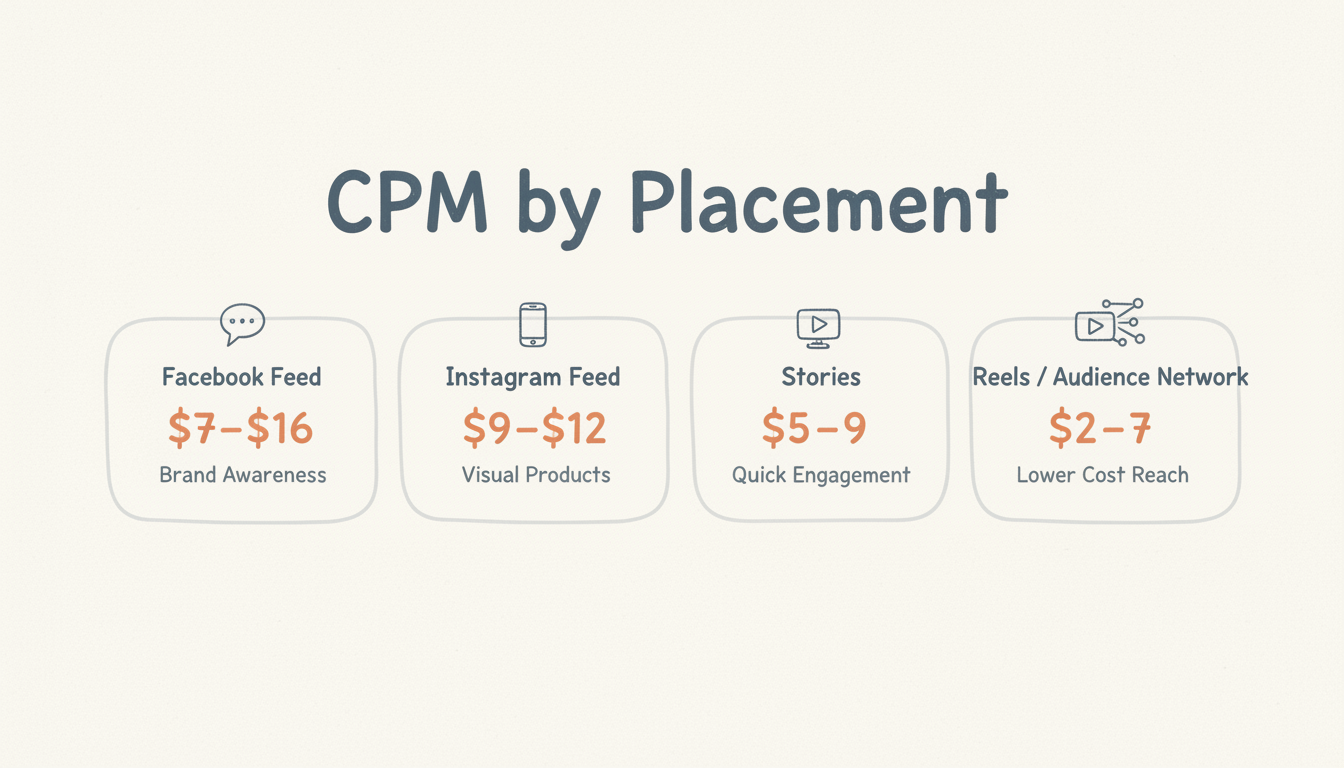
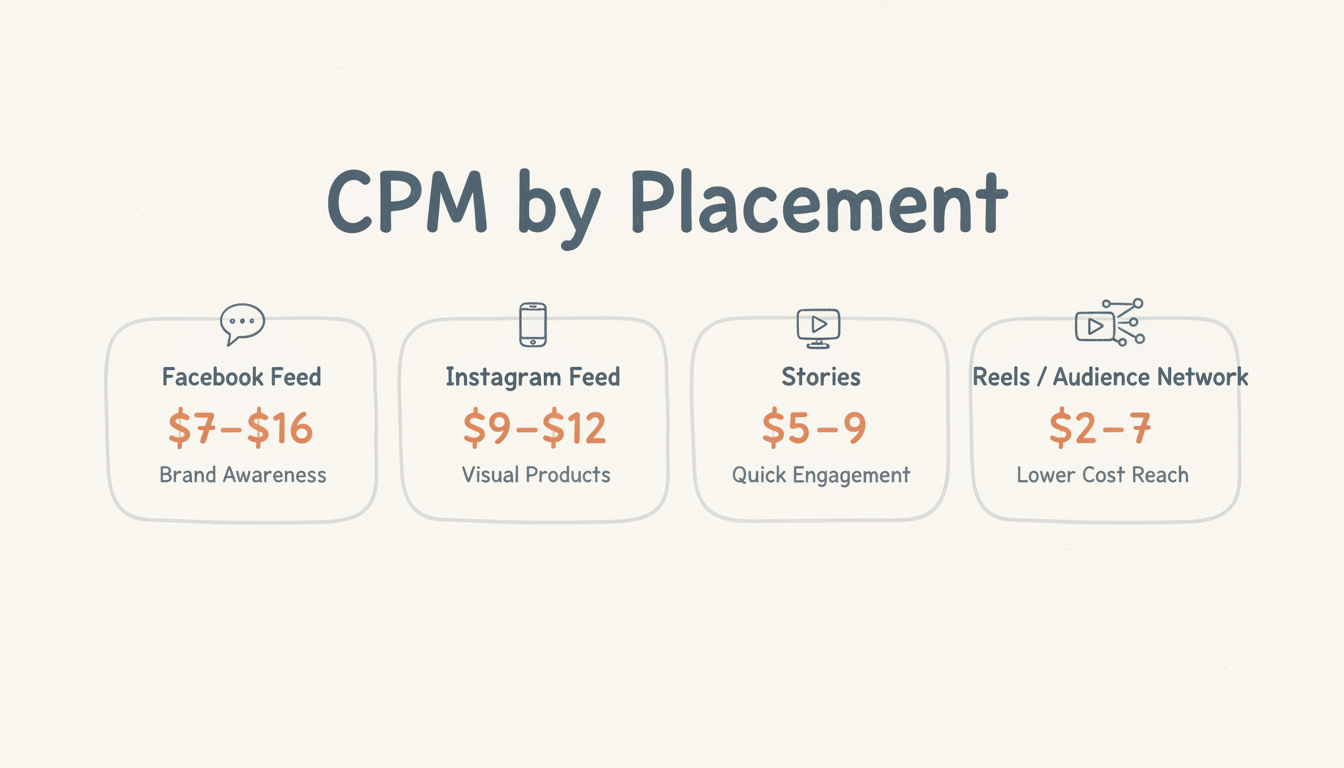
Where your ad appears significantly affects cost:
Placement | Average CPM | Best For |
Facebook Feed | $7 to $16 | Brand awareness |
Instagram Feed | $9 to $12 | Visual products |
Instagram Stories | $6 to $9 | Quick engagement |
Facebook Stories | $5 to $8 | Cost efficiency |
Reels | $5 to $7 | Younger audiences |
Audience Network | $2 to $4 | Extended reach |
According to Facebook ads statistics, Feed placements have the highest CPM (around $16), while Stories and Reels are cheaper at $10-$12.
Your campaign goal also influences CPM. Understanding Facebook ads objectives helps you select the right approach for your budget and goals:
Objective | Average CPM |
Reach | $5 to $7 |
Brand Awareness | $5 to $8 |
Engagement | $4 to $6 |
Video Views | $4 to $7 |
Traffic | $6 to $9 |
Lead Generation | $9 to $13 |
Conversions | $10 to $15 |
Lower-funnel objectives like conversions typically have higher CPMs because you are targeting more qualified audiences who are closer to taking action.
Competition levels vary significantly across industries, directly impacting how much you pay for impressions:
Industry | Average CPM |
Finance & Insurance | $15 to $20 |
Legal Services | $14 to $18 |
Real Estate | $12 to $16 |
Healthcare | $10 to $14 |
Technology/SaaS | $10 to $15 |
E-commerce | $7 to $10 |
Food & Beverage | $4 to $7 |
Entertainment | $4 to $6 |
Data compiled from SocialRails and industry benchmarks.
Industries with higher customer lifetime values and more competition for attention (finance, legal, healthcare) consistently see elevated CPM rates. If your CPM seems high, compare it against your specific industry rather than overall averages.
CPM fluctuates throughout the year:
According to benchmark data, Q4 2025 CPMs averaged $25.49 in the US, roughly 22% higher than Q1.
High CPM eating into your budget? Here are proven strategies to reduce your Facebook cost per impression:
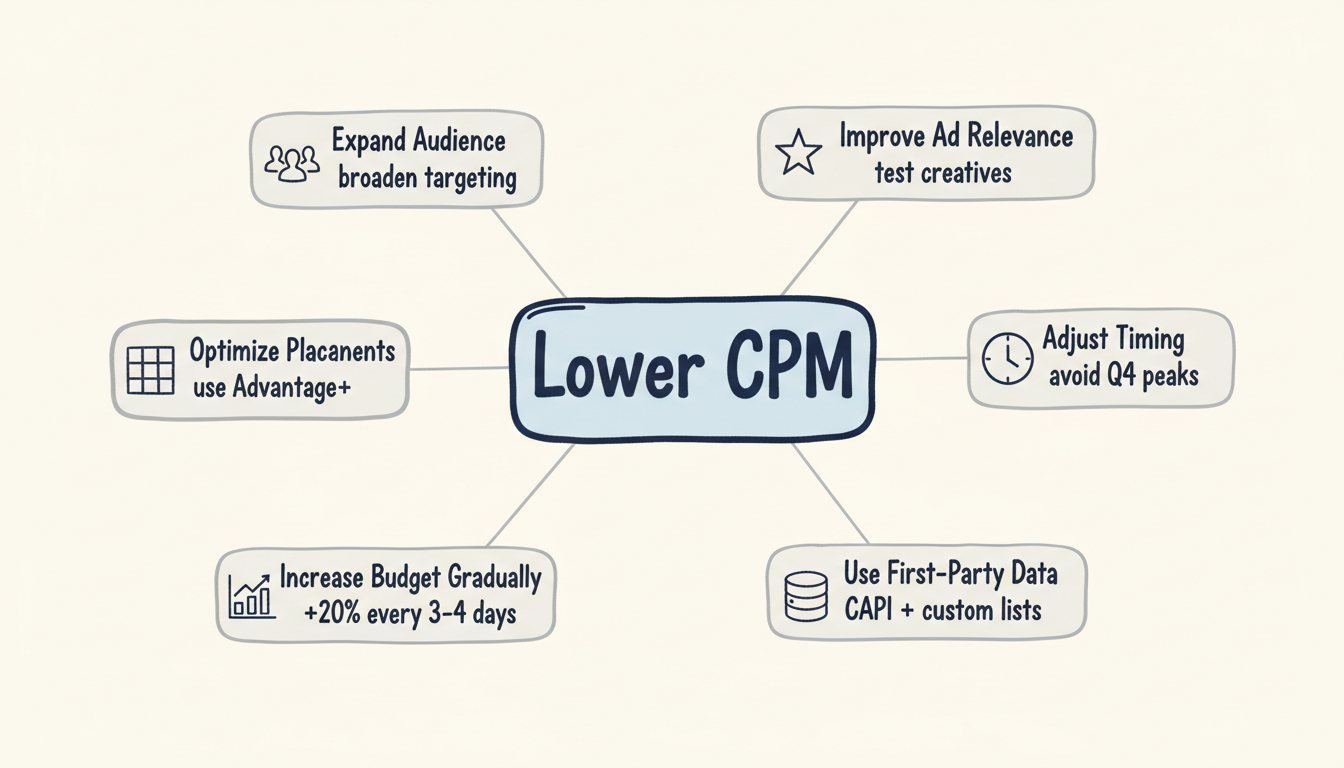
Narrow targeting increases competition. When learning how to run Facebook ads for business, strategic Facebook ads targeting is crucial. Try:
Meta rewards engaging ads with lower costs:
Sudden budget changes can disrupt delivery:
Campaigns using customer lists and Conversions API data often see improved efficiency:
A good CPM is generally under $10 for most industries. Under $5 is excellent. However, you should benchmark against your specific industry. Finance and legal advertisers regularly see CPMs of $15-20, which is normal for those sectors. E-commerce brands should aim for $7-10. Tracking your Facebook ads ROI alongside CPM helps ensure your campaigns remain profitable.
High CPM typically results from narrow targeting, competitive industries, poor ad relevance, or seasonal factors. Try expanding your audience, improving creative quality, or enabling Advantage+ placements. Also check if you are advertising during high-competition periods like Q4.
Neither is universally better. CPM is ideal for brand awareness campaigns where visibility matters most. CPC is better for traffic or conversion-focused campaigns where you want to pay only for engagement. Most conversion campaigns optimize for results rather than impressions.
By submitting this form, you agree to our Privacy Policy and Terms & Conditions.