
February 19, 2026


Getting more return from your Facebook ad spend does not require massive budget increases. Often, the biggest improvements come from optimizing what you already have: better targeting, stronger creative, smarter bidding, and tighter tracking. The advertisers who win on Facebook are not the ones spending the most money but the ones squeezing the most value from every dollar.
This guide covers 12 proven tactics to increase your Facebook ads ROI, organized into quick wins you can implement today, long-term strategies for sustained growth, and common mistakes that silently drain your budget.
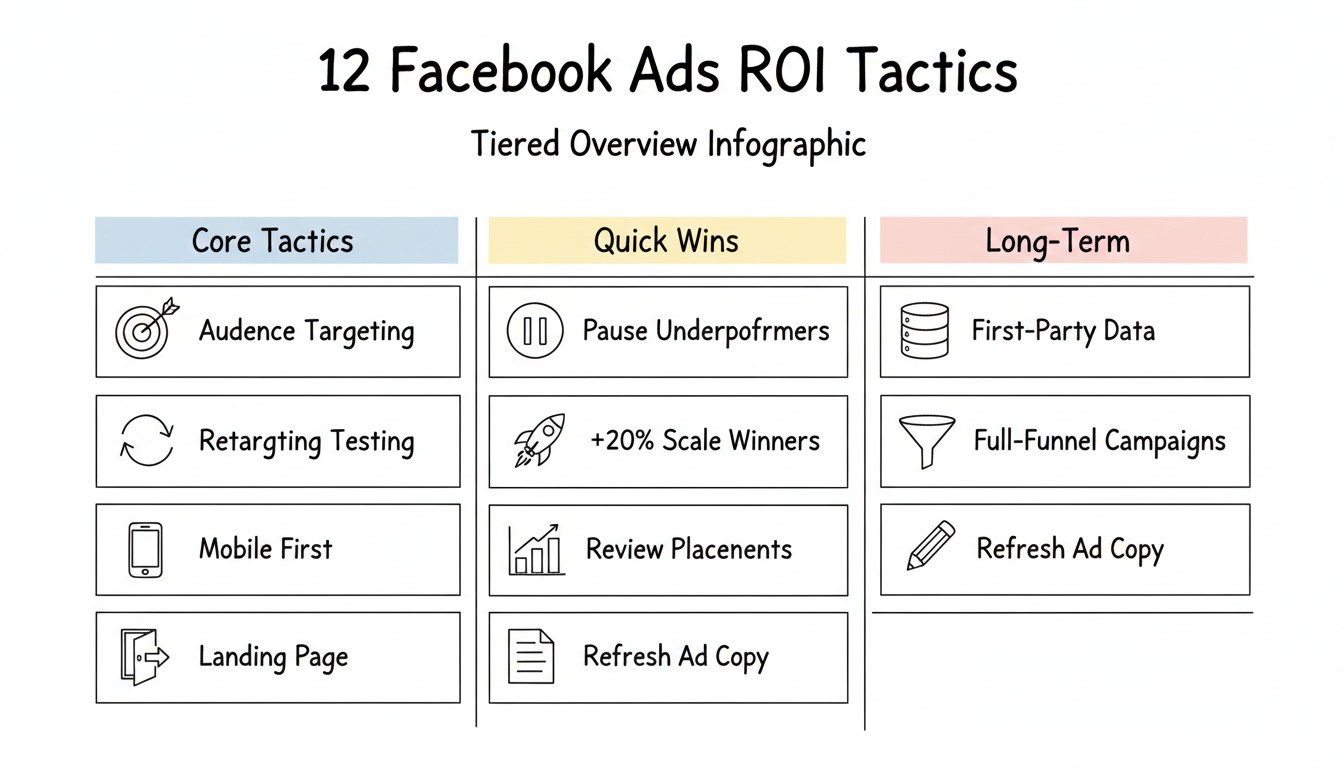
These tactics range from simple adjustments to strategic overhauls. Start with the quick wins, then work through the long-term strategies as you build momentum.
Broad audiences are not always bad, but irrelevant audiences are always expensive. According to Facebook ads optimization research, refining your audience by layering demographics, interests, and behaviors ensures your ads reach individuals most likely to convert.
Action steps:
One company achieved 9.68x ROAS by leveraging interest-based targeting combined with lookalike audiences.
People who already know your brand convert at significantly higher rates. According to retargeting statistics, customers who are retargeted with display ads are 70% more likely to convert.
Retargeting audiences to build:
Ad fatigue kills ROI faster than almost anything else. According to DTC marketing research, testing 3-5 new creative variations weekly fights ad fatigue effectively. When learning how to run effective Facebook ads, creative testing should be your top priority.
Creative testing framework:
Most Facebook users access the platform on mobile devices. Slow-loading or poorly formatted ads lose conversions before they even start.
Mobile optimization checklist:
Bidding too high burns budget. Bidding too low prevents delivery. According to Meta ads bidding research, understanding how to calculate ROI Facebook ads before choosing a bidding strategy prevents common failures.
Bid strategy guidelines:
The best ads in the world cannot save a bad landing page. Your landing page should load fast, match the ad promise exactly, and make the next action obvious.
Landing page essentials:
These tactics can be implemented within hours and often show immediate impact.
Stop spending money on ads that do not work. Set clear performance thresholds and enforce them ruthlessly.
Pause criteria:
According to Facebook automation strategies, automated rules can pause underperforming ads before they burn through budget.
When an ad performs well, scale it before fatigue sets in. A proven meta-ads-scaling-strategy involves increasing budget by around 20% every few days rather than making large jumps.
Scaling rules:
Not all placements perform equally. Some placements may drive cheap clicks but no conversions.
Placement analysis steps:
Sometimes the creative is fine but the copy has gone stale. Test new headlines, body text, and calls-to-action without changing the visual.
Copy refresh ideas:
These strategies require more effort but deliver sustainable ROI improvements.
As tracking becomes harder, your own data becomes more valuable. According to first-party data strategies, combining owned data with Facebook's targeting creates powerful audience segments.
First-party data priorities:
Running only conversion campaigns to cold audiences is expensive. Build a funnel that warms prospects before asking for the sale. Many successful meta ads examples demonstrate the power of full-funnel approaches.
Full-funnel structure:
This approach costs more upfront but reduces overall cost per acquisition by warming audiences before the conversion ask.
Avoiding these errors often improves ROI faster than adding new tactics.
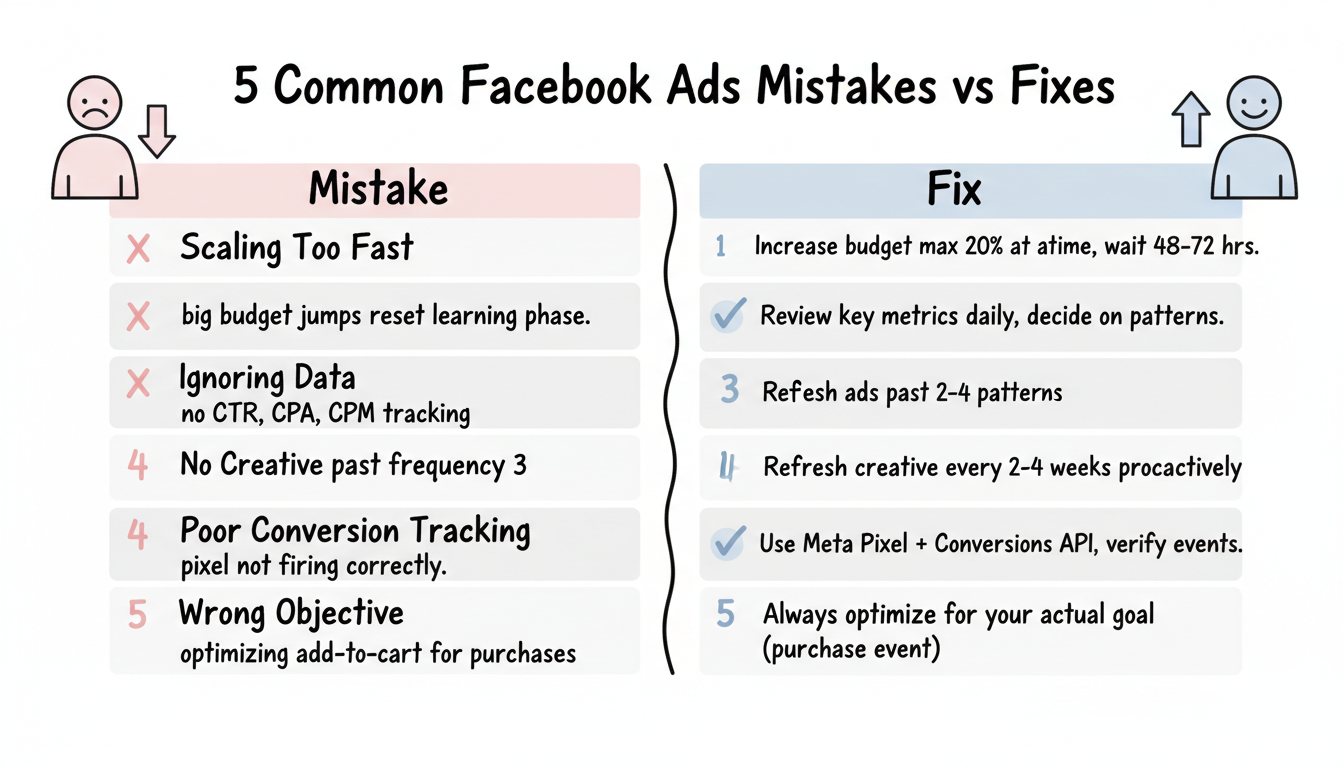
Increasing budget too quickly resets the learning phase and often tanks performance. According to scaling guidelines, one of the biggest mistakes people make is scaling too fast.
The fix: Increase budget by no more than 20% at a time and wait before making additional changes.
Making decisions without data is gambling, not marketing. According to bidding strategy research, you cannot improve Facebook ads cost without having clear data on CTR, CPA, CPM, frequency, and conversion rates.
The fix: Review key metrics daily. Make decisions based on patterns, not single data points.
Running the same ads indefinitely leads to creative fatigue. When your frequency rises above 3 and ROAS declines, it is time for new creative.
The fix: Plan creative refreshes every 2-4 weeks. Have new ads ready before the current ones fatigue.
Bad data leads to bad decisions. If your pixel is not firing correctly or your attribution is broken, you cannot optimize effectively.
The fix: Implement both Meta Pixel and Conversions API. Verify events are firing correctly. Use test events to confirm tracking before launching campaigns.
Optimizing for add-to-carts when you want purchases tells Facebook to find people who add to cart but do not buy. Always optimize for your actual goal.
The fix: Use the purchase event for ecommerce. Use the lead event for lead generation. Trust that Facebook will find the right people when you give it the right signal.
Quick wins like pausing underperformers and increasing budget on winners can show results within days. Strategic changes like audience refinement and creative testing typically need 2-4 weeks to show meaningful impact. Full-funnel restructuring may take 60-90 days to fully mature.
Target ROAS depends on your profit margins. Businesses with 70%+ margins can be profitable at 2x ROAS. Businesses with 40% margins typically need 3x+ ROAS. Calculate your break-even ROAS based on your specific economics before setting targets.
For most advertisers in 2026, automated bidding strategies outperform manual bidding. Meta's machine learning optimizes in real-time better than manual adjustments. Use manual bidding only if you have very specific cost constraints and the volume to support frequent optimization.
By submitting this form, you agree to our Privacy Policy and Terms & Conditions.



