
February 19, 2026


Knowing your Facebook ads ROI is essential for determining whether your campaigns are profitable—and where to invest more. Without accurate ROI tracking, you're essentially flying blind with your ad budget.
This guide covers the formulas you need, step-by-step calculation methods, industry benchmarks, and actionable strategies to improve your returns.
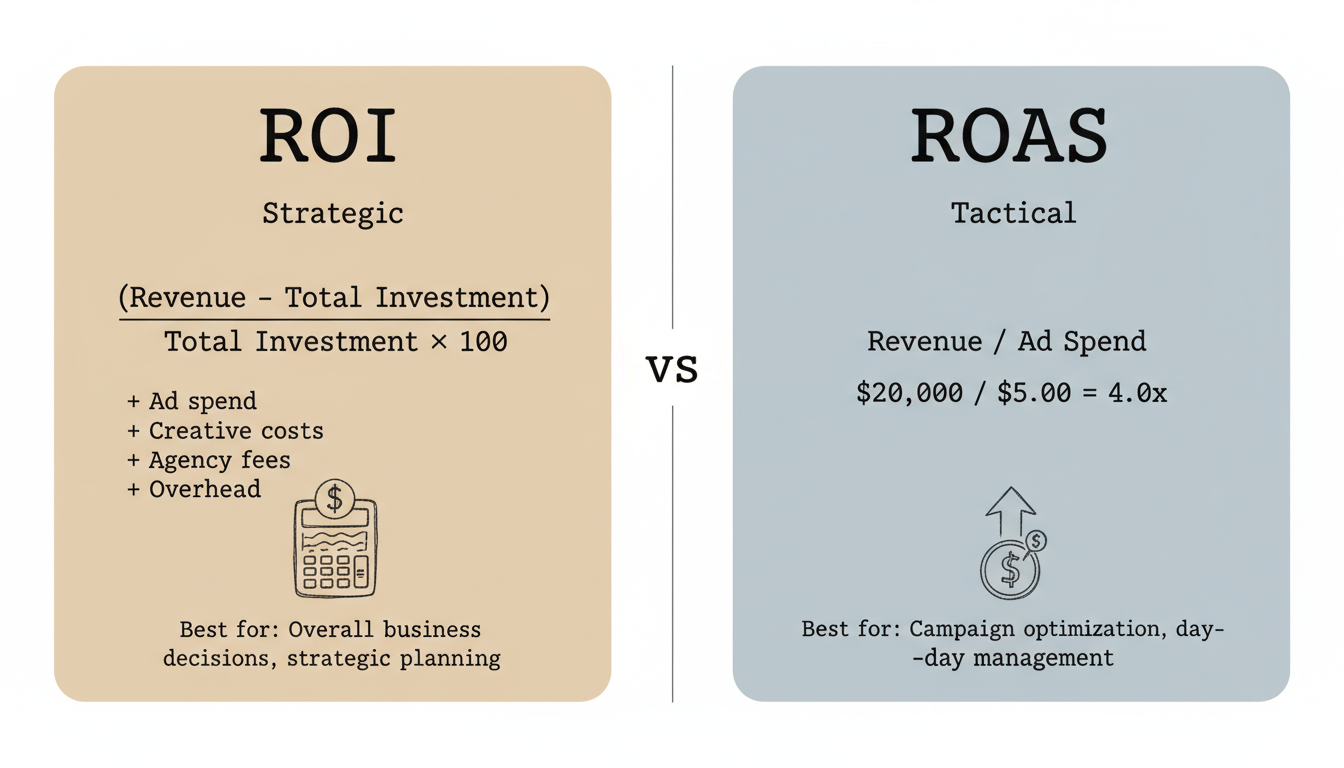
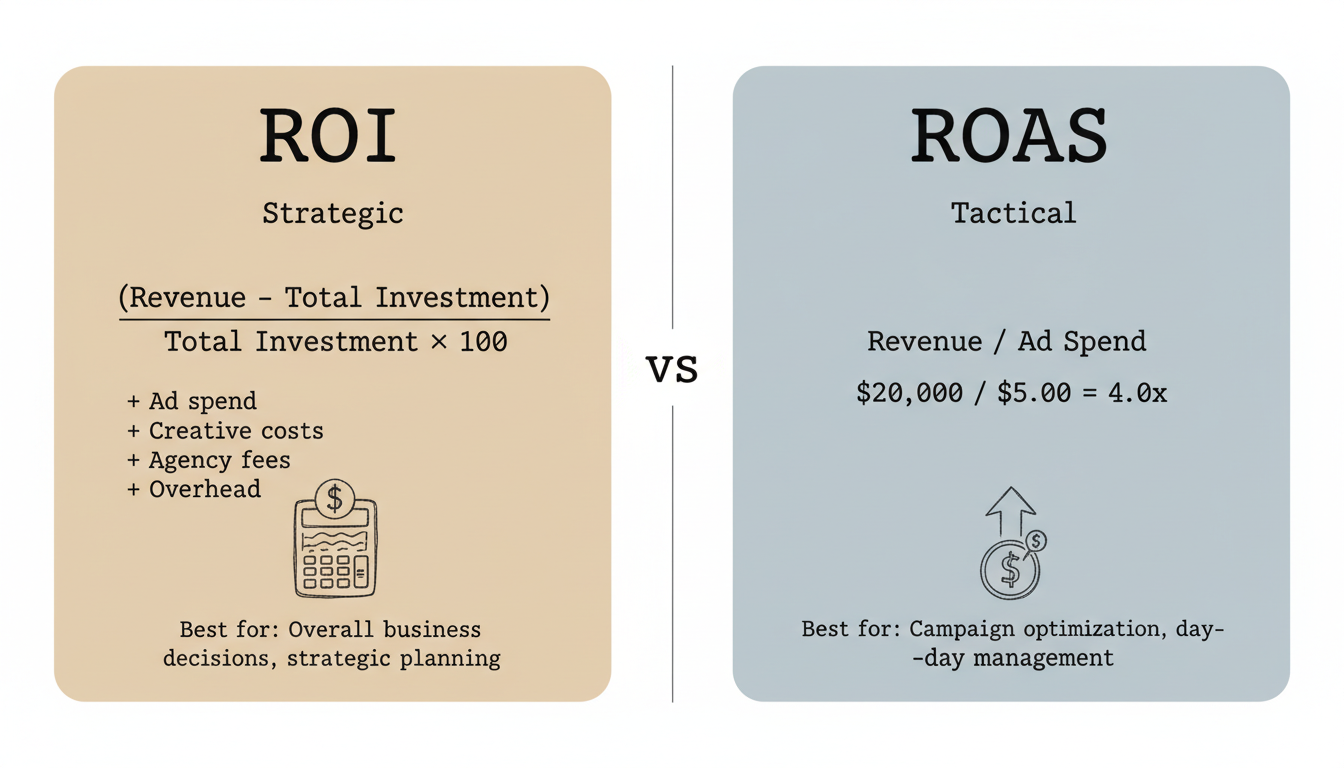
ROI (Return on Investment) and ROAS (Return on Ad Spend) are related but measure different things. Understanding both is crucial for accurate performance analysis.
ROI measures total profitability after accounting for all costs:
ROI = ((Revenue - Total Investment) / Total Investment) × 100
Total investment includes:
According to marketing performance data, the ROI formula gives you a complete financial picture that accounts for all expenses, not just ad spend.
ROAS focuses specifically on revenue generated compared to ad spend:
ROAS = Revenue from Ads / Cost of Ads
For example, if you spent $5,000 on a Facebook campaign and generated $20,000 in revenue, your ROAS would be:
$20,000 / $5,000 = 4.0 ROAS
This means you earn $4 for every $1 spent on ads. ROAS is often expressed as a multiplier (4x or 4:1) or as a percentage (400%).
Metric | What It Measures | Best For |
ROI | Total profitability after all costs | Overall business decisions |
ROAS | Revenue per advertising dollar | Campaign optimization |
ROAS is the more common metric for day-to-day campaign management because it's simpler to track and directly available in Ads Manager. ROI is better for strategic decisions about your overall advertising investment.
Follow this process to calculate your Facebook ads ROI accurately:
Include all costs associated with your campaign:
Example: $2,000 ad spend + $500 creative = $2,500 total investment
Understanding the average cost of facebook ads helps you budget realistically for your total investment.
Track the results based on your campaign objective:
Example: 100 purchases at $50 average = $5,000 revenue
Apply the formula:
ROI = (($5,000 - $2,500) / $2,500) × 100 = 100% ROI
A 100% ROI means you doubled your investment.
For just the ad spend portion:
ROAS = $5,000 / $2,000 = 2.5x ROAS
You earned $2.50 for every $1 spent on ads.
Don't judge campaigns on a single day. Allow 14-21 days minimum for the algorithm to optimize and costs to stabilize before making major decisions.
Understanding industry benchmarks helps you set realistic targets and identify underperforming campaigns.
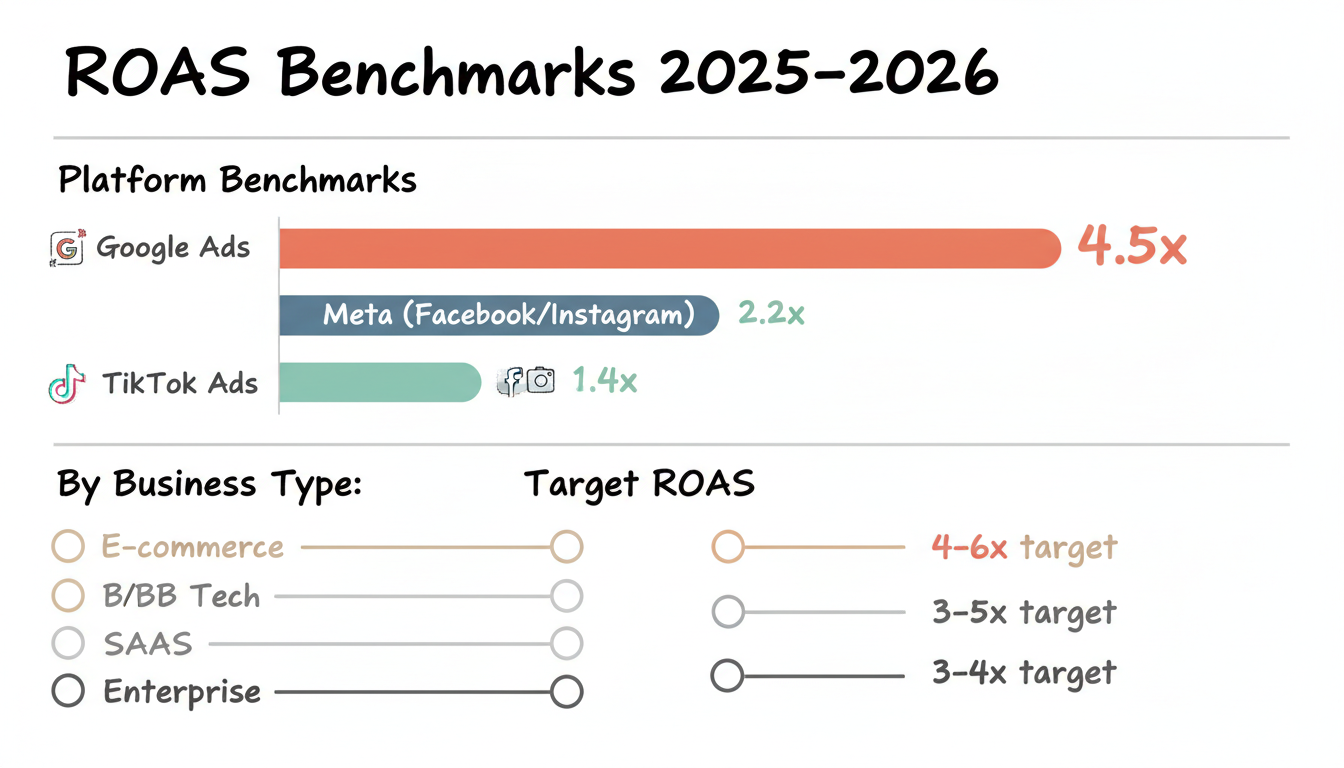
According to recent benchmark data:
Platform | Average ROAS |
Google Ads | 4.5x |
Meta (Facebook/Instagram) | 2.2x |
TikTok Ads | 1.4x |
Industry research shows ROAS varies significantly by sector:
Business Type | Typical ROAS Target |
E-commerce | 4-6x |
B2B Tech | 3-5x |
SaaS | 3-4x |
Enterprise | 2-3x |
If you're starting a facebook ads agency, understanding these benchmarks is critical for setting client expectations.
For context on what's achievable, here are 2026 industry averages:
Industry | Avg. CPC | Avg. CPM | Avg. CPA |
E-commerce | $0.45 | $5.33 | $45.00 |
Retail | $0.70 | $1.38 | $21.47 |
Healthcare | $1.32 | $5.78 | $12.31 |
B2B | $2.52 | $22.50 | $23.77 |
Finance & Insurance | $3.77 | $11.37 | $41.43 |
A ROAS of 4x or higher is generally considered effective and profitable for most businesses. However, your target should depend on:
Once you're tracking ROI, focus on strategies to improve it.
Creative quality has the biggest impact on performance. According to scaling best practices, keeping only top-performing ads active can boost conversion volume by 15-30%.
Test these elements:
Retargeting warm audiences almost always produces better ROI than cold traffic. Use Meta Pixel to track website visitors and create audiences based on specific actions like cart abandonment or page views.
Learning how to run facebook ads for business effectively includes mastering retargeting strategies.
Increasing budgets by more than 20-30% often triggers a learning reset and can raise CPA by 25-40%. Scale winning campaigns slowly to maintain performance.
Ensure your Meta Pixel and Conversions API (CAPI) are correctly configured. Incomplete tracking means incomplete data, leading to poor optimization decisions.
Optimize for purchases or qualified leads rather than clicks or engagement. Facebook's algorithm works best when given clear conversion signals.
Staying compliant with meta ads policy while optimizing for conversions ensures your campaigns remain active and effective.
By submitting this form, you agree to our Privacy Policy and Terms & Conditions.



