
February 19, 2026


Choosing where to spend your advertising budget is one of the most important decisions in digital marketing. Facebook, Instagram, and Google each serve different purposes in the customer journey, and understanding these differences determines whether your ads generate returns or waste money.
This guide breaks down how each platform works, what they cost, when to use each one, and how to combine them for maximum impact in 2026.
Each platform approaches advertising differently based on user behavior and intent.
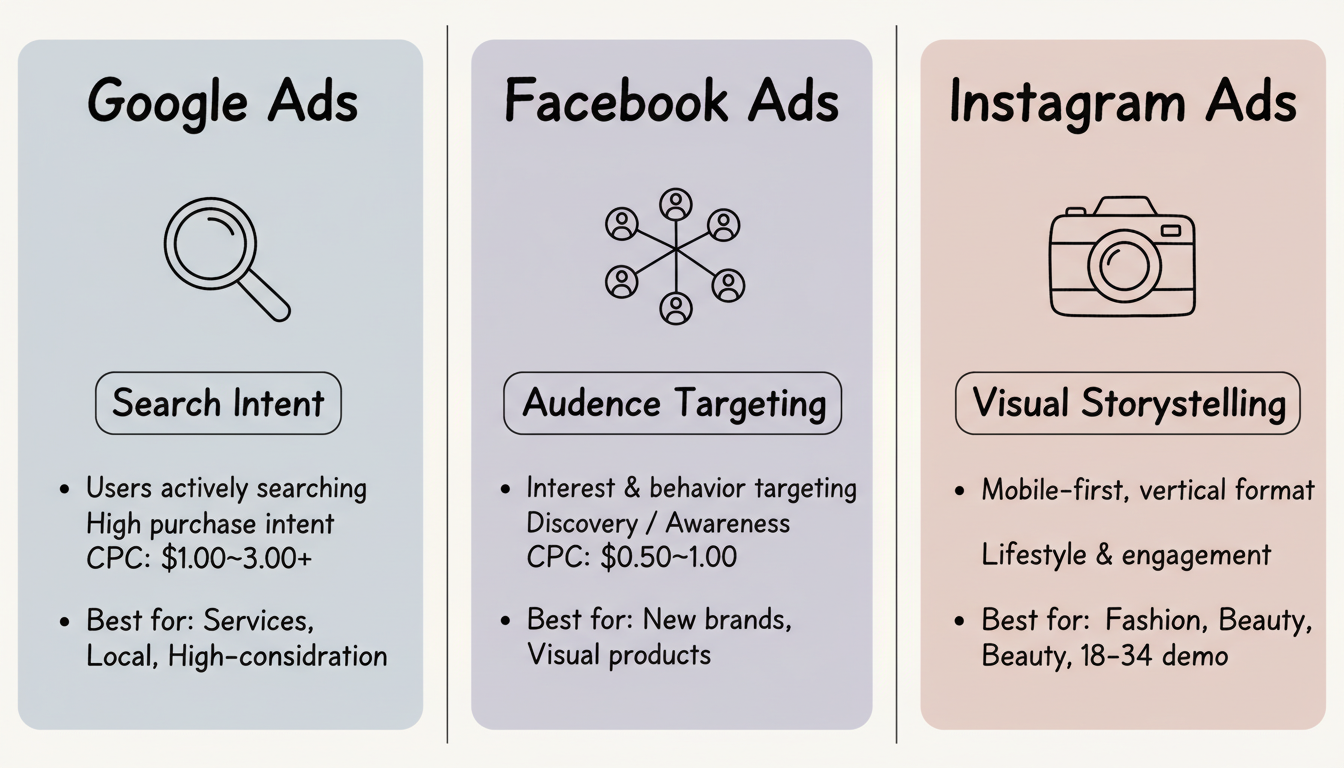
Google Ads is built around search intent. Users come to Google looking for specific products, services, or information. Your ads appear when someone actively searches for what you offer.
According to platform comparison research, Google Ads excels at high-intent leads and fast conversions because users are already searching with clear needs.
How Google Ads works:
Best for:
Facebook Ads target users based on demographics, interests, and behaviors rather than search intent. Users are not actively shopping; they are scrolling through their feeds. Your ads interrupt their experience to introduce products and services.
According to digital advertising platform analysis, Meta remains a core channel for full-funnel performance, primarily designed as a discovery platform that showcases relevant products across Facebook, Instagram, WhatsApp, and Messenger.
How Facebook Ads work:
Best for:
Instagram operates within Meta's advertising system but serves a distinct audience and purpose. The platform skews younger, more visually oriented, and more engaged with lifestyle content.
According to Instagram advertising research, the most effective Instagram ads are mobile-friendly with vertical visuals and minimal text.
How Instagram Ads work:
Best for:
Understanding cost benchmarks helps set realistic expectations and allocate budget effectively. When evaluating meta advertising cost, remember that platform expenses vary significantly based on targeting, creative quality, and campaign objectives.
Metric | Facebook Ads | Instagram Ads | Google Search Ads |
CPC (Cost Per Click) | $0.50-$1.00 | $1.00-$1.50 | $1.00-$3.00+ |
CPM (Cost Per 1,000 Impressions) | $8-$14 | $12-$18 | Varies by display |
CPL (Cost Per Lead) | $10-$30 | $10-$35 | $20-$100+ |
According to social media advertising cost analysis, Meta platforms show average CPMs between $8 and $14 depending on market, while Instagram benchmarks show CPMs around $15.26.
What drives costs up:
What keeps costs down:
Lower cost per click does not always mean better value. According to Google vs Facebook comparison data, Google Ads typically has higher CPC but captures users with stronger purchase intent, often resulting in better conversion rates.
Consider cost per acquisition (CPA) and return on ad spend (ROAS) rather than just click costs when comparing platforms. Understanding facebook-ads-vs-google-ads-cost helps you make informed decisions about where to allocate your budget for maximum return.
Each platform excels in specific scenarios.
High search demand exists: If people actively search for your product category, Google captures that intent directly. Search campaigns work well for established categories with proven demand.
Your product requires research: High-consideration purchases like software, professional services, and expensive items benefit from appearing when users are in research mode.
Local services: Google dominates for local businesses. Users searching "plumber near me" or "dentist in [city]" have immediate intent that Google captures effectively.
You need faster conversions: According to platform performance analysis, Google typically delivers faster conversion speed for service-based offers because users already have clear needs.
Your product is visual: Products that look impressive or benefit from demonstration perform well on Facebook. Fashion, home goods, and consumer products thrive on visual storytelling.
You are building awareness: New brands without existing search demand need to create awareness before they can capture it. Facebook introduces products to audiences who do not yet know they want them.
Your audience responds to targeting: If you can define your ideal customer by interests, behaviors, or demographics, Facebook's targeting precision delivers relevant audiences cost-effectively.
You have strong creative: Facebook rewards compelling creative. If you can produce engaging video or eye-catching images, the platform amplifies your reach at lower costs. Learning how to create facebook ads for beginners helps you develop effective campaigns from the start.
Your audience is younger: Instagram skews toward users 18-34. If that is your primary demographic, the platform provides native access to their attention.
Visual quality is your strength: Brands with strong aesthetic identity, professional photography, or lifestyle positioning find Instagram audiences highly receptive.
You want engagement: According to social media cost research, Instagram users engage actively with content, making it strong for brand building and community development.
Stories and Reels fit your message: Vertical video formats dominate Instagram. If your message works in short, mobile-first video, Instagram delivers.
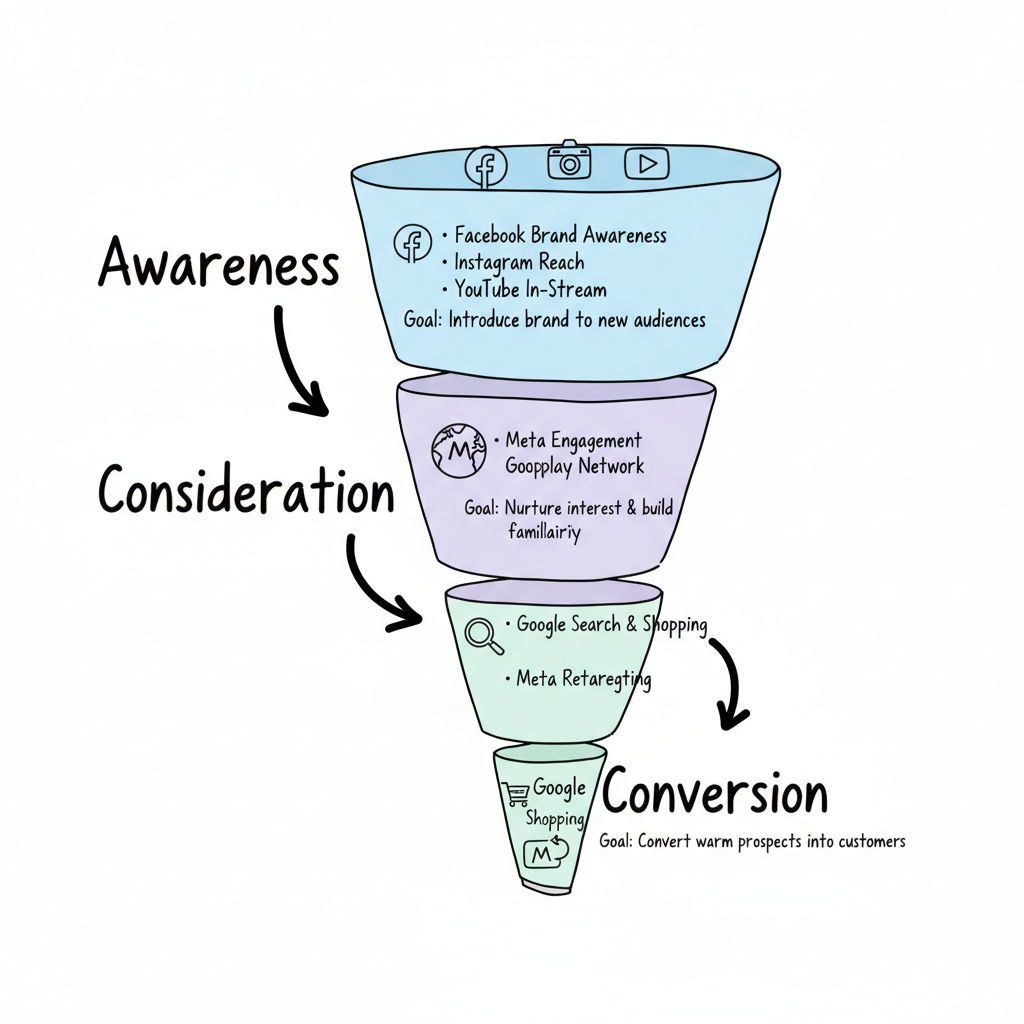
The most effective advertisers do not choose one platform; they use all three strategically.
According to multi-platform strategy experts, in 2026 the best-performing brands integrate both Meta and Google to cover the entire customer journey:
Awareness Stage:
Consideration Stage:
Conversion Stage:
If budget is limited ($3,000-5,000/month): Focus on one platform initially based on your product and audience. Build expertise and data before expanding.
If budget is moderate ($5,000-15,000/month): Split 60/40 between your primary and secondary platform. Test both while maintaining enough spend on each for meaningful optimization.
If budget is substantial ($15,000+/month): Run full-funnel campaigns across all three platforms. Use Meta for awareness and retargeting, Google for intent capture, and measure cross-platform attribution.
Running both platforms creates compounding effects:
This cross-platform lift often shows in assisted conversions where users saw multiple ads across platforms before purchasing. To fully leverage both ecosystems, explore detailed comparisons of google-ads-vs-facebook-ads-which-is-better for your specific business model.
ROI depends on your specific business, audience, and creative. Google typically delivers higher conversion rates due to intent capture. Meta often delivers lower cost per reach. The best ROI usually comes from using both platforms together, with Meta building awareness and Google capturing demand.
Start with Google Ads if your product has established search demand and you want faster conversions. Start with Facebook Ads if your product is visual, search volume is low, or you need to build awareness first. If uncertain, test both with small budgets before committing larger spend.
Yes, both platforms are managed through Meta Ads Manager. You can run identical ads across both or create platform-specific versions. Instagram generally requires more polished, vertical creative while Facebook tolerates longer text and more informational content.
By submitting this form, you agree to our Privacy Policy and Terms & Conditions.



