February 19, 2026


Google Ads and Facebook Ads are the two dominant digital advertising platforms, but they work fundamentally differently. Choosing between them isn't about picking a winner—it's about picking the right strategy for your business goals.
This guide provides a framework for deciding where to invest, analysis by business type, budget considerations, and clear recommendations based on your situation.
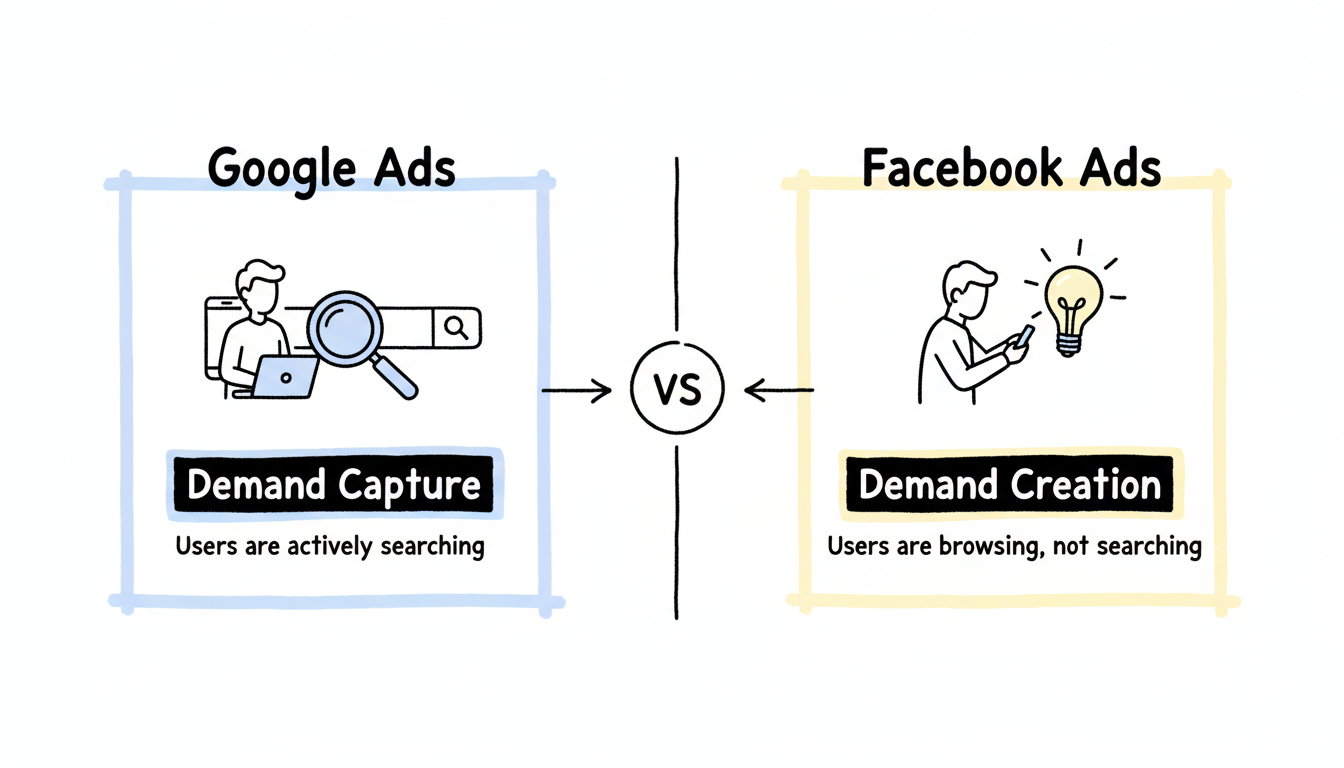
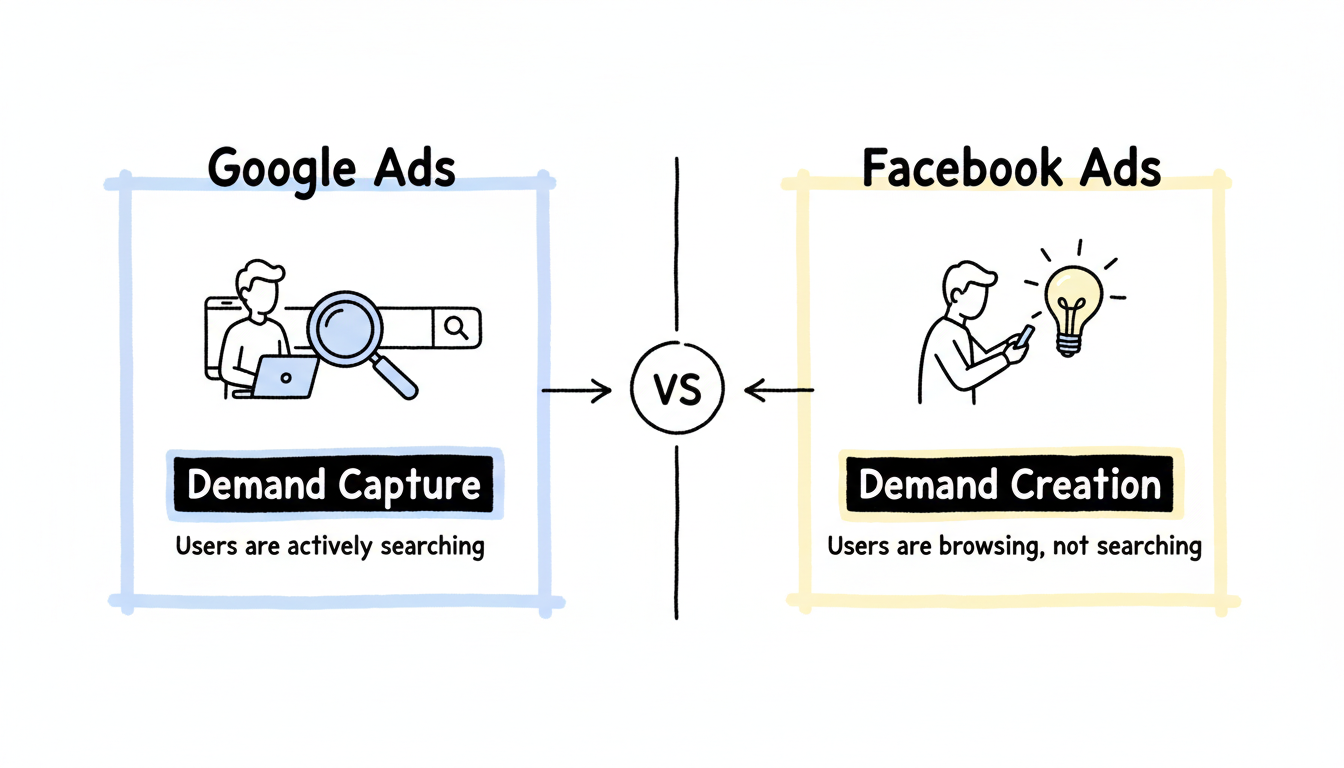
The core distinction between these platforms is intent:
Google Ads captures demand. Users actively search for products, services, or solutions. They have intent—they're looking for something specific right now.
Facebook Ads creates demand. Users are browsing, not searching. They're discovering products and services they didn't know they wanted.
As one 2026 comparison explains: Google Ads is more effective at capturing search intent, while Facebook Ads excels at attracting and educating audiences who aren't actively searching yet.
High-intent situations:
Best use cases:
Discovery and awareness situations:
Best use cases:
The best-performing brands in 2026 aren't choosing one over the other—they're integrating both to cover the entire customer journey:
This full-funnel approach consistently outperforms single-platform strategies for businesses with sufficient budget.
For ecommerce in 2026:
Google Ads strengths:
Facebook Ads strengths:
Recommendation: Start with Google if you have search demand for your product category. Use Facebook to create demand, test creative angles, and scale winners. Most successful brands use both, shifting budgets based on ROAS and seasonality.
Plumbers, dentists, gyms, salons, repair services, and similar local businesses.
Google Ads strengths:
Facebook Ads strengths:
Recommendation: Google Ads should be primary for local services because search intent is extremely strong. Use Facebook for community building and awareness, but Google captures the ready-to-buy customer.
Google Ads reality:
Facebook Ads reality:
Recommendation: If you need immediate, high-intent leads, start with Google. If you can nurture leads over time and have compelling offers, Facebook can generate volume at lower cost. Most B2B companies do best with Google for immediate needs and Facebook for pipeline building.
Facebook Ads usually wins here:
Google Ads alternative:
Recommendation: For pure awareness, Facebook and Instagram are typically more cost-effective. YouTube (within Google Ads) can be powerful for video-focused brands.
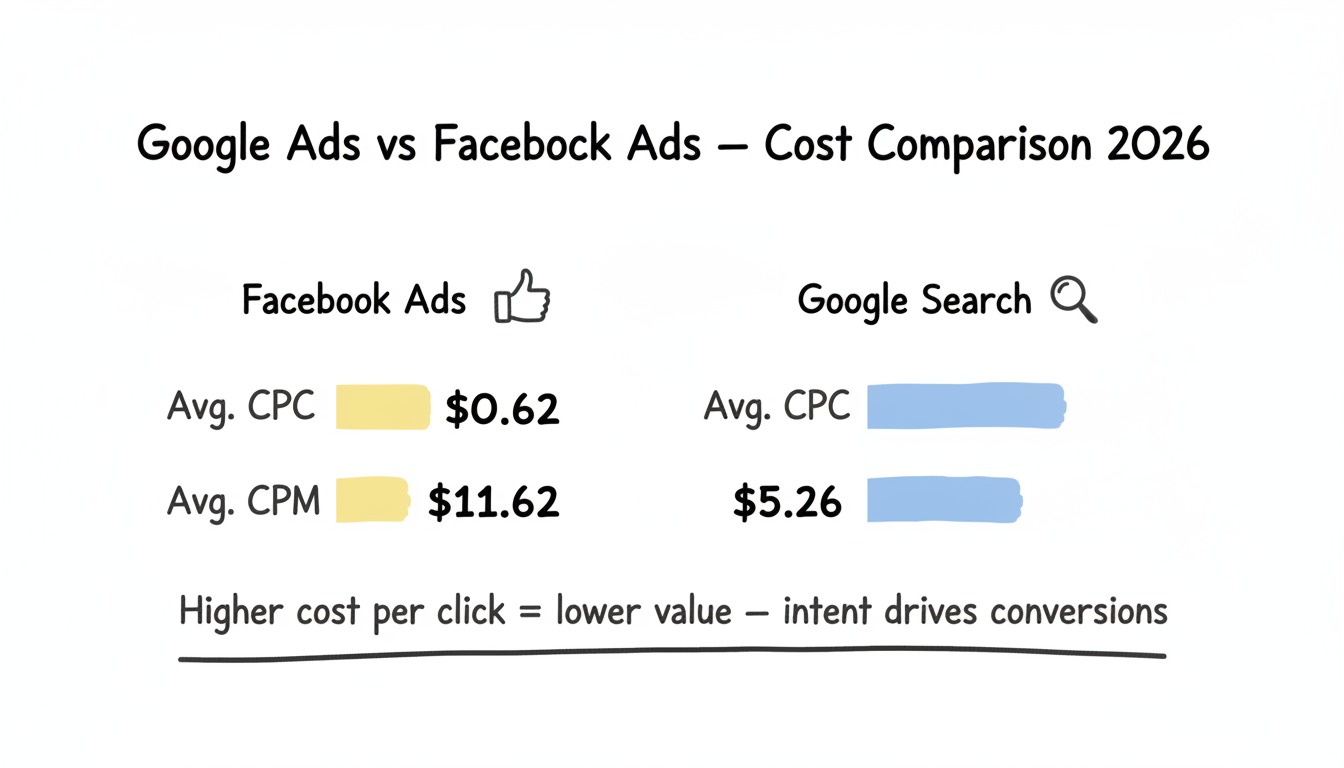
Based on 2024-2025 benchmark data, here's how costs compare:
Metric | Facebook Ads | Google Search Ads | Google Display |
Avg. CPC | $0.62 | $5.26 | $0.63 |
Avg. CPM | $11.62 | N/A | $3.12 |
What this means: Facebook offers lower costs per click, but Google Search delivers higher-intent traffic. Understanding what is good ROI for Facebook ads helps contextualize whether the "cheaper" platform depends entirely on your conversion rates and customer value.
Facebook Ads costs vary significantly by industry:
Industry | Avg. CPC | Avg. CPA |
Healthcare | $1.32 | $12.31 |
Education | $1.06 | $7.85 |
E-commerce | $0.45 | $45.00 |
B2B | $2.52 | $23.77 |
Finance & Insurance | $3.77 | $41.43 |
Retail | $0.70 | $21.47 |
Compare this to Google Ads where finance and legal keywords can exceed $50+ per click. When evaluating Facebook ads cost per day, many high-CPC industries find Facebook provides a more cost-effective entry point.
According to 2026 marketing budget data, paid search (Google Ads) delivers average ROI of 2:1 to 4:1 when executed strategically. However, customer acquisition costs have increased 40% across ecommerce since 2023, now averaging $78 per customer.
For direct ecommerce sales:
For lead generation:
Understanding the average ROI for Facebook ads provides critical benchmarks for comparing platform performance in your specific industry.
For businesses able to use both platforms:
Small budgets ($1,000-$3,000/month):
Medium budgets ($3,000-$10,000/month):
Larger budgets ($10,000+/month):
Go Google Ads first if:
Go Facebook Ads first if:
The best strategy in 2026 is often to use both together:
This approach ensures you're both creating demand (Facebook) and capturing it (Google) rather than depending on one strategy alone. Many businesses partner with a Facebook agency partner to maximize cross-platform effectiveness.
Google Ads trends:
Facebook Ads trends:
Both platforms are investing heavily in AI-driven optimization. The winners will be advertisers who provide these systems with quality creative and let the algorithms optimize delivery.
Neither is universally better—they serve different purposes. Google Ads captures existing demand from people actively searching. Facebook Ads creates demand by reaching people who aren't searching yet. Most successful businesses use both to cover the entire customer journey, with budget allocation based on which delivers better ROI for their specific situation.
Facebook Ads typically offers lower entry costs, with lower CPCs and flexible budgeting that lets beginners experiment on small budgets. However, "cheaper" clicks don't always mean better ROI. Google Ads may cost more per click but often delivers higher-intent visitors who convert at better rates. Start with the platform that matches your business type and goals.
Yes, but start focused. Pick one platform that best matches your immediate needs, build proficiency, and achieve consistent results before splitting budget. A $2,000/month budget spread across both platforms often underperforms $2,000 focused on one platform done well. Once you're profitable on one, expand to the other for incremental growth.
By submitting this form, you agree to our Privacy Policy and Terms & Conditions.