February 19, 2026


Understanding average returns on Facebook advertising helps you set realistic expectations and identify whether your campaigns are underperforming or outpacing the competition. Industry benchmarks provide context, but your specific results depend on margins, targeting, creative quality, and funnel strategy.
This guide covers current Facebook ads ROI and ROAS benchmarks by industry, factors that influence returns, and practical ways to improve your performance.
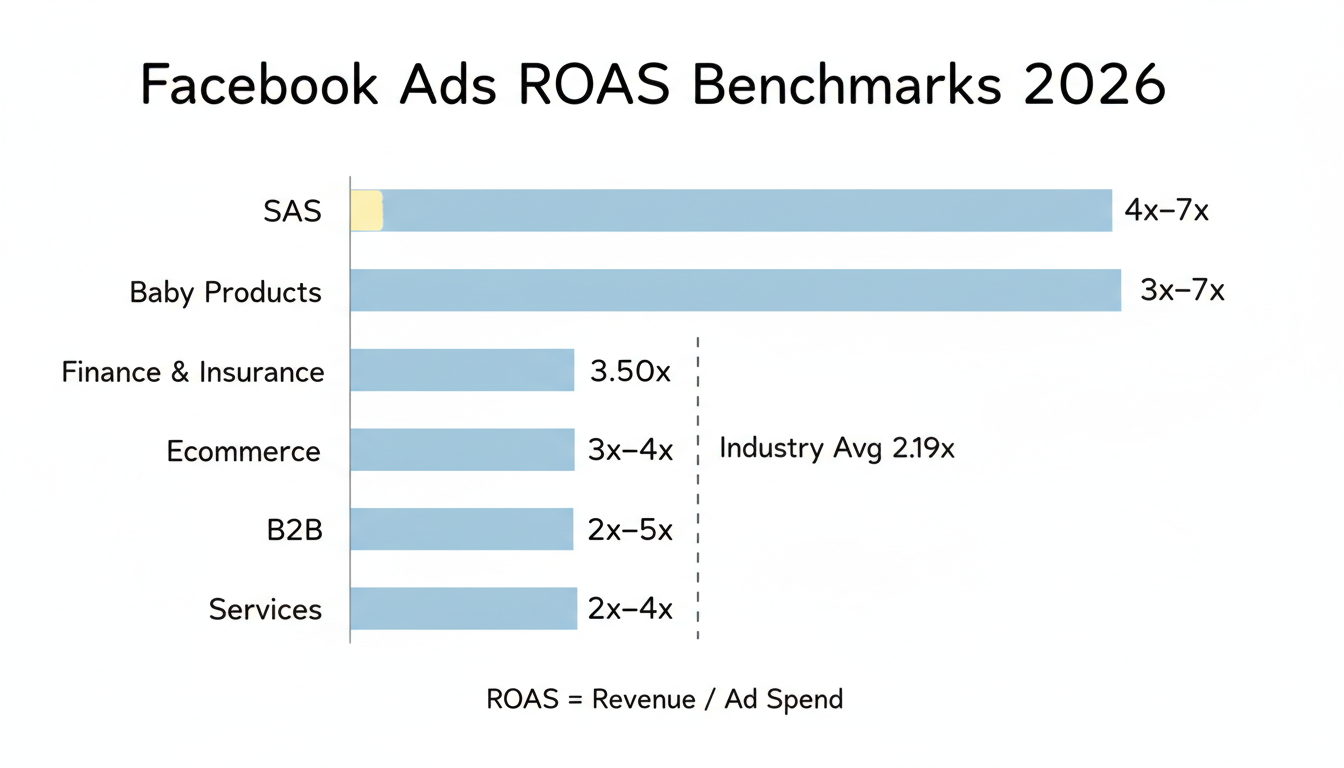
Facebook ad performance varies dramatically across industries. According to ROAS benchmark research, the 2026 average Facebook ads ROAS across all industries is 2.19:1, meaning every dollar spent returns $2.19 in tracked revenue.
However, this average masks significant variation by category.
Industry | Average ROAS | Notes |
Baby Products | 3.71:1 | High urgency, emotional buying, repeat purchases |
Finance & Insurance | 3.50:1 | High customer lifetime value |
SaaS | 4x-7x | Long sales funnels, strong retargeting potential |
Ecommerce | 3x-4x | Variable by product category |
B2B | 2x-5x | Longer sales cycles, higher deal values |
Services | 2x-4x | Often local or niche audiences |
According to Facebook ads ROI analysis, SaaS companies often achieve the highest ROAS due to high lifetime values and strong retargeting potential.
According to social media advertising research, campaign type significantly impacts returns:
Campaign Type | Median ROAS |
Facebook Retargeting | 3.61x |
Facebook Overall | 2.19x |
Google Search | 4.52x |
TikTok (Value Optimization) | 2.25x |
TikTok Overall | 1.41x |
Retargeting campaigns consistently outperform prospecting campaigns because they reach people already familiar with your brand.
Different business models see different returns based on their economics and customer journey.
Ecommerce businesses typically target 3x-4x ROAS on Facebook. According to PPC benchmark data, a 3.5:1 ROAS is a solid cross-industry benchmark.
What affects ecommerce ROAS:
When comparing advertising channels, businesses often evaluate Google Ads vs Facebook Ads for ecommerce to determine the optimal platform mix for their specific products and margins.
B2B companies often see wider ROAS ranges (2x-5x) due to longer sales cycles and higher deal values. According to industry ROAS analysis, B2B SaaS typically achieves 1.70x ROAS on paid search while Facebook can deliver 1.8x average.
B2B considerations:
Service businesses often see 2x-4x ROAS but may focus more on cost per lead metrics. According to Facebook cost data, education services see an average CPA of $7.85 while automotive services average $43.84.
Several factors determine whether your Facebook ads deliver above or below average returns.
According to social media cost research, the more specific and in-demand your audience, the more you pay to reach them. Retargeting warm audiences is almost always cheaper and delivers higher ROAS than cold prospecting.
Targeting impact on costs:
Factor | Effect |
Cold audiences | Higher CPC, lower conversion rate |
Warm retargeting | Lower CPC, higher conversion rate |
Narrow targeting | Higher CPM but potentially better quality |
Broad targeting | Lower CPM but requires strong creative |
Strong creative can overcome targeting challenges and reduce costs. Facebook rewards engaging content with lower delivery costs through its relevance scoring system. If you're just getting started, learning how to create Facebook ads for beginners can help you develop effective creative assets that drive engagement.
Your landing page directly impacts conversion rates. Slow loading, poor mobile experience, or mismatched messaging between ad and landing page kills conversions regardless of how good your targeting is.
According to Facebook advertising cost analysis, costs vary dramatically by industry:
Industry | Average CPC | Average CPM |
Finance & Insurance | $3.77 | $11.37 |
B2B | $2.52 | $22.50 |
Legal Services | $1.81 | $11.31 |
Ecommerce | $0.45 | $5.33 |
Apparel | $0.45 | $5.99 |
Higher competition industries pay more per click but often have higher customer values to compensate. Understanding meta advertising cost benchmarks helps you evaluate your performance relative to competitors.
If your ROAS falls below industry benchmarks, these strategies can help improve returns.
According to digital marketing budget research, social media marketing delivers an average ROI of $5.28 for every $1 spent when properly executed. The key is full-funnel implementation.
Full-funnel approach:
Many businesses partner with a Facebook ads management agency to develop and execute full-funnel strategies effectively, or work with specialized agencies like those offering white label Facebook ads agency services to scale their client management capabilities.
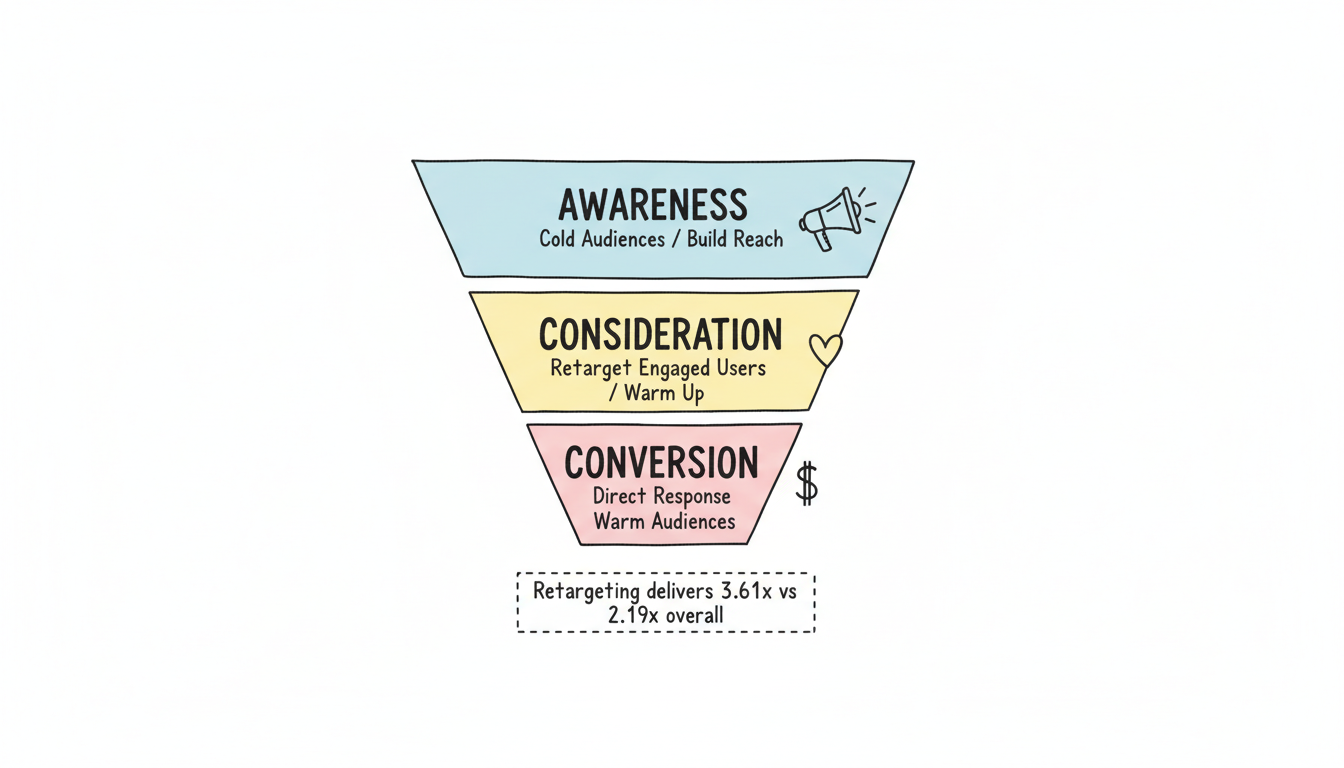
Since retargeting campaigns deliver 3.61x median ROAS compared to 2.19x overall, increasing your retargeting budget allocation often improves overall account performance.
Retargeting audiences to build:
Creative fatigue kills performance over time. Test new formats, messages, and visuals regularly to maintain engagement and keep costs down.
Poor tracking understates your true ROAS. Implement both Meta Pixel and Conversions API to capture more conversion data, especially with iOS privacy changes limiting browser-based tracking. Using a Facebook ads ROI calculator can help you measure true performance across different attribution windows.
According to industry benchmarks, a 4-6x ROAS is often cited as a target, but "good" depends entirely on your margins. A business with 70% margins can be profitable at 2x ROAS, while a business with 30% margins needs 4x+ to break even. Calculate your break-even ROAS based on your specific economics. To understand profitability better, consider exploring what is good ROI Facebook ads for your specific business model.
Common causes include targeting cold audiences without warm-up campaigns, poor creative that fails to engage, landing pages that do not convert, and inadequate tracking that misses conversions. Start by auditing your funnel end-to-end rather than just adjusting ad settings.
ROI = (Revenue from ads - Cost of ads) / Cost of ads. If you spend $1,000 and generate $3,000 in revenue, your ROI is 200%. ROAS uses a simpler formula: Revenue / Ad Spend. The same example would show 3x ROAS.
By submitting this form, you agree to our Privacy Policy and Terms & Conditions.