February 19, 2026


Understanding what constitutes a good ROI for Facebook ads is essential for evaluating campaign success and setting realistic expectations. The answer isn't universal—it depends on your industry, business model, and profit margins.
According to data from Varos, the median ROAS (Return on Ad Spend) on Facebook Ads is 2.24x, meaning advertisers earn $2.24 for every $1 spent. However, this number varies significantly by industry, and what's "good" for one business may be insufficient for another.
ROAS measures revenue generated per dollar of ad spend. ROI factors in all costs, including product costs, fulfillment, and overhead.
ROAS Formula: Revenue from Ads ÷ Ad Spend ROI Formula: (Revenue - Total Costs) ÷ Total Costs × 100
A ROAS of 3x means you earn $3 for every $1 in ad spend. Whether that's profitable depends on your margins.
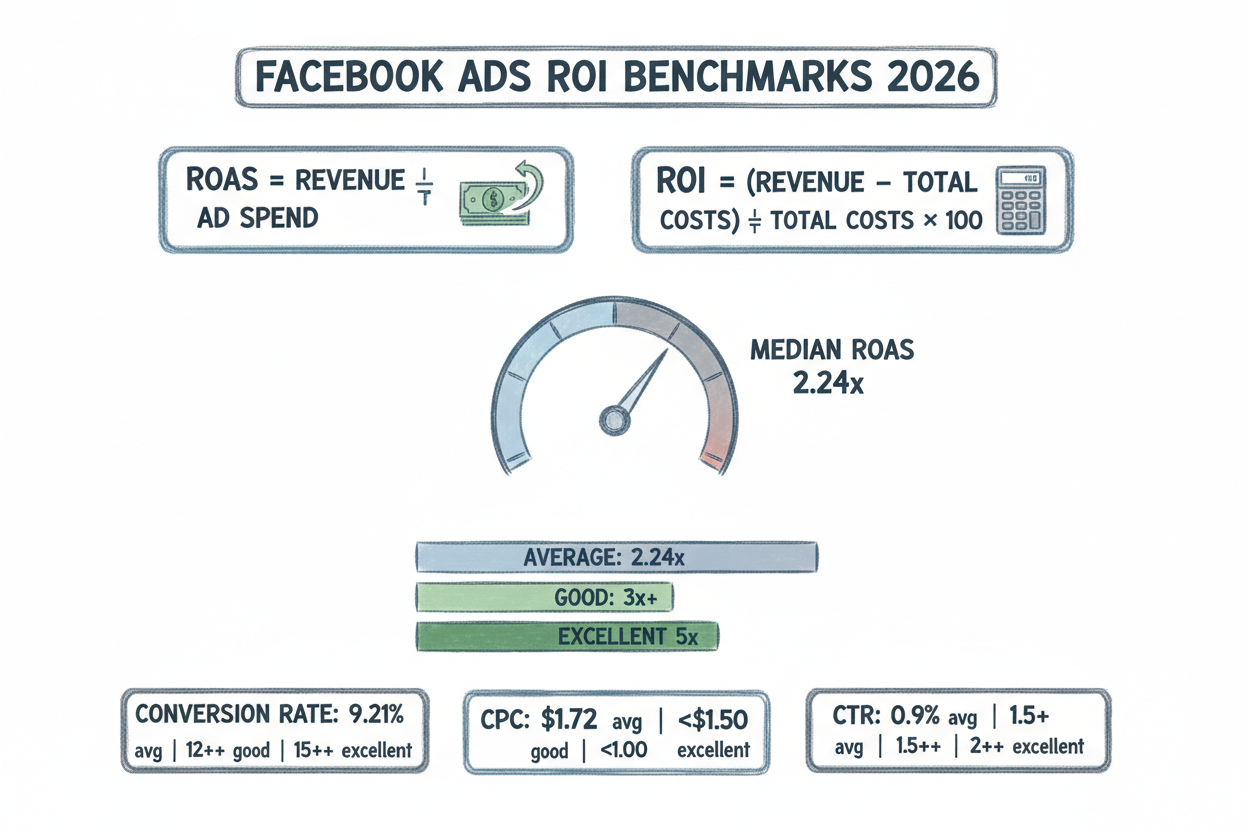
Metric | Average | Good | Excellent |
ROAS | 2.24x | 3x+ | 5x+ |
Conversion Rate | 9.21% | 12%+ | 15%+ |
CPC | $1.72 | <$1.50 | <$1.00 |
CTR | 0.9% | 1.5%+ | 2%+ |
Industry data shows the average conversion rate for Facebook ads across all industries is 9.21%, making it one of the highest-converting digital advertising platforms.
For most businesses, a ROAS of 3x is considered the minimum for profitability after accounting for product costs and overhead. However, this varies:
Different industries see dramatically different results from Facebook advertising. Here's what the data shows for 2026:
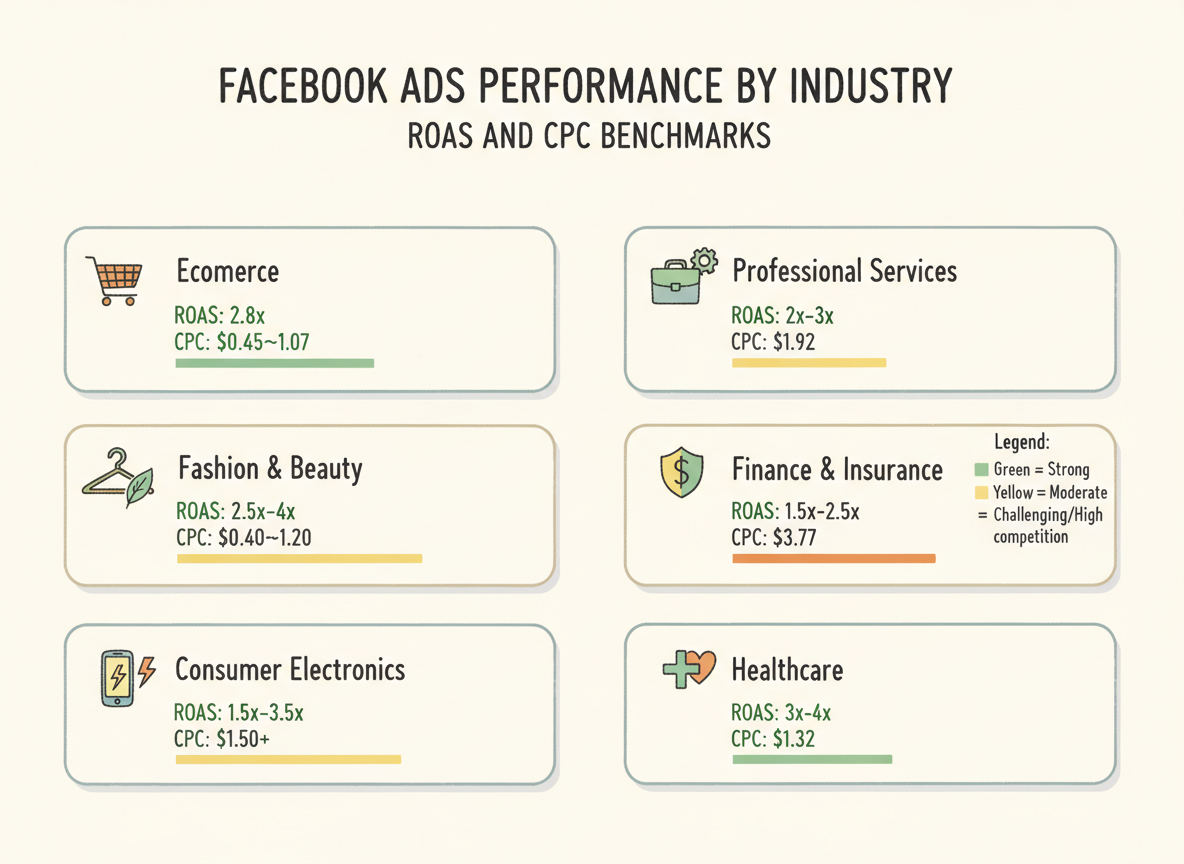
Ecommerce campaigns average 2.8x ROAS, with top performers reaching 3x or higher. Key metrics:
Ecommerce benefits from dynamic product ads and strong retargeting capabilities on Meta platforms.
Fashion and beauty brands typically see:
Visual quality and influencer-style creative significantly impact performance in this vertical.
Consumer electronics ROAS varies widely, typically falling between 1.5x and 3.5x depending on price points and margins. Higher ROAS often requires:
Lead generation for professional services shows:
According to Wordstream data, the average cost per lead for Facebook ads across industries is $23.10.
Finance and insurance face the highest costs due to competitive audiences:
Despite higher costs, the lifetime value of financial customers often justifies the investment.
Healthcare advertising shows favorable economics:
Lower competition and high patient lifetime values make healthcare a strong vertical for Facebook ads.
For direct-to-consumer brands selling products online:
B2C benefits from impulse purchasing and shorter sales cycles. Top ecommerce brands see add-to-cart rates exceeding 10% compared to the 6% average.
B2B Facebook advertising typically shows:
B2B campaigns often focus on lead generation rather than direct sales, making CPL (cost per lead) the primary success metric. A good CPL is highly industry-specific but should be evaluated against customer lifetime value. When comparing acquisition channels, many marketers find insights on platforms like Google Ads vs Facebook Ads Reddit helpful for understanding which platform delivers better returns for their specific business model.
Over 70% of Facebook users visit local business pages weekly, making Facebook effective for local targeting. Local businesses should focus on:
SaaS companies typically track:
A "good" ROI depends entirely on your customer lifetime value and conversion rates through the funnel. SaaS with $100+ monthly subscriptions can afford higher CPAs than those with $10/month products.
Your creative is effectively your targeting in 2026. Better creative leads to lower costs and higher conversion rates. Focus on:
Without accurate tracking, you can't measure true ROI. Essential setup:
Retargeted customers are 70% more likely to convert. Build layered campaigns:
Understanding the structure of a successful Meta ads funnel strategy can significantly improve your targeting and conversion rates at each stage.
High CTR with low conversion often means landing page problems. Ensure:
Profitability depends on your margins. With 60% margins, a 2x ROAS could be profitable. With 30% margins, you likely need 4x+ ROAS. Calculate your break-even point: if product costs are 40% of revenue and ad spend is another 25%, you need ROAS above 4x before considering overhead. Before launching campaigns, use a Facebook ads cost calculator to model different scenarios and determine your break-even ROAS.
Common causes include: weak creative that doesn't stop the scroll, targeting too narrow or too broad, poor landing page experience, tracking issues missing conversions, and insufficient budget for the learning phase. Review each element systematically rather than assuming the platform doesn't work. Small businesses facing budget constraints may benefit from working with a Facebook ads agency small business specialist who can optimize limited budgets more effectively.
Give campaigns at least 7-14 days and 50+ conversions before evaluating ROI. The learning phase requires sufficient data for Meta's algorithm to optimize. Judging campaigns too early often leads to killing potential winners prematurely.
By submitting this form, you agree to our Privacy Policy and Terms & Conditions.