February 19, 2026


SearchGPT doesn't just pull from your website—it synthesizes information from review platforms when answering recommendation queries. When users ask "What's the best project management tool?" or "Should I use [your company]?", SearchGPT weighs review platform data alongside other sources. Your G2, Clutch, and TrustPilot presence directly influences these AI-generated recommendations.
This guide covers platform-specific optimization tactics, not general review management principles.
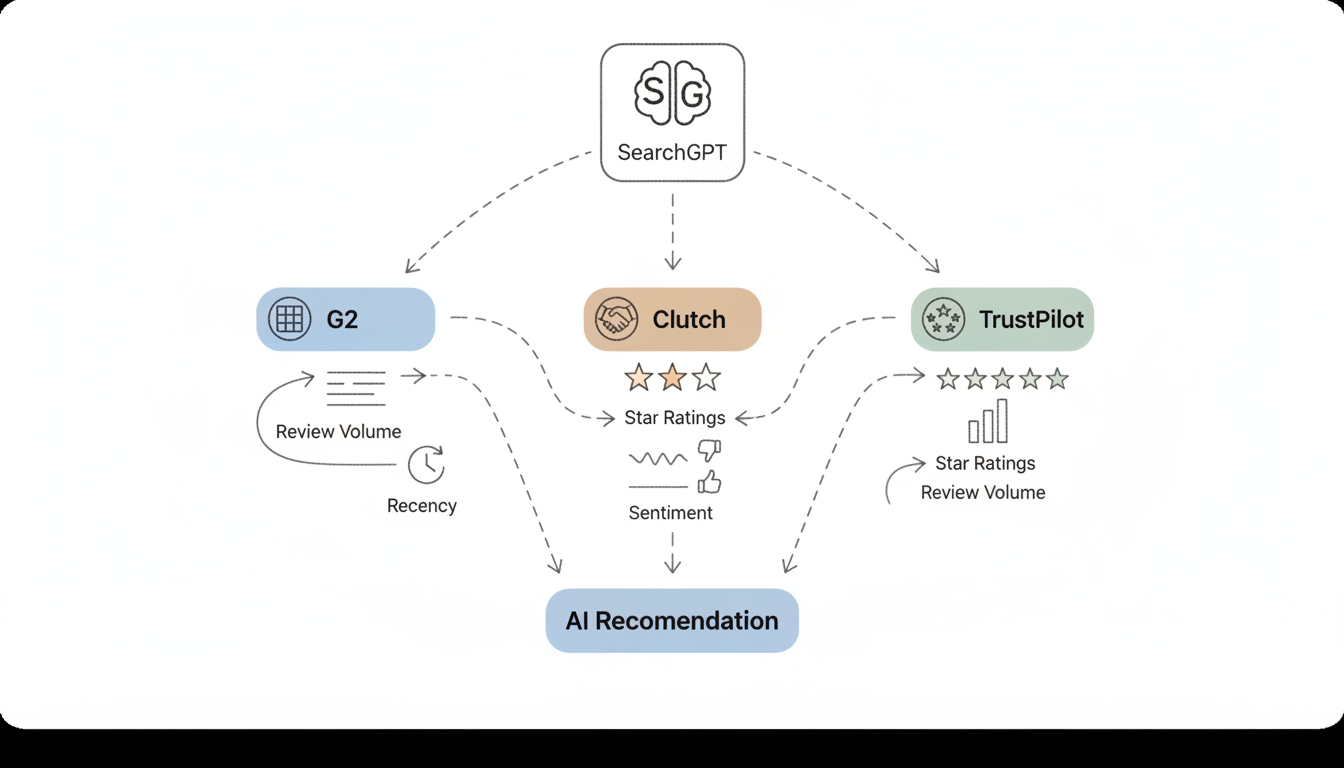
Understanding SearchGPT's review platform integration guides optimization priorities. Companies with strong SearchGPT market share in their category tend to have well-optimized review profiles across multiple platforms.
SearchGPT's review processing behavior:
Query: "Best CRM for startups 2026"

SearchGPT Review Processing:
├── Retrieves G2 category rankings
├── Pulls Capterra comparison data
├── Checks TrustPilot sentiment patterns
├── Analyzes review volume and recency
├── Weighs aggregate ratings
└── Synthesizes into recommendations
Review signals SearchGPT considers:
Signal | Weight | Why It Matters |
Aggregate rating | High | Quality indicator |
Review volume | High | Market validation |
Review recency | Medium-High | Current relevance |
Response rate | Medium | Engagement signal |
Category ranking | Medium | Competitive position |
Review sentiment | Medium | User satisfaction |
G2 carries significant weight for B2B software recommendations.
Complete profiles rank higher in G2's internal algorithms and appear more favorably in SearchGPT citations.
Required profile elements:
Element | Optimization Approach | Impact |
Company description | Match SearchGPT query patterns (include category + use case) | High |
Product categories | Select all relevant categories (primary + secondary) | High |
Feature list | Complete, specific, keyword-rich | Medium |
Pricing information | Accurate, clear tier structure | Medium |
Screenshots | Current, high-quality, showing key features | Medium |
Video demo | 2-3 minute product overview | Lower |
Description formula for AI visibility:
[Company name] is a [primary category] solution that helps
[target audience] [achieve primary outcome]. Key capabilities
include [feature 1], [feature 2], and [feature 3].
[Differentiator statement].
This structure mirrors how SearchGPT presents product descriptions.
Volume and recency drive G2 rankings and SearchGPT citation likelihood. The best answer engine optimization tools often include review monitoring and generation features to help maintain consistent platform presence.
Review request workflow:
Trigger Point | Timing | Request Method |
Post-onboarding success | Day 30-45 | Personal email from CSM |
Feature adoption milestone | Variable | In-app prompt |
NPS survey high score | Immediate | Automated follow-up |
Support ticket resolved positively | 24-48 hours | Support follow-up |
Contract renewal | Post-signature | Account manager outreach |
G2-specific tactics:
Target metrics:
Metric | Baseline | Good | Excellent |
Review count | 25+ | 100+ | 250+ |
Average rating | 4.0+ | 4.3+ | 4.5+ |
Review recency | Quarterly | Monthly | Weekly |
Response rate | 50% | 80% | 95%+ |
Clutch dominates service provider and agency recommendations.
Clutch's verification process carries authority weight with SearchGPT.
Profile completion priorities:
Element | Details | Priority |
Verified badge | Complete verification process | Critical |
Client list | Name recognizable clients | High |
Service lines | Select accurately (affects categorization) | High |
Hourly rate | Range that matches market positioning | Medium |
Team size | Accurate current figure | Medium |
Location | Primary and service regions | Medium |
Verification completion:
Verified Clutch profiles appear more prominently in SearchGPT responses than unverified listings.
Clutch uses verified client interviews—different from self-submitted reviews.
Clutch review process:
Review Flow:
├── You submit client contact information
├── Clutch reaches out to schedule interview
├── 15-minute phone interview conducted
├── Review published after verification
└── You can request updates/additions
Increasing Clutch review volume:
Strategy | Implementation |
Post-project requests | Ask clients at project completion |
Annual relationship check-ins | Request during account reviews |
Case study coordination | Pair case study development with review request |
Referral acknowledgment | Request review when client refers business |
Managing the Clutch interview:
TrustPilot influences B2C and SMB service recommendations.
Profile optimization elements:
Element | Approach | Notes |
Business category | Select most specific category available | Affects visibility |
Company description | Keyword-rich, benefit-focused | 500 characters max |
Trust badges | Display on website | Reinforces legitimacy |
Response templates | Prepare for common scenarios | Speeds response time |
TrustPilot allows direct review solicitation—different from G2's organic model.
Review generation tactics:
Method | Volume Potential | Quality |
Post-purchase email | High | Variable |
Automated integration | High | Variable |
Personal request | Low | High |
Review invitation link | Medium | Medium |
TrustPilot automation setup:
Managing negative reviews:
TrustPilot's open model means more negative reviews appear. Response strategy matters.
Review Type | Response Approach | Timing |
Legitimate complaint | Acknowledge, apologize, offer resolution | 24-48 hours |
Factually incorrect | Polite correction with evidence | 24-48 hours |
Suspected fake | Report through TrustPilot system | Immediately |
SearchGPT considers response patterns. Unaddressed negative reviews impact AI perception more than addressed ones.
Managing multiple platforms efficiently requires systems. Whether you choose free vs paid AEO tools for monitoring, having a systematic approach to review management is essential.
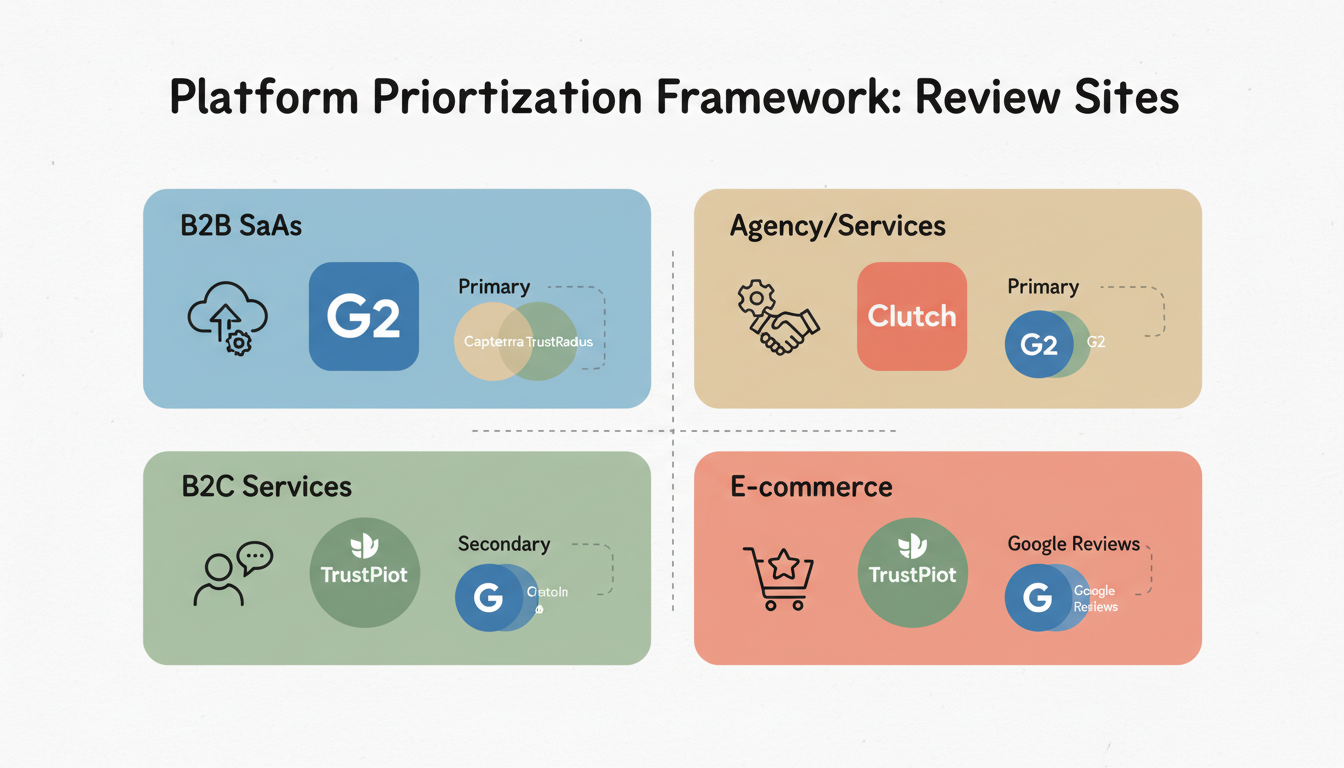
Not every business needs all platforms.
Platform selection by business type:
Business Type | Primary | Secondary | Optional |
B2B SaaS | G2 | Capterra, TrustRadius | Clutch |
Agency/Services | Clutch | G2 | UpCity |
B2C Services | TrustPilot | Google Reviews | Yelp |
E-commerce | TrustPilot | Google Reviews | Site-specific |
Avoid reviewer fatigue while maintaining platform momentum.
Request scheduling:
Monthly Review Plan (example):
├── Week 1: G2 requests (10 customers)
├── Week 2: Clutch client submissions (2-3)
├── Week 3: TrustPilot campaign (if B2C)
├── Week 4: Assessment and follow-up
└── Ongoing: Automated post-transaction requests
Systematic response management across platforms.
Daily review management process:
Connect review platform activity to AI search visibility. Tracking cross-platform AI search ROI helps justify investment in review platform optimization and understand which platforms drive the most value for your business.
Correlation tracking:
Platform Metric | SearchGPT Indicator | What to Track |
Review volume increase | More frequent citations | Query your brand/category |
Rating improvement | More positive framing | Monitor recommendation context |
Category ranking | Higher citation position | Compare to competitor mentions |
Testing protocol:
Optimizing G2, Clutch, and TrustPilot for SearchGPT visibility:
Review platforms serve as trust signals for SearchGPT's recommendation engine. Systematic management across the right platforms improves your visibility when users ask AI systems for recommendations in your category.
By submitting this form, you agree to our Privacy Policy and Terms & Conditions.