February 19, 2026


GEO optimization is the practice of making your content visible and citable in AI-generated responses. Rather than focusing solely on search engine rankings, GEO (Generative Engine Optimization) structures content so AI platforms like ChatGPT, Perplexity, Google AI Overviews, and Claude can find, understand, and cite your brand when generating answers to user queries.
The shift toward AI-powered search has made GEO essential for modern digital marketing. According to OpenAI's 2025 research, 700 million people now use AI assistants weekly, sending approximately 18 billion messages. If your content isn't optimized for how these AI systems work, your brand may become invisible to a rapidly growing audience.
Search behavior has fundamentally changed. People aren't just using Google anymore—they're asking ChatGPT, querying Perplexity, and receiving synthesized answers without visiting websites directly. This transformation creates both challenges and opportunities for brands willing to adapt.
AI search adoption has accelerated. ChatGPT serves over 400 million weekly active users. Perplexity processes millions of research queries daily. Google AI Overviews now appear for increasing percentages of searches, providing direct answers at the top of results pages.
Traditional visibility is declining. Research shows 36.4% of content marketers reported traffic drops between 2024 and 2025 due to AI Overviews and AI search. Content that ranks well organically but doesn't appear in AI responses reaches a shrinking audience.
Citation replaces clicking. When AI systems generate responses, they cite sources within the answer. Users see recommendations without necessarily visiting the recommended sites. Success means being cited, not just ranking.
GEO optimization operates differently from traditional SEO. Instead of optimizing for position in ranked lists, GEO focuses on becoming a source AI systems trust enough to quote and recommend.
AI systems extract information in chunks—they pull specific passages to cite and synthesize. How content is structured determines whether AI systems can effectively use it.
Effective GEO content includes:
Well-structured content extracts cleanly into AI responses. Dense, poorly organized content gets passed over regardless of information quality.
AI platforms prioritize authoritative sources when selecting content to cite. They evaluate authority through signals including domain reputation, consistent expertise demonstration, and cross-platform validation.
Building authority for GEO involves:
AI systems need to understand what your brand represents. Entity clarity ensures your brand identity, expertise areas, and key information appear consistently across the web.
This involves:
Understanding the distinction helps prioritize efforts appropriately. To learn more about the broader evolution of search optimization, explore how AEO vs SEO vs GEO frameworks compare.
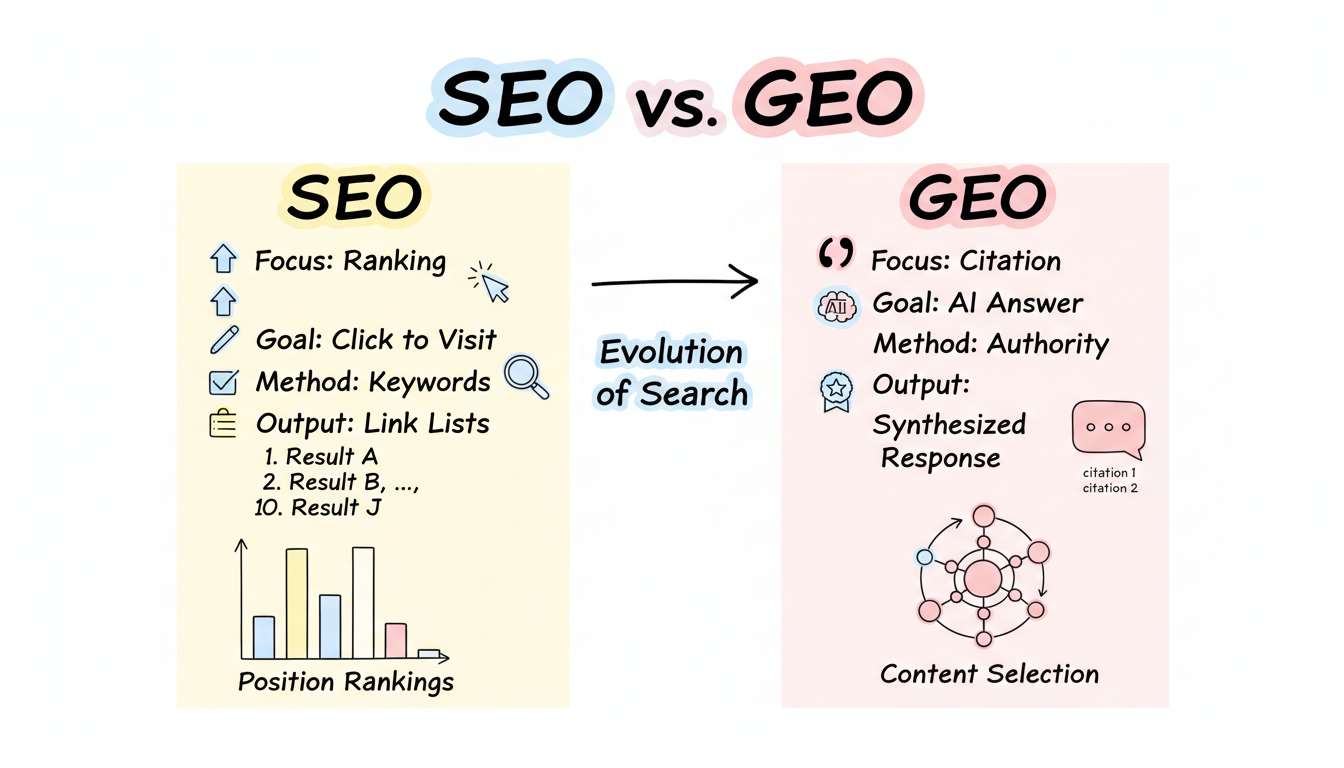
Traditional SEO focuses on ranking. Search engines return lists of links ranked by relevance and authority. SEO optimizes content to climb those rankings—appearing on page one, ideally in top positions. Success means earning clicks from users browsing search results.
GEO focuses on citation. Generative AI platforms don't return link lists. They synthesize answers from multiple sources and cite the content they reference. GEO optimizes content to be selected as a source—to have AI systems quote, attribute, and recommend your content when generating responses.
The mechanics differ fundamentally. SEO involves keyword optimization, link building, and technical factors that help pages rank. GEO involves authority building, content structuring, and entity clarity that make content citation-worthy for AI systems.
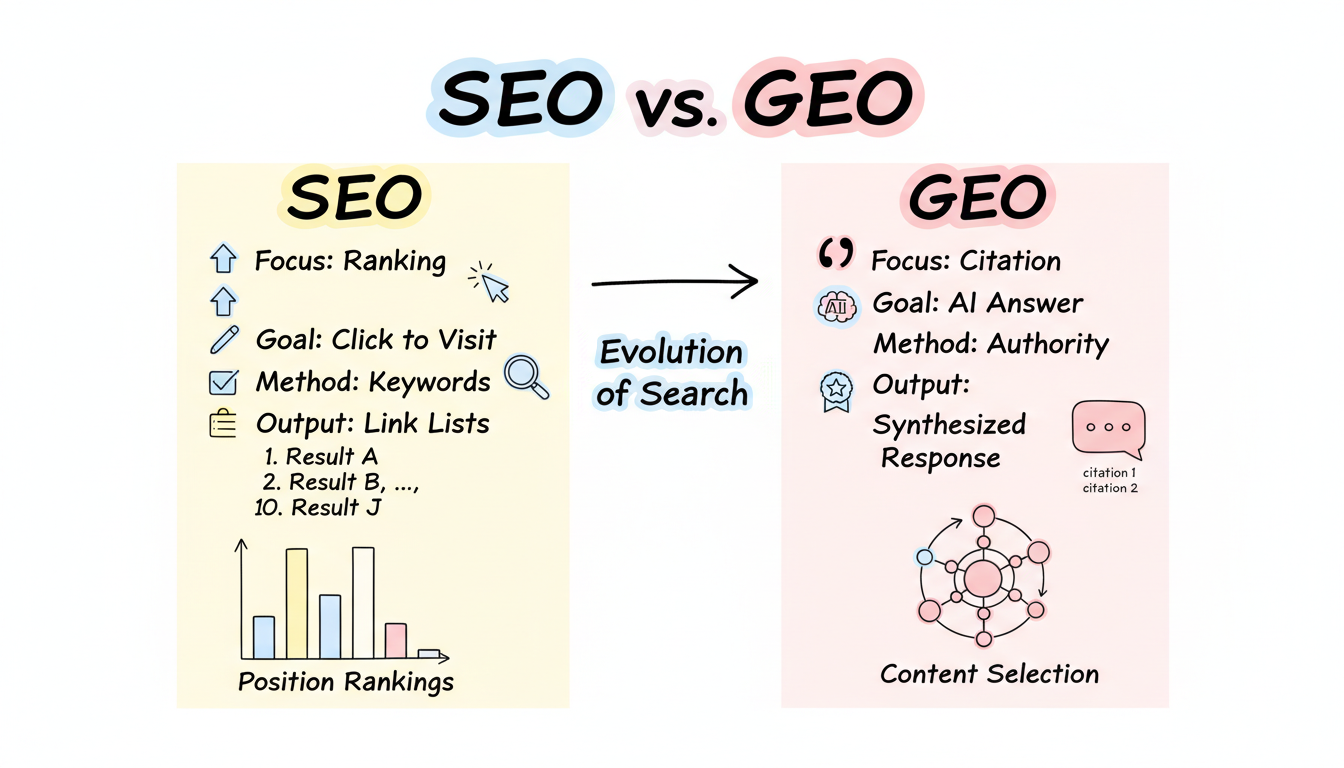
Yet these disciplines connect. Research shows that 87% of Google AI Overview citations come from content ranking in organic positions 1-10. Strong SEO foundations enable GEO success. The relationship is complementary—effective strategies incorporate both.
Successful GEO implementation addresses several interconnected elements.
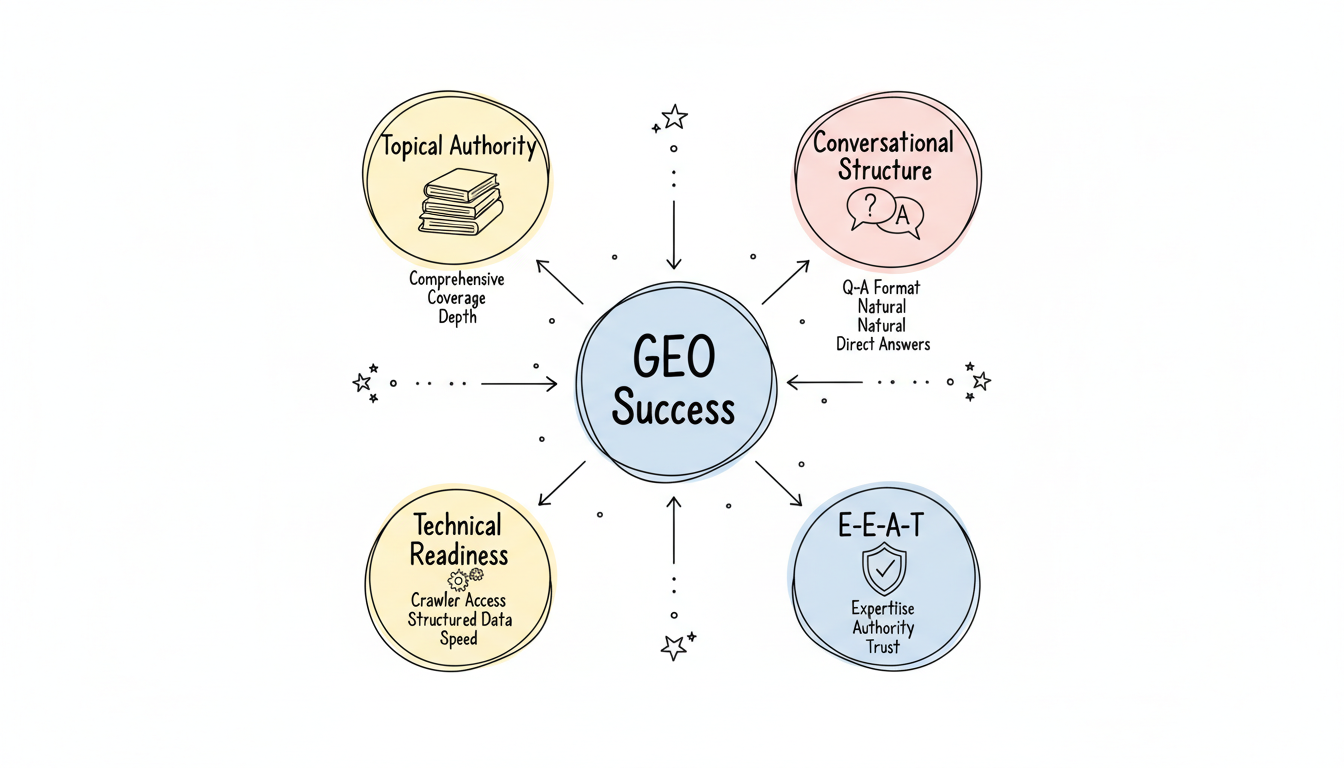
GEO prioritizes comprehensive topic coverage over individual keyword targeting. AI systems evaluate whether content thoroughly addresses subject matter rather than simply containing specific terms.
This means:
AI systems process conversational queries. Content structured to match how people actually ask questions performs better in AI responses. For specialized assistance with AI-first content strategies, many brands work with a generative engine optimization agency to accelerate implementation.
Effective approaches include:
Google's E-E-A-T framework (Experience, Expertise, Authoritativeness, Trustworthiness) influences both traditional rankings and AI citation decisions. Content demonstrating genuine expertise earns citations more frequently than surface-level content.
GEO-effective content shows:
Practical implementation follows a structured approach.
Start by understanding your current state. Search priority queries across ChatGPT, Perplexity, and Google AI Overviews. Document where your brand appears, where competitors appear, and where opportunities exist. Tools like AI search optimization tools can automate much of this monitoring process.
This baseline reveals:
Restructure existing high-performing content for AI extraction:
These improvements often yield results within weeks as AI systems re-process optimized content.
Develop content specifically designed for AI citation:
Verify AI crawlers can access your content. Check robots.txt to ensure you're not blocking GPTBot (OpenAI), ClaudeBot (Anthropic), PerplexityBot, or other AI crawlers. Enable server-side rendering since AI crawlers typically don't execute JavaScript. Learn how to optimize website AI-powered search engines with comprehensive technical configuration.
Track metrics that capture AI visibility alongside traditional SEO performance.
Citation frequency: How often your content appears in AI-generated responses across platforms.
Citation context: Whether you're cited as a primary authority or briefly mentioned among many sources.
Platform coverage: Which AI platforms cite your content and where gaps exist.
Query coverage: Which queries trigger your citations and where you're absent despite relevance.
Specialized tools from providers like Semrush, Ahrefs, and dedicated GEO platforms offer automated tracking across multiple AI systems.
GEO's importance will only increase as AI search adoption continues accelerating. The discipline rewards clarity, authenticity, consistency, and trust—the same qualities that build lasting brand value.
Brands implementing GEO optimization now establish advantages that compound over time. AI systems develop understanding of brand authority and expertise through accumulated signals. Early movers build positioning that later entrants must work harder to displace.
The question isn't whether to implement GEO optimization—it's how quickly you can adapt your digital presence for AI-first discovery.
No. GEO extends SEO rather than replacing it. Traditional SEO foundations—technical excellence, quality content, authority building—remain essential and directly influence AI citation likelihood. The 87% correlation between top-10 rankings and AI Overview citations demonstrates that traditional SEO success enables GEO visibility.
Content structure improvements and technical optimizations can affect citations within weeks. Building substantial authority and consistent citation patterns typically requires 3-6 months of sustained effort. Results compound over time as AI systems recognize and trust your content.
Basic GEO monitoring involves manually searching priority queries across AI platforms. Specialized tools from major SEO platforms and dedicated GEO providers offer automated tracking and insights for brands requiring comprehensive visibility data.
By submitting this form, you agree to our Privacy Policy and Terms & Conditions.