February 19, 2026


Measuring return on investment from answer engine optimization services requires different frameworks than traditional SEO. When AI systems cite your content without always generating clicks, standard traffic-based ROI calculations miss significant value. Organizations that establish proper AEO measurement frameworks can accurately evaluate agency performance and justify continued investment in AI visibility programs.
According to ALM Corp's 2026 SEO budget guide, content, SEO, and AEO programs typically deliver ROI between 5:1 and 10:1 when properly executed. Content marketing alone produces 3x more leads per dollar than traditional advertising while costing 62% less—making measurement frameworks critical for capturing this value.
Standard digital marketing ROI calculations rely heavily on click-through traffic. AEO generates value differently.
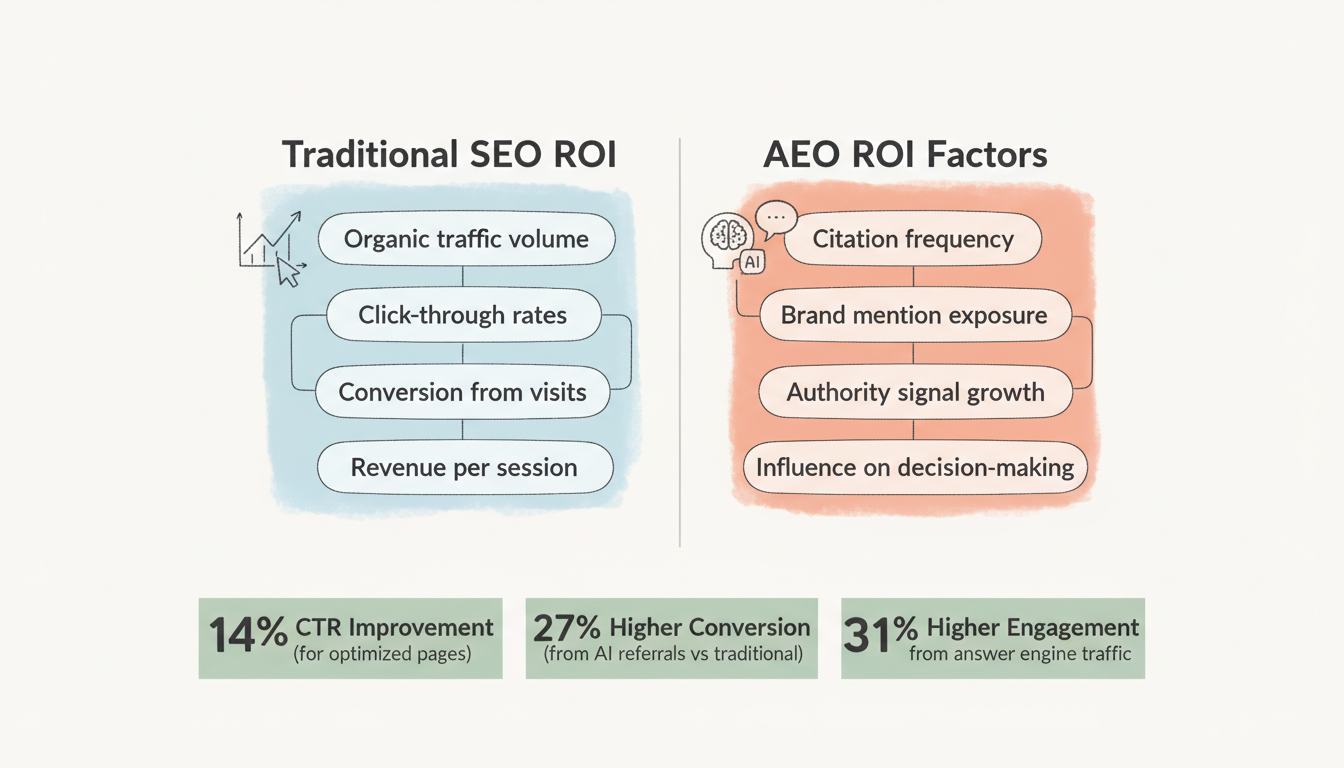
According to SpearPoint Marketing's AEO guide, documented AEO results show 14% click-through rate improvements for optimized pages, conversion rates 27% higher from answer engine referrals versus traditional search, and engagement metrics 31% higher from answer engine traffic.
Traditional vs. AEO ROI factors:
Traditional SEO ROI | AEO ROI Factors |
Organic traffic volume | Citation frequency |
Click-through rates | Brand mention exposure |
Conversion from visits | Authority signal growth |
Revenue per session | Influence on decision-making |
Effective agency evaluation requires tracking metrics specific to AI visibility outcomes.
According to Marketing Experts Hub's agency analysis, agencies should be evaluated on their ability to increase citations across AI platforms, track brand mentions in AI-generated answers, measure share of voice in answer engine responses, and demonstrate visibility improvements over time.
Essential AEO metrics for ROI calculation:
AEO ROI Measurement Framework
├── Visibility Metrics
│   ├── Citation frequency (mentions per month)
│   ├── Brand appearance rate in AI answers
│   ├── Share of voice vs. competitors
│   └── Platform coverage (ChatGPT, Perplexity, Claude)
│
├── Engagement Metrics
│   ├── AI referral traffic (when available)
│   ├── Conversion rate from AI traffic
│   ├── Time on site from AI visitors
│   └── Pages per session
│
├── Authority Metrics
│   ├── Expert attribution frequency
│   ├── Source quality improvements
│   └── Trust signal development
│
└── Business Impact
    ├── Lead quality from AI channels
    ├── Sales influenced by AI visibility
    └── Brand awareness lift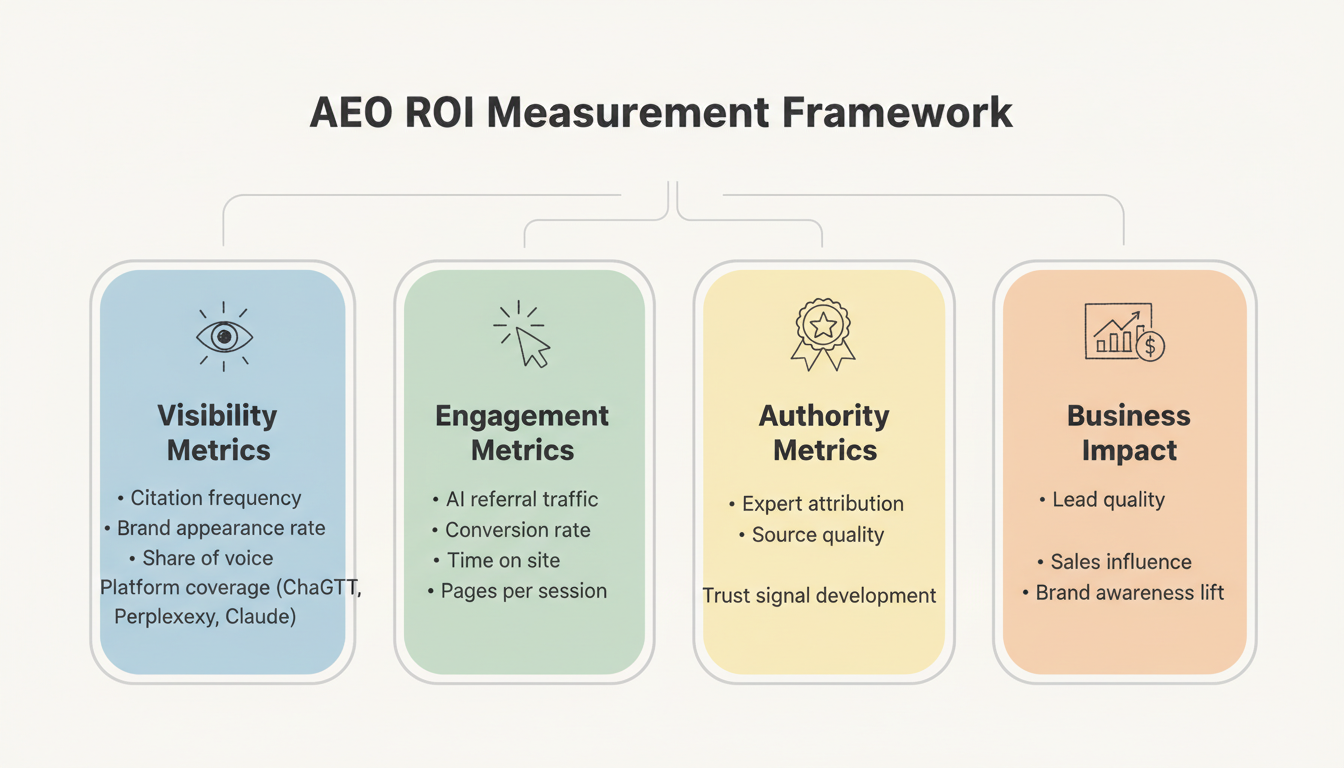
Structured evaluation frameworks enable consistent agency assessment. Understanding the relationship between SEO, AEO, and GEO helps organizations build comprehensive measurement systems that capture value across all AI-driven search channels.
According to First Page Sage's agency rankings methodology, comprehensive agency evaluation uses weighted criteria including AI Visibility Score (25% weight), Average Review Score (30% weight), Client Retention Rate (20% weight), and Years of SEO/GEO Experience (10% weight).
Agency performance scorecard:
Evaluation Criteria | Weight | What to Measure |
Citation results | 25% | Documented citation increases |
Client satisfaction | 30% | Reviews, testimonials, references |
Client retention | 20% | Renewal rates, long-term relationships |
Methodology quality | 15% | Process rigor, reporting frequency |
Experience level | 10% | Years in AEO/GEO specifically |
ROI calculation requires attribution modeling adapted for AI visibility. Organizations implementing AI search conversion funnel optimization can better attribute revenue to AEO efforts by tracking the complete customer journey from AI platform exposure through conversion.
According to ALM Corp, content, SEO, and AEO should receive 25-30% of digital marketing budgets based on typical returns. Organizations investing appropriately in these channels see compound growth in organic visibility and authority over time.
AEO ROI calculation approach:
AEO ROI = (Value Generated - Investment) / Investment × 100

Where Value Generated includes:
├── Direct Value
│   ├── Revenue from AI referral traffic
│   ├── Leads generated via AI channels
│   └── Conversions attributed to AI visibility
│
├── Indirect Value
│   ├── Brand awareness lift (survey-based)
│   ├── Reduced paid media dependency
│   ├── Authority signal appreciation
│   └── Influence on buying decisions
│
└── Attribution Considerations
    ├── AI visibility touchpoints in journey
    ├── Assist conversions from AI exposure
    └── Long-term brand recall effects
Understanding benchmark investment levels contextualizes agency costs.
According to eMarketer's 2025 marketing budget research, 12% of digital marketing budgets were dedicated to GEO/AEO in 2025, with 94% of organizations planning to increase spending in 2026. This represents significant growth in AEO investment as AI search adoption accelerates.
Investment benchmarks by company size:
Company Size | Monthly AEO Investment | Expected ROI Timeline |
Startup | $1,000-$3,000 | 6-9 months |
SMB | $3,000-$8,000 | 4-6 months |
Mid-market | $8,000-$20,000 | 3-5 months |
Enterprise | $20,000+ | 2-4 months |
According to Vertu's GEO guide, measuring AI visibility ROI requires patience—like SEO, AEO results compound over time. Early investment builds authority signals that continue generating returns months after initial optimization.
Certain indicators suggest underperformance requiring attention. When evaluating agencies, reference comprehensive AEO checker tools to verify their reported metrics and validate citation tracking capabilities.
According to SpearPoint Marketing, agencies should provide clear metrics including featured snippet increases, AI Overview appearance rates, voice search inclusion percentages, and citation frequency data. Agencies that cannot provide specific metrics may not have rigorous measurement processes.
Performance warning signs:
Red Flag | What It Indicates |
No baseline measurements | Can't demonstrate improvement |
Traffic-only reporting | Missing AI visibility metrics |
Vague "visibility improvements" | Lack of specific data |
No competitive benchmarking | Missing context for results |
Inconsistent reporting | Process or capability issues |
Sustainable ROI tracking requires systematic approaches. Organizations that understand AI Overview impact analysis can better attribute business outcomes to their answer engine optimization investments and demonstrate clear ROI to stakeholders.
According to Conductor's 2026 AEO/GEO Benchmarks Report, organizations must measure AI visibility as rigorously as SEO visibility—tracking citations and mentions as core KPIs. Having informed, data-driven KPIs for both SEO and AEO enables digital teams to measure total search visibility.
Long-term measurement recommendations:
Measuring AEO services ROI requires adapted frameworks and appropriate expectations:
According to ALM Corp, organizations that treat AEO measurement with the same rigor as other marketing channels position themselves to capture compound returns as AI search adoption continues accelerating.
By submitting this form, you agree to our Privacy Policy and Terms & Conditions.