February 19, 2026


AI search traffic converts at dramatically higher rates than traditional organic search—but only when your conversion funnel is optimized for how AI visitors behave. Users arriving from ChatGPT, Perplexity, and AI Overviews have already received context about your brand and are further along the buyer journey. Capturing this high-intent traffic requires landing pages, forms, and conversion paths designed specifically for AI-referred visitors.
According to Exposure Ninja's AI traffic analysis, AI search traffic converts at 14.2% compared to Google's 2.8%—a 5x improvement that represents a fundamental shift in how businesses should approach AI visibility optimization.
Understanding the conversion advantage informs optimization strategy.
According to Hi Goodie's B2B traffic research, ChatGPT is the most efficient B2B traffic source with nearly 2X the lead-to-close rate of traditional search engines. Users receiving AI-synthesized answers arrive pre-qualified with context about your offering.
AI traffic conversion factors:
Factor | Description | Conversion Impact |
Pre-qualification | AI provided context before click | Higher intent visitors |
Research completion | Users already informed | Shorter decision cycle |
Trust transfer | AI recommended your content | Credibility established |
Specific needs | Long-tail AI queries | Precise matching |
Decision stage | Post-research visitors | Ready to act |
Compare AI traffic performance against other sources.
According to Knotch's organic search analysis, organic search drives 15.6% of total traffic and 26.6% of conversions—1.7x its traffic share. AI search, while smaller in volume, demonstrates even higher conversion efficiency when properly tracked using AI-powered search tools and analytics platforms.
Channel conversion comparison:
Conversion Rates by Traffic Source
├── AI Search Traffic
│   ├── Overall: 14.2%
│   ├── ChatGPT referrals: 12-18%
│   ├── Perplexity referrals: 10-15%
│   └── AI Overview clicks: 8-12%
│
├── Traditional Organic
│   ├── Google organic: 2.8%
│   ├── Bing organic: 2.5%
│   └── Featured snippet clicks: 5-8%
│
├── Paid Search
│   ├── Google Ads: 3.5-4.5%
│   ├── Brand terms: 8-12%
│   └── Non-brand terms: 2-3%
│
└── Other Channels
    ├── Direct traffic: 2-3%
    ├── Social media: 1-2%
    └── Email marketing: 3-5%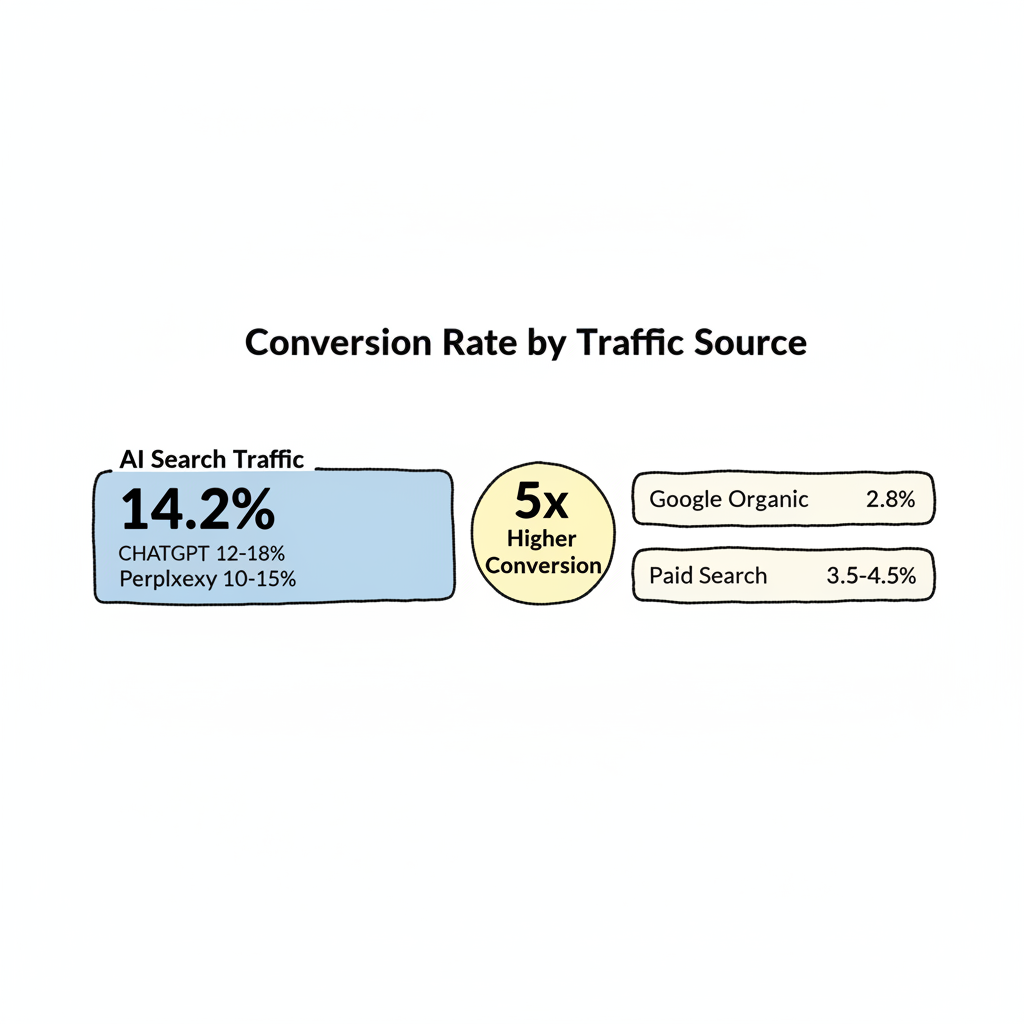
Design experiences that match AI visitor expectations.
According to Fibr's landing page research, landing pages that load in less than 3 seconds have a 32% higher conversion rate. For AI traffic specifically, visitors expect immediate validation that they've reached the right destination. This is especially important when optimizing for generative engine optimization strategies.
AI-optimized landing page elements:
Element | Traditional Approach | AI Traffic Optimization |
Headline | Keyword-focused | Context continuation |
Opening | Problem introduction | Solution validation |
Social proof | General testimonials | Specific use case matches |
CTA placement | Below fold acceptable | Immediate visibility |
Page speed | Under 5 seconds | Under 3 seconds |
Mobile optimization | Responsive | Mobile-first |
Structure paths that match pre-qualified visitor behavior.
According to Hostinger's landing page guide, a well-designed landing page could increase conversion rates by up to 400%. For AI traffic, streamlined funnels that acknowledge prior research perform best.
Optimized funnel structure:
AI Traffic Conversion Funnel
├── Entry Point (Landing Page)
│   ├── Validate AI context
│   ├── Confirm topic relevance
│   ├── Immediate value proposition
│   └── Clear next step
│
├── Engagement Layer
│   ├── Deeper content access
│   ├── Interactive elements
│   ├── Micro-conversions
│   └── Trust building
│
├── Conversion Point
│   ├── Simplified forms
│   ├── Progressive profiling
│   ├── Clear value exchange
│   └── Friction reduction
│
└── Post-Conversion
    ├── Immediate gratification
    ├── Onboarding sequence
    ├── Relationship building
    └── Referral opportunities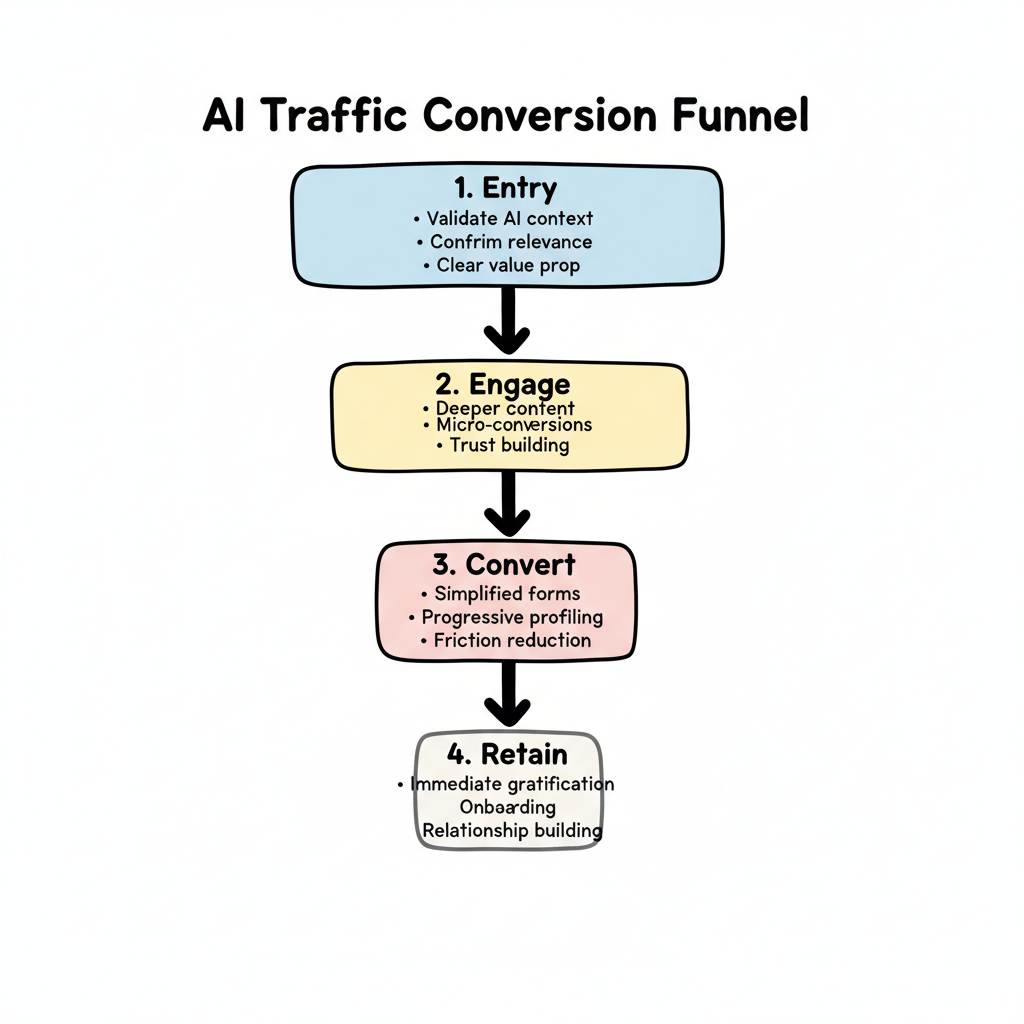
Reduce friction for pre-qualified traffic.
Form best practices:
Field count impact:
Form Fields | Conversion Rate Impact | Best Use Case |
1-2 fields | Highest conversion | Newsletter, content download |
3-4 fields | Moderate conversion | Consultation request |
5-6 fields | Lower conversion | Detailed quote requests |
7+ fields | Significant drop | Only when necessary |
Track and attribute AI-driven conversions accurately.
According to Wix AI Search Lab's measurement guide, comparing conversion rates across your AI channel grouping and other channels reveals whether AI traffic represents higher quality visitors. Proper measurement requires custom channel configuration and understanding the differences between platforms like Microsoft Copilot vs Bing AI.
GA4 conversion tracking setup:
AI Conversion Measurement Framework
├── Channel Configuration
│   ├── Create "AI Search" custom channel
│   ├── Regex for ChatGPT, Perplexity, Claude
│   ├── Position above Referral in priority
│   └── Test with real-time reports
│
├── Conversion Events
│   ├── Define key conversion actions
│   ├── Tag AI-specific micro-conversions
│   ├── Set up enhanced measurement
│   └── Configure attribution windows
│
├── Reporting Setup
│   ├── AI channel vs other channels
│   ├── Conversion rate comparisons
│   ├── Revenue attribution
│   └── Path analysis
│
└── Optimization Insights
    ├── Landing page performance
    ├── Form completion rates
    ├── Drop-off analysis
    └── A/B test tracking
Test specifically for AI visitor behavior.
Testing priorities:
Test Element | Hypothesis | Measurement |
Headlines | Context continuation outperforms generic | Conversion rate |
CTA text | Action-oriented beats informational | Click-through rate |
Form length | Shorter forms convert better | Completion rate |
Page layout | Above-fold CTA improves conversion | Scroll depth + conversion |
Social proof | Specific testimonials beat general | Time on page + conversion |
Score and route AI traffic leads appropriately. Understanding how to allocate your AI search optimization budget effectively requires proper lead qualification metrics.
Lead scoring considerations:
Customize follow-up based on entry path.
Sequence optimization:
AI Traffic Nurture Strategy
├── Immediate Follow-up
│   ├── Thank you with promised content
│   ├── Acknowledge their research journey
│   ├── Provide additional value
│   └── Soft next-step suggestion
│
├── Early Nurture (Days 1-7)
│   ├── Related content recommendations
│   ├── Case studies matching interest
│   ├── Social proof expansion
│   └── Light CTA progression
│
├── Mid Nurture (Days 8-21)
│   ├── Deeper educational content
│   ├── Comparison/evaluation resources
│   ├── Consultation offers
│   └── Urgency introduction
│
└── Late Nurture (Days 22+)
    ├── Decision-stage content
    ├── Direct sales outreach
    ├── Special offers
    └── Re-engagement campaigns
Avoid errors that waste high-converting traffic.
Mistakes to avoid:
AI search conversion funnel optimization captures high-value traffic:
According to Superprompt's AI traffic analysis, AI search traffic converts 5x better than Google because users arrive having already received context about your brand and offerings. Optimizing your conversion funnel for this pre-qualified traffic—through faster landing pages, shorter forms, and relevant content continuation—captures the full value of your AI search visibility investment.
By submitting this form, you agree to our Privacy Policy and Terms & Conditions.