
February 19, 2026


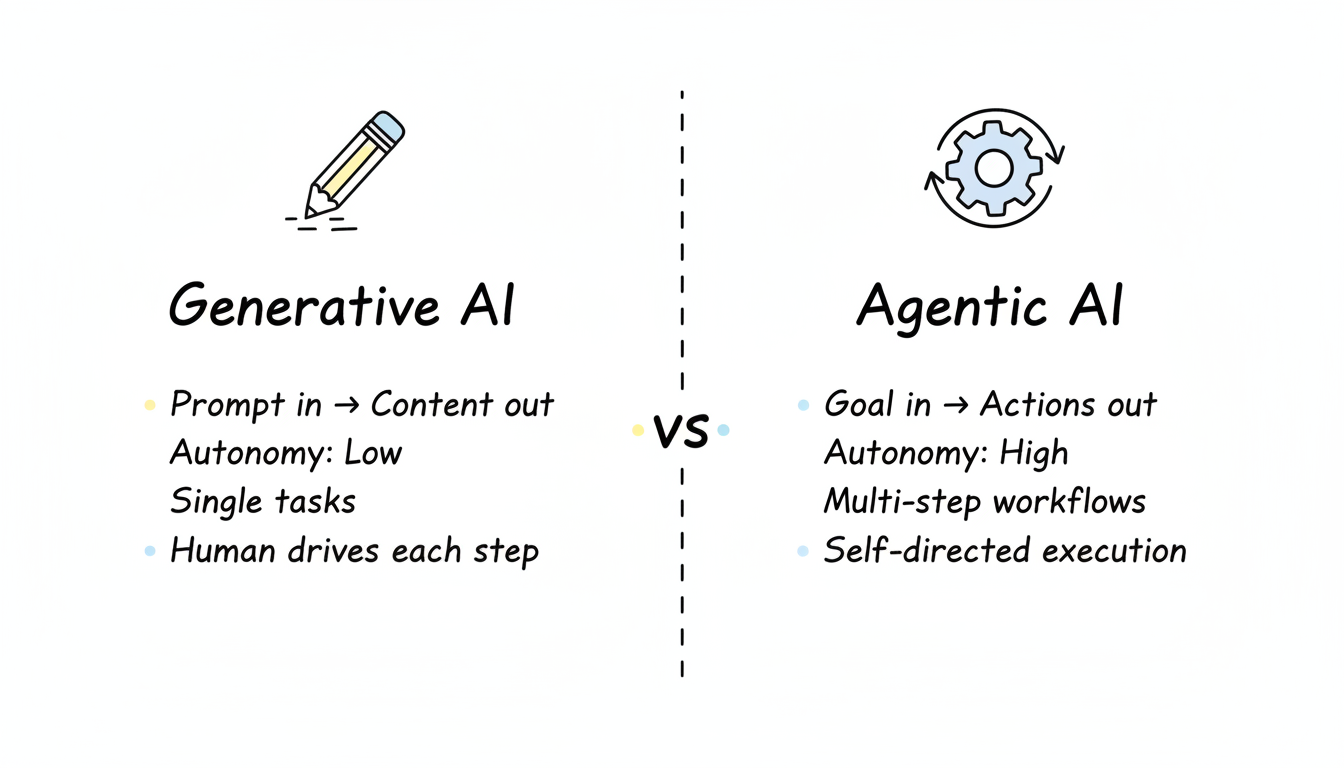
Artificial intelligence has evolved beyond a single technology category. Two distinct paradigms now shape how businesses use AI: Generative AI, which creates content based on prompts, and Agentic AI, which autonomously plans, decides, and takes actions to achieve goals. Understanding the difference between these approaches is essential for choosing the right AI strategy.
According to Omdena's analysis of AI paradigms, the difference between generative AI and agentic AI shapes what your systems can actually achieve. Generative AI excels at creation and assistance, while agentic AI focuses on execution, automation, and goal completion.
Generative AI refers to models that create new content based on patterns learned from training data. When you ask for a blog post, code snippet, email draft, image, or summary, you're using generative AI.
According to Medium's analysis of AI types, generative AI produces content—text, images, audio, video, and code—in response to prompts. It can be conversational but doesn't inherently act in the real world unless connected to tools.
Generative AI characteristics:
Agentic AI goes beyond generation to operate autonomously toward defined goals. These systems don't just create content—they plan, execute, monitor, and adapt workflows with minimal human supervision.
According to Coursera's AI comparison guide, agentic AI systems can take initiative, adapt to changes, and carry out workflows using a four-step process: perceiving data, reasoning to generate solutions, acting with available tools, and learning from feedback.
Agentic AI characteristics:
According to Wald.ai's 2025 guide to AI types, generative AI and agentic AI play different but connected roles in business operations.
Feature | Generative AI | Agentic AI |
Autonomy | Low—requires prompts | High—operates independently |
User input | Direct prompts per task | Overarching goals |
Task complexity | Single tasks | Multi-step workflows |
Primary use | Generate content | Achieve outcomes |
Learning | Based on training data | Continuous from experience |
Implementation | Simpler setup | More complex architecture |
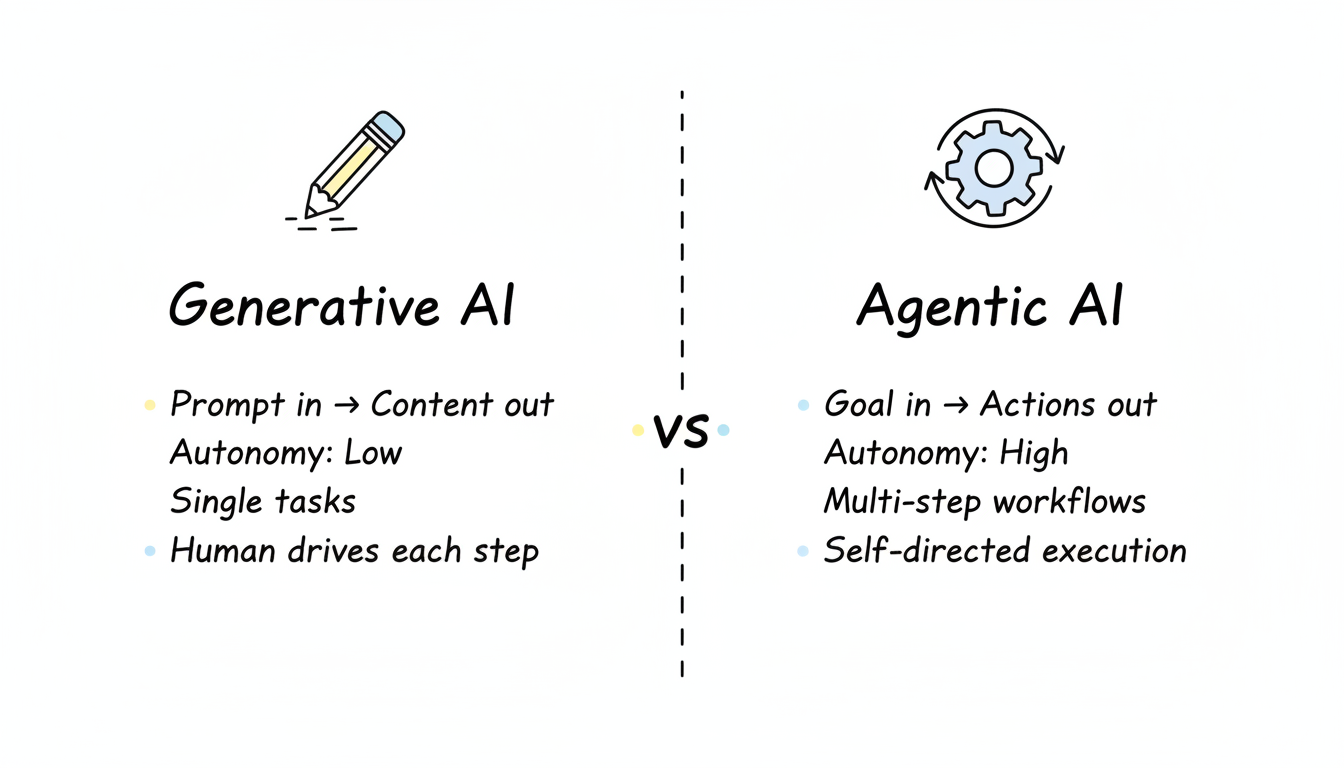
According to Invoca's analysis of AI evolution, agentic AI doesn't replace generative AI—it builds on it. Generative models remain an essential capability inside agentic systems, providing reasoning, language understanding, and content creation. The difference is that agentic AI uses that output as fuel for decisions, actions, and multi-step workflows.
The relationship:
According to Triple Whale's AI comparison, generative AI excels at content-heavy tasks.
Best use cases:
According to Boomi's analysis of agentic AI examples, AI agents are being used in 78% of organizations in some form. Companies are using agentic AI vs generative AI examples to automate IT support, financial operations, and customer service.
Best use cases:
According to Content Marketing Institute's analysis of agentic AI in marketing, agentic AI systems are autonomous programs that can plan, reason, and take action toward complex goals with minimal human intervention—behaving less like passive tools and more like proactive digital co-workers.
Marketing applications:
According to ALM Corp's guide to AI agents for SEO, AI agents are transforming SEO through autonomous keyword identification, competitor analysis, content optimization, and continuous strategy adjustment. Case studies show businesses improving rankings from page 5 to page 1 in 60 days using AI agent-driven approaches.
For businesses implementing AI content optimization strategies, understanding how agentic systems can autonomously manage campaigns becomes critical to staying competitive in 2026.
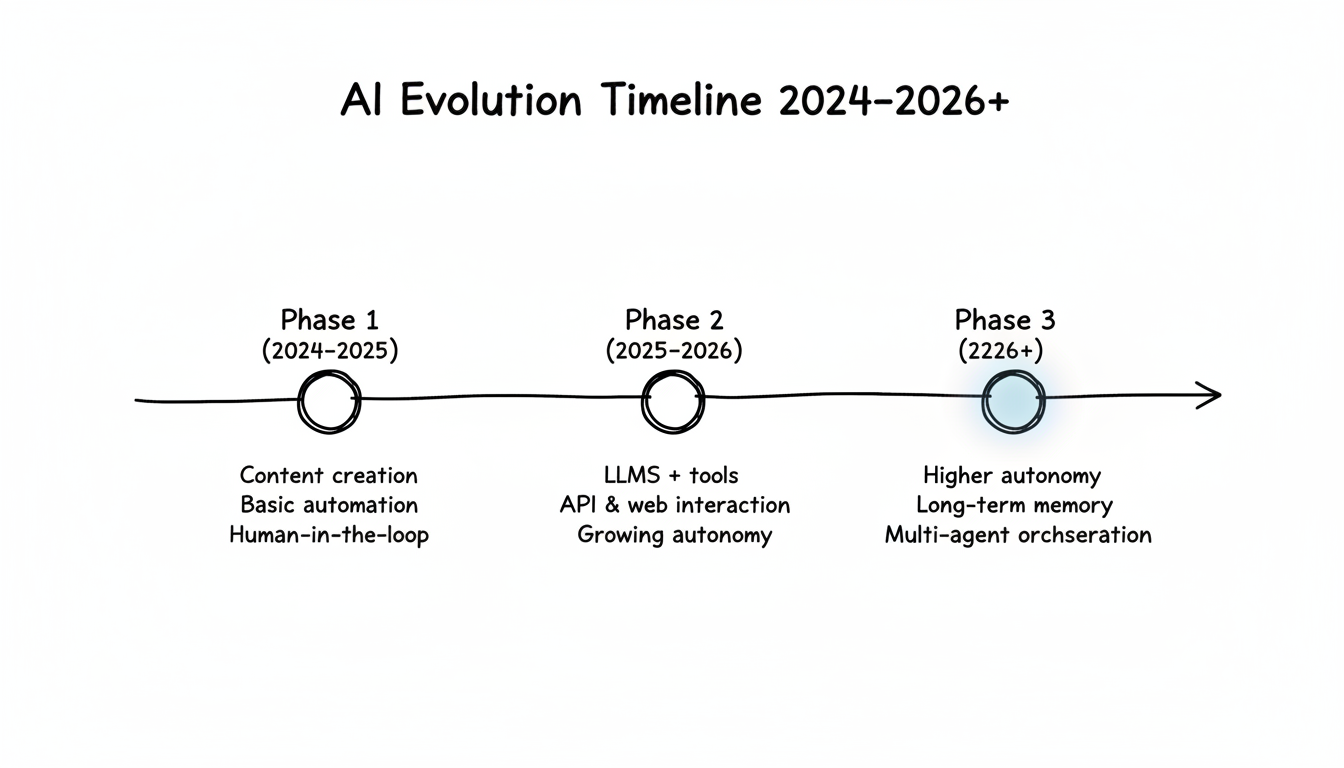
According to LinkedIn's agentic AI roadmap, the transition from generative to agentic AI follows a clear pattern.
Phase 1 (2024-2025): Generative AI dominance
Phase 2 (2025-2026): Emergent agentic capabilities
Phase 3 (2026 onwards): Fully agentic systems
According to Daffodil Software's AI trends guide, agentic AI systems understand high-level goals and autonomously break them down into actionable tasks—operating with initiative, much like proactive team members who notice gaps and fill them.
According to Wald.ai, implementation requirements differ significantly between these AI types.
Generative AI implementation:
Agentic AI implementation:
According to Omdena, the real challenge isn't choosing one over the other—it's understanding your goals well enough to design the right solution. The strongest outcomes often come from combining creative generation with autonomous action.
Integration approaches:
According to Triple Whale, for a product launch, generative AI might create marketing materials while agentic AI determines optimal pricing, inventory allocation, and advertising channels. Organizations developing an AEO marketing strategy template should consider how both AI paradigms integrate to maximize campaign effectiveness.
According to Demand Gen Report's 2026 outlook, 2026 marks an inflection point where AI systems deploy specialized agents for specific roles—product marketing agents, customer marketing agents, brand marketing agents—amplifying team capabilities rather than replacing general tasks.
Gartner predicts that by 2026, up to 40% of enterprise applications will embed task-specific agents, signaling practical integration of agentic capabilities across business systems. Understanding future platform-specific AI search 2026 trends helps businesses prepare for this shift.
Understanding the difference between generative and agentic AI guides strategic technology choices:
The distinction matters for business strategy: generative AI is a powerful tool for creation, while agentic AI represents a shift toward AI as an autonomous executor of complex workflows.
By submitting this form, you agree to our Privacy Policy and Terms & Conditions.



