February 19, 2026


AI search performance varies dramatically across industries. Healthcare organizations see AI Overviews appear in nearly half of relevant queries, while real estate sees them in fewer than 5%. Technology companies receive substantially more AI referral traffic than industrial sectors. Understanding industry-specific benchmarks transforms generic optimization into targeted strategy with realistic goals and meaningful performance indicators.
Universal AI search benchmarks mislead organizations operating in specific verticals.
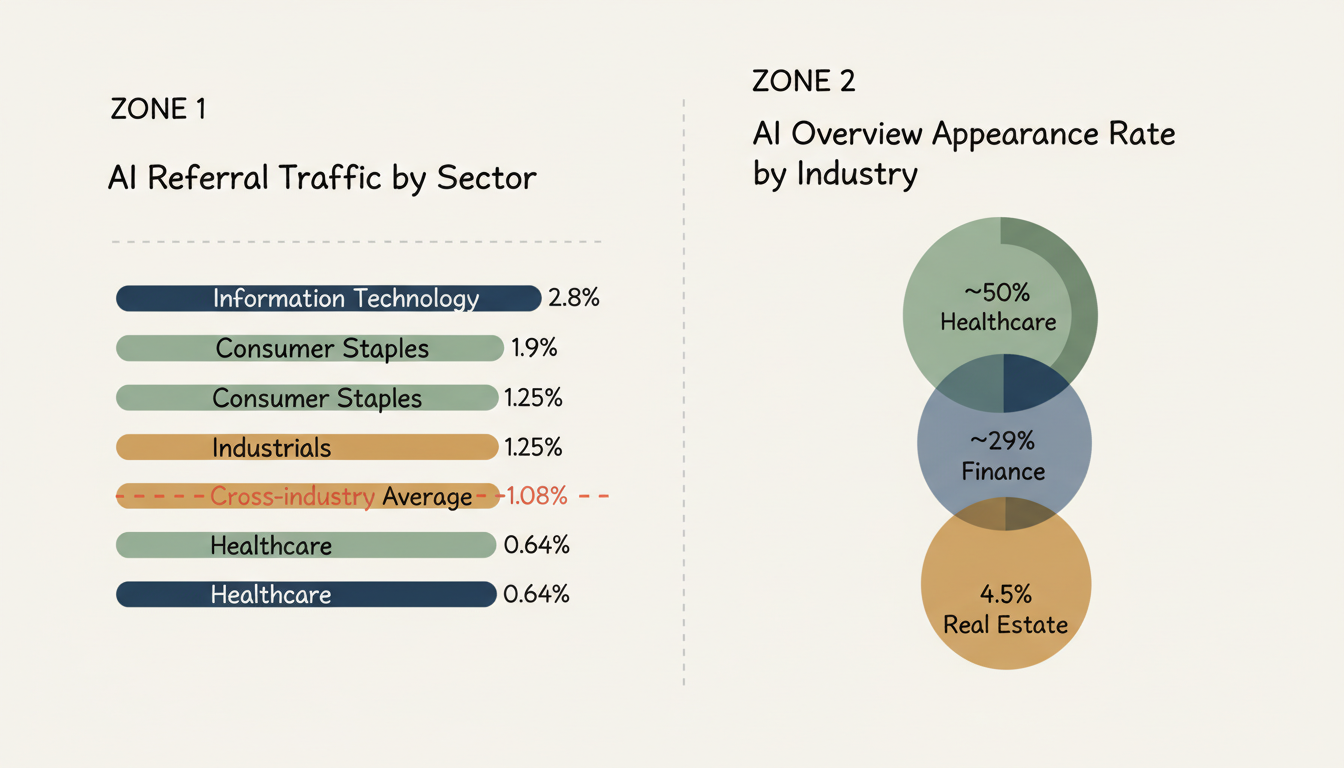
The variance reality: Research from 2026 reveals stark differences in AI visibility across industries. Information Technology sectors see 2.8% of referral traffic from AI sources, while Healthcare receives only 0.64%. Consumer Staples falls in between at 1.9%, with Industrials at 1.25%. The cross-industry average of 1.08% AI referral traffic means nothing without vertical context.
Platform dominance patterns: ChatGPT drives 87.4% of measurable AI referral traffic across industries, but this dominance varies by sector. Technical verticals see higher Perplexity usage among their audiences. Enterprise sectors experience more Microsoft Copilot exposure. Platform prioritization should reflect industry-specific user behavior, as demonstrated in recent cross-platform AI search ROI analysis.
AI Overview appearance rates: The rate at which AI Overviews appear for industry queries determines optimization opportunity. Healthcare queries trigger AI Overviews in 48.75% to 51.6% of searches. Finance queries generate AI Overviews in 25.79% to 32.1% of searches. Real Estate sees AI Overviews in only 4.48% of queries. These rates shape where AI optimization investment delivers returns.
Healthcare faces unique AI search dynamics shaped by information sensitivity and authority requirements.
AI Overview prevalence: Healthcare queries trigger AI Overviews at the highest rate across major industries—approximately 50% of relevant queries. This elevated rate reflects AI systems' confidence in citing authoritative medical sources and the informational nature of health queries.
Citation leaders: Mayo Clinic and Cleveland Clinic dominate healthcare AI citations. Mayo Clinic captures 6.58% citation share across health queries, with Cleveland Clinic at 4.90%. WebMD and Healthline also achieve significant citation frequency. New healthcare content competes against deeply entrenched authority.
Success metrics for healthcare:
Optimization priorities: Healthcare optimization requires exceptional E-E-A-T signals. Author credentials, medical review processes, and source citations carry heavier weight than in other verticals. Schema markup for medical content types—MedicalCondition, Drug, MedicalProcedure—provides explicit signals AI systems value.
Financial services face high query volume with moderate AI Overview rates.
AI Overview prevalence: Finance queries trigger AI Overviews in approximately 25-32% of searches. This lower rate compared to healthcare reflects Google's caution with financial advice queries and YMYL (Your Money, Your Life) considerations.
Citation leaders: NerdWallet captures 6.73% of finance-related AI citations, demonstrating how educational financial content earns visibility. Bankrate and Investopedia also achieve significant citation share. Financial institutions must compete with publishers who have built substantial topical authority.
Success metrics for finance:
Optimization priorities: Finance content benefits from calculator tools, comparison tables, and structured data around financial products. FAQ schema addressing specific financial questions performs well. Regular updates matter given constantly changing rates and regulations. Implementing AI search analytics tracking helps monitor performance across financial product categories.
Ecommerce sees unique conversion dynamics from AI search traffic.
Conversion advantage: Research indicates ChatGPT referral traffic converts at 11.4% for ecommerce sites, compared to 5.3% for traditional organic search. This 2x conversion rate makes AI visibility particularly valuable for direct commerce businesses. Users arriving from AI recommendations demonstrate higher purchase intent.
Citation patterns: Amazon dominates Consumer Staples AI citations with 5.85% citation share. Smaller ecommerce sites face significant challenges earning product-level citations against marketplace dominance. Category and educational content often performs better than product pages for AI visibility.
Success metrics for ecommerce:
Optimization priorities: Ecommerce benefits from comprehensive buying guides, product comparison content, and detailed category expertise. Schema markup for Product, Review, and Offer types improves AI comprehension. Video content showing products in use earns significant citations—video captures 1.74% of AI citations overall.
Technology sectors receive the highest AI referral traffic rates.
Traffic advantage: Information Technology companies see 2.8% of referral traffic from AI sources—nearly 3x the cross-industry average. Technology audiences actively use AI search tools, creating both opportunity and necessity for AI visibility optimization.
Citation distribution: Technology citations distribute across documentation sites, developer platforms, and technical publishers. Stack Overflow, official documentation, and technical blogs earn significant citation share. Brand authority matters less than technical accuracy and comprehensiveness.
Success metrics for technology:
Optimization priorities: Technology content benefits from structured formatting that AI can parse accurately—code blocks, step-by-step procedures, and clear technical specifications. Developer documentation should include comprehensive examples. Regular updates addressing new versions and capabilities maintain citation relevance.
B2B sectors face longer consideration cycles and different AI search behaviors.
Query patterns: B2B queries often involve research phases where AI search plays significant roles. Professionals use ChatGPT and Perplexity for vendor research, capability comparisons, and solution evaluation. AI visibility influences consideration set formation before direct vendor engagement.
Success metrics for B2B:
Optimization priorities: B2B content benefits from comprehensive capability documentation, case studies with specific metrics, and comparison content addressing common evaluation criteria. Schema markup for Organization and Service types establishes entity recognition. Thought leadership content builds citation-worthy authority. Companies adopting universal AI search tactics see improved performance across multiple B2B platforms.
Certain content formats perform consistently across verticals.
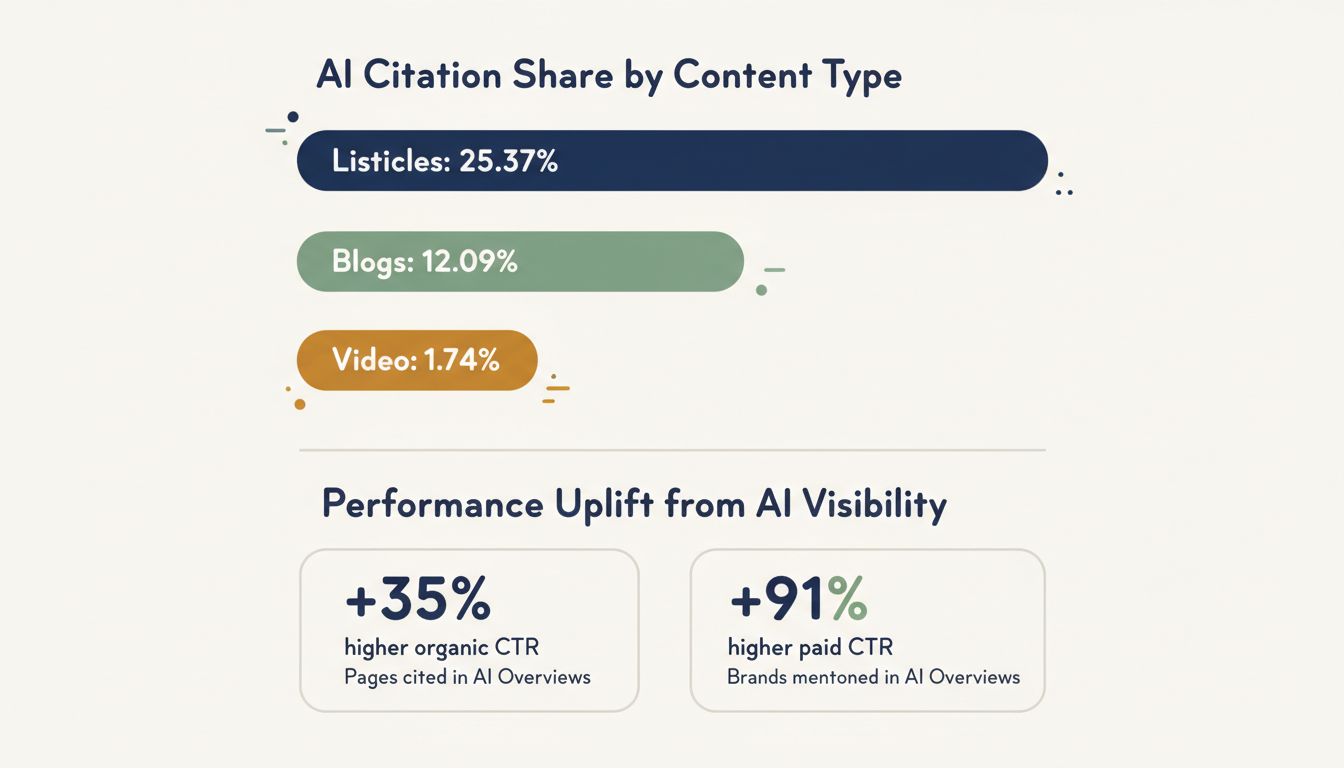
Listicle effectiveness: Listicles capture 25.37% of AI citations across industries—far exceeding their proportion of total web content. The structured format enables easy extraction and citation. Industries should include listicle content in their mix regardless of vertical, as detailed in various AEO success stories and case studies.
Blog performance: Blogs capture 12.09% of AI citations, performing well for informational queries. Educational content explaining concepts, processes, and comparisons earns consistent citations across industries.
Video citations: Video content captures 1.74% of AI citations, with YouTube receiving 25% of Google AI Overview citations. Industries with visual products or processes should invest in video optimization for AI visibility.
Performance impact: Pages cited in AI Overviews see approximately 35% higher organic click-through rates. Brands mentioned in AI Overviews see 91% higher paid click-through rates. These performance impacts apply across industries, though baseline rates vary by vertical.
Translate benchmarks into actionable targets.
Goal-setting framework:
Realistic expectations: Organizations new to AI optimization should target incremental improvement toward industry averages rather than immediate leadership positions. Healthcare organizations can't expect 6% citation share immediately—Mayo Clinic built that position over years.
Measurement cadence: Monitor industry benchmarks quarterly as the landscape evolves. AI search patterns shift as platforms mature and competitors adapt. What represents strong performance today may become table stakes within months.
Start with published research from SEO platforms and industry analysts covering AI search trends. Tools like Profound, Otterly.AI, and major SEO platform reports provide industry breakdowns. Supplement with manual sampling of AI responses for your industry's key queries to validate benchmark relevance.
Healthcare queries tend to be informational with clear factual answers that AI systems can confidently provide. The abundance of authoritative medical content gives AI systems reliable sources to cite. Additionally, users expect comprehensive health information, making AI Overviews particularly useful for medical queries.
Yes, but with realistic expectations and focused strategies. Rather than competing for broad industry queries where leaders dominate, target niche topics, local variations, and specific use cases where large competitors have gaps. AI search rewards comprehensive coverage of focused topics over thin coverage of broad ones.
By submitting this form, you agree to our Privacy Policy and Terms & Conditions.