February 19, 2026


The search landscape has fundamentally shifted. Users no longer want lists of links—they want definitive answers generated in real-time. Mastering generative AI search optimization means understanding how to make AI systems perceive your brand as the most trusted, authoritative source to cite. This comprehensive guide covers the strategies needed to achieve AI search mastery.
According to LinkedIn analysis on mastering GEO, the "Link Era" is fading and the "Citation Era" is here. Mastering GEO is about becoming so authoritative and so unique that AI cannot provide a high-quality answer without including your brand.
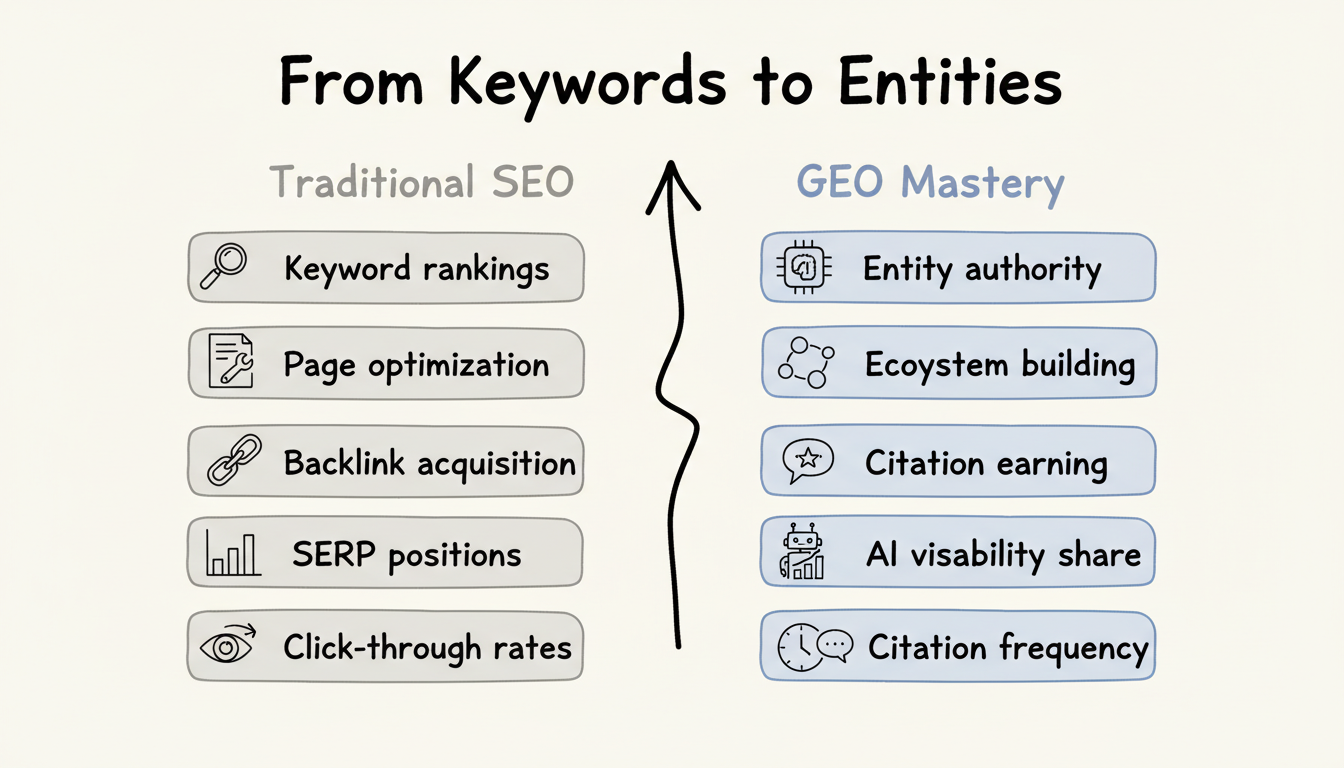
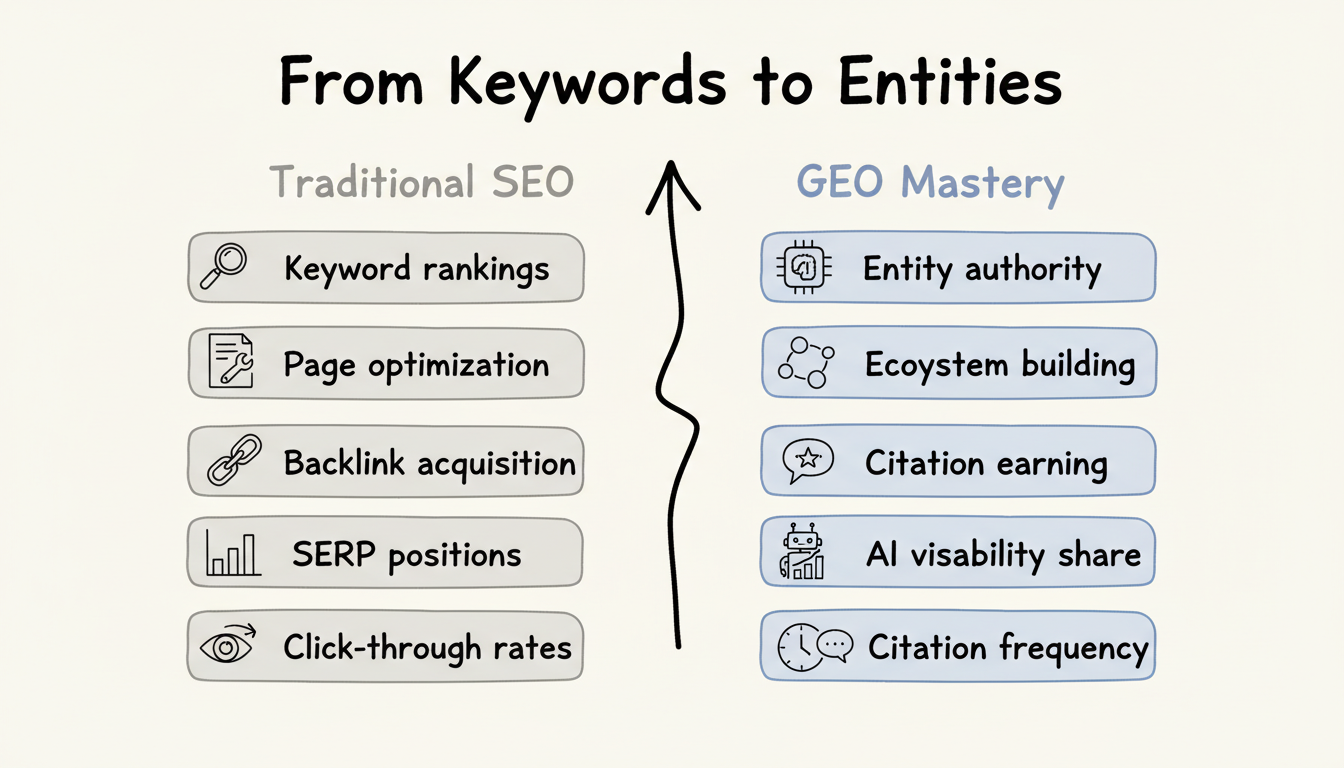
Traditional SEO focused on keywords. Mastering GEO requires focusing on entities—the relationships between your brand, your experts, and the topics you cover.
According to LinkedIn's GEO mastery guide, AI doesn't just look for words; it looks for relationships between your brand, your experts, and the topics you cover. To win in GEO, you must move away from "optimizing pages" and toward "establishing authority over entities."
The fundamental shift:
Traditional SEO Focus | GEO Mastery Focus |
Keyword rankings | Entity authority |
Page optimization | Ecosystem building |
Backlink acquisition | Citation earning |
SERP positions | AI visibility share |
Click-through rates | Citation frequency |
Successful GEO strategy requires hitting three optimization pillars to ensure AI models cite your content.
According to Store Transform's SEO trends analysis, AI Overviews now appear in about 18-21% of all Google searches worldwide, while traditional organic click-through rates have dropped over 30% as AI summaries provide direct answers. Mastering all three pillars is essential.
The three pillars:
Pillar 1: Authority Establishment
├── Expert authorship and credentials
├── Original research and data
├── Cross-platform brand consistency
└── Industry recognition signals

Pillar 2: Content Structuring
├── Answer-first organization
├── AI-extractable formats
├── Schema markup implementation
└── Clear entity relationships

Pillar 3: Trust Building
├── Third-party mentions
├── Verifiable claims with sources
├── Positive sentiment management
└── Cross-web consensus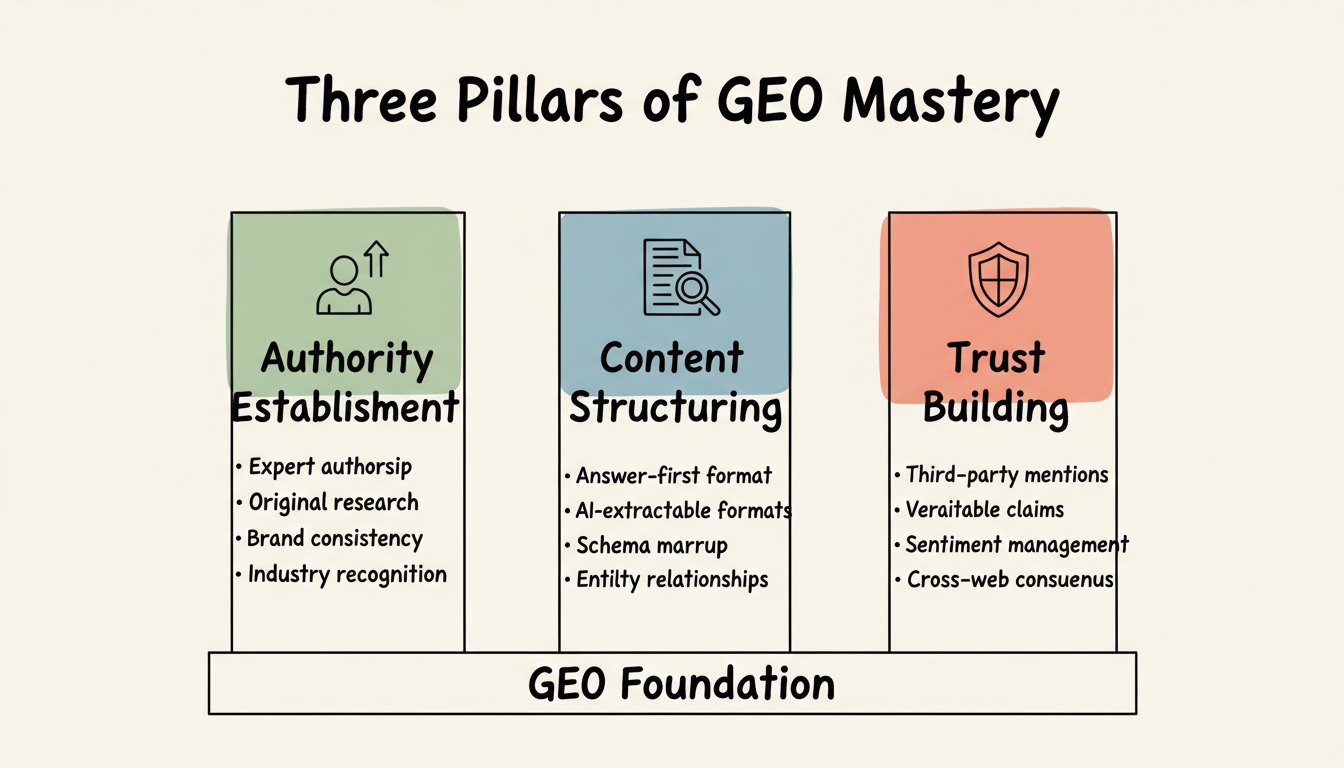
Moving from page optimization to entity authority requires systematic development of brand recognition signals.
According to Growth Engines' 2026 roadmap, GEO focuses on being the "source of truth" for LLMs like Gemini, ChatGPT, and Perplexity. The goal is to be cited within AI-generated summaries, which requires establishing clear entity relationships.
Entity authority tactics:
Tactic | Implementation | Impact |
Schema markup | Define expert-evidence-product relationships | Helps AI map brand to knowledge graph |
Consistent NAP+E | Identical name/address/entity across web | Reduces confusion in AI systems |
Expert profiles | Named authors with verifiable credentials | Builds E-E-A-T signals |
Original research | Publish unique data and insights | Creates citable authority |
Cross-platform presence | Maintain consistent messaging everywhere | Builds consensus signals |
Content must be structured for AI extraction, not just human readability.
According to Local Mighty's AI SEO checklist, AI tools do not pick brands randomly—they look for sources they can verify, cross-check, and confidently reuse. Content must be designed to be quotable.
Content structuring best practices:
According to NachoNacho's SEO/GEO guide, if the section heading is "What is canonicalization?", open with "Canonicalization is the process of selecting the preferred version of a set of duplicate URLs to avoid indexation issues." This helps LLMs lift the answer without reading the entire page.
Mastering GEO doesn't mean abandoning traditional SEO—it means integrating both approaches.
According to Laura Jawad Marketing's GEO strategies, traditional SEO is still working, and AI-driven discovery is becoming more influential. Foundational SEO remains the base layer generative engine optimization is built on. Organizations looking to future-proof their search strategy should consider AI content optimization tools that support both traditional and AI-focused approaches.
The integrated framework:
Layer | Purpose | Priority |
Technical SEO | Crawlability, speed, mobile | Foundation |
Content SEO | Quality, relevance, keywords | Core |
Authority SEO | Backlinks, mentions, trust | Growth |
GEO layer | AI structure, citations, entities | Future-proofing |
According to Revved Digital's GEO SEO guide, businesses that embrace both approaches set themselves up for long-term visibility no matter how people search. The line between GEO and SEO keeps getting thinner.
New metrics define success in generative engine optimization beyond traditional rankings.
According to LinkedIn's GEO analysis, GEO success metrics include visibility (how often your brand appears in AI sources/citations), sentiment (accuracy and positivity of AI summaries), and referral quality (whether users clicking through have higher intent).
GEO mastery metrics:
Metric | What It Measures | Target |
Citation frequency | Brand mentions in AI answers | Increasing trend |
Sentiment accuracy | How AI describes your brand | Positive and accurate |
Platform coverage | Visibility across AI engines | All major platforms |
Referral engagement | Time on site from AI traffic | 2+ minutes |
Return rate | Users coming back from AI | 20%+ within 7 days |
A systematic approach ensures compounding AI visibility over time.
According to Local Mighty, most teams lose time because they do the steps out of order. Following a clear AI search optimization timeline roadmap creates sustainable results through the proper sequence—from entity trust foundation through content hubs, extraction optimization, earned visibility, and tracking.
The mastery workflow:
Mastering AI SEO and generative engine optimization requires systematic approach:
According to Semrush's LLMO guide, most tactics used in traditional SEO are good for LLM optimization too—but additional techniques improve AI visibility specifically. The brands mastering both will dominate discovery as AI-powered search becomes the norm.
By submitting this form, you agree to our Privacy Policy and Terms & Conditions.