
February 19, 2026


Last Updated: January 2026
Agentic AI represents the biggest shift in business automation since the rise of SaaS. Unlike traditional AI tools that perform single tasks, agentic AI platforms create autonomous agents that execute multi-step workflows, make decisions, and collaborate with other agents to accomplish complex goals.
This guide covers the best agentic AI tools in 2026—platforms that help businesses automate everything from marketing and SEO to customer support and internal operations.
Agentic AI tools create autonomous agents—AI systems that can plan, execute, and adapt workflows without constant human oversight. Instead of tools that perform one task at a time, agentic platforms manage entire workflows autonomously.
Key characteristics of agentic AI:

Best for: Teams automating daily operations with AI agents
Pricing: Starting at $49.99/month
Lindy lets you build AI agents that handle everything from email management to meeting notes, custom workflows, and beyond. The platform emphasizes no-code accessibility—you can create agents in minutes without touching code.
Strengths:
Best suited for teams wanting quick automation wins without technical complexity.
Best for: AI workflow automation for everyone
Pricing: Free tier available; paid plans from $15/month
Gumloop positions itself as the easiest way to create AI agents and automated workflows. The visual canvas approach makes building complex automations accessible to non-technical users.
Key features include natural language workflow creation and the ability to chain multiple AI steps into comprehensive automations. Users report combining Gumloop with tools like Claude to create sophisticated agentic workflows.
Best for: Technical teams wanting visual workflow building
Pricing: Open source (self-hosted); cloud plans from $20/month
n8n provides a visual canvas for building automated workflows and AI agents with 400+ integrations. The platform supports natural language workflow creation while offering deep customization for advanced users.
Particularly strong for teams with technical resources who want control over their automation infrastructure.
Best for: Large enterprises needing comprehensive agentic solutions
Pricing: Enterprise (custom)
Kore.ai offers the full range of agentic solutions for workplace productivity, customer service, and process orchestration. Multi-agent orchestration enables enterprises to design AI agents that collaborate seamlessly across customer, employee, and operations use cases.
Enterprise features include governance capabilities, role-based access control, and compliance tools that larger organizations require.
Best for: Enterprise-scale AI with compliance requirements
Pricing: Enterprise (custom)
IBM's agentic platform provides flexible frameworks for building custom agents across domains with enterprise-grade security. Integration with existing IBM infrastructure makes it practical for organizations already invested in the IBM ecosystem.
Strong emphasis on debugging, logging, and audit capabilities for regulated industries.
Best for: Building custom agents across domains
Pricing: Starting at $99/month
Relevance AI provides a horizontal platform for creating specialized agents without extensive development resources. The platform supports various agent types across marketing, sales, operations, and research functions.
Best for: Developers building AI agent teams
Pricing: Starting at $99/month
CrewAI helps developers create role-based agents that work together as coordinated teams. Each agent in a "crew" has defined responsibilities and collaborates with others to accomplish complex objectives.
Ideal for organizations with development resources wanting fine-grained control over agent behavior and interactions.
Best for: Developers building custom agentic applications
Pricing: Open source (framework); cloud services vary
LangChain and LangGraph provide the infrastructure for building custom AI agents with detailed control over reasoning and tool use. The framework approach allows maximum flexibility but requires development expertise.
Strong community support and extensive documentation make it accessible for developers new to agentic AI.
Best for: Research and experimental agent development
Pricing: Open source
Microsoft's AutoGen framework enables creation of conversational AI agents that can work together. Popular in research contexts and for developers exploring multi-agent architectures.
Best for: Business operations across multiple functions
Pricing: Starting at $97/month
Sintra AI provides 12 specialized AI agents handling different business tasks including sales, SEO, customer support, and data analysis. Rather than building custom agents, users deploy pre-configured specialists.
Useful for businesses wanting immediate functionality without configuration.
Best for: IT and HR service automation
Pricing: Enterprise (custom)
Aisera focuses on automating service interactions and operational workflows across IT, HR, customer support, and internal service functions. Deep integration with ITSM tools makes it practical for IT-heavy organizations.
Best for: Contact center automation
Pricing: Enterprise (custom)
Cognigy has evolved into agentic AI specifically for enterprise customer experience. Strong focus on conversation handling and integration with contact center infrastructure.
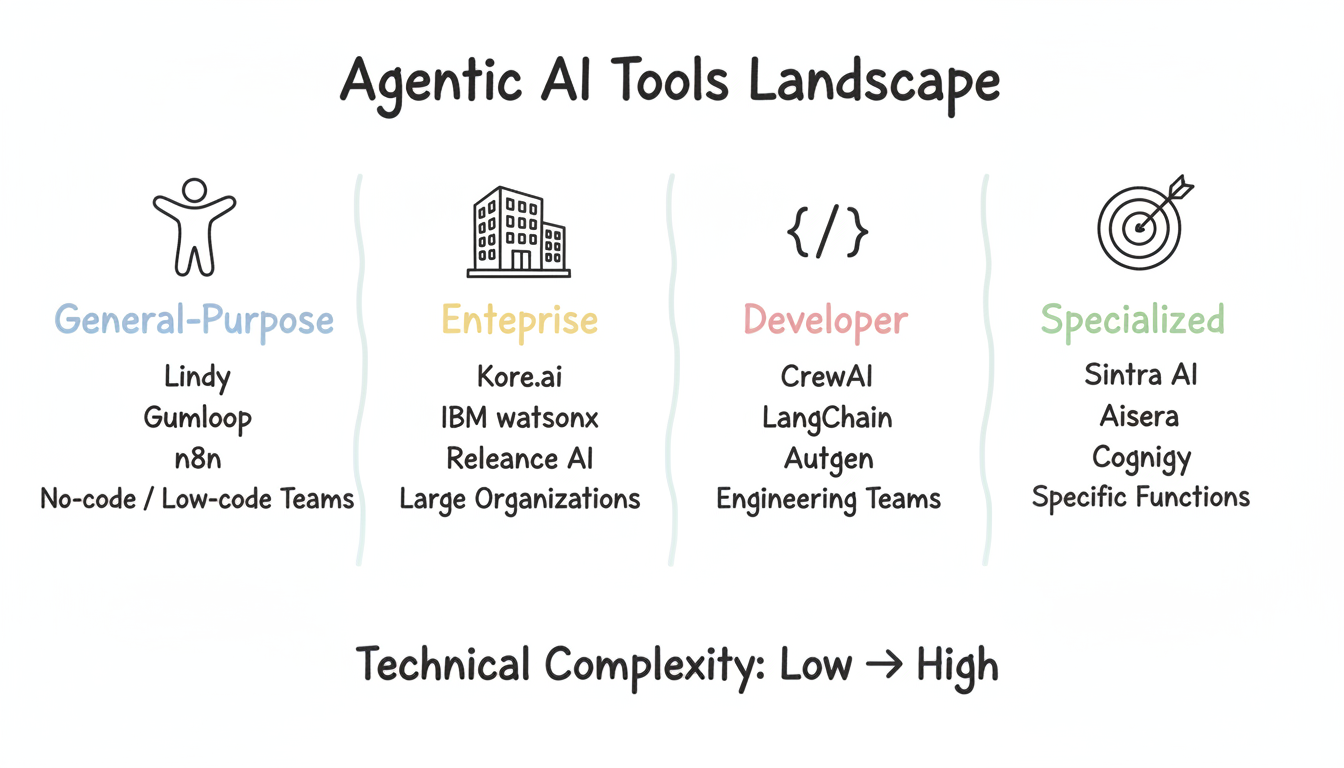
No-code options (Lindy, Gumloop, Sintra): Best for teams without development resources wanting quick deployment.
Low-code options (n8n, Relevance AI): Good for teams with some technical capability wanting customization.
Developer platforms (CrewAI, LangChain, AutoGen): Ideal for organizations with engineering resources wanting full control.
List the systems your agents need to interact with—CRM, email, databases, APIs. Ensure your chosen platform connects to your essential tools. Many successful ChatGPT optimization tactics rely on seamless integration between AI agents and existing business systems.
Enterprises in regulated industries need platforms with compliance features, audit trails, and access controls. Smaller teams may prioritize ease of use over governance.
Begin with a single use case rather than enterprise-wide deployment. Validate that agentic AI delivers value for your specific needs before expanding. This approach mirrors successful GEO implementation guide strategies that start with focused optimizations.
Marketers increasingly use agentic tools for:
The shift toward agentic AI in marketing means platforms that can manage entire workflows autonomously rather than requiring human intervention at every step. Organizations implementing ChatGPT SEO optimization strategies often combine agentic AI platforms with specialized SEO tools for maximum impact.
Agentic AI tools transform how businesses automate work—from single-task tools to autonomous agents managing complex workflows. The category has matured significantly in 2026, with options ranging from no-code platforms for quick wins to developer frameworks for custom implementations.
Start by identifying a specific workflow that would benefit from autonomous execution. Test platforms against that use case before committing to broader deployment. The right agentic AI tool depends on your technical resources, integration needs, and governance requirements—not just features. For teams focused on AI-driven search visibility, exploring AEO software guide options alongside agentic platforms can provide comprehensive automation coverage.
By submitting this form, you agree to our Privacy Policy and Terms & Conditions.



