February 19, 2026


Dental PPC advertising has become essential for practices looking to grow their patient base in competitive markets. With over 200,000 dental practices in the US alone, standing out requires a strategic, data-driven approach to paid search marketing.
In this guide, you'll learn exactly how PPC works for dental practices, what it costs, how to target local patients effectively, and whether to hire a specialized dental PPC agency.
Unlike other industries where customers research extensively before buying, dental patients often need immediate services. Someone searching "emergency dentist near me" or "teeth whitening appointment" has high intent and needs help now—making them ideal PPC candidates.
PPC captures patients at critical decision points:
Each search type requires different ad messaging and landing pages, but all represent patients ready to book appointments.
SEO takes months to show results, and dental practices compete against directories, insurance sites, and established competitors for organic rankings. Understanding the differences between SEM and SEO is crucial when allocating your marketing budget. PPC puts your practice at the top of search results immediately, appearing above organic listings where patients click first.
According to dental marketing data, practices using PPC alongside SEO generate significantly more new patient inquiries than those relying on organic search alone.
While Google dominates search advertising, Microsoft Ads offers compelling advantages for dental practices, particularly those targeting older, more affluent patients. Many practices wonder is Bing Ads worth it, and for dental marketing specifically, the answer is often yes.
Lower Competition: Fewer dental practices advertise on Microsoft, meaning lower CPCs and less bidding competition for valuable keywords.
Demographic Fit: Microsoft's audience skews older and more affluent—a demographic more likely to need dental implants, cosmetic procedures, and comprehensive care that generates higher patient lifetime values.
Desktop Users: Many patients research dental care from work computers, where Bing has higher market share. These tend to be employed patients with dental insurance benefits.
Understanding realistic costs helps you budget effectively and evaluate campaign performance. If you're considering professional help, reviewing PPC agency pricing will give you a baseline for what agencies typically charge.
According to industry benchmark data, dental advertising ranks among the more expensive healthcare categories:
Metric | US Average | Major Metro |
Search CPC | $2.62 - $7.85 | $8 - $15+ |
Display CPC | $0.63 | $0.80 - $1.50 |
Average CVR | 3.36% | 2.5% - 4% |
Average CPA | $78.09 | $100 - $200 |
Note: Highly competitive keywords like "dental implants" or "emergency dentist" in major cities can exceed $20-30 per click.
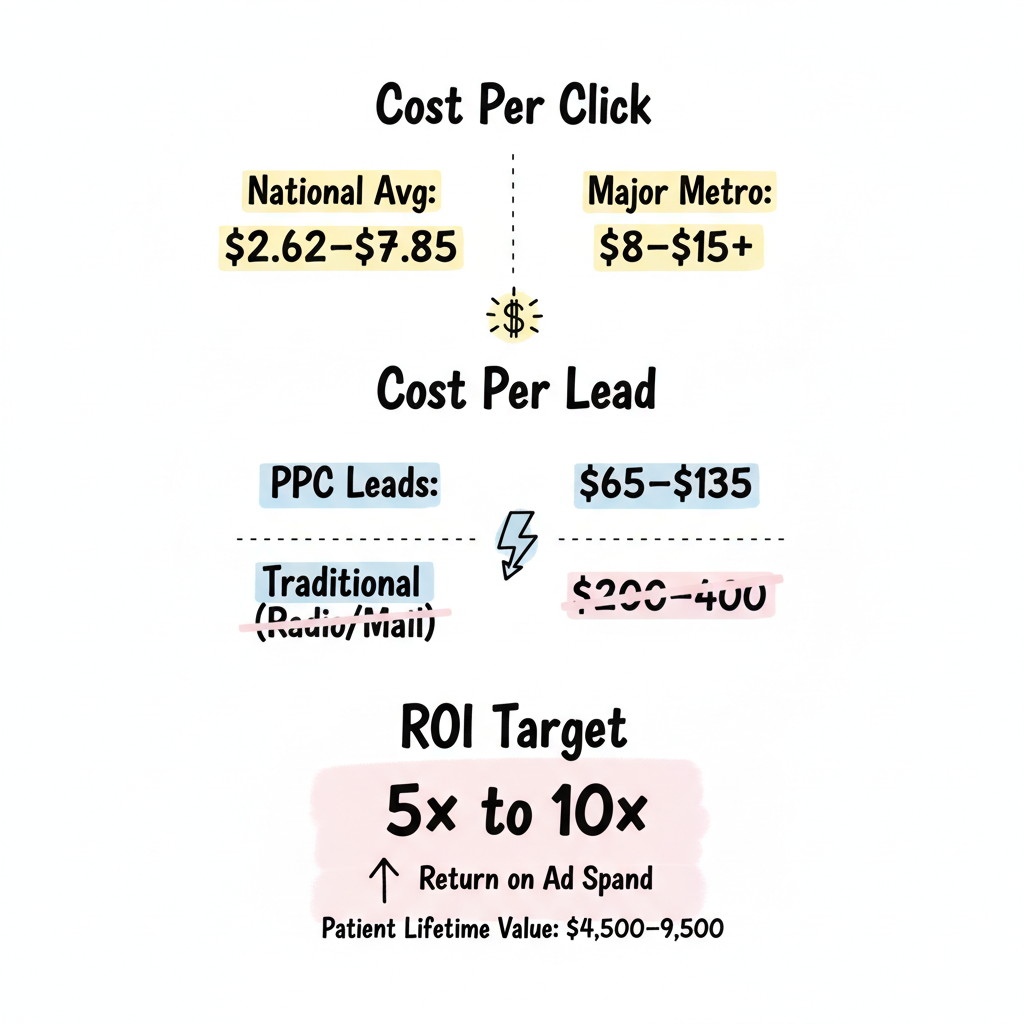
Digital marketing channels typically produce dental leads for $65-$135 each. For context:
The real question isn't "how much does it cost?" but "how much is a new patient worth?"
A 2013 ADA study found patients spent an average of $706 per year on dental care—adjusted for inflation, approximately $945 in 2024 dollars. Over a patient lifetime of 5-10 years, that's $4,500-$9,500+ in revenue.
If your PPC campaign acquires patients for $200 each, your ROI is exceptional. A healthy benchmark is 5:1 to 10:1 ROI on dental PPC spend.
Dental practices serve local communities, making geographic targeting essential for efficient ad spend. Effective PPC advertising strategy and best practices emphasize the importance of hyper-local targeting for service businesses.
Radius Targeting: Set a radius around your practice location. Most dental patients come from within 10-15 miles, though this varies by:
ZIP Code Targeting: Target specific neighborhoods or exclude areas unlikely to produce patients (industrial zones, competitor strongholds).
Location Bid Adjustments: Increase bids for high-value areas (affluent neighborhoods, areas near your practice) and decrease for lower-converting regions.
Structure campaigns around local search intent:
Keyword Type | Example | Intent Level |
Geo-modified | "dentist in [city]" | High |
Near me | "emergency dentist near me" | Very High |
Neighborhood | "dentist [neighborhood name]" | High |
Service + location | "dental implants [city]" | Very High |
Ensure your Google Business Profile is optimized and linked to your ads for:
Effective dental ad copy addresses patient concerns and differentiates your practice. Looking at successful PPC advertising examples and campaigns from other healthcare providers can inspire your creative approach.
Lead with patient benefits:
Include trust signals:
Create urgency appropriately:
Emergency Dental:
Emergency Dentist [City] - Open Today
Same-Day Pain Relief | Walk-Ins Welcome
Call Now - We're Here When You Need Us
Dental Implants:
Dental Implants in [City] - Free Consultation
Replace Missing Teeth Permanently
Experienced Team | Financing Available
General Dentistry:
New Patient Special - $99 Exam & X-Rays
Family Dentist in [Neighborhood]
Accepting New Patients | Book Online
Your landing page converts clicks into appointments. Poor landing pages waste ad spend.
Above the fold:
Page content:
Conversion elements:
Create dedicated pages for each major service campaign:
Generic homepages convert poorly compared to focused landing pages that match ad intent.
Track metrics that matter for your practice growth, not vanity metrics. Effective PPC advertising management and best practices require monitoring the right KPIs to optimize campaign performance.
Lead Metrics:
Quality Metrics:
Efficiency Metrics:
Most dental leads come via phone. Without call tracking, you can't:
Keyword-level call tracking attribution is essential for dental PPC optimization.
Track these metrics monthly:
Metric | Benchmark | Your Target |
Total leads | Varies | Based on capacity |
Cost per lead | $65-$135 | Under $100 |
Lead-to-patient rate | 40-60% | 50%+ |
Cost per new patient | $150-$300 | Under $250 |
ROI | 5:1 to 10:1 | 5:1+ |
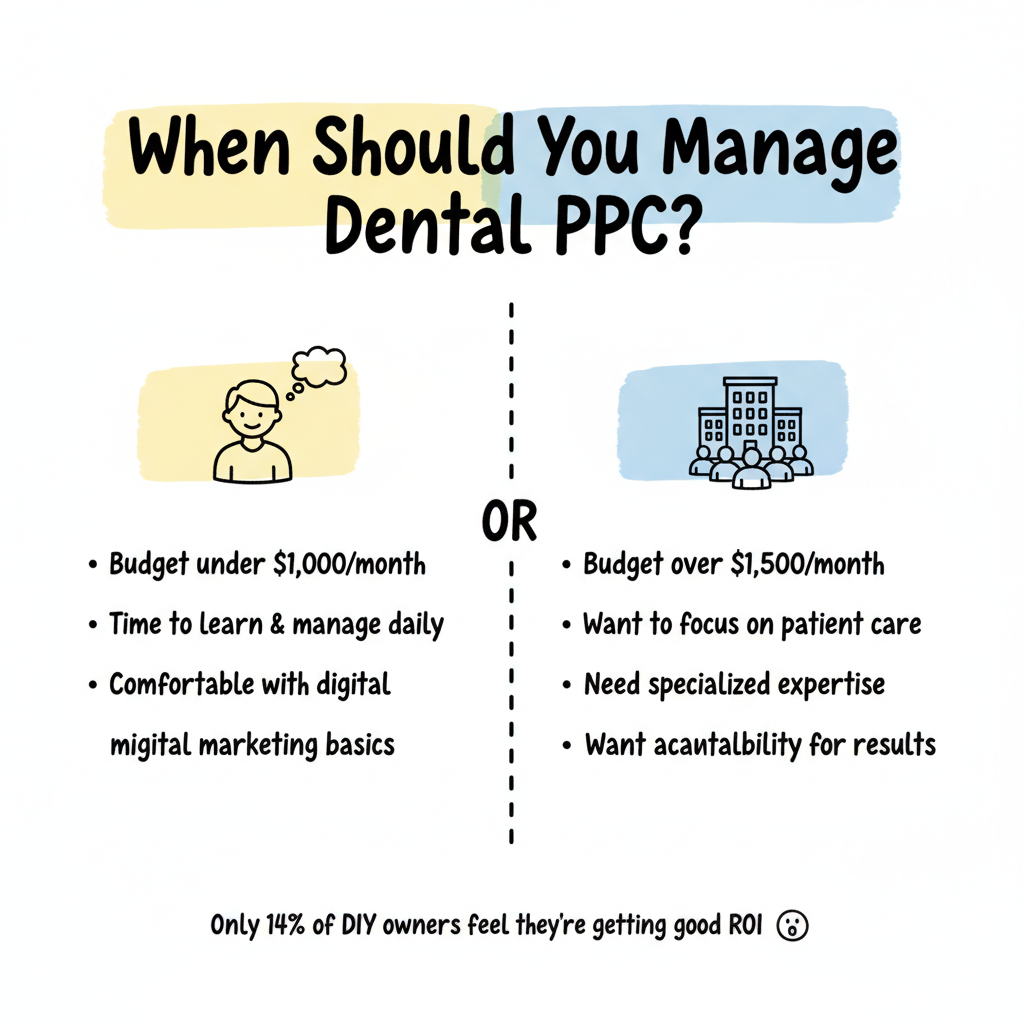
Managing dental PPC effectively requires significant time and expertise. Here's how to evaluate potential agency partners. If you're considering outsourcing, professional PPC campaign management services can deliver better results than in-house efforts for most practices.
Managing yourself makes sense if:
Hiring an agency makes sense if:
A 2025 BrightLocal survey found only 14% of small business owners managing their own Google Ads felt they were getting good ROI—highlighting the expertise gap.
Industry experience:
Transparent reporting:
Realistic expectations:
For practices focused on Google Ads specifically, working with a specialized Google PPC agency can provide platform expertise and better campaign results.
Avoid agencies that:
Most dental practices should budget $1,000-$2,000/month minimum for meaningful results in competitive markets. This gives the advertising algorithms enough data to learn and optimize. Larger practices or those in major metros may need $3,000-$10,000/month to compete effectively.
You can see leads within days of launching campaigns. However, optimization for best results typically takes 60-90 days as you gather performance data, refine targeting, and improve conversion rates. Expect to see consistent ROI patterns after 3 months of active management.
Yes, particularly for practices targeting older, more affluent patients or those in markets with high Google Ads competition. Microsoft Ads typically offers 30-40% lower CPCs with less bidding competition. Many practices allocate 15-25% of their PPC budget to Microsoft for diversification. The comparison between Microsoft Ads vs Google Ads shows clear advantages for certain demographics.
The healthcare industry average conversion rate is 3.36% for search campaigns. Well-optimized dental campaigns with strong landing pages can achieve 5-10% conversion rates for high-intent keywords like emergency services.
By submitting this form, you agree to our Privacy Policy and Terms & Conditions.