
February 19, 2026


Google Ads dominates the paid search landscape with nearly 90% global search market share. For most businesses, advertising on Google isn't optional—it's essential. But running profitable campaigns requires expertise that takes years to develop.
This guide covers everything you need to know about working with a Google PPC agency in 2026, from understanding what services to expect to evaluating agencies and avoiding common pitfalls.
Managing Google Ads in-house sounds appealing until you realize the platform's complexity. Google continuously releases updates, new campaign types, and AI-driven features that require constant learning.
Platform expertise: Agencies manage multiple accounts daily, giving them pattern recognition you can't develop with one account. They've seen what works across industries and budget levels.
Time savings: Google Ads management demands daily attention—bid adjustments, negative keywords, ad testing, landing page optimization. Most internal marketing teams lack the bandwidth.
Tool access: Agencies invest in digital marketing tools for competitive intelligence, automated bidding, and reporting that would be prohibitively expensive for a single business.
Algorithm knowledge: Google's machine learning systems require specific inputs and structures to perform optimally. Experienced agencies understand these nuances.
Certifications and beta access: Google Partner agencies often receive early access to new features and direct support from Google representatives.
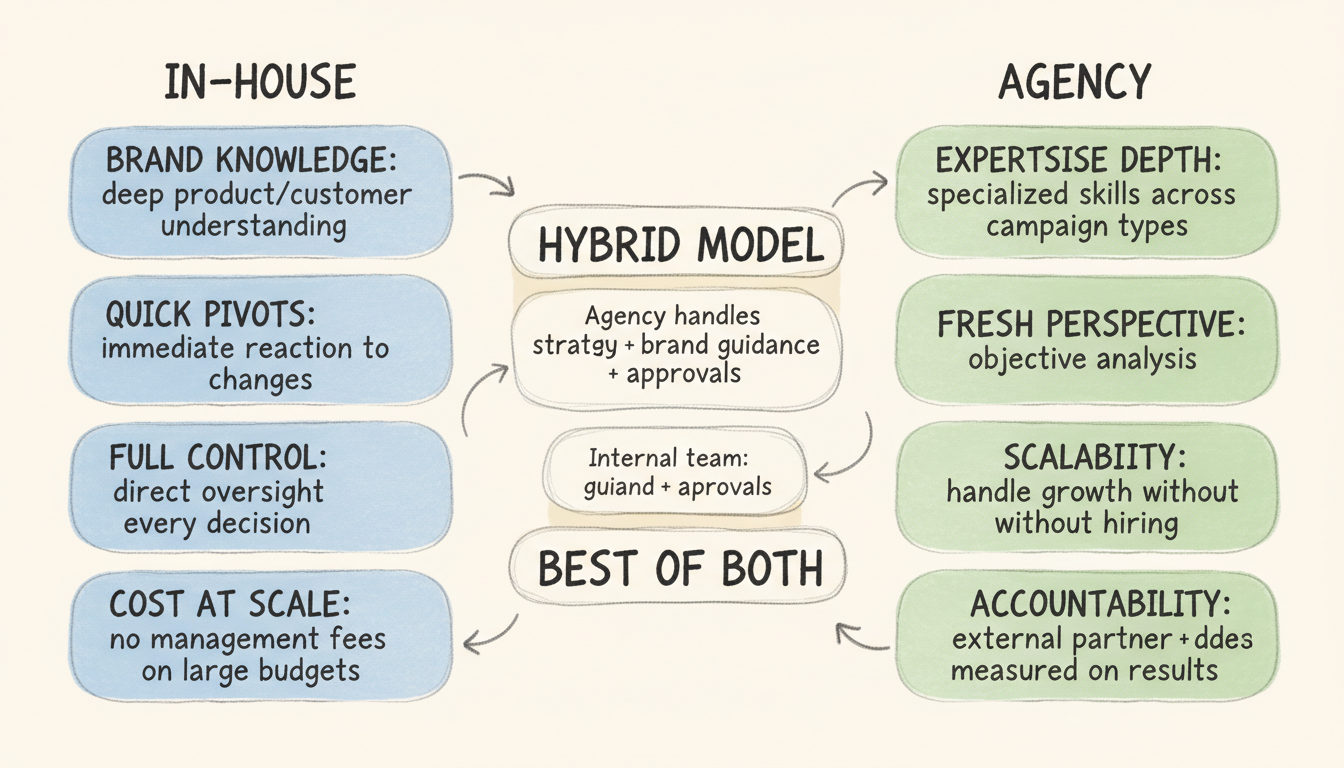
Both approaches have merit. Here's an honest comparison.
Factor | In-House Benefit |
Brand knowledge | Deep understanding of your products and customers |
Quick pivots | Can react immediately to business changes |
Full control | Direct oversight of every decision |
Cost (at scale) | No management fees on large budgets |
Factor | Agency Benefit |
Expertise depth | Specialized skills across campaign types |
Fresh perspective | Objective analysis without internal bias |
Scalability | Handle growth without hiring |
Tool investment | Access to premium tools and data |
Accountability | External partner measured on results |
Many businesses find success with a hybrid model:
Full-service Google Ads agencies provide comprehensive management across the entire Google advertising ecosystem.
Account audit and strategy: Evaluating existing campaigns, identifying opportunities, and developing a strategic roadmap.
Campaign setup and structure: Building campaigns with proper segmentation, ad groups, and targeting configurations.
Keyword research and management: Identifying high-value keywords, monitoring search terms, and building negative keyword lists.
Ad copy creation and testing: Writing compelling ads, running A/B tests, and optimizing for quality score.
Bid management: Setting and adjusting bids based on performance, competition, and business goals.
Landing page optimization: Improving post-click experience to maximize conversion rates.
Conversion tracking: Setting up proper attribution to measure actual business outcomes.
Reporting and analysis: Regular performance updates with actionable insights.
Top agencies manage all Google Ads campaign types:
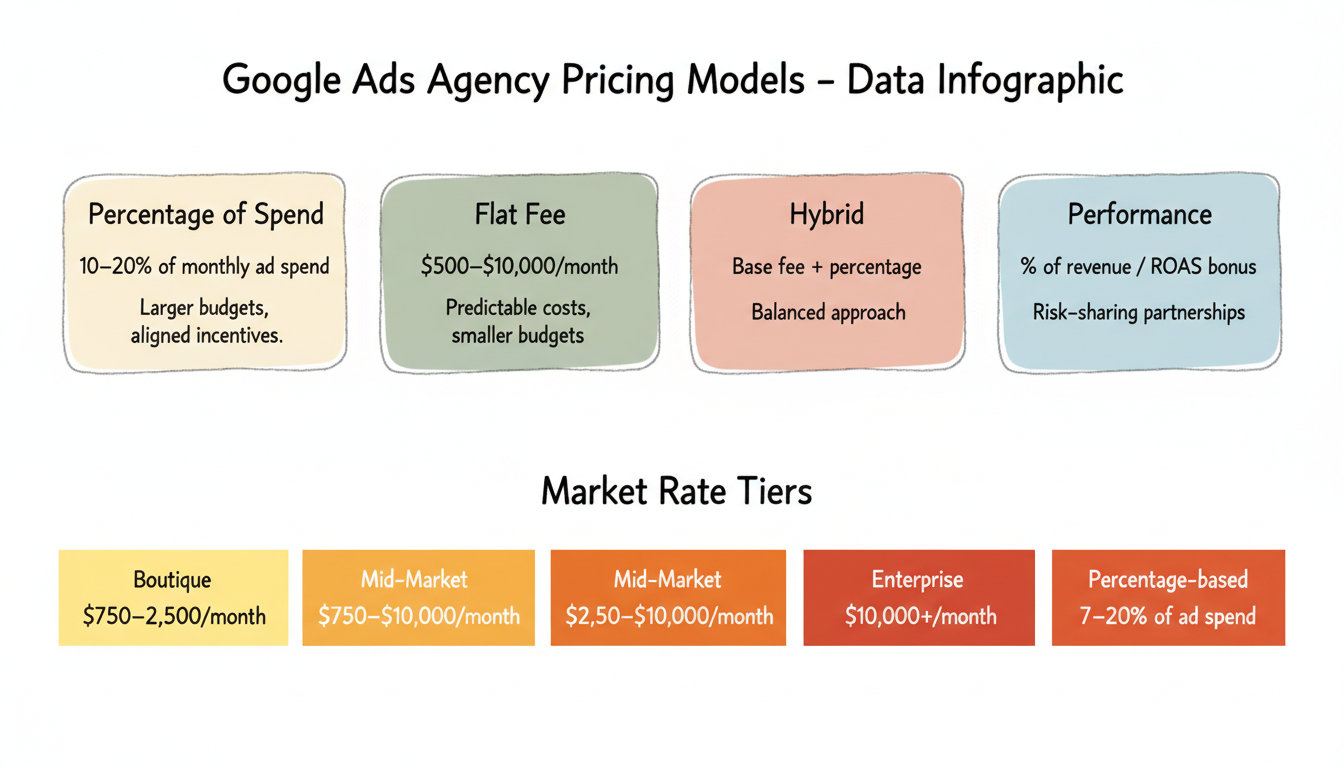
Pricing varies significantly based on agency size, expertise, and service scope. Here are the common models.
Model | Typical Range | Best For |
Percentage of spend | 10-20% | Larger budgets, aligned incentives |
Flat monthly fee | $500-$10,000 | Predictable costs, smaller budgets |
Hybrid | Base fee + percentage | Balanced approach |
Performance-based | % of revenue/ROAS bonus | Risk-sharing partnerships |
According to industry pricing research, typical agency fees fall within 10-20% of monthly ad spend. For smaller businesses with lower budgets, flat monthly fees of $300-$1,000 are common.
A review of top agencies in 2026 shows pricing ranges:
Agency Type | Management Fee Range |
Boutique specialists | $750-$2,500/month |
Mid-market agencies | $2,500-$10,000/month |
Enterprise agencies | $10,000+/month |
Percentage-based | 7-20% of ad spend |
Setup fees are often charged separately, typically $500-$5,000 depending on account complexity.
Cheaper isn't always better. Consider:
Google offers certification programs that indicate agency competence and commitment.
Google Partner: Demonstrates that the agency meets Google's requirements for ad spend management, certifications, and performance benchmarks.
Premier Partner: Top 3% of participating Google Partners. Reserved for agencies with exceptional performance, substantial managed spend, and proven results.
Partner agencies receive:
Agency team members can earn certifications in:
Ask agencies which certifications their team holds—especially those who will actually work on your account.
Selecting the right agency requires due diligence. Here's a systematic approach.
Experience and expertise:
Process and communication:
Results and references:
Transparency:
Strong agencies provide detailed case studies. Look for:
According to agency rankings, top performers can demonstrate results like 312% revenue increases for Shopping campaigns within 90 days—ask for this level of specificity.
Consider starting with:
Not all agencies deliver value. Watch for these warning signs.
No account access: If an agency won't give you login credentials to your own Google Ads account, walk away. You should always own and control your account.
Guaranteed rankings or results: Google Ads has no guarantees. Agencies promising specific positions or results are either naive or dishonest.
Long-term contracts with no exit: Quality agencies retain clients through results, not contracts. Avoid 12+ month commitments without performance-based exit clauses.
Vague reporting: If you can't see exactly what you're spending and what you're getting, there's a problem. Demand transparent, platform-level reporting.
Hidden fees: Setup fees, change request fees, reporting fees—get everything in writing upfront.
Ready to partner with a Google Ads agency? Here's the process.
Before agency conversations:
Typical agency onboarding includes:
Week 1-2: Account audit, access setup, goal alignment Week 3-4: Strategy development, campaign structure planning Month 2: Campaign launch, initial optimization Month 3+: Ongoing optimization, testing, scaling
Expect 60-90 days before campaigns reach optimal performance—anyone promising immediate results is overselling.
Realistic expectations prevent disappointment:
Understanding the complete guide to paid search advertising helps set realistic benchmarks for what professional PPC marketing agency services can achieve.
Once Google campaigns are profitable, consider expanding to Microsoft Advertising for complementary reach. Microsoft offers:
Many agencies manage both platforms, maximizing your paid search coverage. If you're evaluating agencies, understanding Microsoft Advertising managed services alongside Google can help you find a partner that optimizes across both platforms.
Typical agency fees range from 10-20% of ad spend or $500-$10,000 flat monthly fees depending on campaign complexity. For most SMBs, expect $750-$2,500/month for quality management. The ROI should exceed the fee—if it doesn't, something's wrong.
When evaluating costs, it's helpful to understand Microsoft Advertising cost pricing as well, since many agencies offer multi-platform management that can improve overall efficiency.
Google Partners meet baseline requirements for certification and performance. Premier Partners represent the top 3% of agencies with exceptional performance, substantial managed spend, and proven results. Both badges indicate competence, but Premier Partner suggests a higher level of expertise.
Expect 60-90 days before campaigns reach optimal performance. Month one focuses on setup and baseline establishment. Months two and three involve optimization and initial improvements. Meaningful performance gains typically emerge in months four through six.
The same timeline generally applies whether you're working with a best PPC agency for Google or exploring Microsoft Ads PPC agency services.
If monthly ad spend exceeds $5,000 and you lack dedicated PPC expertise internally, an agency usually makes sense. The management fee is offset by better performance, time savings, and avoiding costly mistakes. For smaller budgets, in-house management or automated tools may be more cost-effective.
Understanding SEM marketing fundamentals helps you evaluate whether your team has the expertise to manage campaigns effectively or if partnering with specialists makes more sense.
By submitting this form, you agree to our Privacy Policy and Terms & Conditions.



