February 19, 2026


Search optimization is no longer a single discipline. As AI-powered search platforms grow, marketers must understand how GEO (Generative Engine Optimization) fits within their broader SEO strategy. The relationship between these approaches isn't competitive—it's complementary.
According to Ntooitive's GEO integration guide, while SEO helps your pages rank, generative engine optimization helps your brand appear in AI-generated answers. Together, SEO and GEO ensure visibility whether users are browsing results or consuming AI summaries.
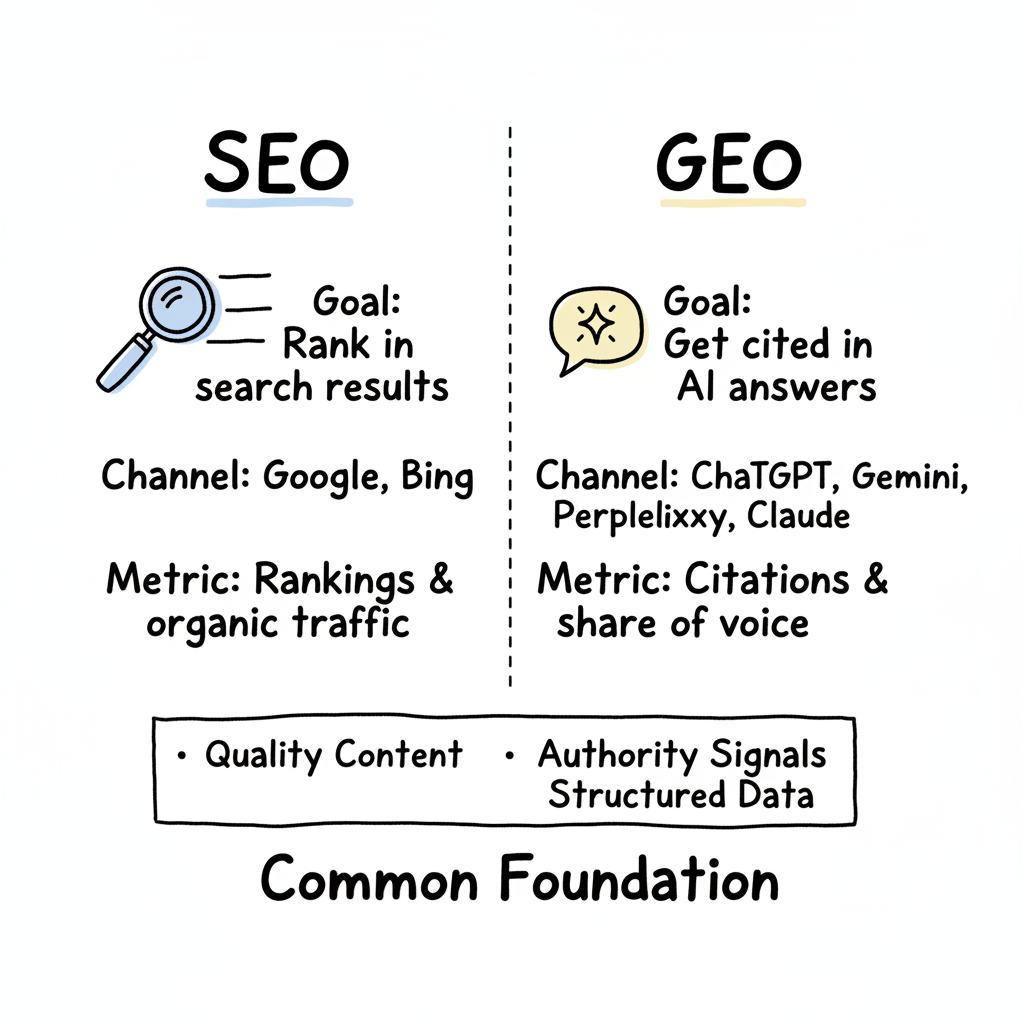
GEO represents an extension of traditional SEO, not a replacement. Both disciplines share fundamental principles while targeting different discovery channels.
According to Firebrand Marketing's GEO best practices guide, SEO remains the foundation of GEO because both search engines and LLMs rely on structured, trustworthy, and authoritative content to understand a brand's expertise.
How GEO and SEO relate:
Aspect | SEO Function | GEO Function |
Goal | Rank in search results | Get cited in AI answers |
Foundation | Quality content | Quality content |
Technical | Site optimization | AI-friendly structure |
Authority | Backlinks | Third-party mentions |
Measurement | Rankings, traffic | Citations, share of voice |

According to StubGroup's GEO guide, while traditional SEO focuses on search engine rankings, GEO optimizes for citation across ChatGPT, Google AI Overviews, Perplexity, Claude, Gemini, and other LLMs. However, the same content quality signals matter for both.
SEO foundations that support GEO:
According to Bluefish's GEO platform comparison, SEO optimizes content for search engine algorithms to improve rankings on results pages, while GEO optimizes content so AI models cite, reference, and surface your brand directly inside generated answers.
According to Firebrand Marketing, effective GEO fits into a broader cross-functional strategy including SEO, content marketing, PR, and social media—all designed to drive brand visibility in AI search results.
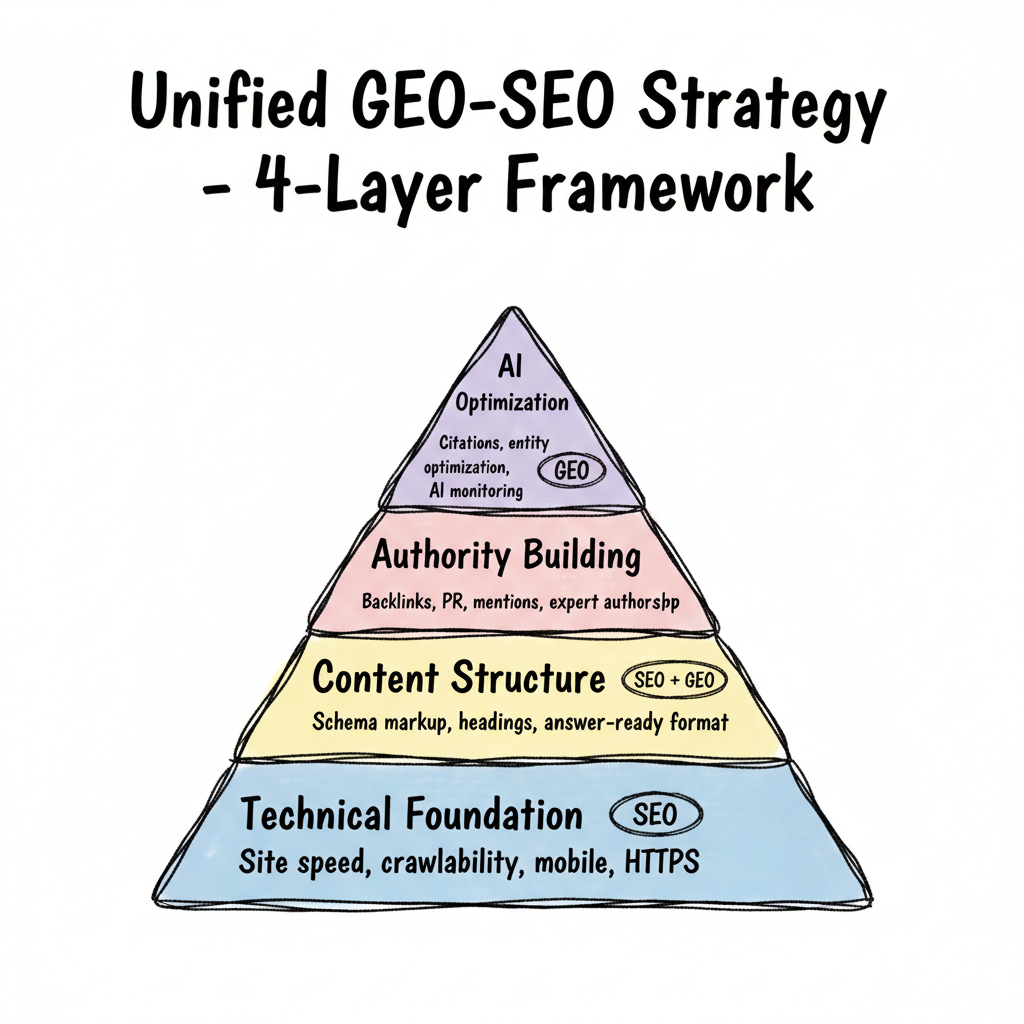
Strategy integration framework:
Layer 1: Technical Foundation (SEO)
Layer 2: Content Structure (SEO + GEO)
Layer 3: Authority Building (SEO + GEO)
Layer 4: AI Optimization (GEO)
According to StoreTransform's SEO trends analysis, to succeed in 2026, businesses must integrate AI-first strategies alongside traditional SEO: implementing E-E-A-T, structured data, GEO, AEO, and AIO approaches.
Translation of SEO tactics:
SEO Tactic | GEO Application |
Keyword optimization | Topic authority building |
Title tags | Clear, extractable headlines |
Meta descriptions | Summary-ready content |
Header structure | AI-parseable hierarchies |
Internal linking | Topic cluster connections |
Backlinks | Citation opportunities |
Schema markup | Entity recognition signals |
According to SEO.com's GEO vs SEO analysis, businesses should integrate both strategies to ensure visibility across traditional search engines, AI-powered platforms, and social media searches, as the search journey is becoming more diversified. Understanding the fundamental differences between GEO vs SEO vs AEO helps marketers allocate resources effectively across these complementary optimization approaches.
According to StubGroup, AI prioritizes structured data, clear hierarchies, citations to authoritative sources, statistics over qualitative claims, and content answering specific user queries.
Content optimization principles:
For SEO:
For GEO:
For both:
According to Omnius's GEO industry report, GEO is the practice of optimizing content to appear in AI-powered answers rather than traditional search engine results pages. Unlike SEO, where focus is to rank web pages in a list of search results, GEO is about making sure that your content is understood, trusted, and referenced by AI.
According to PR News Online's GEO guide, reports that place GEO metrics alongside SEO metrics provide a more complete view of brand visibility, narrative control, and demand creation.
Combined measurement framework:
Metric Category | SEO Metrics | GEO Metrics |
Visibility | Rankings, impressions | Citation frequency, share of voice |
Traffic | Organic sessions | AI referral traffic |
Engagement | Click-through rate | Citation context quality |
Authority | Domain authority | Citation source quality |
Conversion | Organic conversions | AI-referred conversions |
According to PR News Online, creating a GEO scorecard (AI Visibility Index) and placing GEO metrics alongside SEO metrics provides a complete view of brand visibility.
According to StubGroup, traditional SEO platforms don't monitor AI-powered search engine visibility, but traditional SEO tools with GEO features are emerging—SEMrush added AI Overview tracking and citation analysis in 2025.
Tool stack for combined strategy:
Traditional SEO tools:
GEO-specific tools:
Integrated platforms:
Many organizations are also leveraging free AI SEO software tools to complement their paid platforms and extend their optimization capabilities across both traditional and AI-powered search channels.
According to Ntooitive, traditional search engine optimization ensures your content can be found, while generative engine optimization ensures your brand can be recommended.
Mistakes to avoid:
According to LinkedIn's analysis of future search trends, the emphasis will shift to creating AI-friendly ecosystems that are data-driven, clear, and easy for digital assistants to interpret.
Where integration is heading:
According to BigCommerce's ecommerce GEO guide, brands with clean structured data and high-quality product content are significantly more likely to be featured in AI-generated responses across search and shopping platforms—demonstrating how SEO fundamentals power GEO success. Marketers should also explore strategies for optimizing Google AI Overviews as a key component of their integrated search strategy.
Understanding GEO's role within SEO is essential for comprehensive 2026 visibility:
According to PR News Online, brands that treat AI engines as a core discovery channel will outperform those focused exclusively on traditional SEO. The winning approach integrates GEO within a strong SEO foundation.
By submitting this form, you agree to our Privacy Policy and Terms & Conditions.