
February 19, 2026


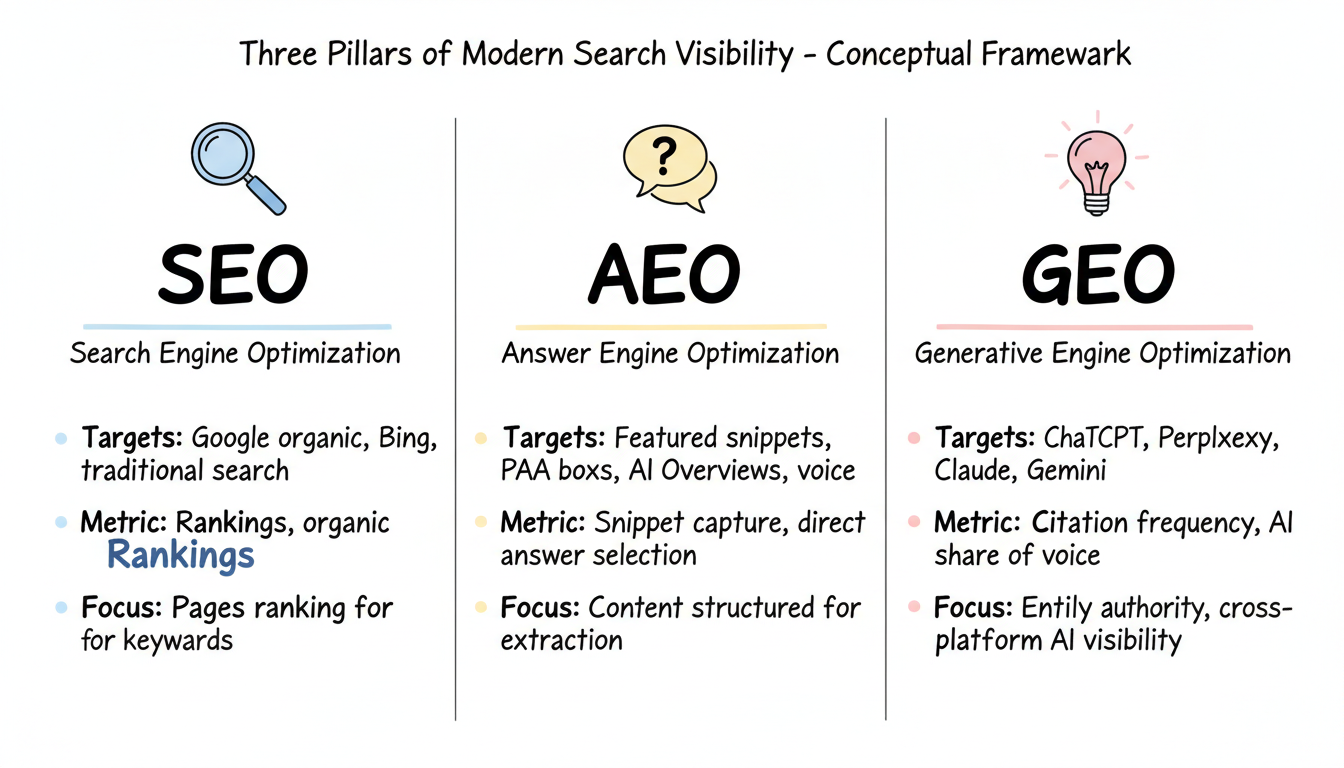
GEO, SEO, and AEO represent three distinct but interconnected approaches to search visibility. Understanding how these disciplines relate—and where each applies—prevents confusion and enables comprehensive search strategies.
This framework clarifies what each discipline does and how they work together.
SEO optimizes content for traditional search engine rankings. The goal: earn positions on search results pages that drive clicks to your website.
SEO targets: Google organic results, Bing results, traditional search engines Success metric: Rankings, organic traffic, click-through rates Primary focus: Pages ranking for target keywords
AEO optimizes content for extraction in direct answer formats. The goal: become the source AI-powered features select when generating direct responses.
AEO targets: Featured snippets, People Also Ask boxes, voice assistant answers, Google AI Overviews Success metric: Featured snippet capture, PAA appearances, direct answer selection Primary focus: Content structured for extraction and quotation
GEO optimizes for citation in AI-generated responses across platforms. The goal: become a trusted source that AI systems cite when synthesizing answers.
GEO targets: ChatGPT, Perplexity, Claude, Gemini, standalone AI assistants Success metric: Citation frequency, mention accuracy, share of voice across AI platforms Primary focus: Entity authority and cross-platform AI visibility
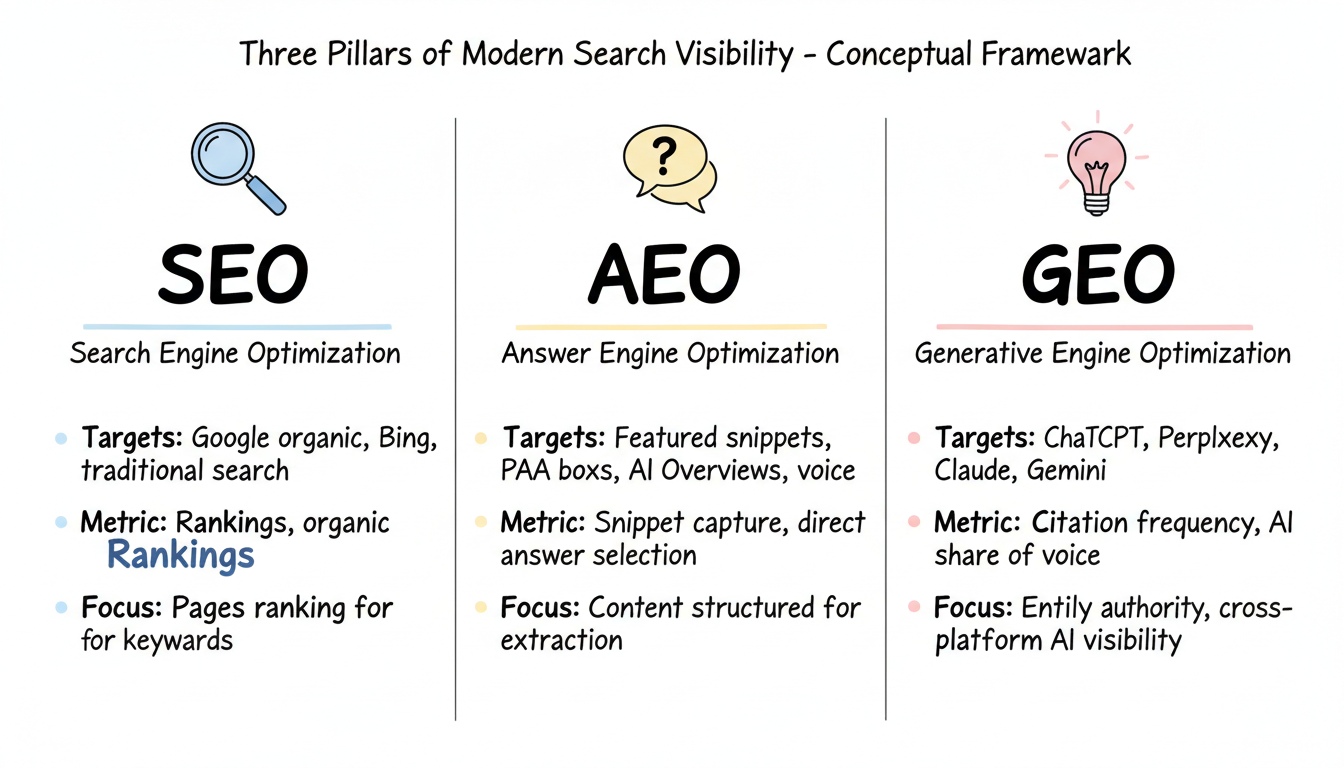
These disciplines form layers of search optimization rather than separate strategies.
SEO provides the base layer. Without crawlable, indexable, authoritative content, neither AEO nor GEO can succeed. SEO establishes:
Key insight: Organizations skipping SEO fundamentals struggle with both AEO and GEO. The foundation matters.
AEO builds on SEO by structuring content for machine extraction. Where SEO ensures content ranks, AEO ensures content gets selected for direct answers.
AEO additions to SEO:
Key insight: AEO shares platforms with SEO (Google) but optimizes for different selection—featured positions rather than organic rankings.
GEO extends beyond Google to AI platforms operating independently. While AEO targets Google's AI features, GEO targets ChatGPT, Perplexity, and other AI systems that users query directly.
GEO additions beyond AEO:
Key insight: GEO requires AEO skills (extraction-friendly content) plus broader platform consideration beyond Google.
Understanding scope prevents misallocation of effort.
Pure SEO focus works when:
Example: E-commerce product pages where users want to compare options directly on sites.
Combined SEO/AEO focus works when:
Example: How-to content where Google displays direct answers above organic results.
All three disciplines apply when:
Example: B2B software research where buyers ask ChatGPT for recommendations alongside Google searches.
Rather than treating GEO, SEO, and AEO as competing priorities, build a unified approach.
Element | SEO Benefit | AEO Benefit | GEO Benefit |
Quality content | Rankings | Extraction selection | Citation potential |
Technical health | Crawlability | Feature eligibility | AI accessibility |
Authority signals | Domain authority | Source preference | Citation trust |
Structured data | Rich results | Explicit relationships | AI comprehension |
Investment in these fundamentals improves all three disciplines simultaneously.
Beyond shared foundations, SEO uniquely requires:
Beyond shared foundations (and SEO), AEO uniquely requires:
Beyond shared foundations (and SEO/AEO), GEO uniquely requires:
If you lack SEO foundations, start there. AEO and GEO build on SEO success.
First phase priorities:
Once SEO basics are established, add AEO if Google displays:
AEO addition priorities:
Once SEO and AEO produce results, add GEO if:
GEO addition priorities:
No. AEO targets Google's AI features (still within Google's ecosystem). GEO targets standalone AI platforms (ChatGPT, Perplexity, etc.) operating independently from Google. Understanding the distinction between SEO vs AEO helps clarify these platform differences.
Technically yes, but results suffer. SEO builds the authority signals GEO depends on. AI systems evaluate source credibility using signals that overlap with traditional SEO authority. Skipping SEO means weaker GEO foundations.
No. GEO addresses different user behavior—people asking AI assistants instead of searching Google. Both behaviors persist. GEO captures AI searchers; SEO captures traditional searchers. Most audiences include both.
Usually not. Skills overlap significantly. SEO practitioners learning AEO and GEO principles can execute all three. Separate teams create fragmentation; integrated approaches work better.
Track metrics appropriate to each discipline:
SEO metrics: Rankings, organic traffic, CTR, conversions from organic AEO metrics: Featured snippet capture rate, PAA appearances, AI Overview inclusion GEO metrics: AI citation frequency, mention accuracy, competitive share of voice
Unified reporting shows total search visibility across all channels.
Assess your current state:
Build strategy based on assessment—SEO first, AEO when relevant, GEO when audiences warrant. The three disciplines work best as layered additions rather than competing alternatives.
By submitting this form, you agree to our Privacy Policy and Terms & Conditions.



