February 19, 2026


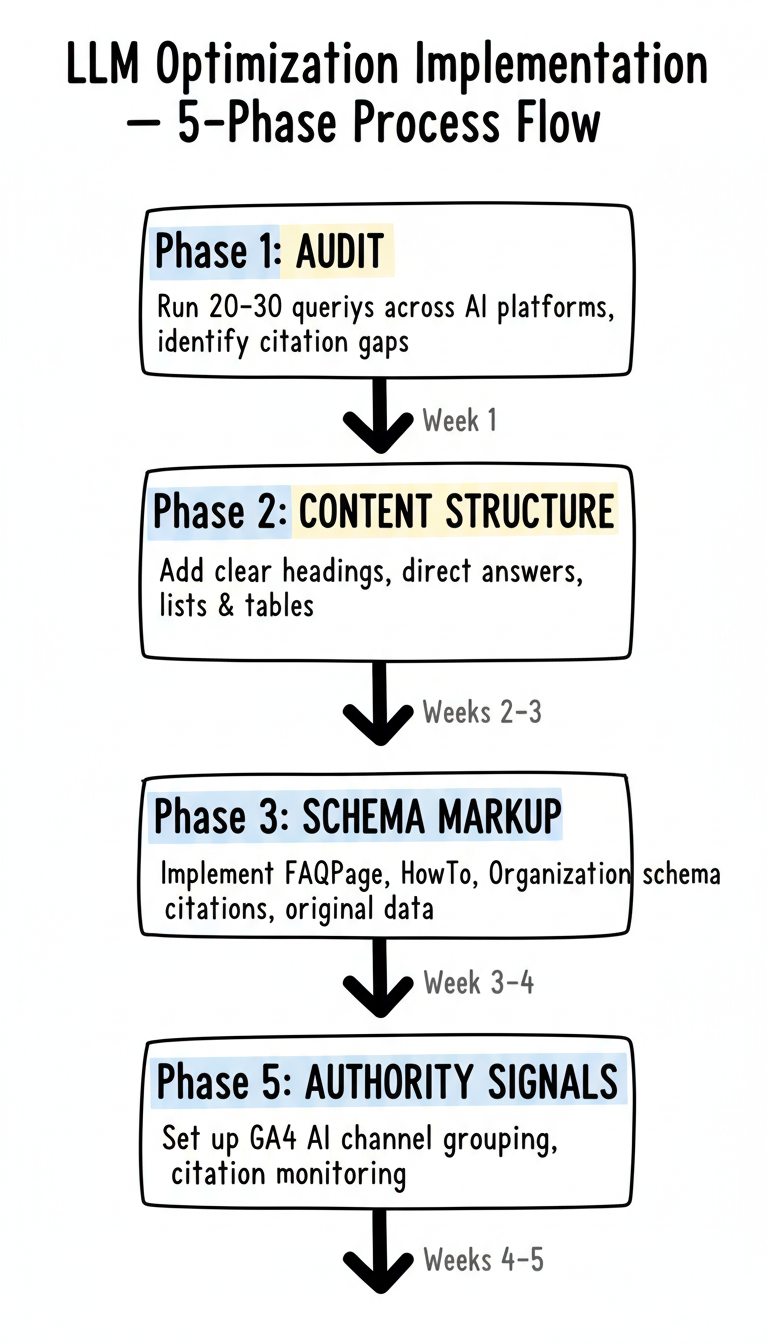
Getting your content visible in AI search results requires a structured implementation approach. This guide walks through the practical steps to start optimizing for LLM-powered platforms like ChatGPT, Perplexity, and Google AI Overviews—from initial audit through measurement setup.
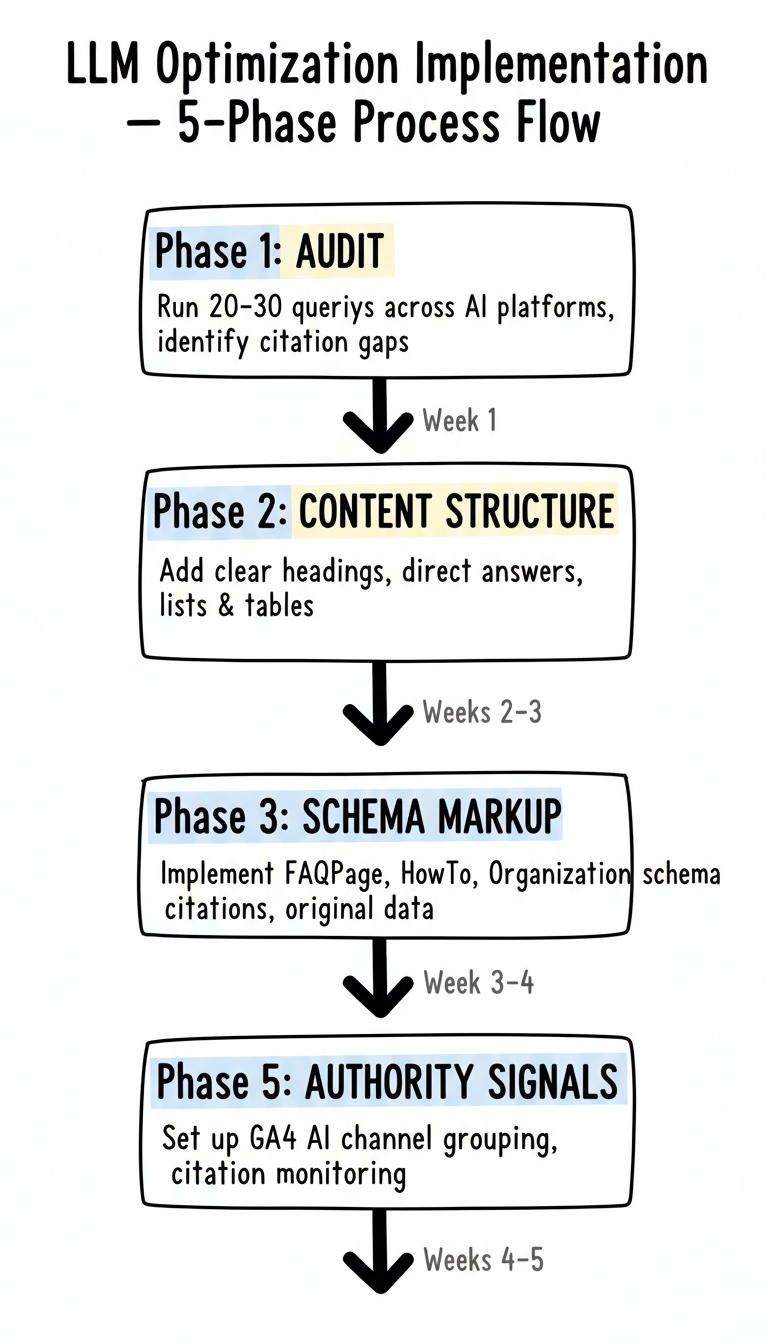
Before optimizing, understand where you currently stand.
Week 1 activities:
Task | How to Execute | Time Required |
Query audit | Run 20-30 relevant queries across AI platforms | 2-3 hours |
Citation check | Document which queries mention your brand | 1-2 hours |
Competitor baseline | Check competitor mentions for same queries | 2-3 hours |
Gap identification | List queries where you should appear but don't | 1 hour |
Audit query structure:
Query types to test:
├── "[Your category] recommendations"
├── "Best [product/service] for [use case]"
├── "How to [task you help with]"
├── "[Competitor] alternatives"
└── "[Industry] tools/software/agencies"
Document findings in a spreadsheet tracking: query, platform, your mention (yes/no), citation position, competitors mentioned.
LLMs extract information from well-structured content. Restructure existing content for better AI comprehension.
Week 2-3 implementation:
Structure requirements:
Element | Implementation | Purpose |
Clear headings | H2 for main topics, H3 for subtopics | Navigation signals |
Direct answers | First sentence answers the section question | Extraction optimization |
Lists and tables | Use for comparisons and steps | Structured data signals |
Definitions | Define terms explicitly | Entity recognition |
Content restructuring checklist:
For each priority page:
□ Add clear H2 question-based headings
□ Write direct answer as first sentence under each H2
□ Convert paragraphs to bulleted lists where appropriate
□ Add comparison tables for multi-option content
□ Include explicit definitions for key terms
□ Add summary section at end
Prioritize your top 10-20 pages based on traffic and relevance to high-value queries. Following AEO content guidelines ensures your restructured content meets the standards that AI platforms prefer when selecting sources to cite.
Structured data helps LLMs understand your content's meaning and relationships.
Week 3-4 implementation:
Essential schema types:
Schema Type | Use Case | Implementation Priority |
Organization | Company pages | High |
FAQPage | FAQ content | High |
HowTo | Process/tutorial content | High |
Article | Blog posts | Medium |
Product | Product pages | Medium |
Review | Review content | Medium |
Basic implementation steps:
Example FAQPage schema structure:
{
  "@context": "https://schema.org",
  "@type": "FAQPage",
  "mainEntity": [{
    "@type": "Question",
    "name": "What is LLM optimization?",
    "acceptedAnswer": {
      "@type": "Answer",
      "text": "LLM optimization is the practice of..."
    }
  }]
}
Start with FAQPage and HowTo schemas—these provide the clearest signals for AI answer extraction. Implementing schema markup knowledge graph connections helps LLMs understand the relationships between your entities and improves citation opportunities.
LLMs prioritize content from authoritative sources. Strengthen your credibility signals.
Ongoing implementation:
Authority building tactics:
Signal Type | Actions | Timeline |
E-E-A-T signals | Add author bios, credentials, bylines | Week 4 |
Source citations | Link to authoritative references | Ongoing |
Original data | Publish research, surveys, statistics | Monthly |
External mentions | Pursue relevant citations and backlinks | Ongoing |
Quick authority wins:
Immediate actions:
├── Add author names and bios to all content
├── Include credentials and expertise indicators
├── Link to authoritative sources (studies, official docs)
├── Add publication and update dates
└── Include methodology notes for any data claims
Authority signals compound over time. Start implementation immediately even as you work on other phases. Learning from winning in AI overview case studies reveals which authority signals make the biggest difference in securing AI citations.
Track progress to validate what works and identify gaps.
Week 4-5 setup:
Measurement infrastructure:
Component | Tool Options | Setup Complexity |
AI referral tracking | GA4 custom channel grouping | Low |
Citation monitoring | Otterly.AI, manual audits | Low-Medium |
Competitive tracking | Ahrefs Brand Radar, manual | Medium |
Content performance | GA4 + Search Console | Low |
GA4 AI channel setup:
Create a custom channel grouping for AI traffic:
Measurement cadence:
Weekly: AI referral traffic check
Bi-weekly: Citation audit (20-30 queries)
Monthly: Full competitive analysis
Quarterly: Strategy review and adjustment
Using AI search performance reporting templates standardizes your tracking and makes it easier to identify trends across platforms.
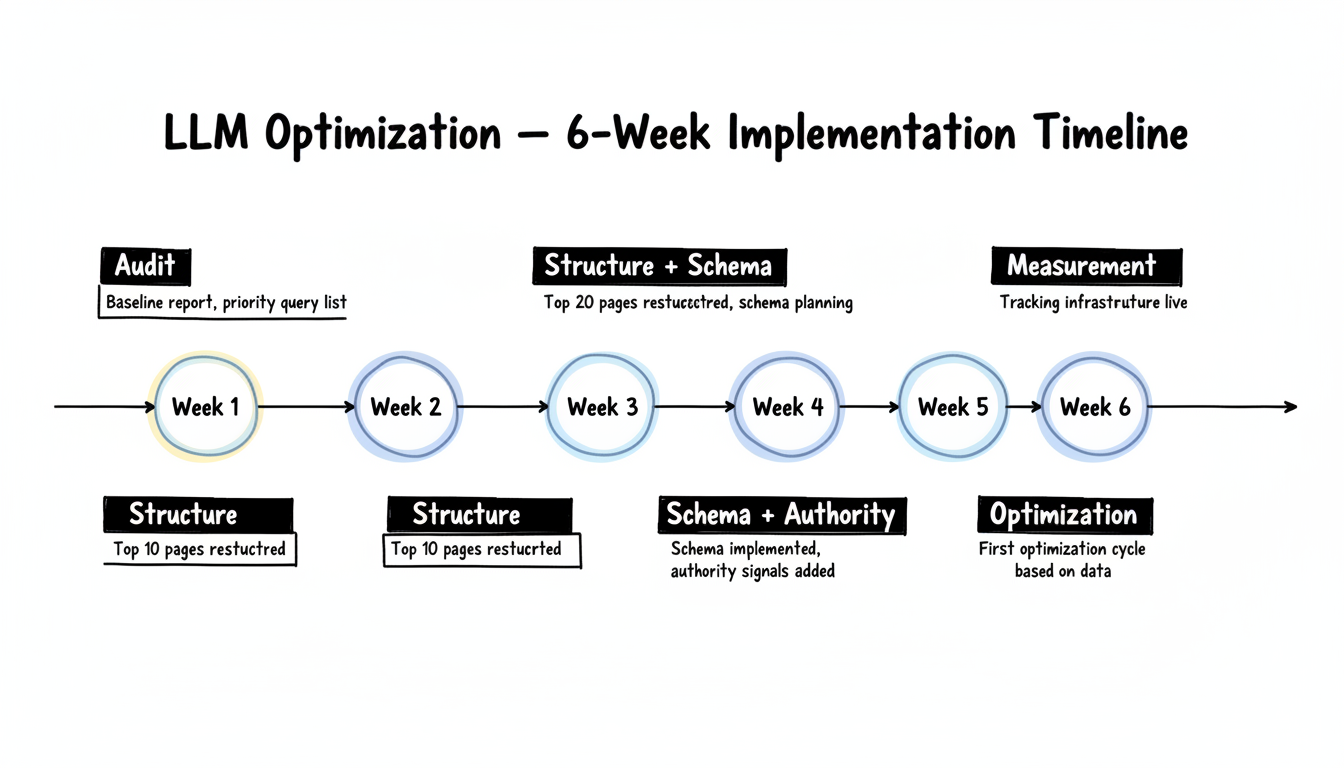
A realistic 6-week implementation schedule:
Week | Focus | Deliverables |
1 | Audit | Baseline report, priority query list |
2 | Structure | Top 10 pages restructured |
3 | Structure + Schema | Top 20 pages restructured, schema planning |
4 | Schema + Authority | Schema implemented, authority signals added |
5 | Measurement | Tracking infrastructure live |
6 | Optimization | First optimization cycle based on data |
Avoid these pitfalls when starting:
Mistake | Why It Happens | How to Avoid |
Optimizing everything at once | Enthusiasm without focus | Prioritize top 20 pages first |
Ignoring existing content | Preference for new creation | Audit and optimize existing assets |
Skipping measurement | Urgency to "do" over "track" | Set up tracking before major changes |
Single platform focus | Familiarity with one AI tool | Test across ChatGPT, Perplexity, Google AI |
Expecting immediate results | SEO timeline expectations | Plan for 2-3 month visibility cycles |
Implementing LLM optimization follows a logical progression:
LLM optimization isn't a single project—it's an ongoing practice. Start with these foundational steps, measure results, and iterate based on what the data shows.
By submitting this form, you agree to our Privacy Policy and Terms & Conditions.