February 19, 2026


Last Updated: January 2026
Search visibility in 2026 requires mastering three interconnected disciplines: SEO (Search Engine Optimization), GEO (Generative Engine Optimization), and AEO (Answer Engine Optimization). Together, these form a comprehensive framework for reaching audiences wherever they search for information.
This guide explains how the three disciplines work together and how to build an integrated approach.
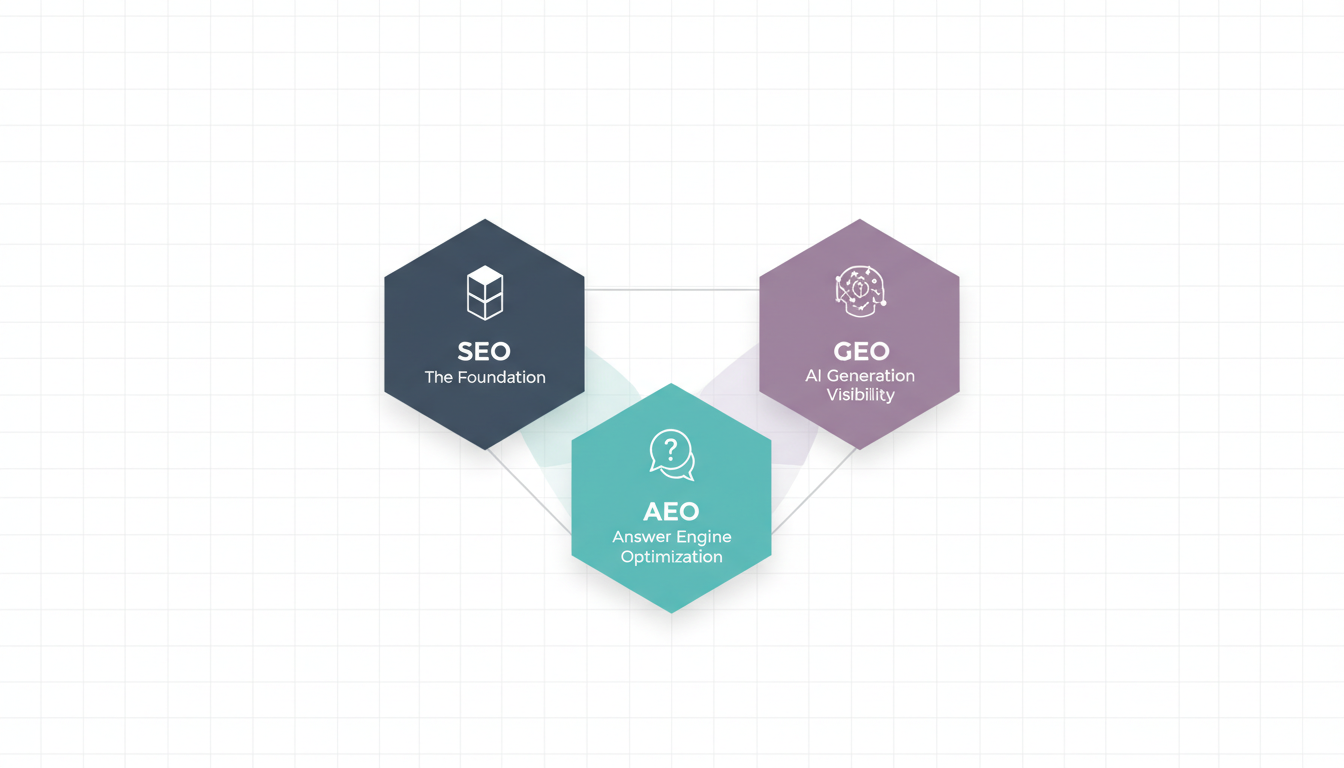
Each discipline addresses different aspects of modern search visibility.
SEO focuses on ranking in traditional search engine results. It's the established discipline that makes content discoverable through Google, Bing, and other search engines.
What it optimizes for:
Success looks like: High rankings, organic traffic, click-through rates
SEO provides the foundation that supports the other disciplines.
GEO focuses on appearing in AI-generated responses. It emphasizes how generative AI systems synthesize answers from source content.
What it optimizes for:
Success looks like: Citations in ChatGPT, Perplexity, and other AI responses
GEO addresses the technology dimension—how AI systems find and use your content.
AEO focuses on becoming the answer when users ask questions. It emphasizes the user experience of receiving direct answers.
What it optimizes for:
Success looks like: Being cited as the trusted answer across platforms
AEO addresses the user dimension—how people receive information directly.
GEO and AEO describe the same underlying challenge from different angles. Understanding GEO vs AEO helps clarify how these disciplines complement each other:
The optimization tactics largely overlap. Both require extractable content, entity authority, question-answer formatting, and technical accessibility. One strategy addresses both disciplines.
SEO intersects with GEO/AEO because:
Think of it as one integrated practice with different emphasis areas rather than three separate programs.

Effective integration aligns all three disciplines.
Without solid SEO, GEO and AEO struggle:
Technical requirements:
Content requirements:
Authority requirements:
Build these foundations first—they support everything else.
Once SEO foundations are solid, add GEO/AEO optimization. Implementing effective generative engine optimization strategies requires both technical and content adjustments:
Content structure adjustments:
Technical additions:
Authority enhancement:
These additions improve AI visibility without compromising SEO performance.
Track success for each discipline:
SEO metrics:
GEO/AEO metrics:
Integrated dashboards showing all metrics provide complete visibility picture.
Apply the framework through systematic workflow.
Evaluate performance across all three areas:
Identify gaps in each area.
Address issues in logical order:
Foundation before enhancement.
Develop content that serves all three disciplines:
Structure approach:
Example content flow:
This structure ranks well, gets cited by AI, and answers user questions.
Continuous improvement across all dimensions:
Adjust strategy based on what performance data reveals.
Three disciplines, one integrated framework. SEO, GEO, and AEO work together rather than competing. Build unified strategy addressing all three.
SEO remains foundational. Strong SEO supports GEO and AEO success. Don't abandon SEO fundamentals for AI optimization.
GEO and AEO overlap substantially. Same optimization tactics serve both. One strategy covers the AI visibility dimension.
Integration beats separation. Coordinated efforts across disciplines outperform siloed programs. Think holistically from the start.
No. The disciplines share enough foundations that integrated teams work better than separate ones. Train existing SEO teams in GEO/AEO-specific tactics rather than creating separate functions. Separation creates coordination overhead and missed optimization opportunities.
Start with SEO investment if foundations are weak. Add GEO/AEO investment once traditional search performance is stable. Most organizations benefit from 60-70% SEO focus with 30-40% dedicated to AI visibility, adjusting based on where your audience searches.
Frame it as comprehensive search visibility. Traditional search remains important (SEO), but AI search is growing rapidly (GEO/AEO). Investment in all three ensures visibility wherever audiences look for information. Use competitive intelligence—show what competitors are doing across both traditional and AI search.
By submitting this form, you agree to our Privacy Policy and Terms & Conditions.