
February 19, 2026


Text fragment identifiers allow URLs to link directly to specific text within a page—not just to anchors or sections, but to exact phrases. For AEO, this technology creates opportunities to improve how AI systems reference, extract, and cite your content. When AI platforms can link users directly to relevant passages, your content becomes more citation-worthy.
This guide explains what text fragment identifiers are, how they support AEO strategy, and how to implement them effectively.
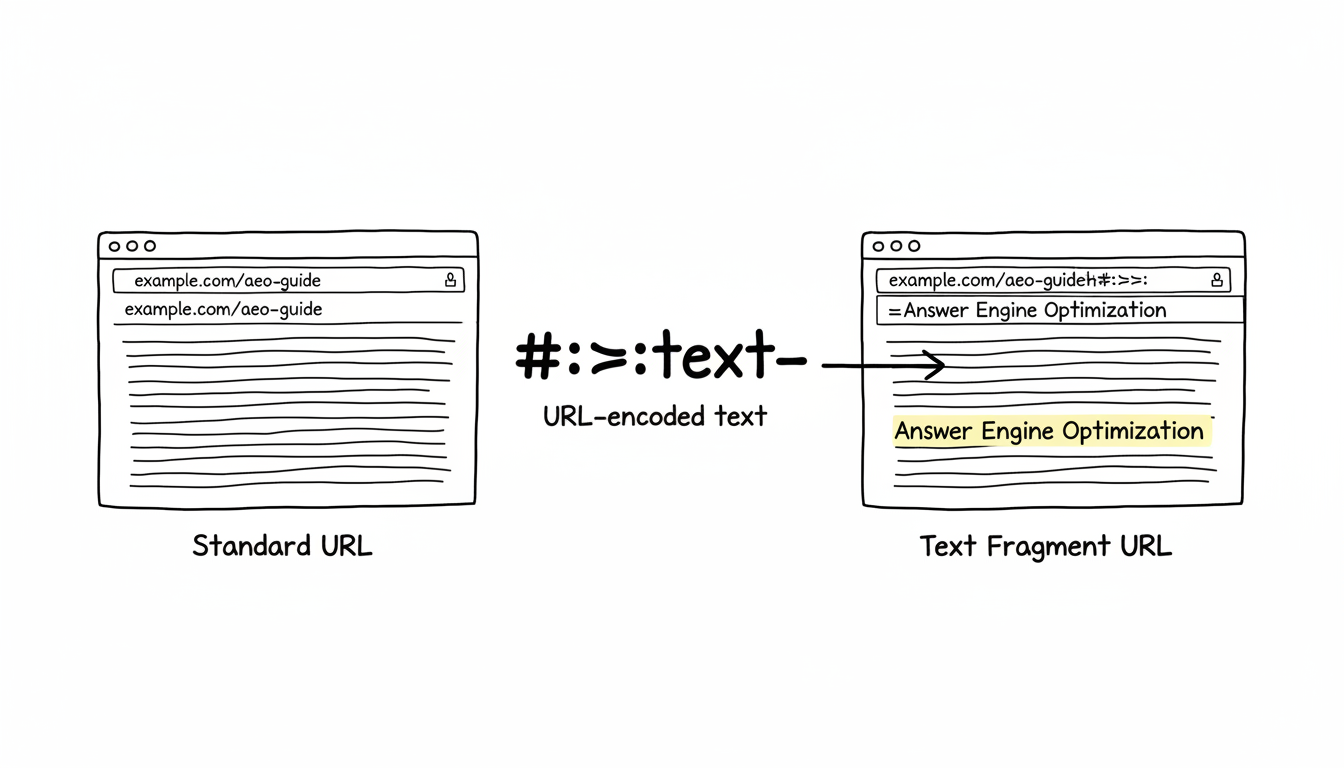
Text fragment identifiers are URL parameters that direct browsers to scroll to and highlight specific text on a page. Unlike traditional anchor links that require HTML id attributes, text fragments work with any text on the page.
Standard URL:
https://example.com/aeo-guideURL with text fragment:
https://example.com/aeo-guide#:~:text=Answer%20Engine%20Optimization%20improves%20visibilityWhen users click the second link, browsers scroll directly to the phrase "Answer Engine Optimization improves visibility" and highlight it. This enables precise deep linking without modifying page HTML.
Text fragments work in Chrome, Edge, and other Chromium-based browsers—covering approximately 70% of web traffic. Safari added support in recent versions. Firefox support remains limited but improving.
Text fragment identifiers align with several AEO vs SEO comparison objectives.
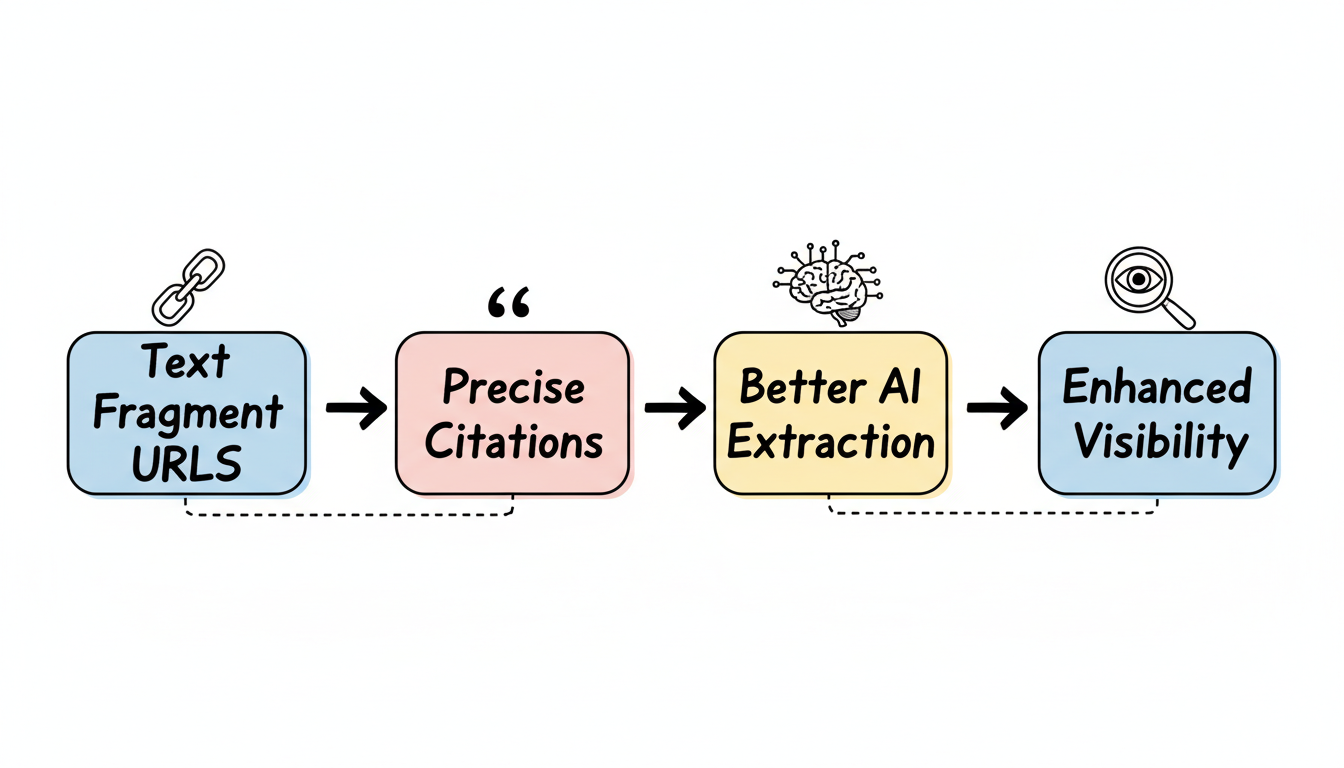
AI systems aim to provide accurate, verifiable information. When AI platforms can link users to the exact passage supporting a claim, citation quality improves. Text fragments enable this precision.
Without text fragments:
"According to Source X, AEO improves visibility by 40%." [Links to homepage]
With text fragments:
"According to Source X, AEO improves visibility by 40%." [Links directly to the specific sentence]
The second citation provides immediate verification. Users see the exact source text without searching through the page.
AI systems extract content in chunks. Text fragment identifiers help define those chunk boundaries explicitly. When you structure URLs with text fragments for key passages, you signal which content segments are independently valuable.
This works particularly well for:
Google's featured snippets often highlight specific text passages. Pages with well-defined, extractable segments perform better for snippet capture. Text fragment architecture reinforces which passages deserve standalone extraction.
When AI systems cite your content with text fragment links, users arrive at exactly the relevant information. This reduces bounce rates and improves engagement—signals that reinforce your content's value for future AI citations.
Effective text fragment implementation requires strategic content structuring aligned with AI search optimization best practices.
Not every sentence deserves a text fragment link. Focus on:
Definitions: "Answer Engine Optimization is the practice of structuring content for AI extraction and citation."
Statistics: "Research shows AEO-optimized content receives 40% more AI citations than unoptimized content."
Actionable advice: "Start AEO implementation by auditing your top 20 pages for extractability."
Original insights: "The key difference between SEO and AEO is the shift from ranking pages to being cited in answers."
Write passages that stand alone. Each citation-worthy segment should be:
Weak structure: "There are many factors. One important consideration is timing. You should also think about resources. Cost matters too."
Strong structure: "Three factors determine AEO success: timing (early adopters gain advantage), resources (dedicated effort vs. ad-hoc), and budget (ROI typically appears within 6 months)."
The second version extracts cleanly. AI systems can cite it directly.
Generate text fragment URLs for your key passages:
Example process:
Reference your own citation-worthy passages when linking internally:
This internal linking with text fragments demonstrates the pattern for external citations.
Combine text fragments with schema markup for enhanced AEO performance. Understanding how answer engines work helps you leverage both technologies effectively.
When implementing FAQ schema, include text fragment URLs in the acceptedAnswer section. This helps AI systems understand both the answer content and where to find it.
The Speakable schema type identifies content suitable for voice assistants. Combine speakable markup with text fragment identifiers to create precise reference points for voice-initiated citations.
Text fragments have practical constraints.
Not all browsers support text fragments. Ensure your content remains accessible and useful even when fragments don't function. The base page should always provide value.
Text fragments rely on exact text matching. If your content changes frequently or loads dynamically, fragments may break. Prioritize stable, evergreen content for text fragment implementation.
Text fragment clicks may not appear in standard analytics as distinct page views. Consider implementing custom tracking if measuring fragment-specific engagement matters for your AI search conversion optimization analysis.
Begin implementing text fragments with these steps:
Text fragment implementation supports the broader AEO goal of making your content maximally extractable and citable.
Text fragments don't directly influence rankings. However, they improve user experience and enable precise citations—both of which support signals that do affect rankings. The primary value is AEO improvement rather than direct SEO impact.
Yes. Text fragments work with any public web page. You can link to specific passages on external sites, which is useful for citations and references. However, you cannot control how others link to your content.
By submitting this form, you agree to our Privacy Policy and Terms & Conditions.



