
February 19, 2026


GEO stands for Generative Engine Optimization in modern marketing contexts. This term describes the practice of optimizing content so AI-powered search platforms—like ChatGPT, Perplexity, Google AI Overviews, Claude, and Gemini—can find, understand, and cite your brand when generating responses to user queries.
The term can cause confusion because "GEO" historically referred to geographic targeting in marketing. However, in 2026's AI-driven search landscape, GEO overwhelmingly refers to Generative Engine Optimization—a discipline that has become essential for digital marketing success.
Marketing terminology evolves with technology. A decade ago, mentioning "GEO" in a marketing meeting would immediately suggest geographic targeting—reaching customers based on their physical location. Geotargeting remains a valid marketing concept, but the acronym GEO has taken on new, dominant meaning.
The shift happened as AI-powered search tools transformed how people find information. When ChatGPT reached 400 million weekly active users and Google integrated AI Overviews into search results, marketers needed vocabulary to describe optimization for these new platforms. Generative Engine Optimization emerged as that term, and GEO became its standard abbreviation.
Today, when marketers discuss GEO, they're almost always discussing how to get AI systems to mention, cite, and recommend their brands. The geographic meaning hasn't disappeared—context makes the intended meaning clear—but Generative Engine Optimization has become the primary association.
Understanding GEO requires contrasting it with SEO (Search Engine Optimization), its more established sibling discipline.
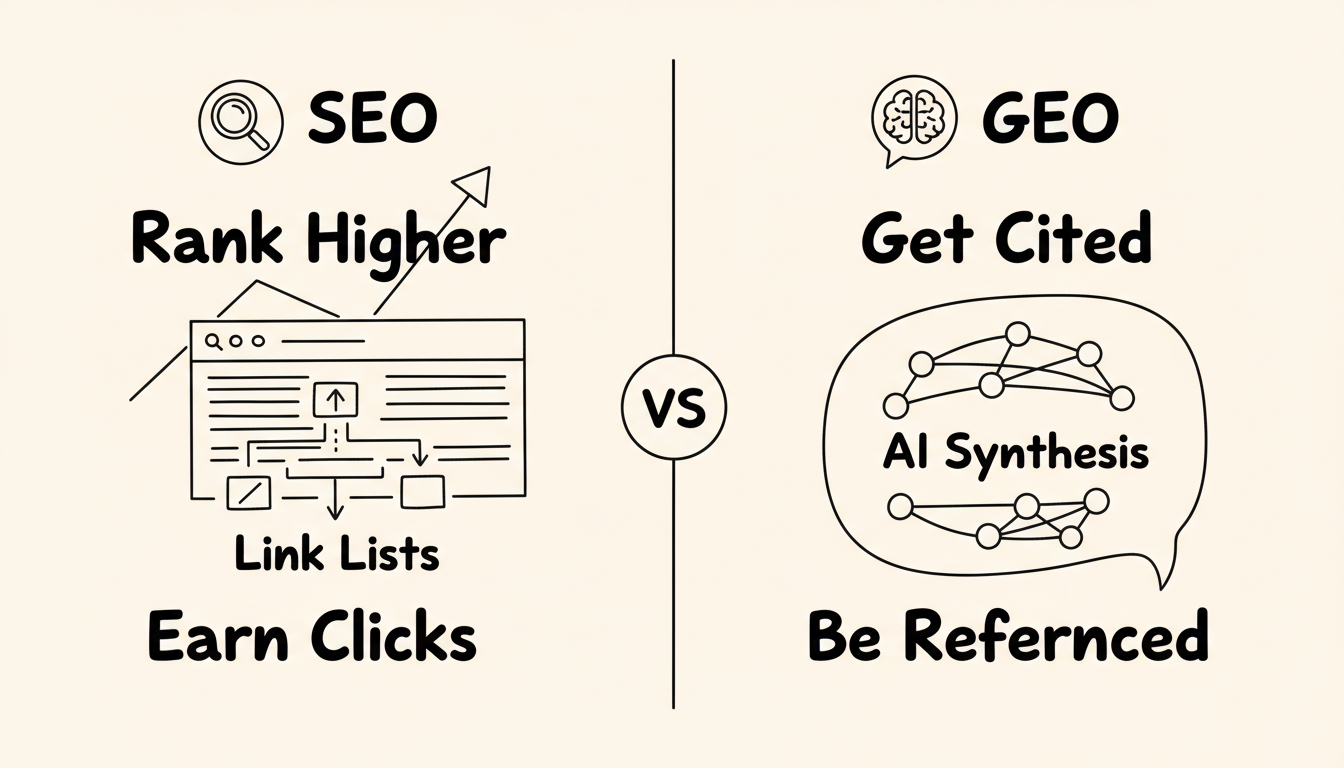
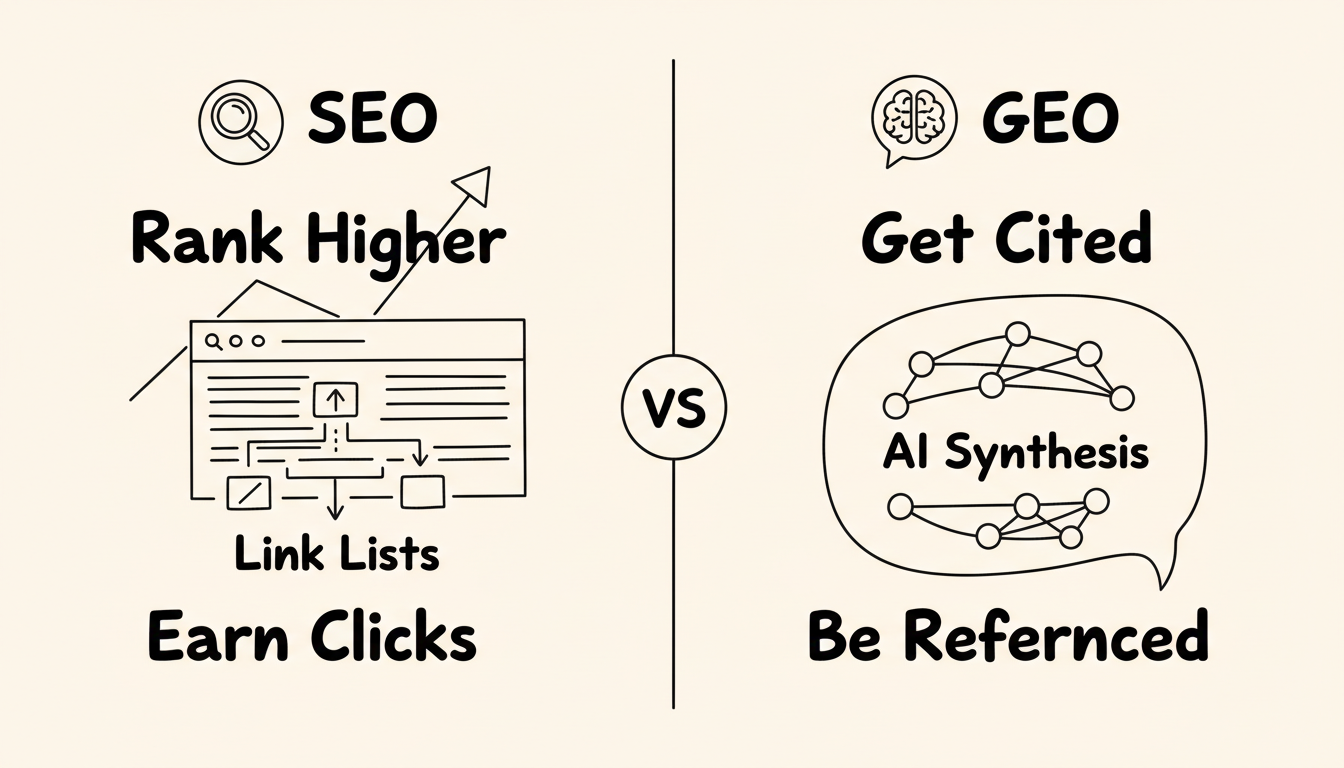
SEO focuses on ranking. Traditional search engines return lists of links ranked by relevance and authority. SEO optimizes content to climb those rankings—appearing on page one, ideally in positions one through three. Success means earning clicks from users browsing search results.
GEO focuses on citation. Generative AI platforms don't return link lists. They synthesize answers from multiple sources and cite the content they reference. GEO optimizes content to be selected as a source—to have AI systems quote, attribute, and recommend your content when generating responses.
The mechanics differ fundamentally. SEO involves keyword optimization, link building, and technical factors that help pages rank. GEO involves authority building, content structuring, and entity clarity that make content citation-worthy for AI systems.
Yet these disciplines connect. Research shows that 87% of Google AI Overview citations come from content ranking in organic positions 1-10. Strong SEO foundations enable GEO success. The relationship is complementary rather than competitive—effective marketing strategies incorporate both.
The rise of GEO reflects how search behavior has fundamentally changed. Users no longer exclusively "Google" their questions. They ask ChatGPT, query Perplexity, consult Claude, and receive AI-generated answers without visiting websites directly.
This shift creates both challenges and opportunities for marketers.
The challenge: If AI systems don't cite your brand, you become invisible to users who rely on AI for research and recommendations. Traditional SEO alone cannot ensure visibility in AI-generated responses.
The opportunity: Early GEO adopters gain competitive advantages while the discipline remains relatively new. Brands that establish AI visibility now position themselves advantageously as AI search adoption continues growing.
The numbers support prioritizing GEO. Studies show that 36.4% of content marketers reported traffic declines between 2024 and 2025 attributable to AI Overviews and AI search. Content that ranks well organically but doesn't appear in AI responses reaches a shrinking audience.
Conversely, brands appearing in AI citations gain exposure to the growing population of users who prefer AI-assisted research. These citations often include direct links, driving qualified traffic from users who already understand your value proposition based on the AI's recommendation.
Understanding what GEO involves helps clarify why the discipline matters.
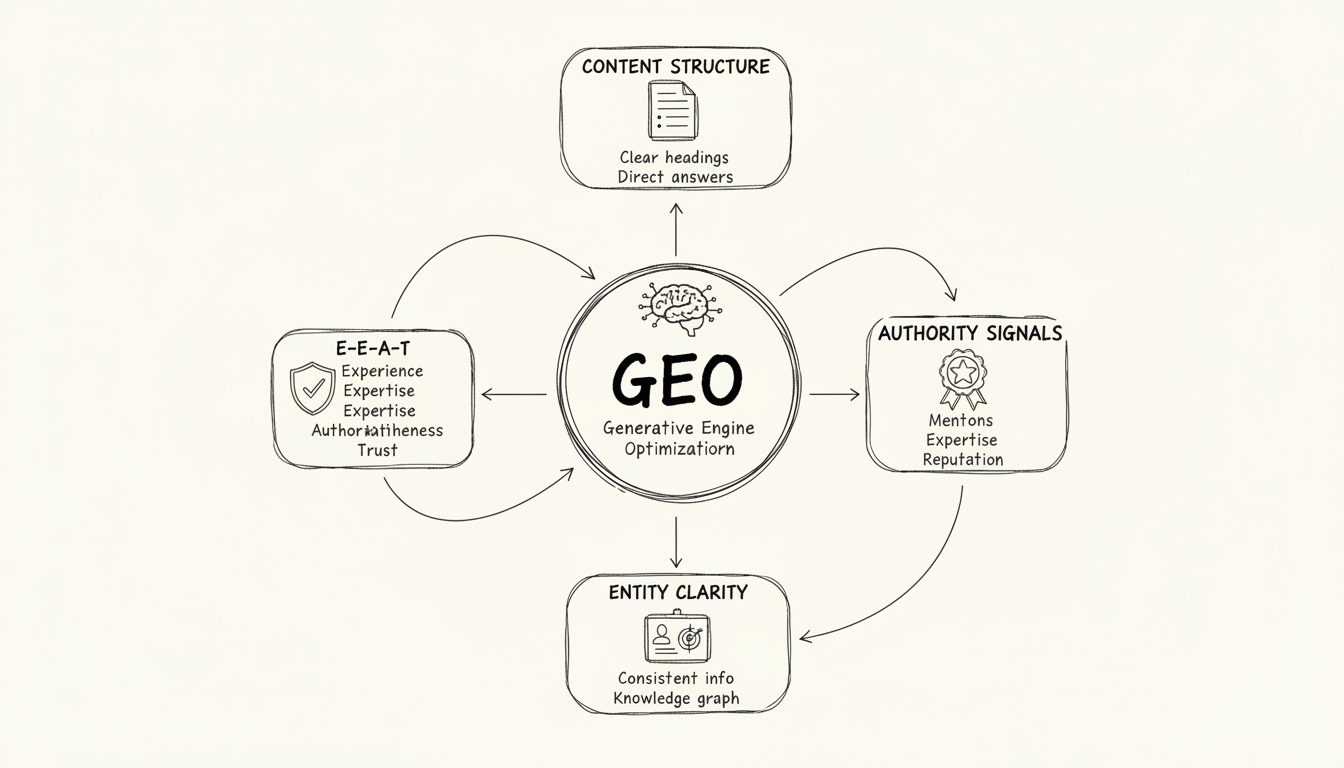
AI systems extract information in chunks. They pull specific passages to quote and synthesize. Content structure determines how effectively AI systems can identify and use your information.
Effective GEO content includes:
Well-structured content extracts cleanly into AI responses. Poorly structured content—dense paragraphs, vague headers, buried answers—gets passed over even when the underlying information is excellent.
AI systems prioritize authoritative sources when selecting content to cite. They evaluate authority through signals including domain reputation, consistent expertise demonstration, and cross-platform mentions.
Building authority for GEO involves:
AI systems need to understand what your brand represents. Entity clarity means ensuring your brand identity, expertise areas, and key information appear consistently across the web.
This involves:
Google's E-E-A-T framework (Experience, Expertise, Authoritativeness, Trustworthiness) influences both traditional search rankings and AI citation decisions. Content demonstrating genuine expertise earns citations more frequently than surface-level content optimized only for keywords.
GEO-effective content shows:
Incorporating GEO into marketing strategy follows a structured approach.
Start by understanding your current state. Search priority queries across ChatGPT, Perplexity, and Google AI Overviews. Document where your brand appears, where competitors appear, and where opportunities exist.
This baseline reveals:
Restructure existing high-performing content for AI extraction. Add clear headings, lead sections with direct answers, create FAQ sections, and update statistics and examples to current figures.
These improvements often yield results within weeks as AI systems re-process optimized content. Understanding how AI SEO works helps marketers identify which content elements AI systems prioritize when selecting sources to cite.
Develop content specifically designed for AI citation. Conduct original research that provides information AI systems cannot find elsewhere. Include specific results and data. Provide attributable expert perspectives.
This content serves both GEO and traditional SEO objectives, maximizing resource efficiency. Many brands also leverage SEO automation tools to scale their content production while maintaining quality standards.
Verify that AI crawlers can access your content. Check robots.txt to ensure you're not blocking GPTBot (OpenAI), ClaudeBot (Anthropic), PerplexityBot, or other AI crawlers. Enable server-side rendering so content doesn't require JavaScript execution to access.
The dual meaning of GEO occasionally creates communication confusion. When discussing optimization strategies, clarify whether you mean Generative Engine Optimization or geographic targeting.
In 2026 marketing contexts, "GEO" without qualification typically means Generative Engine Optimization. Geographic targeting is usually specified explicitly as "geotargeting" or "location-based targeting" to avoid ambiguity.
When encountering GEO in marketing materials, context usually clarifies meaning. Discussions of AI visibility, ChatGPT, content optimization, and citation tracking indicate Generative Engine Optimization. Discussions of regional campaigns, local audiences, and location-based advertising indicate geographic targeting.
As AI search adoption continues accelerating, GEO's importance will only grow. Brands that understand and implement search engine optimization with AI position themselves for visibility in an AI-first information landscape.
The discipline complements rather than replaces traditional SEO. Effective 2026 marketing strategies integrate both—using SEO to build foundations and GEO to extend visibility into AI-powered discovery channels.
No, though the acronym historically referred to geographic targeting. In 2026 marketing contexts, GEO primarily means Generative Engine Optimization—optimizing content for AI-powered search platforms. Geographic targeting is now typically called "geotargeting" to avoid confusion.
SEO and GEO complement each other. Strong SEO foundations increase GEO success likelihood—87% of AI citations come from content ranking in positions 1-10. However, SEO alone doesn't ensure AI visibility. GEO adds optimization specifically for how AI systems select and cite sources.
Content structure improvements and technical optimizations can affect citations within weeks. Building substantial authority and consistent citation patterns typically requires 3-6 months of sustained effort. Results compound over time as AI systems recognize and trust your content.
By submitting this form, you agree to our Privacy Policy and Terms & Conditions.



