February 19, 2026


With TikTok's ad revenue projected to reach $43.96 billion by 2026, brands are pouring money into the platform. But is TikTok advertising actually worth it for your business?
The answer depends on your industry, audience, and goals. This guide breaks down TikTok's real ROI potential with current benchmarks, success stories, and a practical framework to help you decide whether TikTok ads deserve a place in your marketing budget.
TikTok has matured from an experimental channel into a serious advertising platform. The data shows strong performance for brands that fit the platform's strengths.
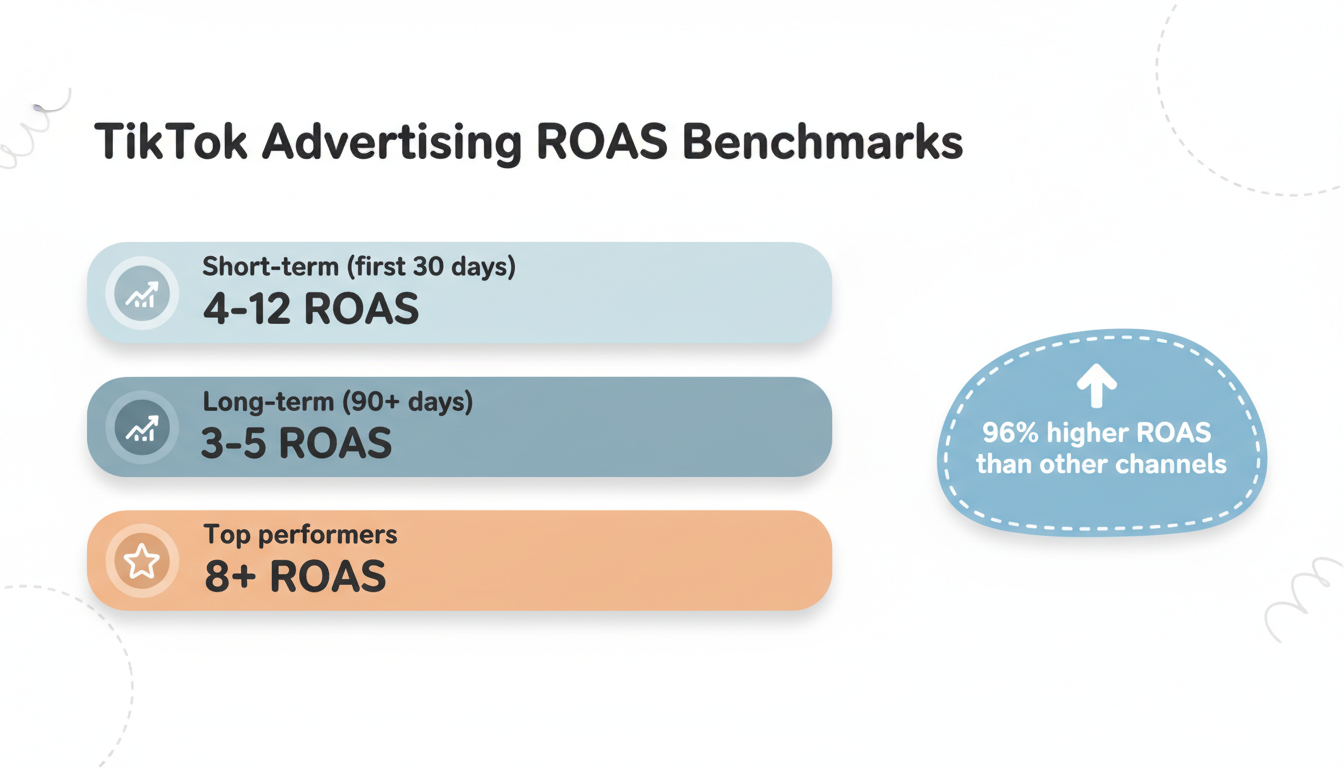
Return on Ad Spend (ROAS) varies significantly based on campaign maturity and optimization:
Timeframe | ROAS Range | Notes |
Short-term (first 30 days) | 4 – 12 | Initial testing phase |
Long-term (90+ days) | 3 – 5 | Sustainable performance |
Top performers | 8+ | Optimized creative and targeting |
According to Nielsen research, TikTok delivers 96% higher ROAS than other digital channels on average. For more detailed benchmarks across different industries, check out our TikTok ROAS benchmarks analysis. This positions TikTok as one of the most efficient paid media options available.
TikTok's unique position in the advertising landscape comes from several factors:
Compared to Meta and Google, TikTok often delivers lower costs. To understand the full pricing landscape, read our comprehensive TikTok ads pricing guide for 2026:
Platform | Average CPM | Average CPC |
TikTok | $3.50 | $0.50 – $1.50 |
Meta (Facebook/Instagram) | $6.59 | $0.70 – $2.00 |
Google Display | $4.00 – $8.00 | $1.00 – $3.00 |
This cost advantage means your testing budget goes further on TikTok, allowing more creative experimentation before scaling winners.
Real results from brands demonstrate TikTok's ROI potential across different verticals.
E-commerce brands consistently see strong TikTok performance. For a detailed breakdown of how e-commerce brands achieve these results, explore our TikTok advertising case study for e-commerce:
Fashion and Apparel:
Beauty and Cosmetics:
Consumer Electronics:
Brands using TikTok Shop see additional lift:
Mobile apps achieve competitive CPIs on TikTok. If you're running app campaigns, our TikTok advertising for apps and user acquisition guide provides campaign-specific strategies:
The platform's young, mobile-native audience converts well for app install objectives.
TikTok advertising delivers strongest results in specific scenarios.
Your product is well-suited for TikTok if it:
TikTok ads work best when you:
Based on industry benchmark data, these verticals consistently perform well. For fashion brands specifically, our TikTok advertising for fashion brands guide covers style-specific strategies:
Industry | Expected ROAS | Key Success Factors |
E-commerce/Retail | 3:1 – 5:1 | Product demos, UGC, TikTok Shop |
Fashion | 4:1 – 6:1 | Try-on videos, outfit inspiration |
Beauty | 4:1 – 7:1 | Tutorials, before/after content |
Food & Beverage | 3:1 – 5:1 | Recipe content, taste tests |
Home Goods | 4:1 – 6:1 | Organization, transformation videos |
Fitness | 3:1 – 5:1 | Workout content, results showcases |
TikTok isn't the right platform for every business. Consider alternatives if:
If you experience these during initial campaigns, TikTok may not be viable:
Use this framework to estimate TikTok's ROI potential for your business.
Gather your current performance data:
Use industry benchmarks to project performance:
Projected Monthly Revenue = (Monthly Budget / Average CPM × 1000) × CTR × Conversion Rate × AOVExample Calculation:
Impressions: $3,000 / $6.00 × 1000 = 500,000
Clicks: 500,000 × 1.5% = 7,500
Conversions: 7,500 × 2% = 150
Revenue: 150 × $75 = $11,250
ROAS: $11,250 / $3,000 = 3.75
Your first 30-60 days will have higher costs:
TikTok often shows stronger halo effects than other platforms:
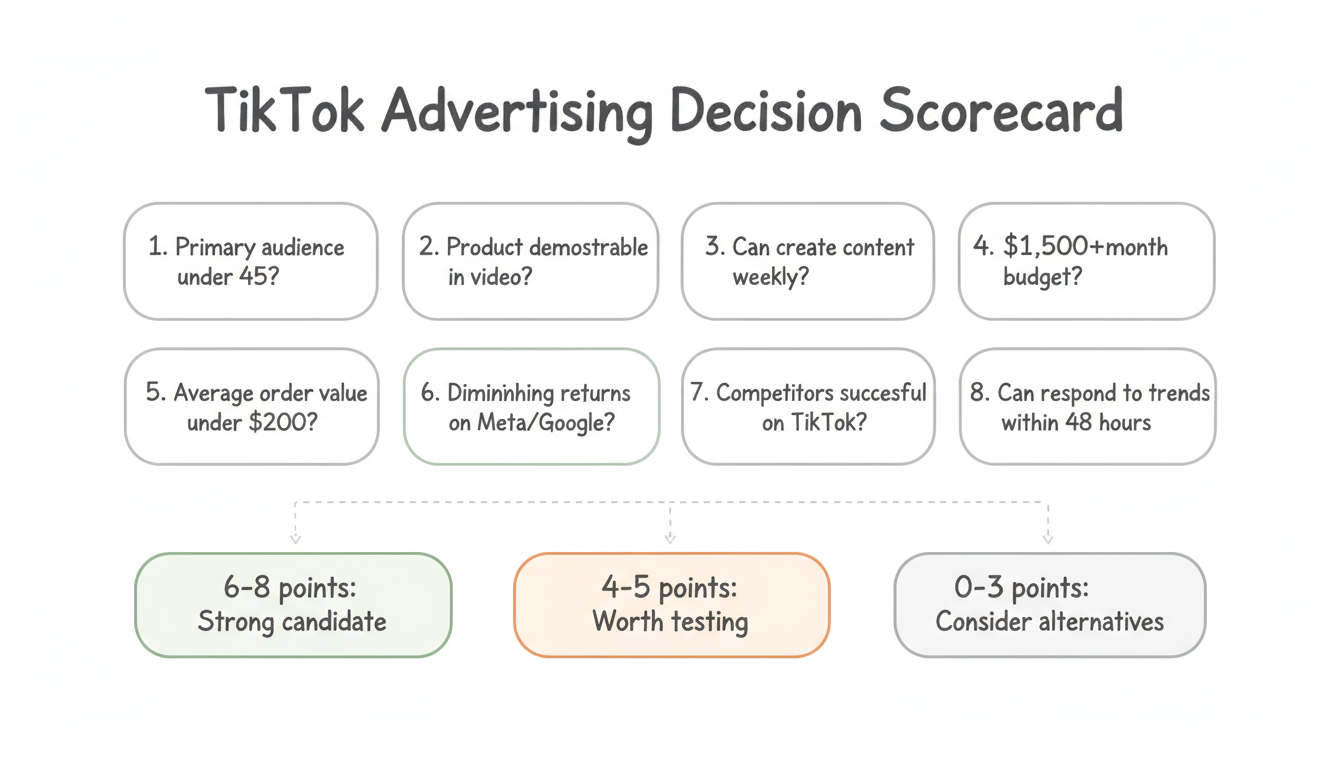
Answer these questions to determine if TikTok is worth testing:
Score 1 point for each "Yes":
Scoring:
If you decide to test TikTok, our complete guide to TikTok advertising in 2026 provides a comprehensive roadmap. Here's where to start:
Before launching campaigns, ensure you've properly configured your TikTok pixel setup for accurate conversion tracking.
During your test period, monitor performance through TikTok ads reporting and analytics:
A successful test shows improving trends across these metrics, even if absolute numbers don't match other channels yet.
TikTok can be highly effective for small businesses, particularly those with visually appealing products targeting ages 18-44. The platform's lower CPMs mean smaller budgets go further. However, small businesses should budget at least $1,500 for initial testing and have capacity to create authentic, platform-native content regularly.
TikTok ROAS varies by industry but typically ranges from 3:1 to 5:1 for e-commerce brands after optimization. Short-term ROAS during initial testing can reach 4-12, while long-term sustainable ROAS usually settles between 3-5. Top-performing accounts with optimized creative and targeting can achieve 8+ ROAS.
Most advertisers need 4-6 weeks to exit the learning phase and see stable performance. Initial results (engagement, traffic) appear within days, but meaningful conversion data typically requires 2-4 weeks. Full optimization usually takes 60-90 days of consistent investment and creative iteration.
TikTok and Facebook serve different strengths. TikTok excels at discovery, brand awareness, and reaching younger audiences with lower CPMs. Facebook offers broader targeting options, better B2B capabilities, and often higher conversion rates. For a detailed comparison, read our TikTok ads vs Instagram ads analysis. Most brands see best results using both platforms with different objectives.
To gather meaningful data, plan for $1,500-3,000 over 60 days minimum. TikTok's minimum daily budget is $50 per campaign and $20 per ad group. Budgets below $1,000/month typically don't provide enough data for the algorithm to optimize effectively or for you to identify winning creative.
By submitting this form, you agree to our Privacy Policy and Terms & Conditions.