February 19, 2026


TikTok advertising has transformed from an experimental channel to an essential component of modern marketing strategies. With over 1.6 billion monthly active users and $34.8 billion in platform revenue, TikTok offers unparalleled opportunities to reach engaged audiences at costs that consistently beat Meta and Google.
Whether you're launching your first campaign or optimizing existing efforts, this guide covers everything you need to succeed with TikTok advertising in 2026—from ad formats and costs to targeting strategies and performance measurement.
TikTok advertising is paid promotion through TikTok's self-serve Ads Manager platform or managed service options. Unlike traditional digital advertising, TikTok ads appear natively within the For You Page (FYP), blending with organic content that users scroll through daily.
The platform operates on an auction-based system where advertisers bid for ad placements based on campaign objectives. TikTok's algorithm then optimizes delivery to users most likely to take your desired action—whether that's watching your video, clicking through to your website, or making a purchase.
If you're new to the platform's interface, our TikTok Ads Manager tutorial provides a comprehensive walkthrough of all core features including the Dashboard for monitoring spend and performance, Campaign section for managing your advertising, Tools for audience and creative management, and Analytics for detailed reporting.
TikTok's advertising platform has matured significantly, making it a compelling choice for brands across industries. For those evaluating whether the platform aligns with their business goals, our analysis of whether TikTok advertising is worth it in 2026 examines the data in detail. Here's why TikTok deserves a place in your 2026 media mix:
TikTok reaches over 1.5 billion monthly active users globally, with 136 million users in the United States alone. The platform's largest demographic is users aged 25-34, representing 35.3% of users over 18, though engagement spans all age groups.
What makes TikTok's audience particularly valuable:
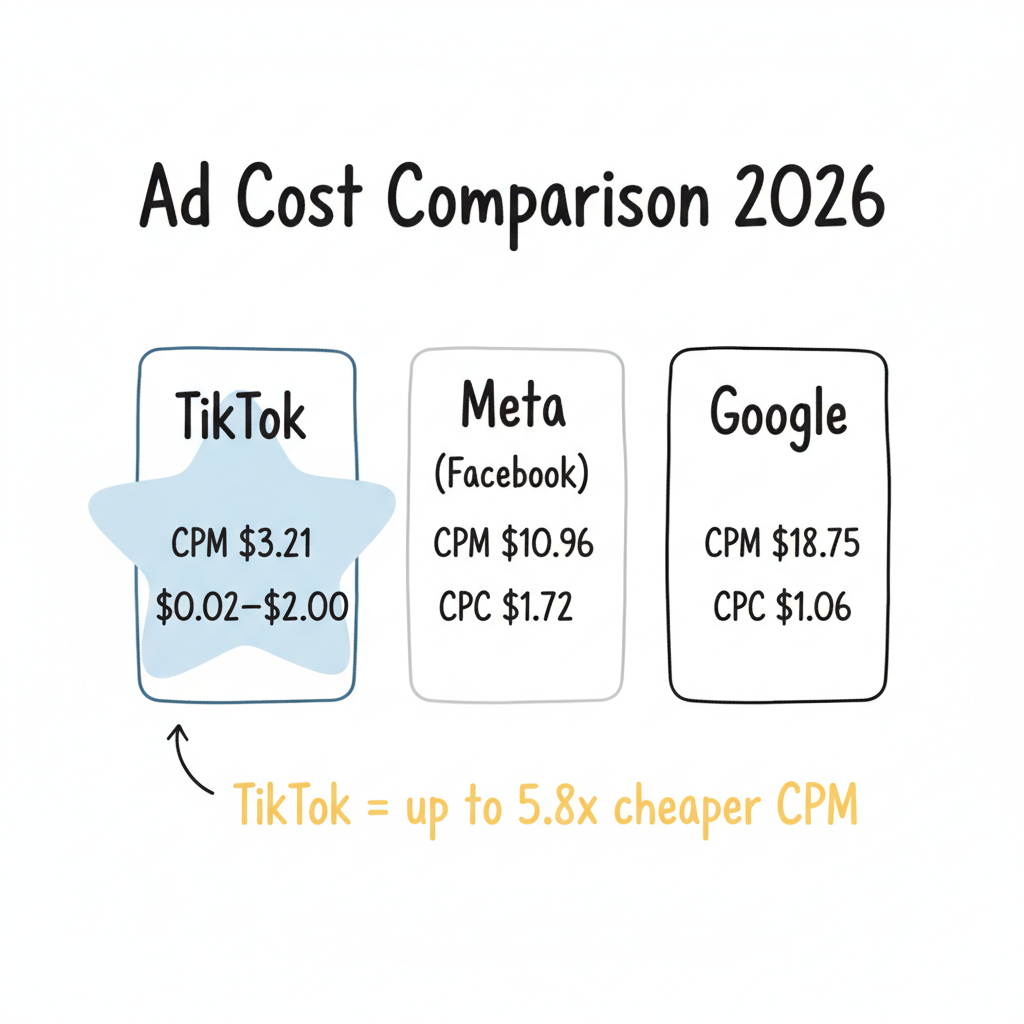
TikTok consistently delivers lower costs than competing platforms. Understanding TikTok advertising pricing in 2026 helps you budget effectively and maximize ROI. According to 2026 benchmark data from WebFX:
Metric | TikTok | Meta (Facebook) |
Average CPM | $9.16 | $14.91 |
Average CPC | ~$1.00 | $1.72 |
Average CTR | 0.84% | 0.90% |
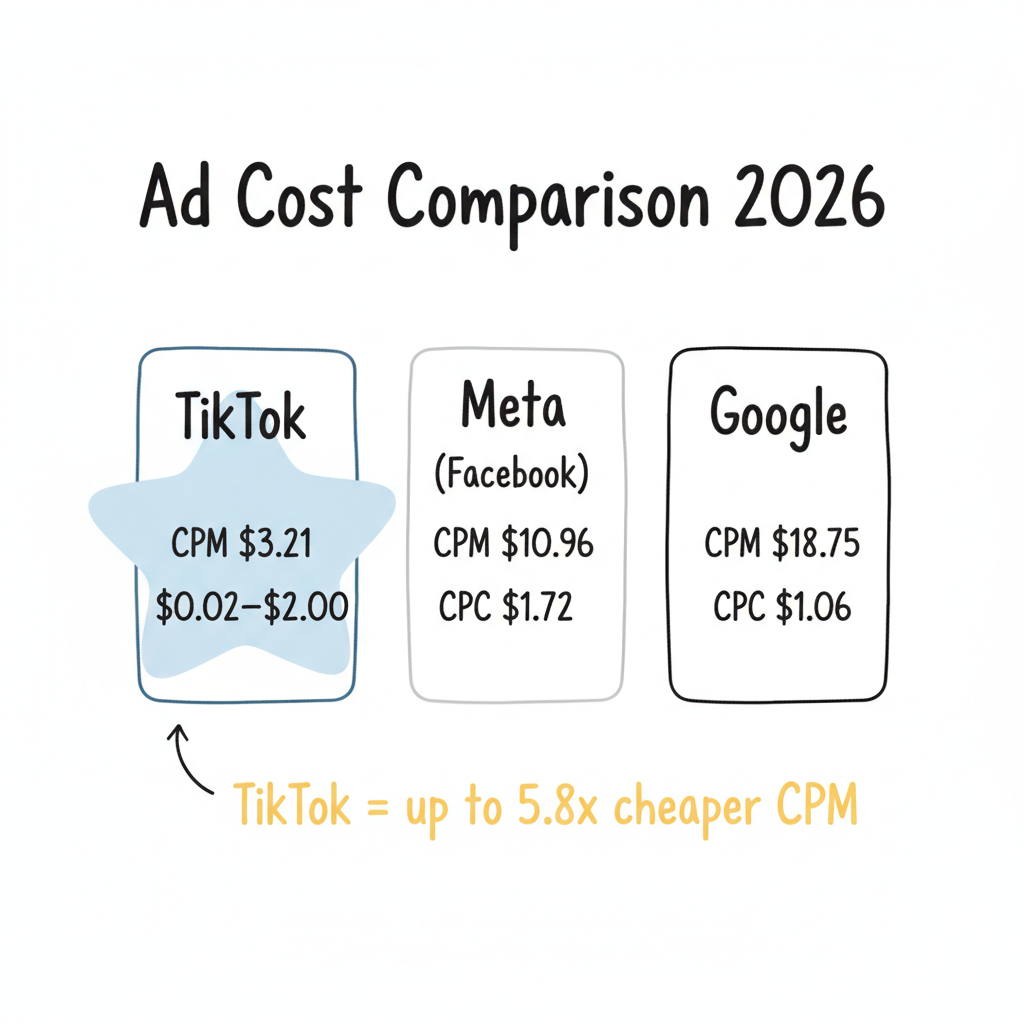
Shopify's 2026 analysis shows even more favorable comparisons:
Platform | CPM | CPC |
TikTok | $3.21 | $0.02–$2.00 |
Meta | $10.96 | $1.72 |
$18.75 | $1.06 |
For a detailed cost-benefit analysis comparing these platforms, see our TikTok vs Facebook ads comparison and TikTok vs Instagram ads guide.
TikTok Shop has become a significant driver of social commerce. TikTok Shop sales are forecast to exceed $20 billion in 2026, with half of U.S. social shoppers projected to make purchases on TikTok. The platform's in-app checkout drives 10%+ conversion rates—dramatically higher than standard ad campaigns sending users off-platform.
Unlike platforms where reach depends heavily on follower counts, TikTok's algorithm for advertising surfaces content based on engagement quality. This levels the playing field for advertisers, meaning a well-crafted ad from a small brand can outperform a mediocre ad from an enterprise competitor.
TikTok offers multiple ad formats to match different campaign objectives. For complete technical requirements and best practices, consult our TikTok ad specs and requirements guide. Understanding each format's strengths helps you select the right approach for your goals.
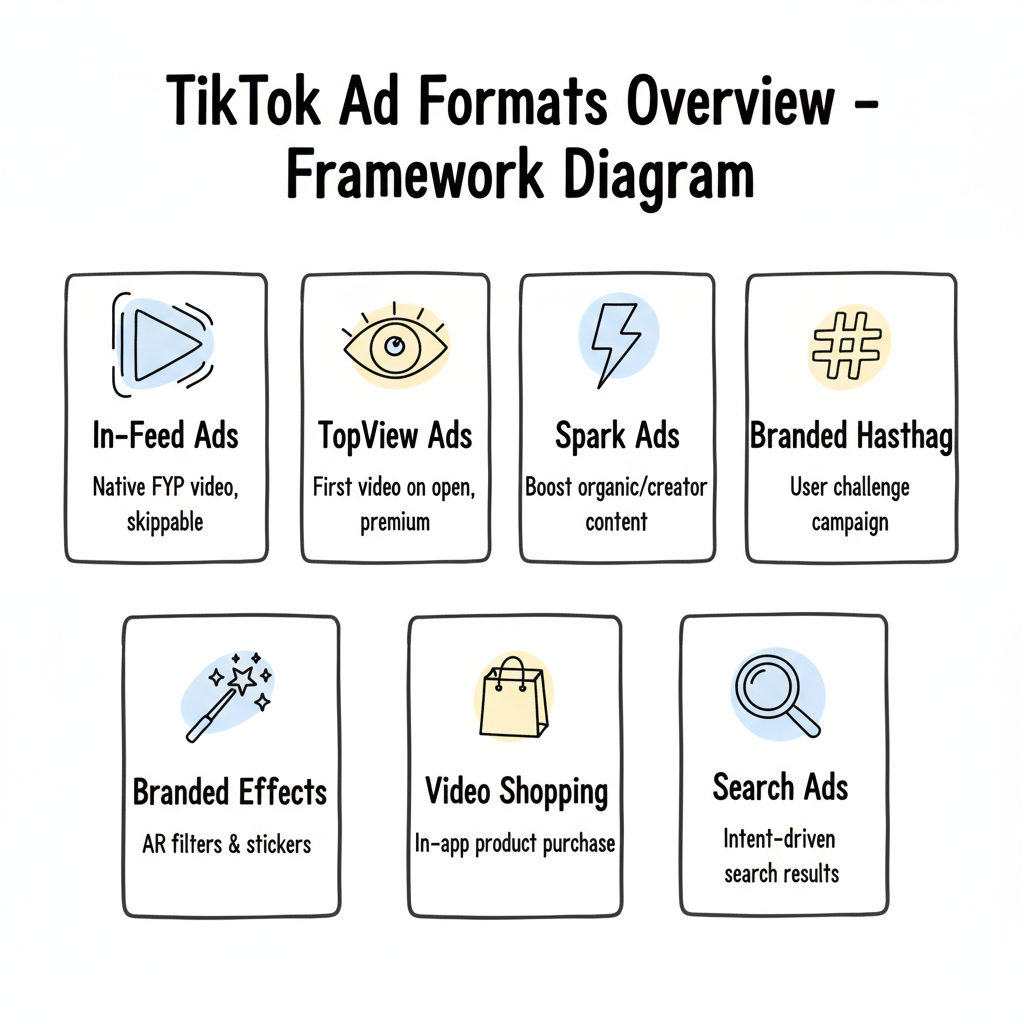
In-Feed ads appear natively in users' For You Page, looking and feeling like organic TikTok content. They're skippable, which means your creative must earn attention within the first seconds.
Specifications:
2026 performance benchmarks:
Best for: Traffic, conversions, app installs, brand awareness at scale
TopView ads are premium placements that appear as the first video when users open TikTok. They start with a 3-second full-screen takeover before transitioning to an interactive in-feed experience. Learn more about implementing this high-impact format in our TikTok TopView ads guide.
Performance:
Best for: Major product launches, brand awareness campaigns, reaching mass audiences quickly
Consideration: TopView ads require significant budget and are typically booked through TikTok sales representatives rather than self-serve.
Spark Ads allow you to boost organic TikTok content—either from your own account or from creators who authorize their posts. This format preserves the authentic, native feel while amplifying reach. Our TikTok Spark Ads guide covers advanced strategies for maximizing this format's unique advantages.
Key advantages:
Best for: Amplifying proven organic content, influencer partnerships, authenticity-focused campaigns
Branded Hashtag Challenges invite users to create content around your brand's hashtag and theme. They appear on TikTok's Discover page and include a dedicated landing page showcasing user submissions. For implementation details, see our branded hashtag challenge guide.
Structure:
Best for: Brand awareness, user-generated content generation, viral potential
Consideration: Hashtag challenges require substantial investment ($150,000+) and work best for brands with broad appeal.
Branded Effects are custom AR filters, stickers, and special effects that users can apply to their own videos. They encourage interaction and create shareable branded experiences.
Performance: ~8% engagement rate
Best for: Interactive brand experiences, encouraging user-generated content, memorable brand moments
Video Shopping Ads integrate product information directly into video content, enabling users to browse and purchase without leaving TikTok.
Types:
For e-commerce brands looking to maximize revenue through this format, our TikTok catalog ads guide and TikTok live shopping guide provide detailed implementation strategies.
Best for: E-commerce brands, direct response campaigns, TikTok Shop sellers
Search Ads are text and video ads appearing in TikTok search results when users actively look for products, tutorials, or entertainment.
Best for: Intent-driven conversions, capturing users actively researching your product category
TikTok advertising costs vary based on ad format, targeting, competition, and creative quality. For a complete breakdown of budgeting strategies and cost optimization tactics, see our detailed TikTok advertising cost per month analysis. Here's what to expect in 2026:
According to Admetrics' 2026 pricing guide:
Metric | Range |
Cost Per Click (CPC) | $0.30–$1.50 |
Cost Per Thousand Impressions (CPM) | $5.00–$12.00 |
Cost Per Engagement (CPE) | $0.01–$0.07 |
Cost Per App Install (CPI) | $0.50–$1.80 |
WebFX benchmarks show CPMs ranging from $3.21 to $10.00, with an average of $9.16. For industry-specific benchmarks, consult our guides on TikTok CPM benchmarks 2026 and TikTok CPC benchmarks 2026.
TikTok requires minimum budgets at both campaign and ad group levels:
Different verticals experience varying costs based on competition and audience behavior. Our industry-specific guides cover specialized strategies for e-commerce brands, dropshipping businesses, beauty brands, fashion brands, fitness brands, D2C brands, and small businesses.
E-commerce and Retail:
Mobile Apps and Gaming:
B2B and Services:
For service-based businesses, our guides on real estate lead generation and local restaurant advertising provide sector-specific insights.
Several variables influence your actual TikTok advertising costs:
TikTok ad costs rose approximately 12.28% year-over-year in 2026 due to increased advertiser competition. Despite this increase, TikTok remains more cost-effective than Meta and Google for most advertisers. For the latest data and projections, see our TikTok advertising trends 2026 report and TikTok advertising statistics.
Creating your first TikTok ad campaign involves several key steps. For those just starting out, our comprehensive how to run TikTok ads guide walks through the entire process with screenshots and optimization tips. Here's a walkthrough of the process:
For agencies managing multiple client accounts, our TikTok Business Center guide and TikTok agency account overview explain the platform's organizational structure and permissions.
The TikTok Pixel tracks user actions on your website, enabling conversion tracking, audience building for retargeting, and optimization for specific events. Our TikTok Pixel setup guide provides step-by-step instructions for all major platforms.
Installation options:
TikTok organizes objectives into three categories:
Awareness:
Consideration:
Conversion:
TikTok offers multiple targeting dimensions. For comprehensive coverage of all available options and advanced strategies, see our TikTok ads targeting options guide.
Demographics:
Interests and Behaviors:
Custom Audiences:
Lookalike Audiences:
Find users similar to your best customers with narrow, balanced, or broad expansion options. Our TikTok lookalike audiences guide explains how to build and optimize these high-performing segments.
Budget options:
Bidding strategies:
Upload your video or image creative, then add display name, profile image, ad text (1-100 characters recommended), call-to-action button, and destination URL or app store link. For detailed creative guidance, consult our TikTok ad creative best practices and TikTok UGC ads strategy guides.
Review all settings, then submit your campaign for review. TikTok typically approves ads within 24 hours. Once live, monitor performance in Ads Manager and optimize based on results. If you encounter issues with campaign delivery, our TikTok ads not spending troubleshooting guide addresses common problems and solutions.
Success on TikTok requires understanding what makes content perform on the platform. Follow these best practices to maximize your results:
The most important rule: don't make ads, make TikToks. Content that looks and feels native to the platform consistently outperforms polished, traditional advertising.
According to TikTok's official creative guidelines:
The first 3 seconds determine 71% of whether users keep watching or scroll past. TikTok's official guidance recommends prioritizing your hook in the first 6 seconds to boost engagement.
Effective hook strategies:
While TikTok allows videos up to 60 seconds for ads, research suggests 21-34 seconds is the sweet spot for optimal performance. Industry guidance for 2026 indicates 15-30 seconds works best for most advertising content.
The key principle: every second must earn its place. Shorter, tighter content typically outperforms longer videos padded with filler.
TikTok recommends displaying 5-10 words per second when using text overlays. Text serves multiple purposes:
TikTok suggests running 3-5 different creatives per ad group and 3-5 diversified ad groups per campaign. Creative variation is especially important during the exploration phase when TikTok's algorithm is learning what works for your audience. Our TikTok A/B testing guide provides a framework for systematic experimentation.
When testing, prioritize creatives with significant differences rather than minor variations. Test different hooks and opening sequences, messaging angles, creator styles, product demonstrations, and calls-to-action.
TikTok's algorithm responds to engagement velocity—how quickly videos accumulate interactions. As ad frequency increases, engagement typically declines.
Brands that use trending sounds are 1.2x more likely to drive full-funnel impact. Monitor trending sounds weekly and identify opportunities to incorporate them authentically into your creative strategy.
Use TikTok's Creative Center to discover trending hashtags, popular sounds and music, top-performing ads in your category, and creative insights and patterns. Our TikTok Creative Center guide explains how to extract actionable insights from this powerful research tool.
Effective measurement enables optimization. For a complete framework covering all key metrics and reporting workflows, see our TikTok ads reporting and analytics guide. Here are the key metrics to track and how to interpret them:
Reach and Impressions:
Engagement Metrics:
Conversion Metrics:
For e-commerce advertisers focused on profitability, our TikTok ROAS benchmarks guide provides industry-specific targets and optimization strategies.
Based on WebFX and industry data:
Metric | Benchmark |
CTR (In-Feed) | 0.84% average |
CTR (TopView) | 12-16% |
Video Completion Rate | 40%+ indicates strong creative |
Conversion Rate (E-commerce) | 0.46% average |
CPM | $3.21–$10.00 |
CPC | $0.25–$4.00 |
TikTok offers multiple attribution windows:
For accurate measurement:
If you see these patterns, take action:
Avoid these frequent errors that waste budget and limit results:
Simply cropping a YouTube or Instagram ad for TikTok rarely works. TikTok requires vertical 9:16 formatting (not just cropped), native-feeling creative (not polished production), platform-appropriate hooks, and TikTok-native elements (trending sounds, text overlays, effects).
Advertisers often save the best for later, but TikTok users scroll quickly. Front-load your most compelling content in the first 3 seconds.
Highly produced content with perfect lighting and b-roll often gets scrolled past. Users expect authentic, creator-style content. The aesthetic should be DIY rather than commercial.
TikTok's algorithm is highly effective at finding your audience. Overly narrow targeting restricts the algorithm's ability to optimize and often increases costs. Start broader and let performance data guide refinements.
Running one or two creatives limits your learning and makes you vulnerable to creative fatigue. Maintain multiple creative variations and continuously test new approaches.
For e-commerce brands, TikTok Shop integration can dramatically improve conversion rates by keeping users in-app. Sending users to external websites adds friction and often reduces conversions. Our TikTok Shop marketing strategy guide explains how to leverage this powerful commerce platform.
TikTok is a sound-on platform. Silent or poorly-audio-designed ads miss a significant engagement opportunity. Use trending sounds, voiceovers, or music to capture attention.
TikTok campaigns require active management. Check performance regularly, refresh creatives before fatigue sets in, and optimize based on data.
If your ad account gets suspended, don't panic. Our TikTok ad account suspension and reinstatement guide walks through the appeals process and prevention strategies.
Understanding how TikTok compares to other advertising platforms helps you allocate budget effectively.
Factor | TikTok | Meta (Facebook/Instagram) |
Average CPM | $3.21–$9.16 | $10.96–$14.91 |
Average CPC | $0.30–$1.50 | $1.72 |
Primary Audience | 18-34 | Broader age distribution |
Content Style | Native, creator-style | More polished accepted |
Commerce Integration | TikTok Shop | Meta Shops |
Best For | Discovery, awareness, younger audiences | Retargeting, broad reach, conversions |
When to choose TikTok: Discovery-focused campaigns, Gen Z/millennial targeting, brand building, cost-efficient reach
When to choose Meta: Detailed retargeting, broader age targeting, established conversion campaigns
For a detailed comparison, see our TikTok ads vs Facebook ads guide and TikTok ads vs Instagram ads comparison.
Factor | TikTok | |
Average CPM | $3.21 | $18.75 |
User Intent | Discovery/entertainment | Active search |
Ad Format | Video-first | Search, display, video |
Best For | Awareness, brand discovery | Intent capture, retargeting |
When to choose TikTok: Building brand awareness, reaching users before they're actively searching
When to choose Google: Capturing high-intent search traffic, remarketing to previous visitors
For platform-specific comparisons, consult our TikTok vs Google Ads analysis and TikTok vs YouTube ads guide.
Most brands achieve best results by using TikTok alongside other platforms:
Once you've mastered the fundamentals, these advanced tactics can significantly improve performance:
Build custom audiences from website visitors, video viewers, and engaged users, then serve tailored messages based on their previous interactions. Our TikTok retargeting and remarketing guide covers pixel-based audiences, engagement retargeting, and sequential messaging strategies.
Collaborating with TikTok creators adds authenticity and extends your reach. The TikTok Creator Marketplace connects brands with vetted creators, while our TikTok influencer rates guide helps you budget appropriately for partnerships.
TikTok's affiliate program allows creators to earn commissions promoting your products, creating a performance-based growth channel. See our TikTok affiliate marketing strategy for implementation details.
Develop comprehensive campaigns that integrate organic and paid efforts. Our TikTok marketing strategy 2026 guide covers content planning, community building, and cross-channel integration.
For terminology and platform-specific concepts, reference our TikTok ads glossary whenever you encounter unfamiliar terms.
While TikTok's self-serve platform is accessible to DIY advertisers, working with a specialized agency often makes sense for brands scaling beyond experimental budgets. Our guide on how to choose a TikTok ad agency walks through the evaluation process, and we've compiled a directory of the best TikTok marketing agencies in 2026 based on performance data and client reviews.
For agencies specifically focused on influencer campaigns, see our list of top TikTok influencer marketing agencies. If you operate a TikTok Shop, our TikTok Shop marketing agency directory features specialists in social commerce.
TikTok agencies typically charge through:
For marketing professionals considering launching their own practice, our guide on how to start a TikTok ad agency covers business setup, client acquisition, and operational frameworks. The TikTok Partner Program offers official agency certification and benefits.
Real-world examples demonstrate how different business types succeed on TikTok:
Our e-commerce advertising case study shows how a D2C brand achieved 5.2x ROAS through user-generated content and TikTok Shop integration. The campaign combined Spark Ads amplifying customer testimonials with Catalog Ads dynamically showcasing products.
A mobile gaming company reduced cost per install from $4.50 to $1.20 while improving Day 7 retention by 23%. Our app install case study breaks down their creative testing framework and audience segmentation strategy.
TikTok advertising costs vary by format and targeting. Average CPMs range from $3.21 to $10.00, while CPCs typically fall between $0.30 and $1.50. Minimum campaign budgets start at $50, with $20/day minimum at the ad group level. Actual costs depend on competition, targeting specificity, and creative quality.
Research indicates 21-34 seconds is optimal for most TikTok advertising. While the platform allows up to 60 seconds, 15-30 seconds is the recommended sweet spot for 2026. The key is ensuring every second adds value—shorter, tighter content typically outperforms padded videos.
Yes, TikTok can be highly effective for small businesses due to its cost efficiency and algorithm-driven discovery. With CPMs often lower than Meta and Google and an algorithm that rewards engaging content regardless of account size, small businesses can achieve significant reach without enterprise budgets. Start with $500-1,000/month to test performance before scaling.
TikTok typically offers lower CPMs ($3.21-$9.16 vs $10.96-$14.91) and reaches younger audiences more effectively. Facebook/Meta provides more mature targeting options and stronger retargeting capabilities. Most brands benefit from using both platforms strategically—TikTok for discovery and Meta for conversion-focused campaigns.
E-commerce brands, particularly in fashion, beauty, and consumer goods, see strong results due to TikTok Shop integration. App developers benefit from cost-effective install campaigns. D2C brands thrive with authentic creator content. That said, B2B brands and service businesses are also finding success as the platform's audience matures.
Install the TikTok Pixel on your website to track user actions after clicking ads. For more robust tracking, implement TikTok's Events API for server-side conversion reporting. Use UTM parameters for Google Analytics integration and compare platform-reported data against your own analytics for accuracy.
By submitting this form, you agree to our Privacy Policy and Terms & Conditions.