February 19, 2026


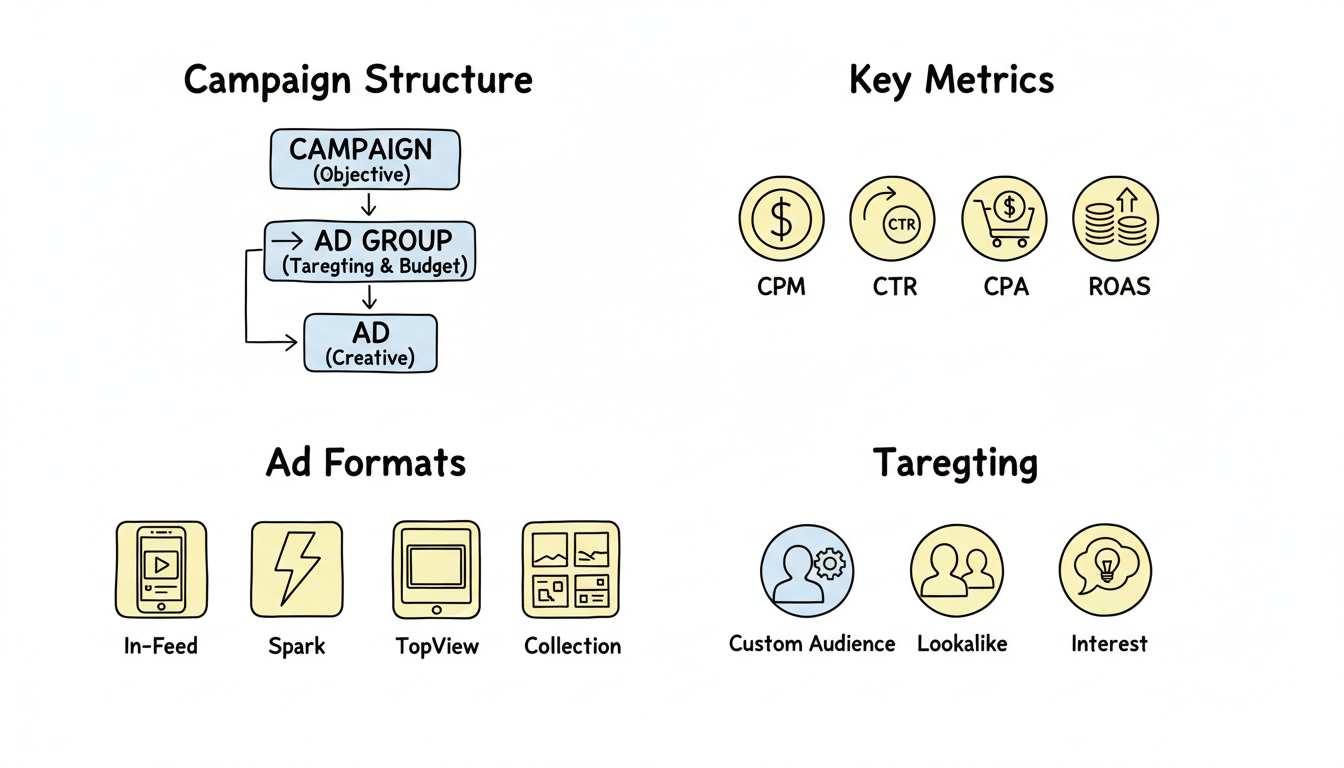
Navigating TikTok advertising can feel overwhelming when you're surrounded by unfamiliar terminology. From CPM to Spark Ads, understanding TikTok advertising terms is essential for running successful campaigns.
This comprehensive TikTok ads glossary covers 50+ essential terms every marketer needs to know in 2026. Bookmark this page as your reference guide when managing TikTok advertising campaigns.
A method of comparing two versions of an ad (or ad element) to determine which performs better. On TikTok, you can test different creatives, audiences, or placements to optimize campaign performance.
The container within TikTok Ads Manager that holds your campaigns, ad groups, and ads. One Business Center can manage multiple ad accounts.
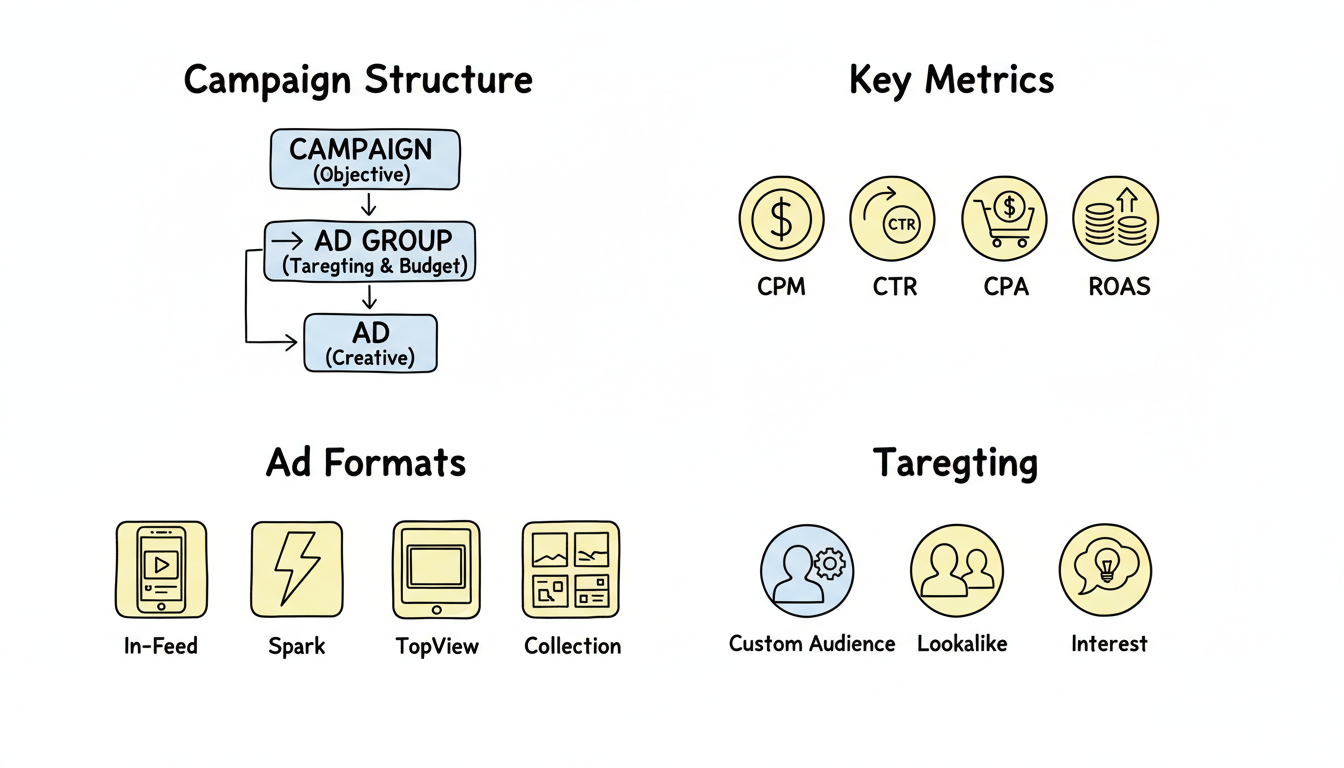
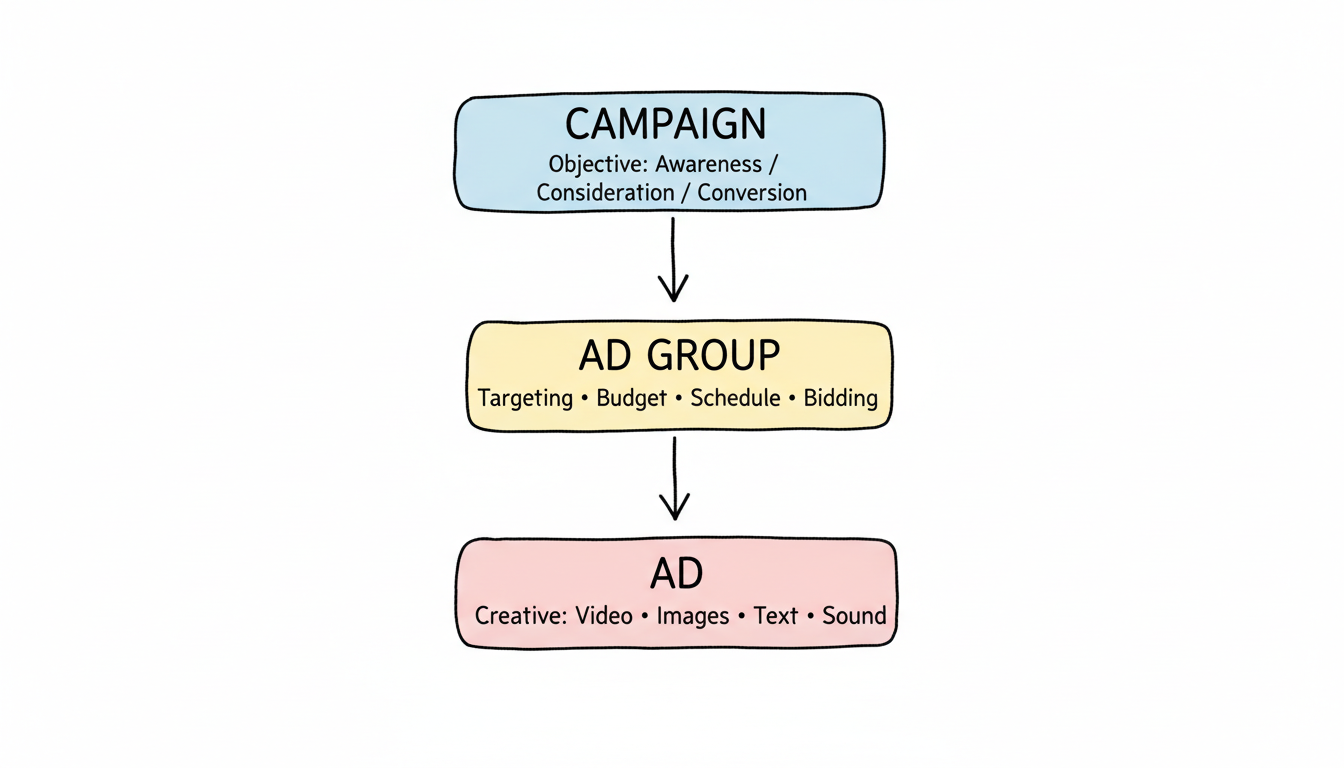
The visual and audio content of your advertisement—the actual video, images, text, and sound that users see and hear.
The decline in ad performance that occurs when your target audience sees the same ad too frequently. On TikTok, ad fatigue typically sets in when frequency exceeds 3.0 per week.
The middle level of TikTok's campaign structure, containing your targeting settings, budget, schedule, and bidding strategy. Multiple ad groups can exist within a single campaign.
TikTok's internal measure of how well your ad matches user interests and behaviors. Higher relevance can result in lower costs and better placement.
TikTok's recommendation system that determines which content—including ads—appears on users' For You Pages. Understanding the TikTok algorithm is crucial for advertising success.
The time period during which a conversion is credited to an ad. TikTok offers both click-through and view-through attribution options.
TikTok's network of third-party apps and websites where your ads can appear beyond the TikTok app itself. Includes interstitial, rewarded, and native ad placements.
The amount you're willing to pay for a specific action (click, impression, or conversion). TikTok offers automatic and manual bidding options.
A high-impact ad format that displays full-screen when users open TikTok. Brand Takeovers cost approximately $30,000 per day but guarantee exclusive category visibility.
Custom AR filters, stickers, and special effects that brands create for users to include in their own TikTok videos. Increases brand awareness through user participation.
A sponsored challenge encouraging users to create content using a specific branded hashtag. Appears on the Discover page and drives user-generated content at scale.
TikTok's centralized platform for managing business assets, team members, and partner access. The command hub for TikTok for Business operations.
The top level of TikTok's advertising structure. Each campaign contains an objective (awareness, consideration, or conversion) and one or more ad groups.
An ad format displaying multiple images or videos that users can swipe through. Effective for showcasing product collections or telling sequential stories.
A structured data file containing your product information (images, prices, descriptions) used for Shopping Ads and Dynamic Showcase Ads.
The percentage of people who click on your ad after seeing it. Calculated as: (Clicks ÷ Impressions) × 100. TikTok benchmarks typically range from 1.5-3% for strong In-Feed Ads.
An e-commerce ad format combining video content with clickable product tiles. Users can browse and purchase without leaving TikTok via an Instant Gallery Page.
The percentage of viewers who watch your video ad to the end. A completion rate above 40% typically indicates engaging content.
A desired action taken by a user after seeing or clicking your ad—purchases, sign-ups, app installs, or other defined goals.
The average cost to acquire one conversion. Calculated as: Total Ad Spend ÷ Number of Conversions.
The average cost for each click on your ad. TikTok CPC typically ranges from $0.50-$1.50 depending on industry and targeting.
The cost per 1,000 ad impressions. To understand industry benchmarks and optimize your campaigns, review the latest TikTok CPM benchmarks for 2026. In-Feed Ads typically cost $4-$8 CPM, while TopView Ads range from $20-$50 CPM.
TikTok's resource hub for discovering trending content, sounds, hashtags, and creative inspiration. Essential for developing native-style ads.
A targeting option that uses your existing customer data (email lists, website visitors, app users) to reach specific people on TikTok.
The maximum amount you're willing to spend per day on an ad group or campaign. TikTok requires minimum daily budgets of $50 for ad groups.
The percentage of viewers who interact with your content through likes, comments, shares, or clicks. Higher engagement signals content quality to the algorithm.
How quickly your content accumulates engagement after posting. A video with 100 engagements in the first hour outperforms one with 1,000 over 24 hours algorithmically.
Directing TikTok's algorithm to find users most likely to complete a specific conversion event, like purchases or registrations.
TikTok's main content feed, personalized for each user by the recommendation algorithm. The primary placement for In-Feed Ads.
The average number of times each user in your target audience sees your ad. Monitor to prevent ad fatigue.
A keyword or phrase preceded by # that categorizes content and helps the algorithm understand and distribute your videos.
The attention-grabbing opening seconds of a video. Research shows 71% of watch decisions are made in the first 3 seconds.
The total number of times your ad is displayed, regardless of whether users interact with it.
Native video ads that appear in users' For You Page feeds between organic content. The most common TikTok ad format, skippable and interactive.
A fast-loading, in-app storefront that opens when users tap products in Collection Ads or Shopping Ads.
Reaching users based on their demonstrated interests, determined by their content consumption patterns and interactions. Learn more about advanced targeting options for TikTok ads.
The destination URL where users arrive after clicking your ad. Should align with ad messaging and be optimized for mobile.
An ad format with built-in forms that let users submit information without leaving TikTok. Ideal for collecting emails, phone numbers, or other data.
The initial period when TikTok's algorithm gathers data about your ad performance. Typically requires 50 conversions before optimization stabilizes.
The total amount you're willing to spend over an entire campaign duration, as opposed to daily budgets.
A targeting option that finds new users who share characteristics with your existing customers or custom audiences.
TikTok's required minimum budget thresholds. Campaigns require $500 minimum; ad groups require $50 daily minimum.
Video content that matches the organic style and feel of user-generated TikTok videos. Ads that look native consistently outperform polished corporate content.
The goal of your campaign that determines available ad formats and optimization options: Awareness, Consideration, or Conversion.
The specific action you want TikTok to optimize for within your chosen objective (clicks, impressions, conversions, etc.).
TikTok's audience network for advertising across third-party apps. Extends reach beyond the TikTok platform.
A piece of code installed on your website that tracks user behavior and conversions. For complete setup instructions, see our TikTok Pixel setup guide for 2026. Essential for measuring TikTok ad performance and building retargeting audiences.
Where your ads appear—TikTok feed, TikTok search results, Pangle network, or automatic placement across all available inventory.
Interactive ad format allowing users to engage with a mini-game or demo experience within the ad. Popular for app promotion and gaming.
The total number of unique users who see your ad at least once. Different from impressions, which count total views.
Showing ads to users who have previously interacted with your brand—visited your website, engaged with your content, or added items to cart.
Revenue generated divided by ad spend. A ROAS of 4.0 means $4 revenue for every $1 spent. Understanding View-Through Attribution is essential for accurate ROAS measurement.
TikTok's AI-powered campaign type that automates targeting, bidding, and creative optimization for maximum performance with minimal manual management.
An ad format that lets you boost existing organic TikTok posts—either your own or creator content with permission. Combines paid reach with organic engagement signals. For detailed implementation strategies, explore our comprehensive Spark Ads guide.
TikTok's built-in feature for A/B testing different ad variables (creative, audience, placement) with statistical significance.
TikTok's AI-powered creative tools that help generate video ads, translate content, and create variations at scale.
The criteria used to define which users see your ads—demographics, interests, behaviors, custom audiences, or lookalikes.
The self-serve platform for creating, managing, and analyzing TikTok advertising campaigns. New to the platform? Start with our TikTok Ads Manager tutorial.
TikTok's integrated e-commerce platform allowing in-app purchases. Hosts over 15 million merchants worldwide.
Full-screen video ads displayed when users first open TikTok, up to 60 seconds long. Premium placement with high visibility and engagement.
Audio clips currently popular on TikTok. Using trending sounds in ads can increase algorithmic distribution and boost reach beyond paid impressions.
Content created by regular users rather than brands. TikTok ads featuring UGC-style content typically outperform traditional advertising.
E-commerce ad format showcasing products with shoppable links, optimized for driving purchases through engaging video content.
The number of times your video ad has been viewed. TikTok counts a view after a minimal watch duration (typically 2 seconds).
Crediting conversions to ads that users viewed but didn't click on. Essential for measuring brand impact beyond direct clicks.
Total time users spend viewing your video. A primary signal the TikTok algorithm uses to determine content quality and distribution.
CPM (Cost Per Mille) charges you per 1,000 impressions regardless of clicks, while CPC (Cost Per Click) only charges when users click your ad. CPM is better for awareness campaigns; CPC works for driving specific actions.
Spark Ads let you boost existing organic TikTok posts as paid advertisements. You can promote your own content or creator posts (with permission), maintaining all original engagement metrics while adding paid reach.
During the learning phase, TikTok's algorithm gathers data to optimize your ad delivery. This typically requires approximately 50 conversions. Avoid making major changes during this period to let the system stabilize.
Understanding this TikTok advertising terminology empowers you to navigate Ads Manager confidently, communicate effectively with your team, and make data-driven optimization decisions. As the platform evolves, bookmark this glossary and refer back whenever you encounter unfamiliar terms in your campaigns.
By submitting this form, you agree to our Privacy Policy and Terms & Conditions.