
February 19, 2026


Finding the right TikTok ad agency can mean the difference between wasting thousands on ineffective campaigns and generating substantial returns from the platform's 1.5+ billion monthly active users. With TikTok advertising becoming increasingly competitive and sophisticated in 2026, many brands are turning to specialized agencies rather than managing campaigns in-house.
This guide walks you through everything you need to know about selecting a TikTok advertising agency—from understanding different agency types and pricing models to identifying red flags and evaluating results.
TikTok's advertising platform has evolved significantly, and the learning curve for effective campaigns has steepened. Here's why brands increasingly partner with specialized TikTok marketing agencies:
TikTok operates differently from Meta or Google advertising. According to industry research, 71% of users decide whether to keep watching within the first three seconds—meaning TikTok-specific creative expertise is essential. Agencies specializing in TikTok understand these nuances:
Agencies typically maintain relationships with verified TikTok creators across multiple tiers. Research shows that micro-influencers (10K-100K followers) often deliver the best balance of reach, engagement, and cost-efficiency. For brands looking to leverage creators, exploring TikTok influencer marketing agencies and understanding TikTok influencer rates is essential. Established agencies can:
While agencies charge management fees, experienced TikTok agencies often deliver better cost efficiency through:
Understanding TikTok CPC benchmarks and TikTok CPM benchmarks helps you evaluate if your agency is achieving competitive rates.
TikTok advertising requires constant attention. According to experts, ads wear out quickly on TikTok—some clients refresh creative every three to five days. An agency handles this ongoing workload, freeing your team to focus on core business operations.
Not all TikTok agencies offer the same services. Understanding the different types helps you find the right fit for your needs.
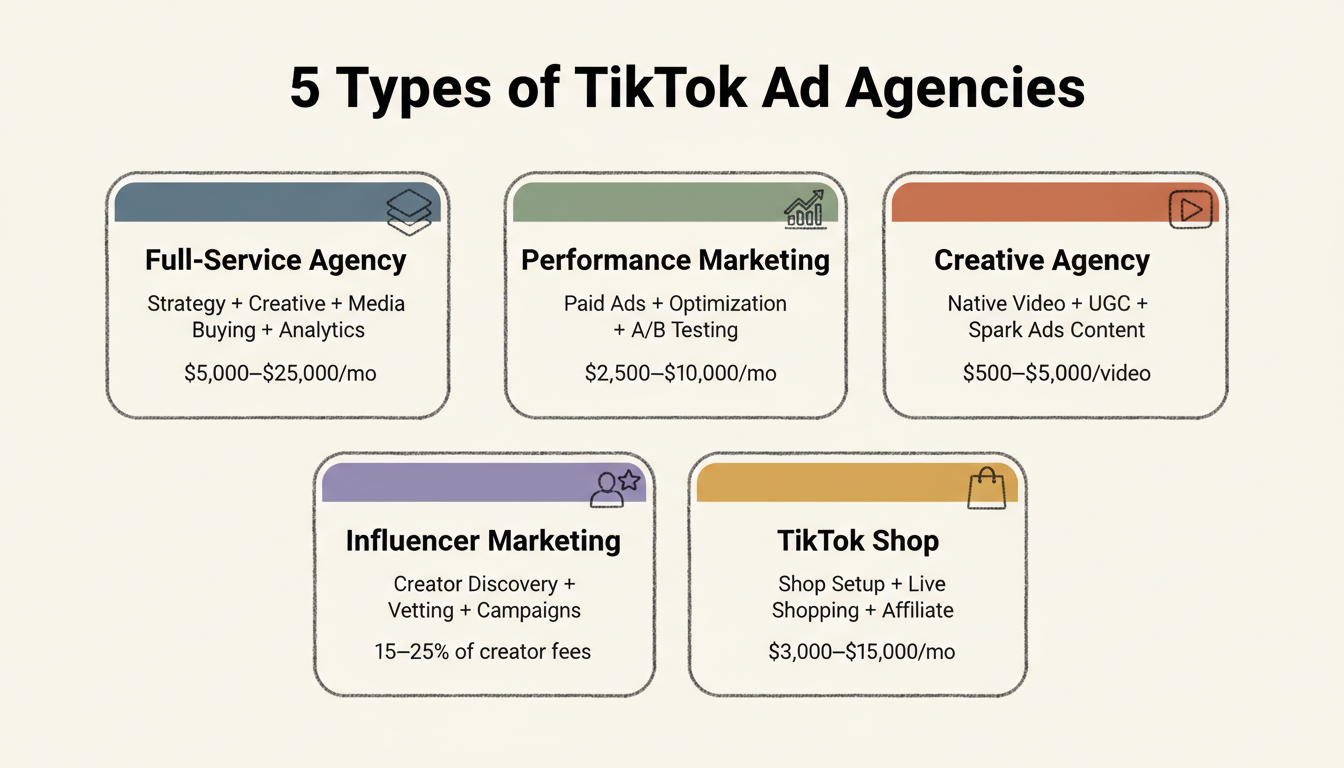
These agencies handle everything TikTok-related:
For e-commerce brands, working with TikTok Shop marketing agencies that understand both advertising and in-app commerce can be particularly valuable.
Best for: Brands wanting a complete solution without managing multiple vendors Typical monthly retainer: $5,000–$25,000+ depending on ad spend and scope
These agencies focus specifically on paid advertising results:
Best for: Brands with existing creative resources who need media buying expertise Typical monthly retainer: $2,500–$10,000+ (often percentage of ad spend)
Specialized in TikTok content production:
Understanding TikTok ad creative best practices and TikTok ad specs ensures your creative agency delivers platform-optimized content.
Best for: Brands handling media buying in-house but lacking TikTok creative capabilities Typical pricing: $500–$5,000 per video depending on complexity
Focus on creator partnerships and influencer campaigns:
Best for: Brands prioritizing organic reach and creator partnerships over paid ads Typical pricing: 15–25% of creator fees plus retainer
Specialize in TikTok's e-commerce features:
Best for: E-commerce brands wanting to sell directly on TikTok Typical monthly retainer: $3,000–$15,000
Industry-specific agencies also exist, including those specializing in TikTok advertising for beauty brands, fashion brands, fitness brands, and D2C brands.
The most critical factor is documented experience running successful TikTok campaigns—not just general social media or digital marketing experience.
Questions to ask:
What to expect:
TikTok advertising lives or dies on creative quality. When evaluating agencies, consider how their approach to TikTok UGC ads aligns with your brand's needs. According to industry benchmarks, successful In-Feed ads in 2026 achieve:
Evaluate agencies on:
You should always have full visibility into campaign performance and spending. Agencies should be comfortable providing access to TikTok ads reporting and analytics.
Non-negotiables:
According to industry sources, one major red flag is agencies that run campaigns under their master account instead of yours. This means you lose all historical data if you ever switch agencies.
TikTok offers official certifications and partner programs:
While certifications aren't everything, they demonstrate an agency's commitment to TikTok expertise and access to official resources and support. Agencies familiar with the TikTok Partner Program often have additional platform insights.
Beyond technical capabilities, consider:
Use these questions during your evaluation process:
Understanding how agencies charge helps you compare options accurately and budget appropriately. For context on overall platform investment, review our guide on TikTok advertising cost per month.
The most common model for performance-focused agencies.
How it works: Agency charges 10–20% of your monthly ad spend as their management fee.
Example: $10,000 monthly ad spend × 15% = $1,500 management fee = $11,500 total monthly cost
Pros:
Cons:
Common for full-service agencies and creative-focused engagements.
How it works: Fixed monthly fee regardless of ad spend, often tiered by service level.
Example tiers (based on industry research):
Pros:
Cons:
Less common but growing, especially for e-commerce.
How it works: Agency compensation tied to specific outcomes (cost per acquisition, ROAS targets, revenue share).
Example: Base retainer of $3,000 + $5 per lead generated, or 3% of attributed revenue.
Pros:
Cons:
Common for specific campaigns or one-time initiatives.
How it works: Fixed price for defined deliverables and timeline.
Example: $15,000 for a three-month product launch campaign including strategy, creative, and media buying.
Pros:
Cons:
Based on current industry data, here's what to expect for different business sizes:
Business Size | Minimum Ad Spend | Typical Agency Fee | Total Monthly |
Small Business | $1,500–$3,000 | $1,500–$3,000 | $3,000–$6,000 |
Mid-Market | $5,000–$20,000 | $3,000–$7,000 | $8,000–$27,000 |
Enterprise | $25,000+ | $10,000–$25,000+ | $35,000–$50,000+ |
Note: TikTok's minimum campaign spend is $500, but most experts recommend at least $1,500–$3,000 for a meaningful 30-day test. For detailed budget planning, see our complete guide to TikTok advertising.
Watch for these warning signs when evaluating TikTok agencies:
Red flag: Agency wants to run campaigns under their TikTok Ads Manager account rather than yours.
Why it matters: If you part ways, you lose all historical campaign data, pixel data, and audience learnings. This is widely recognized as a major red flag in the industry.
What to require: Your brand owns the TikTok Business Center and Ads Manager accounts. Agency gets partner access.
Red flag: Agency can't or won't provide detailed breakdowns of how your money is spent.
Warning signs:
What to require: Clear, itemized statements showing exact platform spend versus agency fees.
Red flag: Agency promises specific ROAS, CPA, or view counts before understanding your business.
Why it matters: No ethical agency can guarantee specific performance outcomes. Too many variables (your product, creative quality, market conditions, competition) affect results.
What's acceptable: Agencies sharing benchmark ranges and case studies from similar clients while being clear these are examples, not promises.
Red flag: Agency primarily shows Facebook, Instagram, or Google experience when you ask about TikTok.
Why it matters: TikTok requires different creative approaches, targeting strategies, and optimization tactics. General digital marketing skills don't automatically transfer. Understanding TikTok vs Facebook ads, TikTok vs Instagram ads, and TikTok vs Google Ads shows platform-specific expertise.
What to look for: TikTok-specific case studies, team members with documented TikTok campaign experience, understanding of TikTok-specific features like Spark Ads.
Red flag: Agency promises immediate results or rapid scaling without a testing phase.
Why it matters: Effective TikTok campaigns require creative testing and optimization. Experts recommend at least 2–4 weeks of testing before scaling successful approaches.
What's realistic: 30–60 days to establish baseline performance, ongoing optimization from there.
Red flag: Slow response times, missed meetings, or constantly changing account managers during sales process.
Why it matters: If communication is poor before they have your business, it rarely improves after.
What to evaluate: Response times during sales process, consistency of team members involved, clarity of communication.
Red flag: Vague answers about what's included in their fee, or discovery of undisclosed markups.
Common hidden costs:
What to require: Comprehensive scope document detailing all potential costs before signing.
When evaluating agencies, these credentials indicate verified expertise:
TikTok's official partner program badges agencies across categories:
You can verify partner status through TikTok's official partner directory.
Available through TikTok Academy, this certification validates:
Ask potential agencies if their team members hold this certification.
While TikTok-specific credentials matter most, these broader certifications indicate professional standards:
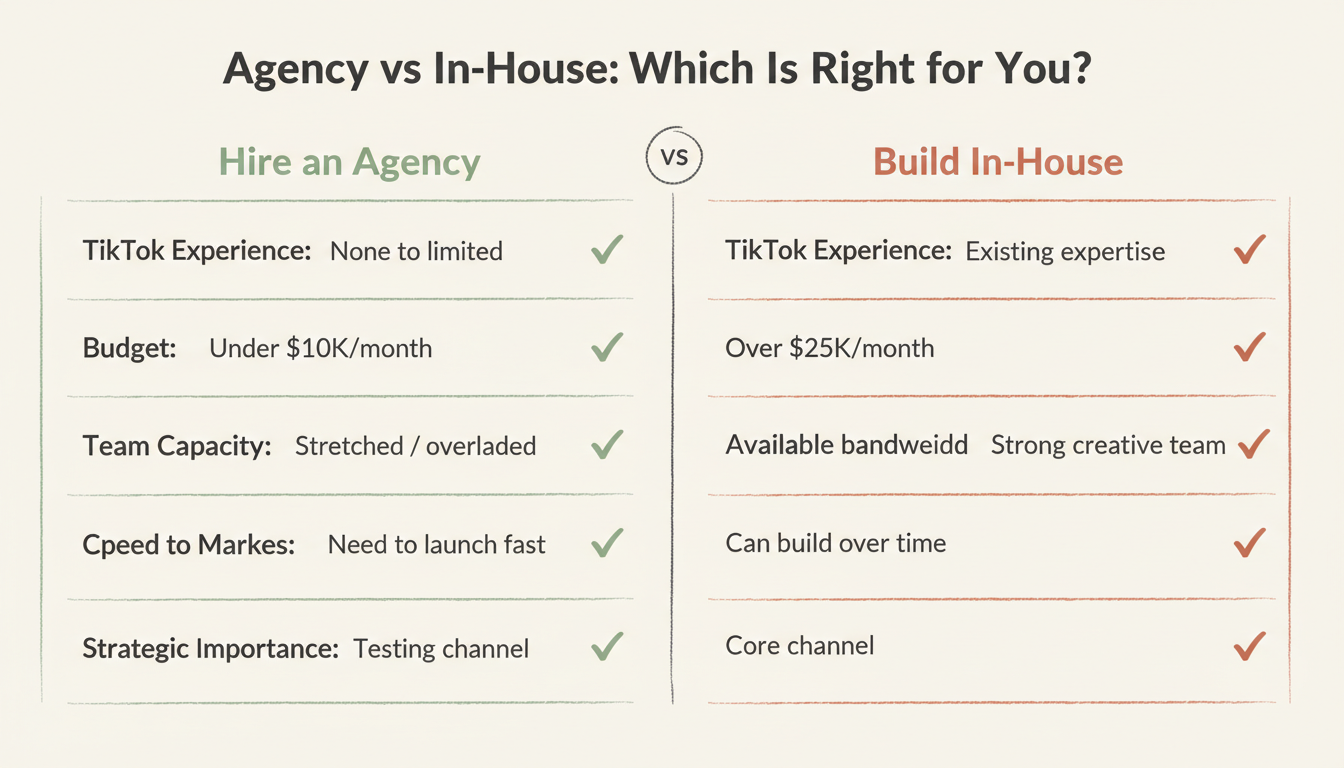
The choice between building an in-house TikTok team or hiring an agency depends on several factors.
Consider an agency if:
Specific business types may particularly benefit from specialized agencies, including small businesses, e-commerce brands, dropshipping businesses, restaurants, and real estate professionals.
Consider in-house if:
For entrepreneurs considering how to start a TikTok ad agency, understanding both sides of this decision is valuable.
Many brands use a hybrid model:
This approach balances expertise access with cost efficiency and brand control.
Factor | Favors Agency | Favors In-House |
TikTok experience | None to limited | Existing expertise |
Budget | Under $10K/month | Over $25K/month |
Team capacity | Stretched | Available bandwidth |
Creative resources | Limited | Strong creative team |
Speed to market | Need to launch fast | Can build over time |
Strategic importance | Testing channel | Core channel |
Once you've hired an agency, here's how to measure their performance. For detailed metrics tracking, familiarize yourself with TikTok Ads Manager to understand the data your agency should be reporting.
Primary metrics to track:
Secondary metrics:
For terminology clarity, reference our TikTok ads glossary to ensure you and your agency are aligned on metrics.
Your agency should provide:
Weekly: Performance snapshot with key metrics, budget pacing, any urgent issues
Monthly: Comprehensive report including:
Quarterly: Strategic review covering:
Give agencies reasonable time to demonstrate results:
Evaluate fairly: If an agency hits benchmarks within agreed timelines while being transparent about challenges, they're performing well. If metrics consistently miss targets without clear explanations or improvement plans, that's concerning. Reviewing TikTok advertising case studies helps contextualize expected performance.
Consider ending the relationship if:
Before switching, document specific issues and give the agency opportunity to address them. Sometimes a candid conversation resolves problems. If switching, understand TikTok agency accounts to ensure smooth transitions.
TikTok ad agency costs typically range from $2,500 to $25,000+ per month for management fees, depending on scope and ad spend. Most agencies charge either a flat retainer or 10–20% of ad spend. Small businesses should budget at least $3,000–$6,000 total monthly (ad spend plus fees) for meaningful campaigns.
Look for documented TikTok-specific experience (not just general social media), transparent reporting practices, account ownership (you own the ad accounts), relevant certifications like TikTok Marketing Partner status, and clear communication during the sales process. Ask for case studies with actual metrics from campaigns similar to yours.
No, you can run TikTok ads yourself through the self-serve TikTok Ads Manager platform with a minimum budget of $500. However, agencies provide expertise that can improve results significantly, especially for brands new to TikTok's unique creative requirements and rapid content cycles.
Most agencies require 3–6 month initial commitments, which is reasonable given the time needed for creative testing and optimization. Be cautious of agencies demanding 12+ month contracts upfront. After the initial period, month-to-month arrangements with 30-day notice are standard.
TikTok agencies specialize in the platform's unique requirements—native vertical video creative, trend-driven content, TikTok Shop, and creator partnerships. General social media agencies may spread expertise too thin across platforms. For meaningful TikTok results, look for agencies with dedicated TikTok teams and demonstrated platform-specific success.
By submitting this form, you agree to our Privacy Policy and Terms & Conditions.



