
February 19, 2026


GEO AI optimization focuses on making your content attractive to the AI systems that generate answers for millions of users daily. ChatGPT, Perplexity, Google AI Overviews—each platform decides which sources to cite when synthesizing responses. Understanding what drives those decisions shapes effective optimization.
The goal isn't just visibility. It's becoming the source AI systems trust enough to quote.
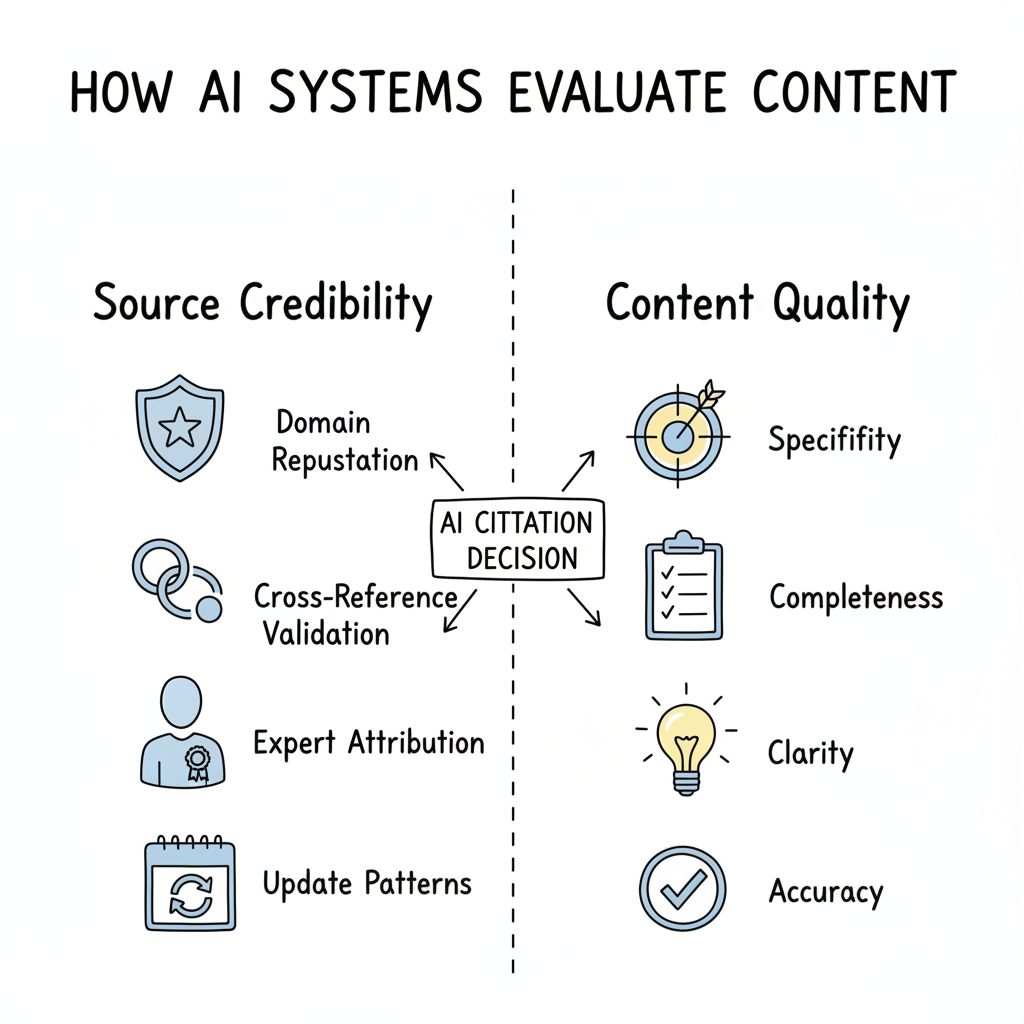
AI platforms don't randomly select sources. They evaluate content through specific lenses that determine citation worthiness.
AI systems assess whether sources deserve user trust. This evaluation happens through:
Domain reputation: AI platforms track which domains consistently provide accurate information. Sites with established expertise earn citation preference over newer or less verified sources.
Cross-reference validation: When multiple authoritative sources agree on information, AI systems gain confidence in citing any of them. Isolated claims without corroboration get skipped.
Expert attribution: Content attributed to named experts with verifiable credentials signals reliability. Anonymous or unclear authorship reduces citation probability.
Update patterns: Regularly maintained content suggests active accuracy management. Stale content with outdated information loses citation preference over time.
Beyond source credibility, AI evaluates content itself.
Specificity: AI systems prefer citing concrete facts over vague generalizations. "Conversion rates increased 23%" beats "conversion rates improved significantly."
Completeness: Content that thoroughly addresses a topic provides more citation opportunities than surface-level coverage. Understanding what is GEO (Generative Engine Optimization) helps you structure content for maximum citation potential.
Clarity: Well-structured content with clear explanations parses more reliably. AI systems can extract clean quotes without misrepresenting context.
Accuracy: AI platforms increasingly verify facts against their training data and other sources. Inaccurate content gets deprioritized.
How you structure content affects extraction success.
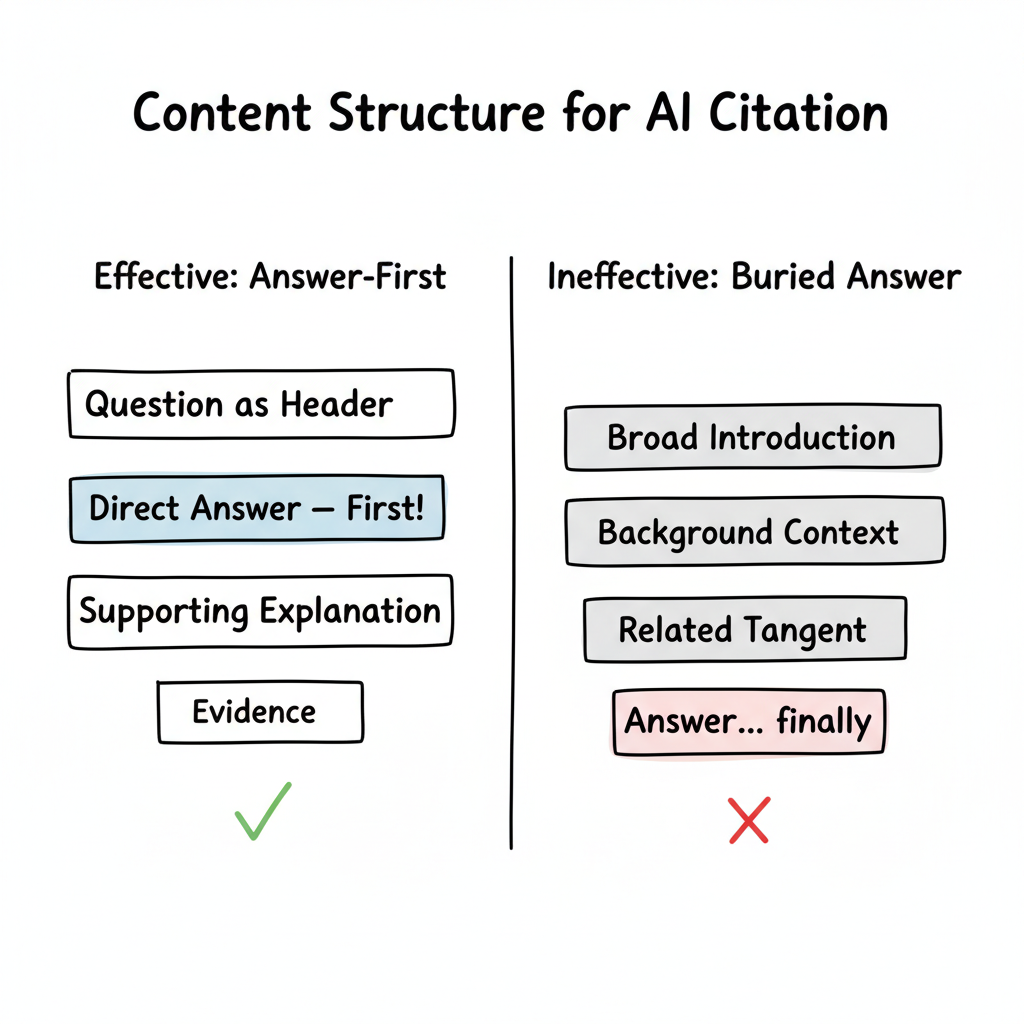
AI systems scan for direct answers to present to users. Content that buries answers in lengthy preambles gets skipped for sources that deliver information immediately.
Effective structure:
[Question as header]
[Direct answer in first sentence]
[Supporting explanation]
[Evidence and examples]
Ineffective structure:
[Broad topic introduction]
[Background context]
[Related tangent]
[Eventually, the answer]
Place your most valuable information immediately after section headers. AI extraction often focuses on opening statements.
AI systems extract individual paragraphs or sentences, not entire articles. Each paragraph must stand alone when quoted out of context.
Test your content: Read any paragraph in isolation. Does it make sense? Does it convey complete information? If readers need surrounding paragraphs to understand, restructure.
Paragraph length: Keep paragraphs under 80 words with one main idea each. Shorter paragraphs enable cleaner extraction without mid-thought truncation. Proper list formatting for LLM optimization further improves extraction accuracy.
Create statements AI systems can directly quote when answering user questions.
High-citation format:
Low-citation format:
Definitiveness attracts citations. Hedged language suggests uncertainty AI systems prefer not to convey.
Different AI platforms weight factors differently.
ChatGPT combines training data knowledge with real-time web search. Optimization priorities:
Establish persistent presence: Content that remains accurate over time builds into ChatGPT's foundational knowledge. Evergreen content serves both training data and real-time search.
Optimize for conversational queries: ChatGPT users ask questions naturally. Match content headers and structure to conversational phrasing.
Build external validation: ChatGPT cross-references information across sources. Third-party mentions and citations strengthen your content's citation probability.
Perplexity emphasizes real-time information with transparent sourcing. Optimization priorities:
Freshness matters most: Perplexity strongly prefers recently updated content. Establish regular update schedules for priority pages. Staying current with SearchGPT algorithm updates and changes ensures your optimization strategies remain effective.
Clear timestamps: Display "last updated" dates prominently. Recent timestamps directly influence Perplexity's source selection.
Link-worthy content: Perplexity shows sources with links. Content that earns citations needs to provide enough value that users might click through.
AI Overviews pull from Google's search index with AI synthesis. Optimization priorities:
Traditional SEO correlation: Content ranking well in organic search has higher AI Overview citation probability. SEO fundamentals directly support AI Overview visibility.
Featured snippet alignment: Content structured for featured snippets often performs well in AI Overviews. The formatting principles overlap. Meeting AI Overview content requirements positions your content for better citation rates.
E-E-A-T signals: Google's expertise, experience, authoritativeness, and trust signals influence AI Overview source selection heavily.
Technical factors affect how well AI systems can access and parse your content.
AI platforms need to reach your content. Review:
Schema markup helps AI systems understand content context:
Organization schema: Defines your brand entity clearly Person schema: Establishes author credentials Article schema: Provides publication metadata FAQ schema: Explicitly marks question-answer pairs
Structured data contributes approximately 10% to AI content evaluation. Not decisive alone, but meaningful in competitive contexts. Implementing HowTo schema for AI search provides another structured data opportunity for citation enhancement.
AI systems cross-reference brand information across the web. Inconsistent information creates confusion:
Single inconsistencies—different founding dates, conflicting expertise claims—undermine the trust AI systems need to cite confidently.
Track these indicators to evaluate optimization impact:
Citation frequency: How often does your content appear in AI responses for target queries? Test regularly across platforms.
Citation accuracy: When AI cites you, does it represent your information correctly? Inaccurate citations indicate structural problems.
Competitive visibility: How does your citation share compare to competitors for important queries?
Referral traffic: Are AI platforms driving measurable visits? Track AI-specific referral sources in analytics.
GEO AI optimization compounds. Early efforts create foundations later work builds upon.
Content investment: Each well-optimized piece adds to your citeable content library. Volume and quality both matter.
Authority signals: External mentions, backlinks, and expert validation accumulate. Current PR efforts influence future AI visibility.
Platform trust: Consistent accuracy builds reputation with AI systems. Sources that prove reliable earn ongoing citation preference.
Start with priority content—the pages that matter most for business outcomes. Optimize thoroughly, monitor results, and expand what works.
By submitting this form, you agree to our Privacy Policy and Terms & Conditions.



