February 19, 2026


Building a winning Meta ads strategy in 2026 requires a fundamentally different approach than even two years ago. With Meta's Andromeda update reshaping how ads are delivered and AI-powered optimization becoming the default, advertisers who cling to outdated tactics are watching their performance decline.
The most successful campaigns now focus on AI-guided optimization, customer-centric creative, first-party data integration, and measurable conversions. This guide breaks down exactly how to structure your Meta advertising strategy across the entire funnel, from audience building to scaling profitably.
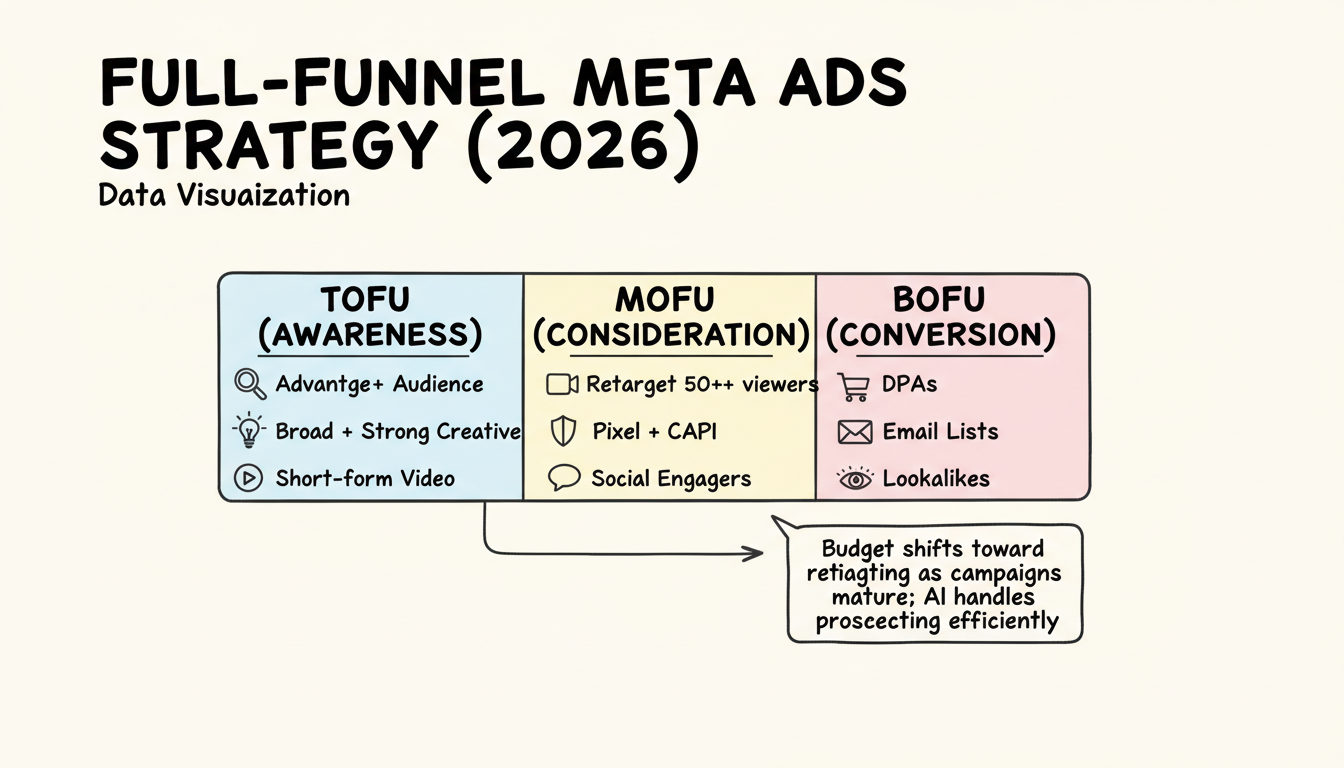
A full-funnel Meta ads strategy ensures you reach prospects at every stage of their buying journey. Rather than running isolated campaigns, your ads should work together as a cohesive system.
At the awareness stage, your goal is reaching new audiences who have never encountered your brand. In 2026, this means:
Once prospects know your brand, nurture them toward conversion:
Drive purchases and leads from your warmest audiences:
The key insight for 2026: shift budget from heavy prospecting early on to increased retargeting as campaigns mature. Meta's AI handles prospecting efficiently, while strategic retargeting captures users who need multiple touchpoints before converting. Understanding how to run effective facebook ads across the entire funnel is crucial for maximizing your advertising investment. 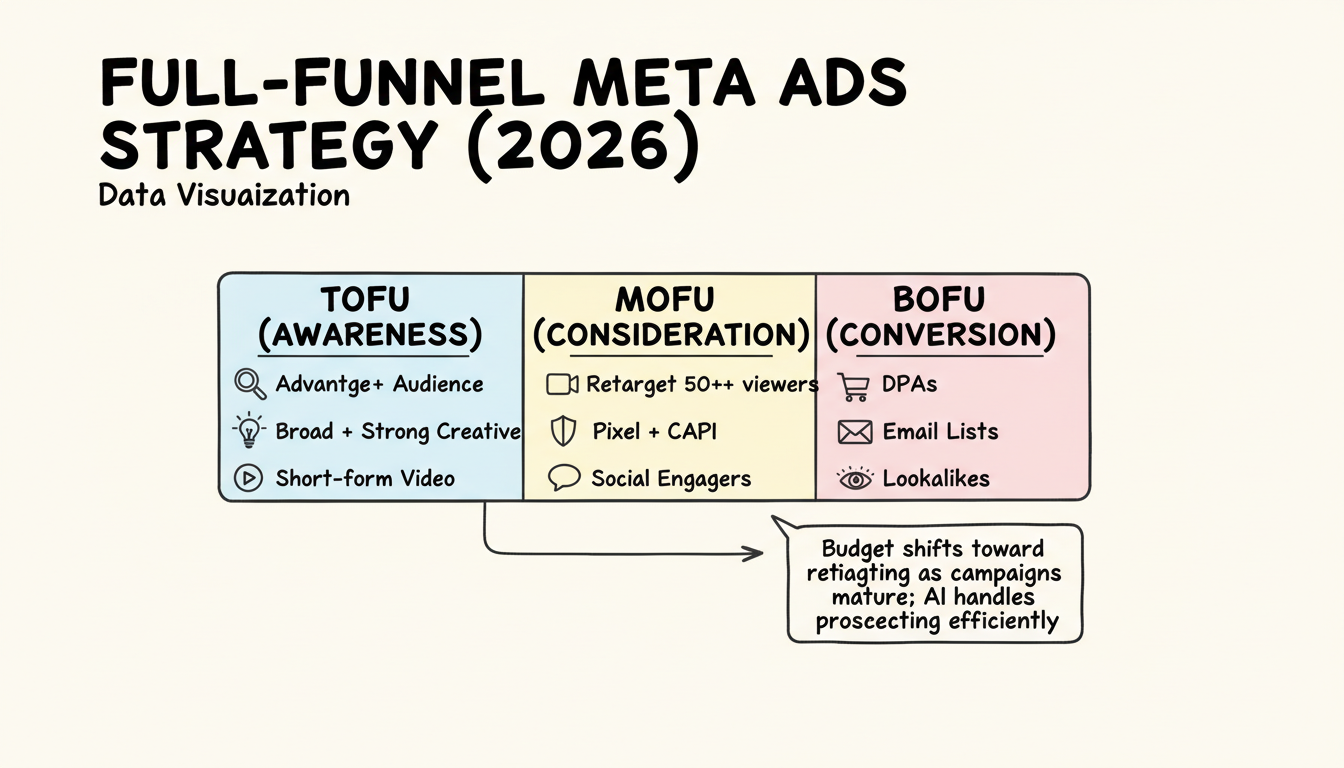
Audience targeting in 2026 looks nothing like it did in 2022. Meta's machine learning now creates high-accuracy audience segments based on behavior, purchase intent, and real-time engagement data.
What is working now:
With privacy regulations and the deprecation of third-party cookies, first-party data has become central to Meta ads performance. According to industry experts, brands that capture and effectively use first-party data see better targeting precision, improved ROAS, and stronger customer understanding.
Best practices for first-party data:
If you're managing multiple clients, learning how to run facebook ads for clients with proper data segregation and privacy compliance is essential for maintaining trust and performance.
Test multiple audience approaches simultaneously:
According to testing data, 1% to 3% lookalikes tend to work best, but performance varies by account and industry.
In 2026, creative is the primary lever for Meta ads performance. With Advantage+ handling audience targeting automatically, the quality and diversity of your creative determines success.
Meta's new delivery system (Andromeda, Gem, and Lattice) relies heavily on creative signals to determine who sees your ads. The algorithm analyzes your creative to match it with the right audience segments.
As creative strategists note, winning in 2026 requires creative diversity and speed over polish.
Native-style content wins:
Creative diversity is mandatory:
Refresh frequently:
Many businesses wonder about facebook ads vs boosted posts when it comes to creative strategy. The answer is clear: ads manager provides far more control over creative testing and optimization than simple post boosting.
Structure your account for maximum creative velocity:
This separation allows you to maintain high creative testing velocity without resetting your largest campaigns into the learning phase. 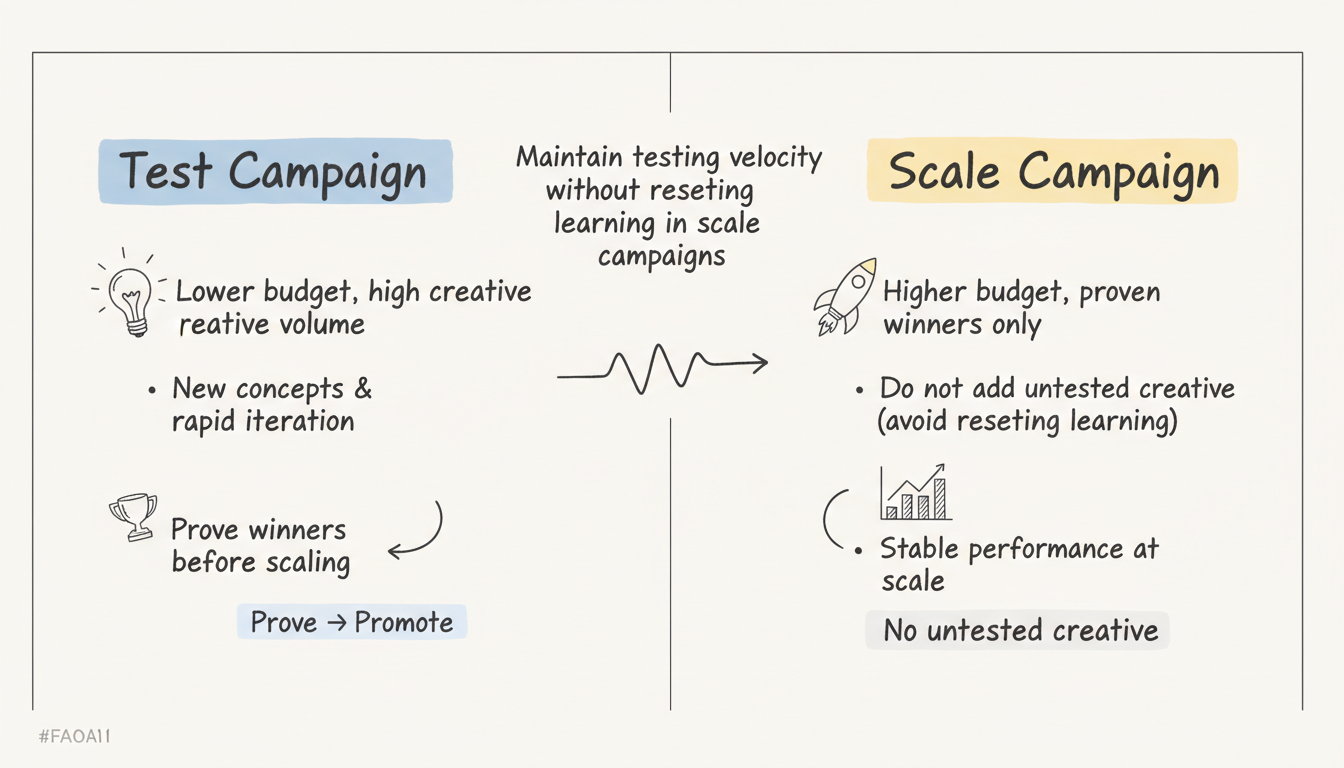
Choosing the right bidding strategy impacts both cost efficiency and scaling potential. Understanding the nuances of meta ads bidding strategy can make the difference between profitable campaigns and wasted budget.
Lowest Cost (default): Meta spends your budget to get the most results at the lowest cost. Best for accounts gathering data or testing.
Cost Cap: You set the maximum CPA you are willing to pay. Meta optimizes delivery to stay at or below that threshold. Ideal when you have clear profitability targets.
Bid Cap: You set the maximum bid for each auction. Provides the most control but can limit delivery.
ROAS Goal: Available for purchase-focused campaigns. Set your target return on ad spend.
Strategy | Best For | Consideration |
Lowest Cost | New campaigns, testing | Can lead to cost creep at scale |
Cost Cap | Profitability-focused scaling | May limit delivery if cap is too tight |
Bid Cap | Maximum cost control | Requires understanding of auction dynamics |
ROAS Goal | Ecommerce with clear margins | Needs significant conversion data |
When planning your budget, it helps to understand facebook ads cost per click benchmarks for your industry to set realistic bidding expectations.
Scaling Meta ads profitably requires patience and the right approach. Increase spend too quickly and you will reset learning and tank performance.
Vertical Scaling: Increasing budget on existing campaigns
Horizontal Scaling: Adding new campaigns, ad sets, or creative
Only scale when you have:
Before scaling significantly, use a facebook ads roi calculator to verify that your unit economics support increased spending without sacrificing margins.
Common scaling mistakes to avoid:
The best brands in 2026 treat AI as a teammate. Use it to handle optimization while you focus on creative strategy and business decisions.
Start with Advantage+ Sales campaigns if you run ecommerce, or Advantage+ leads for lead generation. Use broad targeting and let Meta's AI find your audience. Focus your effort on creating diverse, authentic creative. Begin with a daily budget of $50-100 and scale only after achieving stable results for at least one week. If you're just getting started, check out how to run facebook ads for business for a comprehensive beginner's guide.
Plan to test new creative weekly. Even winning creative experiences fatigue over time. Maintain a pipeline of new concepts and aim to have 10-50 ads running simultaneously. Pause ads when frequency exceeds 3-4 or when CPA increases significantly.
For most advertisers in 2026, Advantage+ campaigns outperform manual setups. HP UK saw a 17% increase in leads and 15% lower cost per lead using Advantage+ versus manual campaigns. However, test both approaches for your specific account. Some accounts still benefit from manual targeting control.
Spend less on retargeting than you might assume. Meta's AI now handles prospecting efficiently. A typical split is 70-80% prospecting and 20-30% retargeting, though this varies by business model. Monitor overlap between campaigns and adjust based on frequency data. For businesses wondering about how much to run ads on facebook, start with at least $1,500-2,000 monthly to gather meaningful data across the funnel.
Not necessarily. When comparing facebook ads vs instagram ads vs google ads, remember that Facebook and Instagram share the same ad platform and audience network. Most campaigns perform best with automatic placements enabled, allowing Meta's algorithm to optimize delivery across both platforms based on where your audience is most engaged.
By submitting this form, you agree to our Privacy Policy and Terms & Conditions.